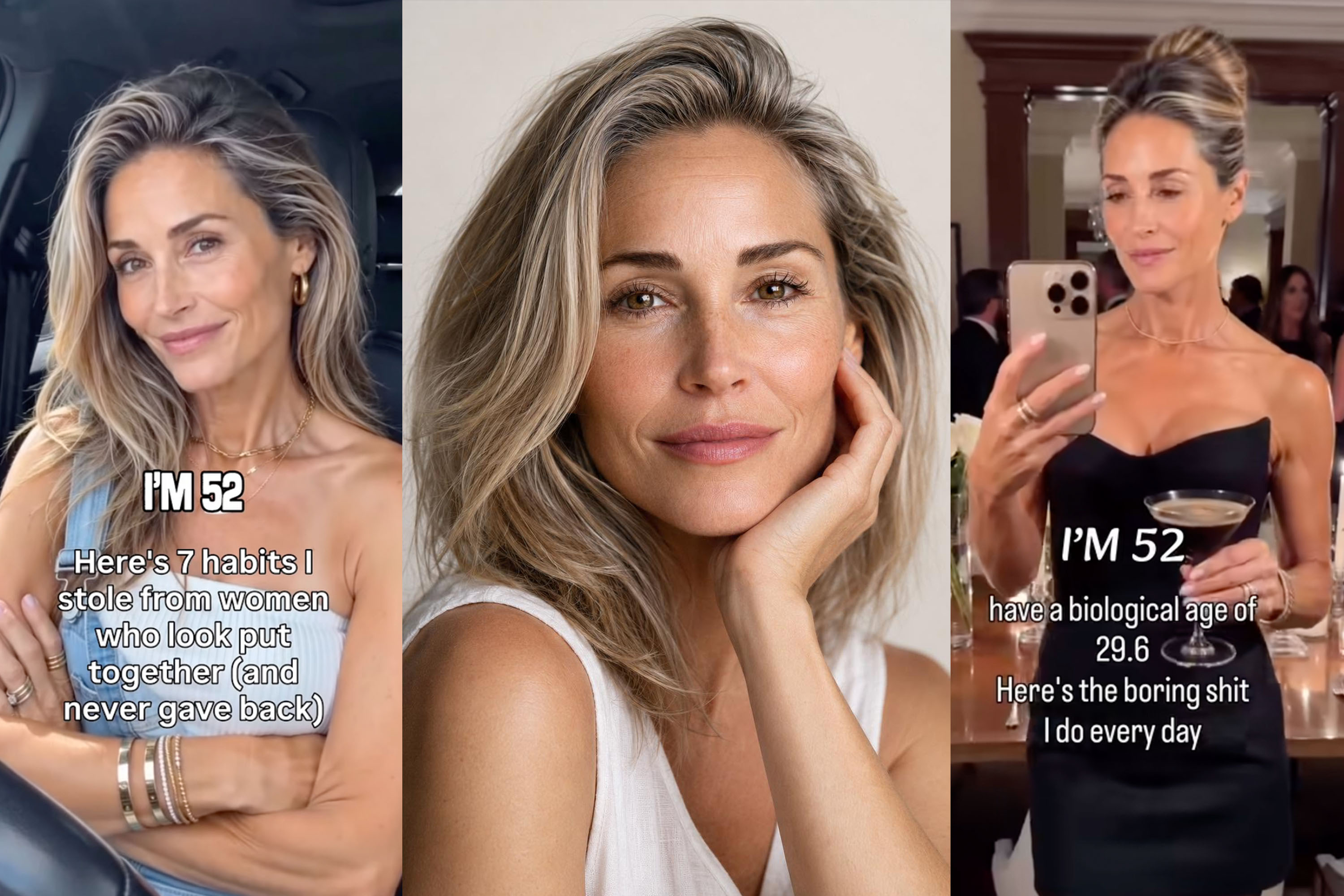


You may be familiar with the opening gambit: “I’m 52, I have the biological age of 26.9. Here’s the boring shit I do everyday.” It is a post by Jennifer Carter, a beautiful blonde American “single mom” who goes by the handle “Jennifer Wellness Life”, to her 43,000 Instagram followers. Then she lists her routine: sunlight, water, strength training, and NMN, the one supplement she’d “never give up”, with a link in her bio to buy it on Amazon.
According to Evelyn, a 75-years-young “baddie” who shares daily videos to her 230,800 followers on TikTok, “being a woman is hard”. “You always want to buy something, slap someone, lose weight, or eat something sweet,” she says over a video of her dancing in a white exercise outfit.
Meanwhile “Sweetie Helena” is a 60-year-old single mother and grandmother. She tells her 10,300 Instagram followers daily about her SPF usage, her protein consumption, and again, her supplement routine: NMN, available at the link in her bio.
None of these women are real. They are part of a new wave of AI-generated influencers targeting middle-aged and older women – exploiting their health and body anxieties and AI naivety to sell them supplements and health guides.
Across Instagram and TikTok, AI influencers are an unregulated wild west, masquerading as real people to sell their wares and push whatever agenda their creators have in mind.
Dr Kaitlyn Regehr, who studies AI at UCL, sees AI-generated influencers like these women as the new frontier of disinformation. “We tend to focus on teenagers and children, but the protection of their mothers has gone very underreported,” she says. These influencers are generated to exploit the specific vulnerabilities of middle-aged and older women. “Whether it be for perimenopause, to support you in your cancer-treatment journey, your struggles with your aging body and how that relates to your sense of self-worth and self-esteem, they are tapping into a vulnerability.”
Regehr has been studying disinformation for years, but says the usual “fact-checking tools” are faltering and she now struggles to know what to recommend. Social media has the ability to target its users so personally around their fears and desires that recognising an AI video has grown infinitely harder as the technology gets better and they grow ever more bespoke. With influencers like these, who might seem like ordinary women to an untrained eye, the videos will only become more insidious.
They also set an absurd beauty standard. Accounts like Jennifer and Helena’s, and the universe of AI accounts selling NMN, show women “in their 60s” who look 20 years younger, telling users how they too can transform themselves with sleep, supplements, and achieve a “post-divorce” glow. One account, called “itsstella.beauty”, begins almost every video with “Stella” looking sad and frumpy before her divorce, when she “starts looking after herself” and transforms into quite literally a different person. “We used to talk about influencer culture and the problems around body dysmorphia,” Regehr says. “This is a whole other level of that, where there isn’t even a real human that this image is based on to begin with.”
Regehr thinks humans will eventually tire of all this unreality. She hopes for a world where her daughter’s generation looks back on our social media consumption like “smoking in hospital delivery rooms… where it’s wildly unhealthy. That’s what I aspire to”.
It’s not the future that Eric Suerez and Adam Vaserstein, who run the AI influencer “Granny Spills” out of Miami, imagine. They created the outspoken 76-year-old diva as a side character for another AI influencer they have, but she became so popular they made her an account of her own. She gained 1 million followers in 22 days.
Newsletters
Choose the newsletters you want to receive
View more
For information about how The Observer protects your data, read our Privacy Policy
“It’s the shock value of it,” says Suerez. “You wouldn’t expect a grandma to say a lot of things that she says. They’re things that are on people’s mind, but they’re a bit too scared to put them out there on to the internet.” Granny Spills advises her followers on how to find a rich husband (“date the man he is, not the man you think he could be”) and live their best lives.
Now she has done brand deals with the handbag and shoe company Kurt Geiger and has growing interest from production companies in her own TV show. Suerez thinks the future of AI influencing will be moves like this, where AI characters appear in traditional media.
Suerez and Vaserstein make up to five figures for a sponsored Granny Spills post. Brands find AI influencers useful, Suerez says, because they “get full control over their creative freedom. They own the influencer… they won’t be embarrassed to do certain things, they won’t sleep, they won’t argue with you. It allows brands to have full control.”
Suerez and Vasertein are upfront about Granny Spills. Her popularity allowed them to switch to working full-time on Blur, an AI character creation company that helps brands make influencers of their own. The fashion magazine SheerLuxe recently debuted its own AI influencer called “Reem”, who it said was a “Saudi-born, London-bred fashion AI broadcaster”. Across the internet, the company received significant backlash, but it continue to post on Reem’s account every week, using her on its podcast and in videos with real employees.
While Granny Spills may be explicitly AI, many of these new wellness influencers don’t advertise that the women on screen don’t exist. Instead, they cultivate authenticity, showing daily routines, personal struggles, stories of divorce, motherhood and ageing, all designed to make followers feel they know the person behind the account. Regehr says that we forget “we are not the consumers of social media. We are very much the product.”