

This article first appeared as part of the Daily Sensemaker newsletter – one story a day to make sense of the world. To receive it in your inbox, featuring content exclusive to the newsletter, sign up for free here.
Severe flooding has killed more than 170 people in Thailand, prompting an apology from the prime minister that the government was “unable to take care and protect them”.
So what? This is the least citizens expect from their leaders. Humanity has become far more resilient to disaster over the past hundred years. But extreme weather is challenging society’s vulnerabilities and what has happened in Thailand shows the
•
limits of forecasting;
•
role topography can play in compounding natural hazards; and
•
devastation that will result from being slow to adapt to climate change.
Triple threat. Last Tuesday a rare storm formed over the Malacca Strait which runs between Indonesia, Malaysia and the southern tip of Thailand. Cyclone Senyar was unusual as it built up near the equator. Its impact was worsened by Typhoon Koto and Cyclone Ditwah, which joined it in a three-system cluster.
Heavy toll. The cluster combined with monsoon rains to cause flooding and landslides. More than 1,100 people have died across Sri Lanka, Indonesia, Malaysia and Thailand. Hundreds are still missing and millions have been displaced.
Trying to respond. Death tolls from natural hazards have dropped sharply over time, even though there are many more people on the planet and an increasing number who have moved to the coastline. This is thanks to supercomputer modelling that can predict storms in their infancy, alongside early warning systems and evacuation.
Constant struggle. But the ability of small changes in weather patterns to make major differences is a limiting factor. So too are unpredictable conditions from global warming. This year Australia’s Bureau of Meteorology scrapped seasonal cyclone forecasts, saying they were less reliable due to the “changing climate”.
Back to Asia. It can be hard to attribute a single weather event to temperature rises, but flooding consistently tops the list of climate hazards in southeast Asia. It is thought that climate change can strengthen tropical cyclones, while a hotter planet creates more intense monsoon rains because warmer air holds more moisture.
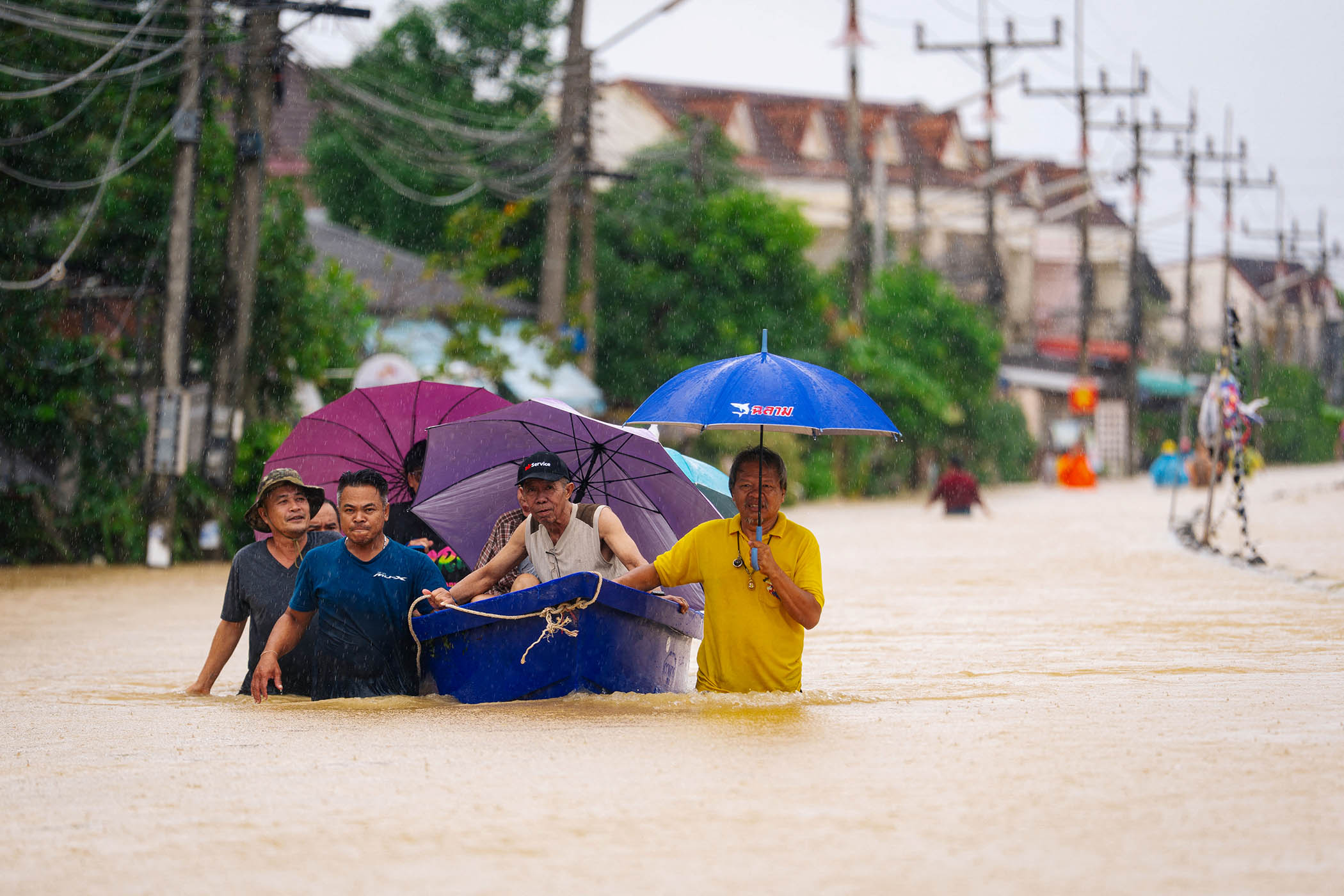
But political leadership also plays a role. Images from Hat Yai, a city in southern Thailand, depict streets that had turned into rivers of murky brown water and people perched on their roofs waiting for rescue. The Hat Yai district was inundated at extraordinary speed, with more than 60cm of rainwater falling in three days.
Not ready. The provincial governor gave an evacuation order, but residents told journalists they did not receive warnings as they had in previous disasters. This was possibly because the cell network was knocked out by the floods. The mayor said the city had fewer than five boats to mount rescues. None of them was serviceable.
Newsletters
Choose the newsletters you want to receive
View more
For information about how The Observer protects your data, read our Privacy Policy
At risk. Hat Yai’s topography made it vulnerable. It is built on low ground sloping down to a lagoon complex. Steep slopes from Kho Hong hill channel rain down onto the city.
Not inevitable. The full picture of what happened in Thailand is still emerging, but it doesn’t have to be this way. Take Bangladesh, where a tropical cyclone claimed at least 300,000 lives in 1970. It was one of the deadliest natural disasters in recorded history.
Learning to cope. Casualty rates from more recent storms in Bangladesh have reduced dramatically, thanks to improved forecasting and an early warning system that spans radio and TV broadcasts, text messages and volunteers that patrol the streets to alert their communities.
Running risks. The problem is that many societies around the world have increased their vulnerability. It is natural to want to build or farm on a floodplain. The land is flatter and more fertile, while access to water makes it easier to ship goods. But unchecked development is dangerous.
Rising tides. When people build houses at the water’s edge, there is less space for the river to expand and contract, less soil and fewer trees to slow floodwater. Even if it needs long-term thinking, humanity has to adapt to a changing planet.
Not go the other way. Jakarta is the capital of Indonesia, where more than 750 people have died in the past week. The city sprawls in a fertile plain where 13 rivers flow out to sea. Its paved surfaces and straightened channels can accelerate floods downstream.
What’s more… The UN recently identified it as the most populous city in the world. It is now home to 42m people.
Photograph by Arnun Chonmahatrakool / Thai News Pix / AFP via Getty Images