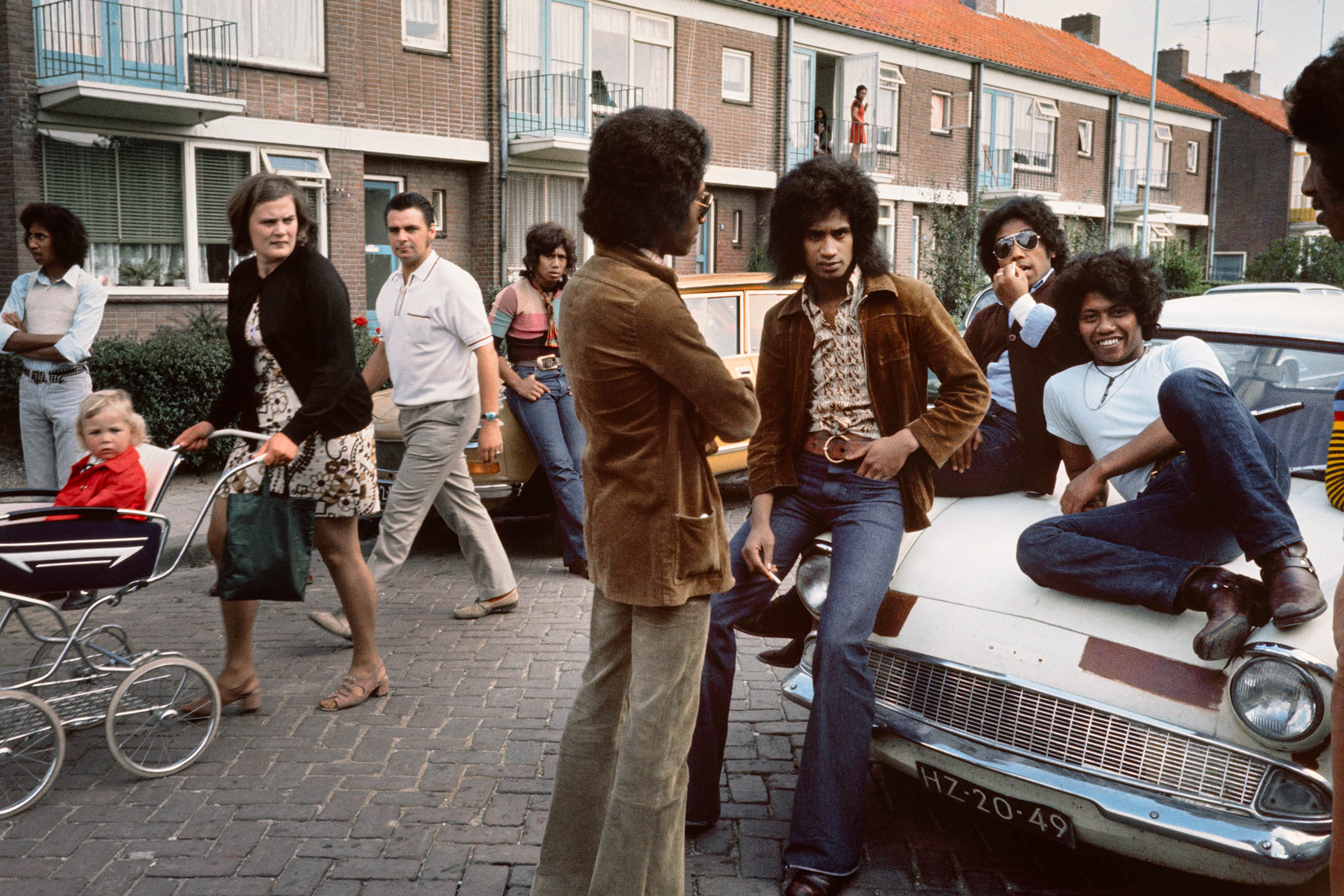

It’s very much a picture of two halves. On the right is a group of stylishly dressed Moluccan men arranged around a 1959 Ford Anglia. The fashions – flares, brown suede jackets, ruffled shirts, voluminous afros – were pretty cutting-edge for a central Netherlands town such as Tiel in 1970, and the men, whose attitudes range from relaxed to moodily self-conscious, seem well aware of this fact.
The passers-by on the left, by contrast, are more conservatively dressed and – if the expression of the woman pushing the pram is anything to go by – somewhat at odds with their neighbours. Whether there’s any actual animosity present in this moment is debatable, and recent testimonies from locals responding to the image suggest otherwise, but the sense of a culture clash in Ed van der Elsken’s photo is hard to overlook.
“It tells the whole story in one frame,” says Hinde Haest, who has curated a new show of Van der Elsken’s work at the Rijksmuseum. The Moluccan community had been in the country for 20 years at this point. After Indonesia declared independence from the Netherlands in 1945, a civil war erupted and 12,500 Moluccan soldiers, who had fought with the Dutch army, were evacuated to the Netherlands with their families.
The arrangement was meant to be temporary, but as the Moluccan dream of self-determination faded, the families stayed on. Second-generation Moluccans became frustrated by the lack of action, leading to the occupation of the Indonesian ambassador’s Wassenaar residence, in a suburb of the Hague, in 1970 and the fatal shooting of a policeman. Greater acts of violence were to follow, but these simmering tensions were probably why Van der Elsken, a renowned Dutch photographer who had recently taken up magazine photojournalism, was visiting Tiel.
“It strikes at the heart of what he’s known for,” says Haest of this image. “He was able to see larger trends in society in the mundane things he’d find on the street.” It’s also characteristic of Van der Elsken that there’s an unseen third element to the Tiel picture. “He’s very known for being in direct contact with his subject,” says Haest. “He would shout or flirt or do something strange, which made people respond, and so you can really feel his presence in the frame, even though he’s not in it himself.”
Ed van der Elsken: Up Close is at the Rijksmuseum, Amsterdam, from 19 June to 13 September
Newsletters
Choose the newsletters you want to receive
View more
For information about how The Observer protects your data, read our Privacy Policy