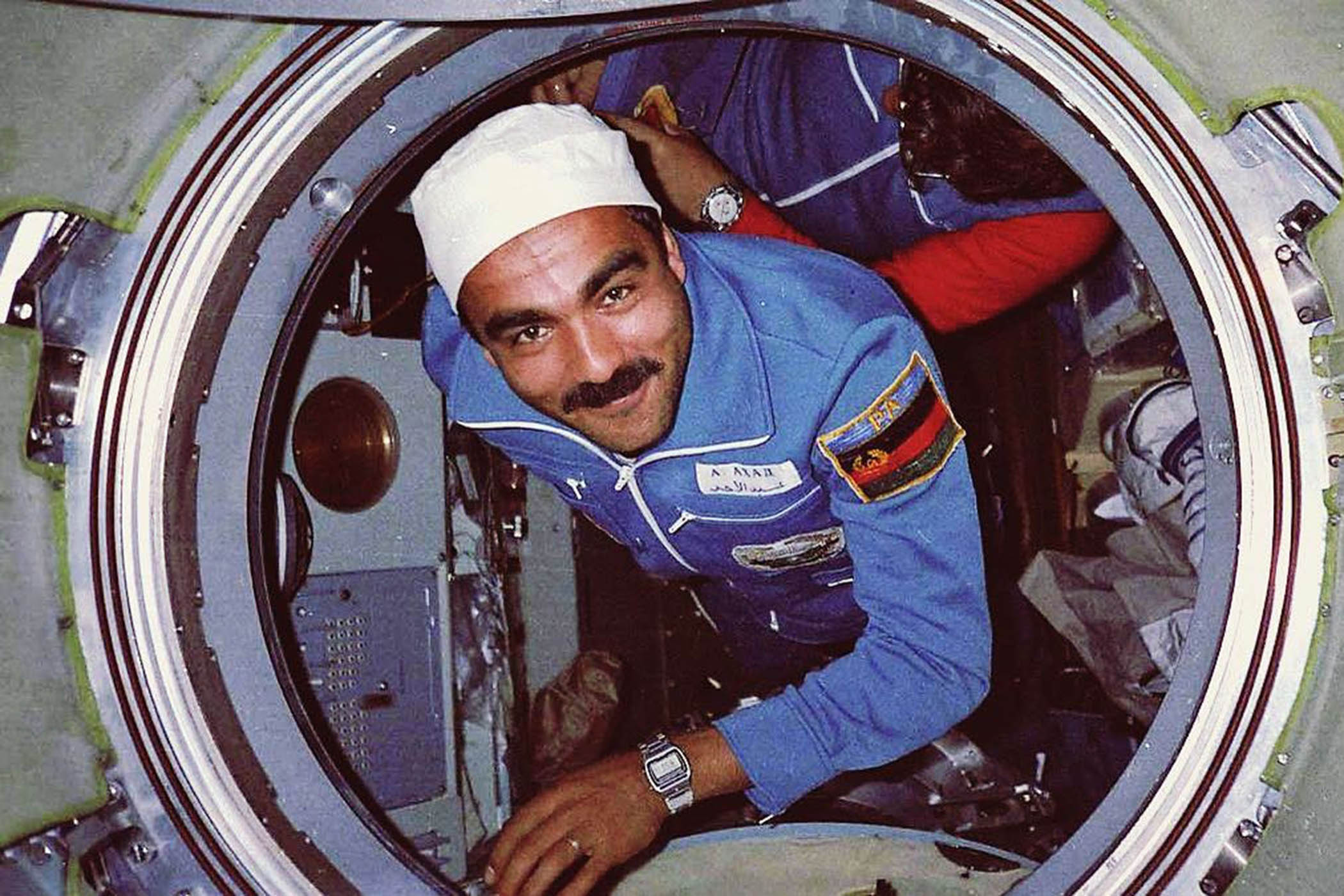
Abdul Ahad Momand’s journey into space was expected to last for only eight days. Three hours into his return in September 1988, however, the engines on his Soyuz spacecraft failed, preventing re-entry, and he had to spend a further 24 hours in orbit. With limited food, water and oxygen, the man who had dreamed of being Afghanistan’s Yuri Gagarin instead faced becoming the Soviet space programme’s Major Tom, floating to his death in a tin can.
It was only Momand noticing a warning light that the spacecraft was about to jettison its engines and the snap decision by Vladimir Lyakhov, his commander, to shut down the system that gave them a chance. “What have you done?” mission control asked Lyakhov. “Saved our lives,” he replied. Momand later said they were two seconds from disaster.
During their wait for scientists to reprogram the ship’s computer, correcting an error caused by malfunctioning alignment sensors, Momand and Lyakhov kept their spirits up by telling jokes. After a day’s orbit, the engines finally fired correctly and when they landed in what is now Kazakhstan the men made light of their troubles. “It happens,” Momand told broadcasters with a shrug.
Afghanistan was the 20th country to send one of its people into space, three years before Helen Sharman became the first British astronaut. Momand, a fighter pilot in the Soviet-backed Afghan air force, had been chosen from more than 400 applicants for the Interkosmos programme for Moscow’s allies. His mission was brought forward at short notice so it could happen before the Soviet Union had completed its withdrawal from Afghanistan after nine years of war against the Mujahideen.
During his week on the Mir space station, he assisted with experiments and took images of Afghanistan so the country could be mapped in detail for the first time, with the aim of helping to predict earthquakes and identify possible sources of oil and gas. He was the fourth Muslim in space but the first to take a Qur’an, from which he read on camera, his legs held by Lyakhov to stop him floating out of shot.
When he telephoned his mother from Mir, Pashto became the fourth language officially to be spoken in space. He also spoke to Mohammad Najibullah, the Afghan president, and gave a message to his countrymen: “Take your neighbour by the hand, lay down your arms. Let’s solve our problems through dialogue.” It was a message he repeated 25 years later on a return to his homeland when he met President Hamid Karzai.
He told his countrymen from space: ‘Lay down your arms. Let’s solve our problems through dialogue.’ It was a message he repeated 25 years later to President Hamid Karzai
He told his countrymen from space: ‘Lay down your arms. Let’s solve our problems through dialogue.’ It was a message he repeated 25 years later to President Hamid Karzai
At the age of 16, he moved to Kabul, then a city with a liberal, international feel, to attend high school. He went to the capital’s polytechnic university before being drafted into the military soon after the People’s Democratic party seized power in 1978. He joined the air force and was training in Kyiv when the Soviet army entered Afghanistan. From 1981, he was a navigator at Bagram airbase where he met and later married Bibigul, the daughter of one of his senior officers. They would have two daughters and a son.
In 1984, he was invited to train as a cosmonaut at Star City, outside Moscow, but his ticket to space was not guaranteed. There was another Afghan prospect, Mohammad Dawran, a colonel while Momand was a mere captain. When the training programme was accelerated, Dawran had a poorly timed attack of appendicitis and Momand was preferred. Some suggested he was chosen because he was from the same ethnic group as Najibullah, though Lyakhov told the BBC that Momand was simply sharper and more lively than his rival and, ironically, “had his feet on the ground”.
His mission departed from the Baikonur Cosmodrome in Kazakhstan on 29 August 1988. Momand returned nine days later to a hero’s welcome. However, on the day he was garlanded with flowers in Kabul, the mujahideen struck the city with 25 rocket attacks, killing 35. He was made deputy minister of aviation but when Najibullah was deposed in 1992, Momand fled to Germany with his family and claimed asylum.
He found work in a space-research institute in Stuttgart and later as an accountant. While he was nervous about returning to Afghanistan in 2013, he found only kindness. Karzai told him that although they had been on opposing sides in the Soviet-Afghan war, he had felt pride and happiness at a countryman going to space, while Dawran, by then commander of the Afghan air force, said he felt no bitterness that his rival had been chosen. Momand gave Dawron the watch he wore in space.
Newsletters
Choose the newsletters you want to receive
View more
For information about how The Observer protects your data, read our Privacy Policy
Twenty-five years after his mission, Momand reflected that you get a different view from space. “You look at the planet and your mind is flooded with new feelings,” he said. “You see no countries or borders, you only see the Earth and the whole of it is your home.”
Abdul Ahad Momand, Afghan cosmonaut, was born in 1959 and died on 21 June 2026
Photograph by Roscosmos