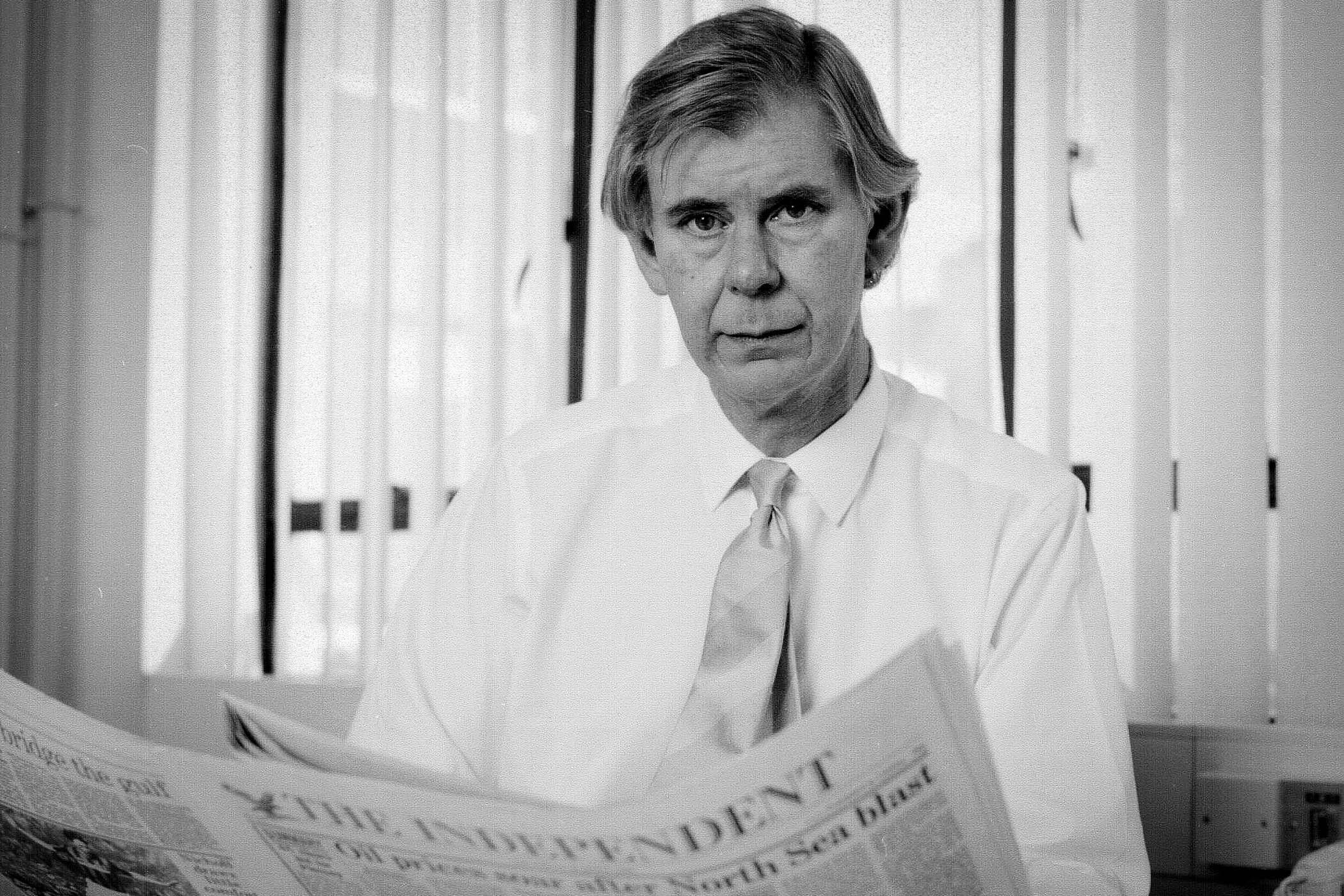

With the snappy slogan, “It is. Are you?” the first British broadsheet newspaper for more than a century was launched on 7 October 1986. The marketing team had wanted to call it the Meridian, which tested well with focus groups but was hated by its founding editor. Andreas Whittam Smith insisted it be called the Independent.
A vicar’s son who wore pinstriped suits and a Garrick tie, Whittam Smith had seemed a model mid-career establishment journalist, city editor of the Daily Telegraph, when he relayed his dream to two colleagues to start a different kind of newspaper. Matthew Symonds and Stephen Glover were persuaded and so a year of fundraising and team-building began.
From a rented office on London’s City Road, where furniture was still wrapped in plastic and the electricity supply was erratic, Whittam Smith assembled a staff of 100, many of them refugees from Rupert Murdoch’s Wapping-era News UK, others from opposing political wings of the Telegraph and Guardian.
“If it hadn’t been for Andreas it wouldn’t have happened,” Glover said. “Though Matthew kept us going when we were flagging.” In the chaos, basics were almost forgotten. With weeks to go, they realised there wasn’t a dark room. Ironically, high-quality large photographs set the Independent apart right from the start. “It takes time for good writing to be recognised,” Whittam Smith said, “but the photos were our ambassadors.”
He also encouraged humour, printed a daily poem and listings, allowed four-letter words without asterisks and was famously uninterested in royals. Anne Spackman, who joined as a young reporter from the Sunday Times, recalled “an exciting, collegiate” atmosphere, which came from the top. “Other editors dominated by fear,” she said. “He was reasonable, clever and with high standards. As soon as you showed flair for something he would ask you to do more of it.”
Glover said Whittam Smith saw his role as that of an orchestra conductor. “He wanted to get the best out of everybody,” he said. “He was happy for others to have good ideas.” Yet he also liked to be disruptive. “He was 90% bishop, 10% member of the Baader-Meinhof gang,” Glover said. “A quiet persona with a bit of devilment inside.”
Within two years, the paper broke even as its circulation passed 400,000 and overtook the Times. However, it suffered from overreach with the launch of a Sunday paper, after a bid for The Observer failed, as the economy went into recession. Sales fell when Murdoch launched an aggressive price war and Whittam Smith was forced out in 1994.
‘He was 90% bishop, 10% member of the Baader-Meinhof gang’
‘He was 90% bishop, 10% member of the Baader-Meinhof gang’
Stephen Glover, co-founder of the Independent
Whittam Smith was born in Macclesfield in 1937, and educated at Birkenhead School and Oxford. After a brief spell in banking, he was encouraged by his wife, Valerie, whom he married in 1964, to join the Stock Exchange Gazette. Until 1986 his career was entirely in business journalism for several national papers as well as Investors Chronicle, which he edited from 1970 to 1977.
Three years after leaving the Independent, he was made president of the British Board of Film Classification, taking a more liberal line on censorship than expected. He granted a video release to such films as The Exorcist and The Texas Chainsaw Massacre and raised eyebrows by saying every town should have a sex shop to cut illegal trade.
He insisted he had never seen a pornographic film until then. “The first one astonished me,” he told Lynn Barber in The Observer. “It was called Pregnant and Milking No 5. It was the No 5 that got me.” He was bemused by how many lacked a decent plot, and likened watching them to going to the dentist. “Often it’s nowhere near as bad as you fear,” he said. “But when it is bad, I feel as if my mind has been soiled.” The video he found hardest to watch was on body piercing.
Newsletters
Choose the newsletters you want to receive
View more
For information about how The Observer protects your data, read our Privacy Policy
Robin Duval, a former director of the BBFC, recalled a man who was “quite shy and introverted, kind and punctiliously polite” but said he “could not have been more supportive when we needed a word in the right Whitehall ear”.
In 2002, the vicar’s son with a finance background left for his perfect job: managing the Church of England’s investment portfolio as the First Church Estates Commissioner. While he upset some with the sale of bishops’ palaces in Durham, Worcester and Carlisle, he left the finances in a healthier condition. In 2016, the year before he left, it made a 17% return.
Rowan Williams, the former archbishop of Canterbury, said: “Andreas had a real awareness of how decisions would have an impact on the average parish and he never shirked difficult issues that called for moral courage. He had the gift of knowing both when and how to take time and also when and how to 'call' time and decide.”
Whittam Smith, who was knighted in 2015, had the appearance of a cathedral dean yet constantly surprised people. Murdoch once said he had “the charisma of a poached egg” but the author Sebastian Faulks, his literary editor at the Independent, compared him to Jack Nicholson’s character in Easy Rider: “A real straight who had suddenly been given his head.”
Whittam Smith was dismayed when the editor of La Repubblica told him: “Whenever I think of an Englishman, I think of you.” He had hoped to be thought of as cosmopolitan. Later, he was delighted to be attacked by the Daily Mail after approving the cinema release of the 1997 film version of Lolita. “It described me as ‘this urbane liberal’,” he said. “I was so pleased.”
Patrick Kidd
Andreas Whittam Smith, journalist, film censor and church commissioner, was born on 13 June 1937 and died on 29 November 2025, aged 88
Photograph by Avalon/Getty