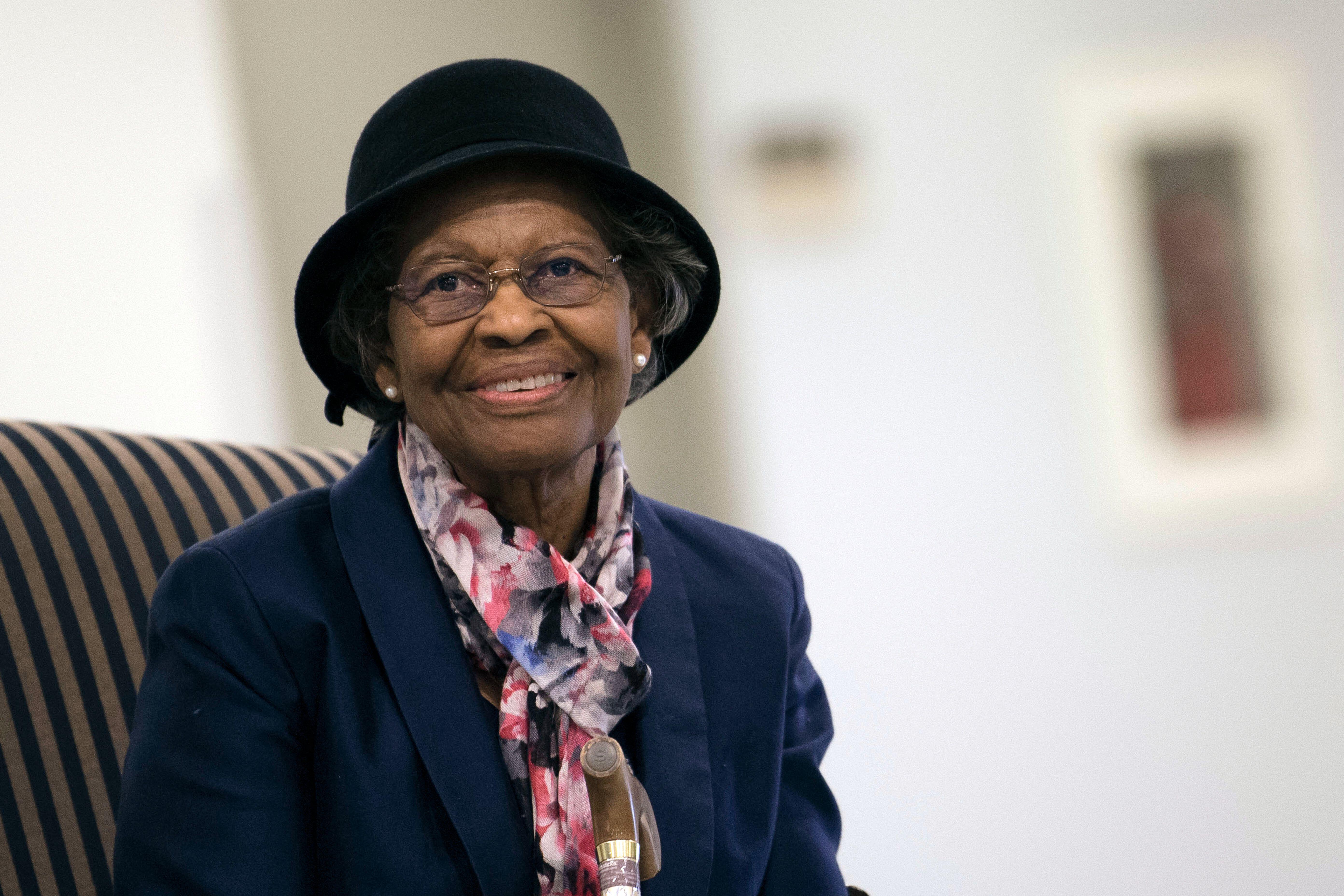



Gladys West had no sense of where her life’s journey would lead – an irony, perhaps, for a mathematician whose work underpins the navigation systems now guiding the world.
She was born in poverty on a small farm in Virginia, and her early ambitions were to become a teacher or a seamstress, a step up from a life picking cotton or crushing tobacco in a factory, as her mother did.
Education gave her a way out. West won a scholarship to study mathematics at university and then began a 40-year career in US Navy research where her modelling of the Earth’s surface using satellite data would be used in the development of GPS. The results of her work now sit in almost every pocket.
At the time, West had little idea of the significance her research would assume. “When you’re working every day, you’re not thinking: ‘What impact is this going to have on the world?’” she said many years later. “You’re thinking: ‘I’ve got to get this right.’”
It was not until her late eighties that her contribution was formally recognised when she was inducted into the US Air Force Hall of Fame. However, West was more than a brilliant mathematician. As a black woman in a field dominated by white men, she was a social trailblazer. “We always get pushed to the back because we are not the ones that are writing the book of the past,” she said. “It was always them writing, and they wrote about people they thought were acceptable.”
Gladys Mae Brown was born in rural Dinwiddie County, Virginia, at the start of the Great Depression. School was a three-mile walk but she was determined to take advantage of what it offered. “I was gonna get an education and I was gonna get out of there,” she told the Guardian in 2020. Awarded one of just two full scholarships to Virginia State College, she completed a bachelor’s degree in mathematics, taught for a period, and returned to gain a master’s degree in 1955.
The following year, West took a job at the Naval Surface War Center in Dahlgren, Virginia. She was the second black woman the centre had hired, and one of only four black employees. Another, Ira West, became her husband in 1957. The couple had three children.
While many of their friends were active in the civil rights movement, West and her husband felt unable to participate in protests as government employees. Instead, she sought to challenge prejudice through integration and excellence by proving that she was as capable as any white mathematician. “They hadn’t worked with us,” she said. “They don’t know [black people] except to work in the homes and yards. So you got to show them who you really are. We tried to do our part by being a role model.”
Her early work involved solving mathematical problems with pencil and paper, but as the navy adopted computers she was tasked with identifying their errors. “Nine times out of 10 they weren’t completely right,” she recalled. In the early 1960s, she contributed to an award-winning astronomical study examining Pluto’s motion relative to Neptune.
She was later appointed project manager for Seasat, the first Earth-orbiting satellite capable of monitoring the oceans and collecting data on sea-surface temperatures, winds, currents and wave heights.
Newsletters
Choose the newsletters you want to receive
View more
For information about how The Observer protects your data, read our Privacy Policy
From the mid-1970s, West worked on programming an IBM 7030 Stretch computer to produce an accurate model of the Earth’s shape – a geoid – accounting for gravitational, tidal and other distortions. The 1985 launch of the Geosat observation satellite, which had a radar altimeter that could measure distance to the surface to within an accuracy of 5cm, refined her research, which was published the next year.
Her modelling was used in the development of the GPS system, launched as a military project in 1973 and was expanded for commercial use. Yet, her role remained largely unrecognised until after her retirement in 1998. A short biography submitted for a university alumni reunion caught the eye of a sorority member, who pressed for her achievements to be honoured.
West was subsequently celebrated as one of the “hidden figures” of female mathematicians working on early military computing. She was named by the BBC as one of its 100 women of 2018. In 2021, she became the first woman to receive the Prince Philip Medal from the Royal Academy of Engineering. “I just thought it was my work,” she said. “I didn’t brag about what I was working on.”
Professor Bashir Al-Hashimi, chair of the academy awards committee, said her work “was relied on by the engineers who realised GPS”, adding that today’s accuracy could be traced back to West’s “elegant, efficient mathematics and extraordinary diligence”.
Jane Plitt, founder of Virginia’s National Center for Women’s Innovations, which held an exhibition in her honour, described her as “petite in stature but gigantic in impact”.
For all the ubiquity of GPS, however, West herself preferred paper maps and her own judgment. “I’m a hands-on kind of person,” she said. “If I can see the road and see where it turns and see where it went, I am more sure.”
Gladys West, mathematician, was born on 27 October 1930 and died on 17 January 2026, aged 95
Photograph by Adrian Cadiz, US Air Force