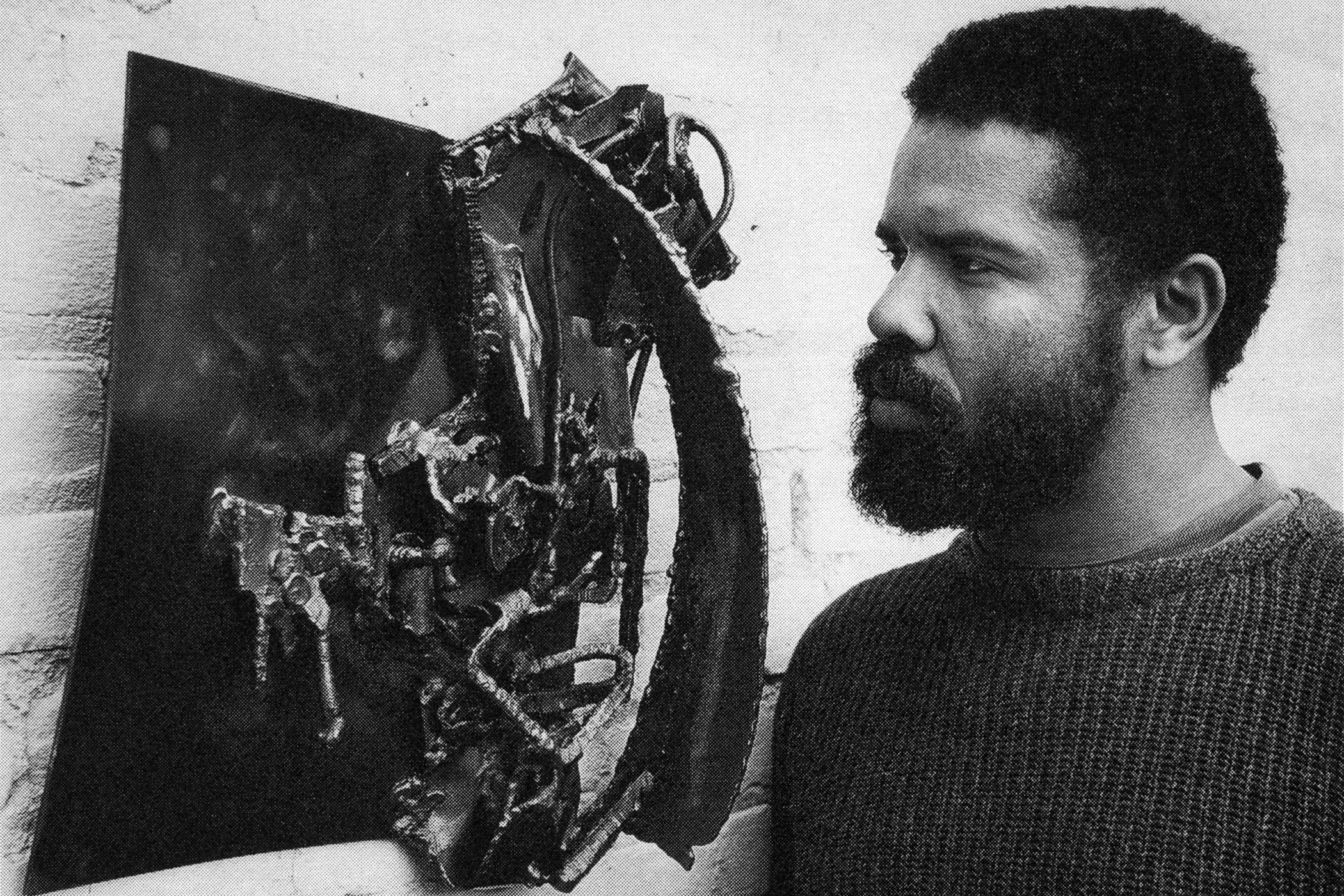

In 1963, a young African-American artist who had moved from the segregated south to Los Angeles took a few scraps of steel and welded them together. What this abstract work resembled fell on the beholder and the angle from which they viewed it – Are those two sharp triangles protruding from a circle the hands of a clock or the blades of a knife? Is that a hammer smashing someone’s head or a lever? – but to most it seemed clear what Some Bright Morning represented: oppression, violence, fear.
Melvin Edwards took the name for this small wall piece, nine inches wide and little more than a foot long if you include the dangling chain with a misshapen blob at the end, from a phrase in a book called 100 Years of Lynchings by Ralph Ginzburg. The author spoke of black farm workers being threatened that they would be attacked “some bright morning”. The lumps of metal at the welded points represented the victims’ wounds and weals, the scars that defaced the American dream.
Some Bright Morning was the first of 300 pieces, constructed over 60 years, in what became his Lynch Fragments series. Everyday metalware – horseshoes, padlocks, scissors, bolts, nails – took on a sinister new form when combined for art, especially when displayed in a gallery with dozens of others.
An agricultural rake might evoke teeth or the jaw of a mantrap
An agricultural rake might evoke teeth or the jaw of a mantrap
The agricultural rake on Memory of Winter (1996), for instance, might evoke teeth or the jaw of a mantrap; Ready Now Now (1988), made after a visit to Zimbabwe, seems to replace a human head with a sharp-bladed hoe. “In my world, anything might become something,” he told the New York Times in 2012.
The series was produced in three phases. The first, in the mid-1960s, was inspired by violence against black communities. Edwards said it was a response to the police killing of Ronald Stokes at a mosque in Los Angeles; Stokes’s scarred body “sticks in my head”, he said.
The second phase came in 1973, after he had moved to New York, and was in response to the Vietnam war, while the third resumed in 1978, and continued to the end of his life, inspired by regular trips to Africa. Edwards set up a studio in Senegal, where he worked for a few months a year from 2000, and learned bronze-casting in Benin.
The Lynch Fragments were mostly small, which he said aided experimentation. “Hyper-creative jazz musicians learned to condense their ideas into three minutes for recording time,” he said. “So you get great masterpieces of music that are not very long.” But he also produced monumental works, such as the Rockers series of kinetic sculptures, inspired by his grandmother’s rocking chair, or the 25ft high Breaking of the Chains, installed in San Diego in 2016 to commemorate Martin Luther King Jr.
Melvin Eugene Edwards Jr was born in Houston, Texas, in 1937. The family moved to Ohio in 1944 – this, he said, was the first time he saw a white face – but returned five years later. Attracted to art from a young age, at high school he took extra classes at Houston’s Museum of Fine Arts. In 1955, he went to the University of Southern California to study art and play American football. He married a fellow student, Karen Hamre, in 1960; and later married the poet Jayne Cortez and, after her death, the curator Diala Touré.
Although he described himself as a “hotshot painter”, Edwards took up welding in 1959 under the disengaged tutoring of a graduate called George Baker. “He laid out six sticks of steel, gave me the fundamental methodology for joining them and then basically said: ‘Don’t bother me’,” Edwards recalled. His moment of inspiration came from the geometric shapes he saw driving behind a garbage truck, making him realise art could be found in everyday metal. Welding was for him like “drawing in the air”.
Edwards was ‘one of those artists who keep getting noticed for having been overlooked’
Edwards was ‘one of those artists who keep getting noticed for having been overlooked’
In 1965, he had his first solo exhibition at the Santa Barbara Museum of Art, where he showed a work-in-progress called Chaino, a heart-like lump of metal suspended by chains, a regular element of his work. In 1970, he became the first African-American sculptor to have a solo exhibition at the Whitney Museum, but joined a boycott of its group show “Contemporary Black Artists in America” the following year because it had refused to hire a black curator.
Newsletters
Choose the newsletters you want to receive
View more
For information about how The Observer protects your data, read our Privacy Policy
It took a long time for him to gain wider recognition. The critic Barry Schwabsky wrote in the Nation in 2017 that Edwards was “one of those artists who keep getting noticed for having been overlooked”. His work was included in the 2015 Venice Biennale, the first to have an African curator, and a solo exhibition that opened in Germany in 2024 also visited Bern and Paris, where it ran until February 2026.
In 2021, New York’s City Hall Park hosted a retrospective spanning 50 years from his first Rocker sculpture, Homage to Coco, to a new piece called Song of the Broken Chains. Edwards disliked being asked about his message, which he felt was personal. “You just keep an open mind about your own ideas,” he said. “Not so much about the opinions of others.”
Melvin Edwards, sculptor, was born on 4 May 1937, and died on 30 March 2026, aged 88
Photograph by Melvin Edwards/ADAGP