
It begins very slowly and does not speed up. A high Irish woman’s voice sings a couple of haunting lines in a foreign language, accompanied by a few synth chords. Then three men join to sing the chorus, just as steadily, just as beautifully: “Fol lol the doh fol the day.” Moya (born Máire) Brennan, the soloist, later said that people in England thought they were singing “On the dole, all day”. It was 1982.
Clannad’s appearance on Top of the Pops – the first time a song had been performed there in Irish Gaelic – was certainly different. On a bill that featured Michael Jackson and Donna Summer, the performance of Theme from Harry’s Game, an ITV series set during the Troubles in Northern Ireland, was so low-energy as to be almost soporific, yet it had something mystical. It reached No 5 in the UK charts.
When Noel Edmonds first played it on Radio 1, the switchboard lit up with people asking about it, so Edmonds immediately played it again. The U2 singer Bono said he almost crashed his car when he heard it. “Máire has one of the greatest voices the human ear has ever experienced,” he said. U2 used it as their warm-up music. Three years later he duetted with her on the Clannad song In a Lifetime.
Theme from Harry's Game was briefly taken off the air after a false claim that it was IRA propaganda. Clannad had to translate the lyrics, which were taken from a book of Irish proverbs that essentially meant: “Everything that is and will be, will cease to be, the moon and the stars, youth and beauty.”
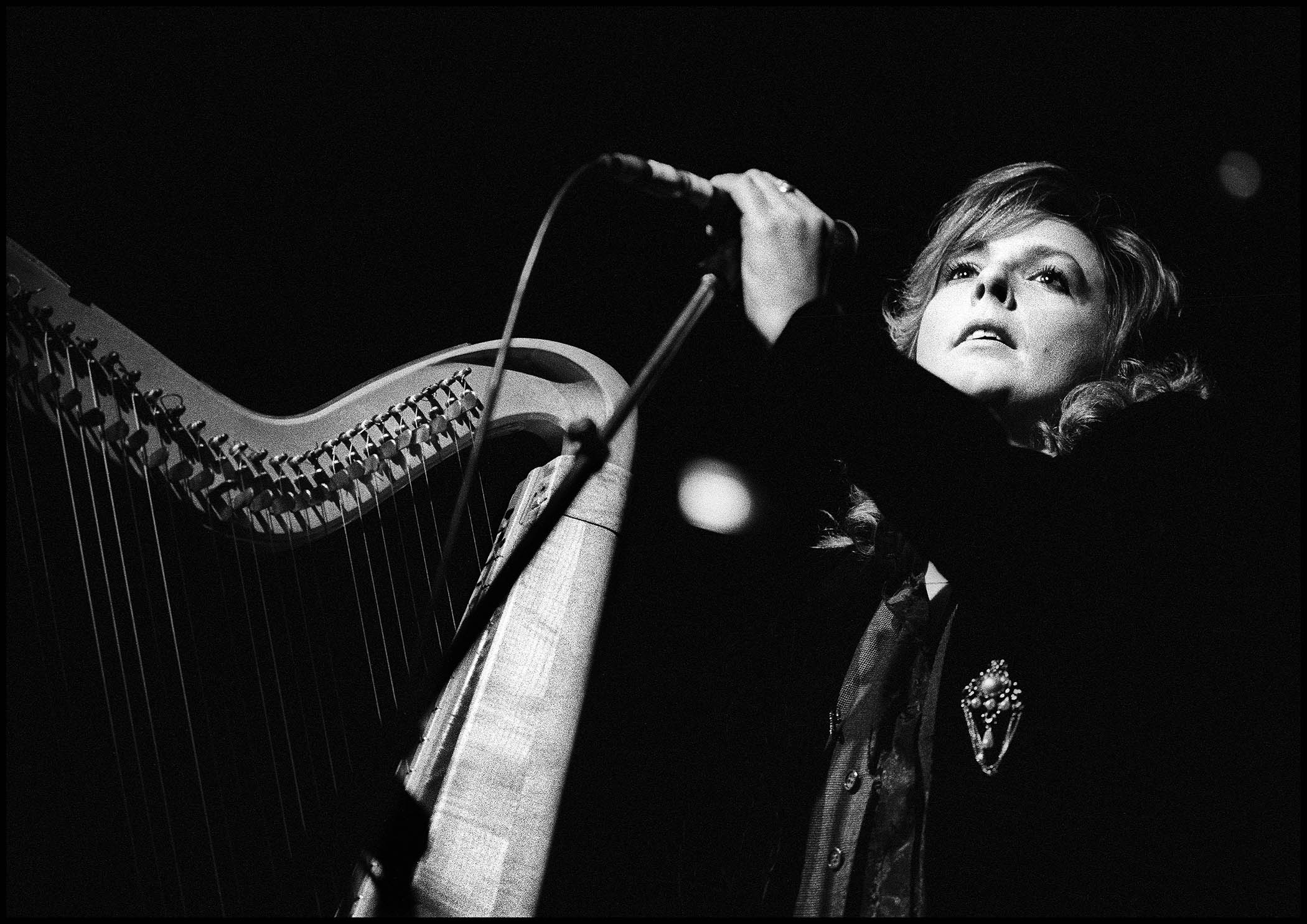
Brennan, who began using the name Moya from 2002, was the eldest of nine children who performed in the Donegal pub their father had bought in 1968. With two brothers, Pól and Ciarán, and their twin uncles Noel and Pádraig Duggan, she formed Clannad in 1970. They recorded 17 albums, won a Bafta (for their theme for the ITV series Robin of Sherwood), a Grammy and an Ivor Novello award, and sold 15 million records. Brennan, who also played the harp, later had a successful solo career.
In 1982, however, they were struggling. Brennan’s sister, Eithne, had just left the band to pursue a solo career — very successfully, as the singer Enya— and had taken their manager. Venues in Ireland did not want to book them because they sang in Irish. As Brennan told the Irish News in 2022: “They regarded it as a poor man’s language.” Oddly, they were more successful in Germany. Harry’s Game, which Brennan and her brothers wrote in a week, changed everything. After 12 years, they were an overnight success.
Máire Philomena Ní Bhraonáin was born in Dublin but raised on the Donegal coast in a house built on the grounds of her grandfather’s school. Her father, Leo, ran a travelling band called Slieve Foy that also featured the Duggan twins, while her mother, also Máire, was a music teacher. The younger Máire studied the harp, piano and singing at the Royal Irish Academy of Music, and had the same singing teacher as Dana and Feargal Sharkey.
The children used to perform songs by the Beatles, the Beach Boys and Joni Mitchell that had been translated into Irish. The Duggan boys also went round local villages with a tape recorder, capturing traditional folk songs so they would not be forgotten.
One night in 1970, Leo’s Tavern was visited by a police sergeant who wanted to encourage the children to enter a competition at the Letterkenny Folk Festival. They won with a song called Liza and were given a recording contract with Philips, but disagreed with the label’s wish for them to perform in English. Originally called Clann as Dobhar (Irish for “Family from Dore”) they shortened it to Clannad for their debut album in 1973.
Newsletters
Choose the newsletters you want to receive
View more
For information about how The Observer protects your data, read our Privacy Policy
Fame did not bring happiness at first. Alcohol, cannabis and cocaine took their toll on Brennan, as did having to travel to England for an abortion at the age of 19. She had an 18-month marriage to Dublin musician Pat Farrell in the mid-1980s. After a miscarriage, she gave up drugs, became a devout Christian and in 1990 married Tim Jarvis, a photographer, with whom she had two children, both now musicians.
In 1992, she released her first solo album, Máire. She was nominated for a Grammy for her fourth album, Whisper to the Wild Water, in 2001. Although her style was often called “new age”, she disliked the pagan implications. In 2000, she performed her song Perfect Time in Rome in front of Pope John Paul II. She also focused on charity work, visiting Africa and Brazil for the Christian Blind Mission, and in 2020 recorded a single with other Irish female singers in aid of a domestic abuse charity.
Clannad reformed from time to time despite the deaths of the Duggan twins, and played their final live show at the Royal Albert Hall in 2024. Last year, they reunited again for an intimate concert at Leo’s Tavern, which is still owned by the family and where Brennan had formed a regular open mic night to find new talent.
They remained rooted in their rural community. “I didn’t think I had much of a voice,” Brennan said in 2020. “I would have loved to have been a rock’n’roller, but I realised I had a different timbre and an ethereal feel. Whenever people ask where that sound comes from I say, ‘Go to Donegal. You’ll feel the earthiness and the atmosphere.’”
Moya Brennan, singer and harpist, was born on 4 August, 1952, and died on 13 April, 2026, aged 73
Photograph by Rob Verhorst/Redferns via Getty Images