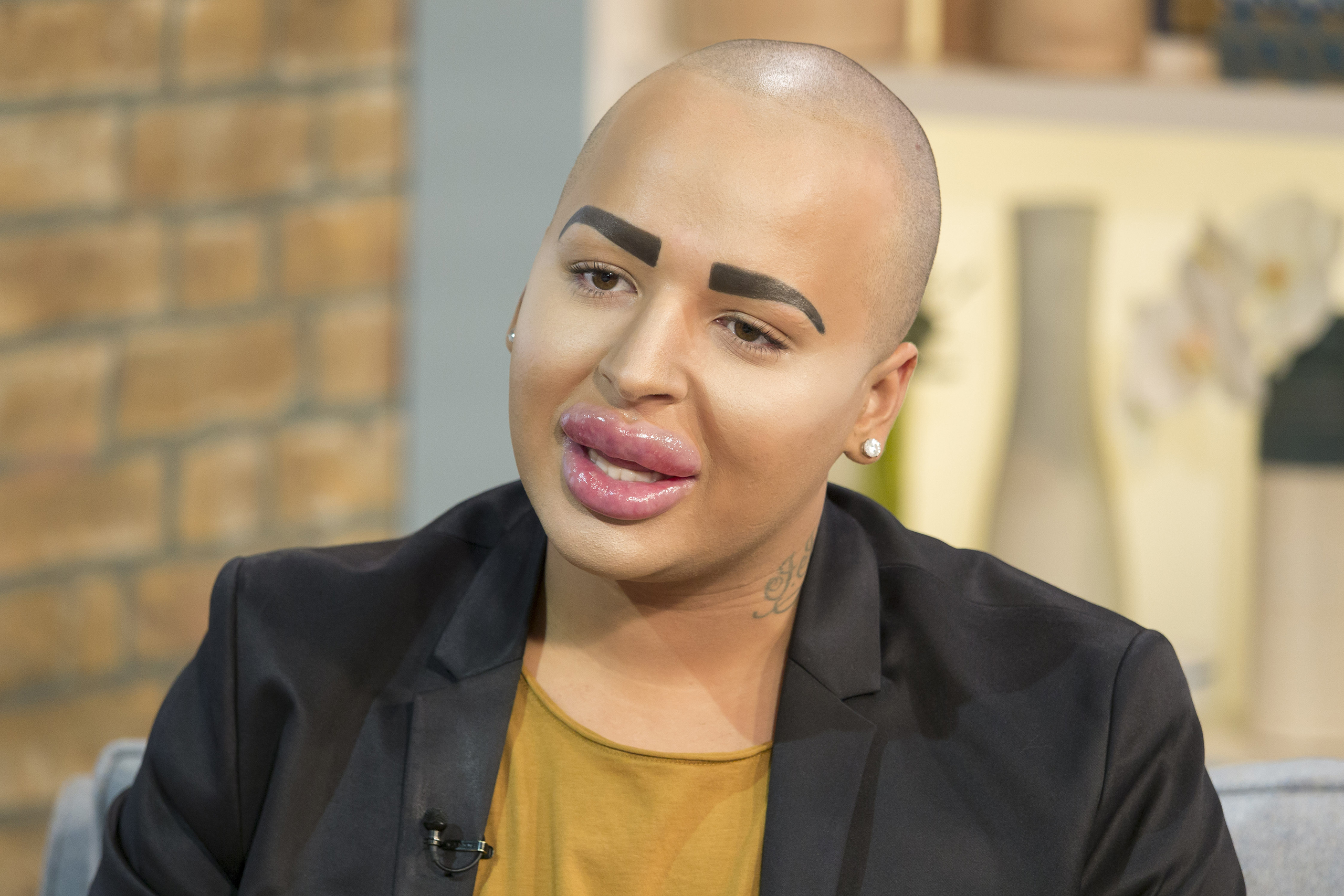

Jordan James Parke became famous twice. The first time, at 25, he was quizzed on This Morning by Eamonn Holmes about the £130,000 he’d spent on plastic surgery (pictured). It was 2016. He looked pretty, burnished, groaning at old photographs pre-jobs: nose and lips. Later he appeared on Botched, the show about surgeries gone wrong, where he complained of filler leaking from his now engorged mouth, and introduced his new career as an aesthetician in Manchester. He’d retrained and rebranded himself the Lip King.
This was the era of the Instagram Face, when people responded to social media selfies by asking surgeons to systematically adjust their faces to mimic the photos on their phones. A shift was happening, culturally, technologically, and around the eyes too, as noses neatened and lips swelled with filler. Parke’s body became a billboard for his business, a sketchbook where he tried to work things out.
Four nose jobs, eye surgery, liposuction and a chin implant later, by the time he appeared on US telly Parke had sharp cheekbones, split-apple lips and severe breathing problems. Still, he was planning a BBL (Brazilian Butt Lift), and intended to keep having procedures forever. “Plastic surgery is like sex,” he added. “You can’t have it once.”
By the time he appeared on American television Parke had sharp cheekbones, split-apple lips and severe breathing problems
By the time he appeared on American television Parke had sharp cheekbones, split-apple lips and severe breathing problems
The second time Parke became famous was when the BBC reported that he had been arrested on suspicion of manslaughter (he was never charged). In 2024 Alice Webb, a 33-year-old mum of five, became the first British person to die after having a non-surgical BBL. It was reportedly carried out by Parke. Currently there is no regulation around who can provide procedures that don’t involve incisions, meaning non-surgical BBLs are reportedly being performed in Airbnbs, garden sheds and public toilets, where abscesses and tissue necrosis are frequently misdiagnosed as bruising.
Reporting on the rise of BBLs, soon after Parke was on Botched, I went to a cosmetic surgery expo in London. At one end of the conference hall a woman was having her jawline stuck with fillers in front of a silent crowd. At the other, a spokesperson entered late and said sorry for the delay: there had been another death.
I discreetly looked around at the beauty journalists assembled. Nobody raised an eyebrow. BBLs still have the highest death rate of all procedures (conservatively, 1 in 3,000 operations) which has led MPs to argue that only doctors should be allowed to perform them. This would act as a de facto ban, as very few doctors would take the risk. Would it reduce the number of fatalities? Probably. Would it reduce the number of people wanting to change their bodies, and willing to go underground for surgery? Probably not.
On Ash Wednesday, Parke was found dead in Canary Wharf, with two people arrested on suspicion of manslaughter, and police “reviewing information that suggests the victim may have been undergoing a cosmetic procedure”. His fame either ended or bloomed then, depending on your filter.
When Parke first appeared on TV, cosmetic procedures weren’t yet normalised in the way they are today. Eamonn Holmes grimacing at Parke’s lips, Ruth Langsford asking how his mother feels, a pitch of pity and confusion that in a couple of years would undoubtedly be replaced by weariness. Within a decade, the idea of spending all your money on surgical procedures could seem, to some, rather than vain or insane, both rational and advisable. Hence the rising number of people who, like Parke, retrain in aesthetics, taking day courses in injecting dermal fillers. He also trained others, in Botox and BBLs
While cosmetic procedures have boomed, less interest has been shown in why people have them, or why they continue to have them even after the original unwieldy nose or thin lip has been altered, and return for more. It’s estimated that up to 20% of people who have cosmetic surgery are suffering from Body Dysmorphic Disorder, when someone’s obsession with their perceived flaws begins to ruin their life, leading them to have repeated cosmetic procedures in hopes of achieving relief. The practitioners who see people with BDD first are not GPs but cosmetic surgeons. People aren’t going to their doctors about this because they don’t think they’re ill, they just think they’re ugly.
I have no idea whether Parke had BDD. All I know of the guy is his changing silhouette on screen. But his appears to be an undistilled example of a life shaped by mad beauty standards and the increasing accessibility of dangerous procedures. Even if Alice Webb’s family don’t see justice, then perhaps a spotlight on Parke’s death could offer a wider reckoning, a moment to consider the paths of ads, needles and normalisation that led to two young people dying for a perfect body.
Photo by Ken McKay/ITV/Shutterstock
Newsletters
Choose the newsletters you want to receive
View more
For information about how The Observer protects your data, read our Privacy Policy