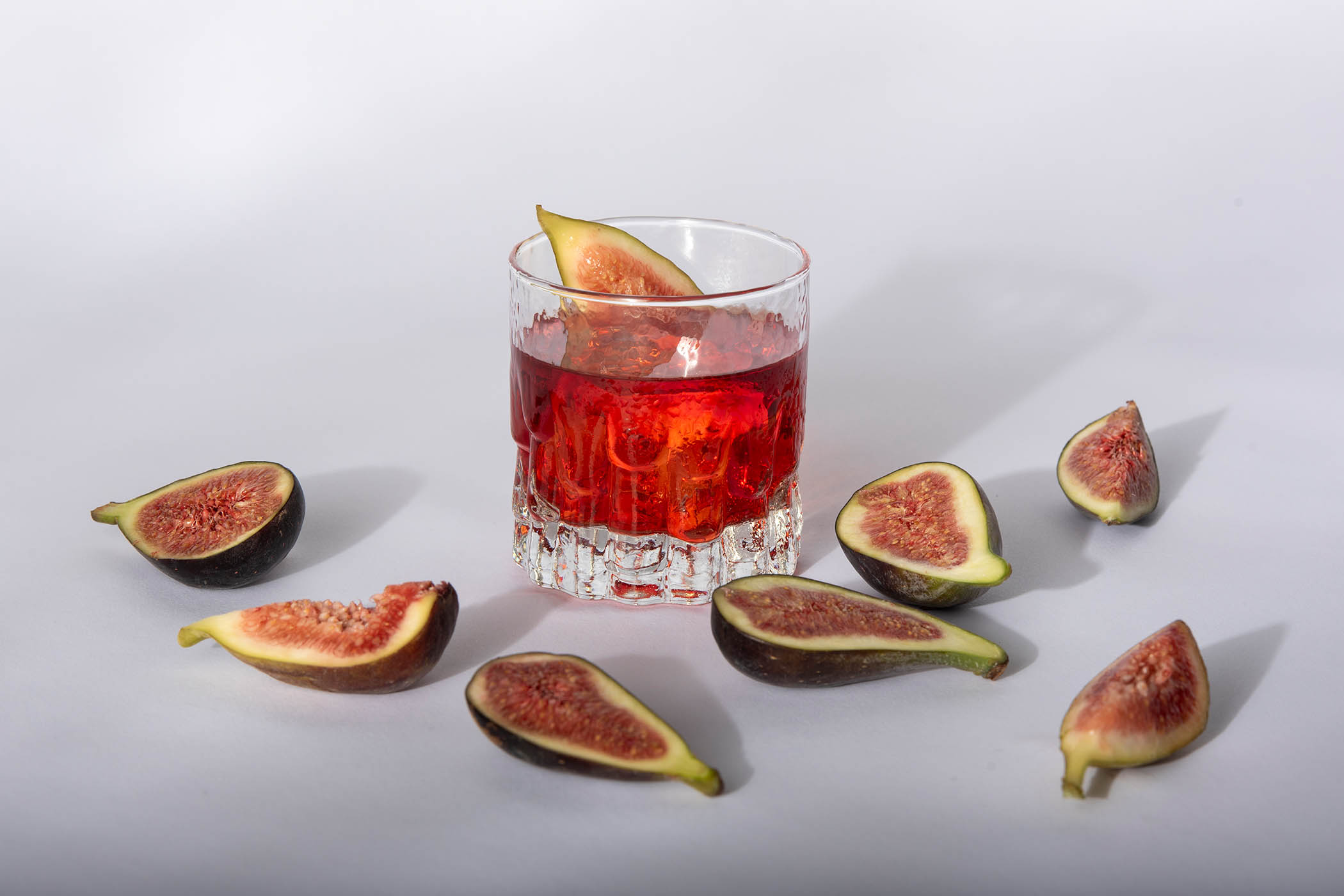


Do you ever feel like you’ve inadvertently become a bit of a moodboard? I had this creeping realisation while sitting at the bar before eating at Merlin Labron-Johnson’s restaurant Osip recently. I was visiting to celebrate this column, and had applied quite a bit of fig perfume before arriving. As I smelled the fragrance of sour leaves and fleshy fruit mixing with my own pheromones, I realised I’d also ordered one of the restaurant’s fig negronis. The oil from green fig leaves has been popping up on fancy menus all over the country recently. I’m a walking, talking trend report! I’m in the pocket of Big Fig!
Fig is a taste I’ve loved since eating my first a few years ago. Before then, I related the fruit to the fig roll, which I didn’t care for and thought were for grannies. But biting into a ripe fig, feeling the pronounced texture of its pulpy flesh… I’m late to the party, of course. Fig trees were one of the first plants to have been cultivated by humans. Fossils have been found on a site in the Jordan Valley as old as 9400-9200 BC. Figs featured heavily in the food of Middle Eastern and Mediterranean cultures, where the plant flourishes in periods of drought (although we can grow them here, too). The fruit is used today to display a semiotic abundance, whether it’s drizzled with honey as part of an expensive raw diet or added as decoration in an opulent dinner spread. I’ve even seen fig trees in people’s houses.
Today, a fig is both an echo of the hedonism of ancient civilisations and a rustic taste indicator of the modern dining class. And in this way, it makes sense that it appears on the menus at bang-on-trend restaurants such as Osip.
Figs are both an echo of the hedonism of ancient civilisations and a rustic taste indicator of the modern dining class
Figs are both an echo of the hedonism of ancient civilisations and a rustic taste indicator of the modern dining class
Merlin told me there are loads of fig trees around Bruton in Somerset, where his restaurant is, which allows him to use their leaves and fruit year-round. “We can dry the leaves to store them, and freeze the oil we make,” he said. “To make our Fig-leaf Negroni, we infuse the Campari with fig leaves for a few days.” He wanted to make a negroni that “feels exotic – the leaves have a faint coconut flavour and fragrance – but which uses local ingredients”.
Spring, the restaurant that was run by the brilliant and much-missed chef Skye Gyngell, who sadly died last month, shared their own recipe for the infusion they use in their Fig-leaf Negroni earlier this year. Here, the usual gin is replaced with fig-leaf liqueur, a concoction that requires toasting the leaves in the oven (this releases the flavours and oils) and then infusing it with vodka.
If you want to incorporate the herbaceous nuttiness of fig into your own drinks projects, I can wholeheartedly recommend Nicola Lamb’s Substack on this subject – each one of her Kitchen Projects are impossibly exhaustive, but nonetheless approachable. In this one, she shares fig-leaf foraging advice from two experts, plus tips on how to infuse it into milk, syrups and jams.
At home, you can add a handful of leaves into your spirit bottles for a few days to make your own fig-leaf spirit – vodka is my favourite. Add a shot or two of the liquid to taste with soda in a highball, with a leaf wrapped around the inside of the glass. Or simply pour Osip’s Fig-Leaf Negroni over ice if, like me, you’d rather leave it to the professionals.
Newsletters
Choose the newsletters you want to receive
View more
For information about how The Observer protects your data, read our Privacy Policy