




If you had to pick a moment when matcha jumped from being a niche drink to becoming the kind of beverage you can buy in Tesco or, say, frothed up in the café at Stevenage train station, you might settle on 8.44pm on Thursday 2 March 2023, when Marisa Poster and Teddie Levenfiche strode on to Dragons’ Den to pitch their start-up matcha business, PerfectTed.
Levenfiche was dressed in a white T-shirt and leprechaun-green trousers, and he boxer-bounced on the balls of his feet to psyche himself up. Poster, who has wavy blonde hair parted in the middle, wore an emerald blouse and a black business suit. Both of them were 25. They looked as though they had just rolled out of a Saint Patrick’s Day party.
But their sell was a masterclass. Matcha, a vibrantly green, finely ground powder made from green tea leaves, was the energy drink we never knew we needed, they told us. It provides a slow-release, long-lasting boost; it can help manage ADHD and is perfect for caffeine-reducers; it is potentially beneficial for mental cognition and supplies our bodies with a raft of antioxidants and amino acids. Forget kombucha. Hell, forget coffee. Matcha was the 1,000-year-old drink of the future.
Poster, PerfectTed’s chief energy officer, and Levenfiche, who was in charge of operations and delivery, were asking for £50,000 for a 5% stake in their business, which sells matcha powder and also cans of fruity matcha infusions. Very quickly it became clear the Dragons were interested in buying what the pair were selling. “Is there anything wrong with this business?” asked entrepreneur Peter Jones. Sara Davies gushed, “You’ve come in here with an absolutely brilliant product. You two are fantastic. If there was ever a case study for how to come into the Den and knock it out of the park, you would absolutely epitomise that.”
One by one, all five Dragons made their offers to invest: “a rare clean sweep,” the voiceover told us. Levenfiche and Poster scuttled to the back of the room to rank them (“I’m freaking out!” Levenfiche whispered) before deciding to join forces with Jones and Steven Bartlett, the presenter of the podcast The Diary of a CEO. As the PerfectTed founders left the room, Deborah Meaden admitted she was “well jel”. Jones crowed, “We are going to make matcha-lot of money.”

Clean sweep: PerfectTed’s founders Teddie Levenfiche and Marisa Poster
Dragons’ Den has typical viewing figures of around three to four million, and the impact of the pair’s appearance on the programme was immediate. At a viewing party to celebrate the episode, PerfectTed’s founders – who also include Levenfiche’s older brother, Levi, who is married to Poster – noticed that Shopify notifications were blowing up on their phones: in just 10 seconds, they’d received 106 orders for PerfectTed products. The month before Poster and Levenfiche pitched on the show, the company had business sales amounting to £9,000; that March, it exploded to £400,000. Within a year, PerfectTed’s sales were more than £1m every month. Or, if you prefer business vernacular, a “matcha-lot of money”.
Very rarely in the food world has an ingredient been propelled from obscurity to ubiquity quite as swiftly as matcha. Before Dragons’ Den, it’s a safe bet that most viewers of the show had never heard of it. It was certainly unlikely they’d tasted its umami-heavy, sometimes bitter flavour. Three years on, it is impossible to avoid: not just in drinks, but in brownies, in popsicles, even in eye creams. On 1 April last year Here We Flo, a UK company that makes organic sanitary products, announced it was launching matcha-infused period pads (“Inner peace, outer protection”) before adding a PSA that it was just yanking our chains.
Every piece of research shows matcha’s popularity spiking off the graph. Britain is now the fastest growing market in Europe. Last summer matcha drink sales grew in cafés by 114%, accounting for 4% of all drinks sold. Vitally, it is also a money-spinner: the average price of a matcha drink is £4.50, which is £1 more than a typical cappuccino. It’s a similar story worldwide, especially in the United States. The global market is projected to grow from $4.23bn in 2024 to nearly $8bn in 2033.
These are just the numbers. Social media is where matcha’s parakeet-green hue invades feeds, solicited or otherwise. Last summer the international retail chain Blank Street Coffee disappeared “Coffee” from its name, because matcha drinks now made up half of its business. (Its blueberry matcha, delivered to customers with an ombré effect that shifts from purple to iridescent green, is especially Instagrammable). One of the stranger emails I received last year came in December, from Unilever, announcing that their “scientists” had crowned matcha 2026’s Stain of the Year.
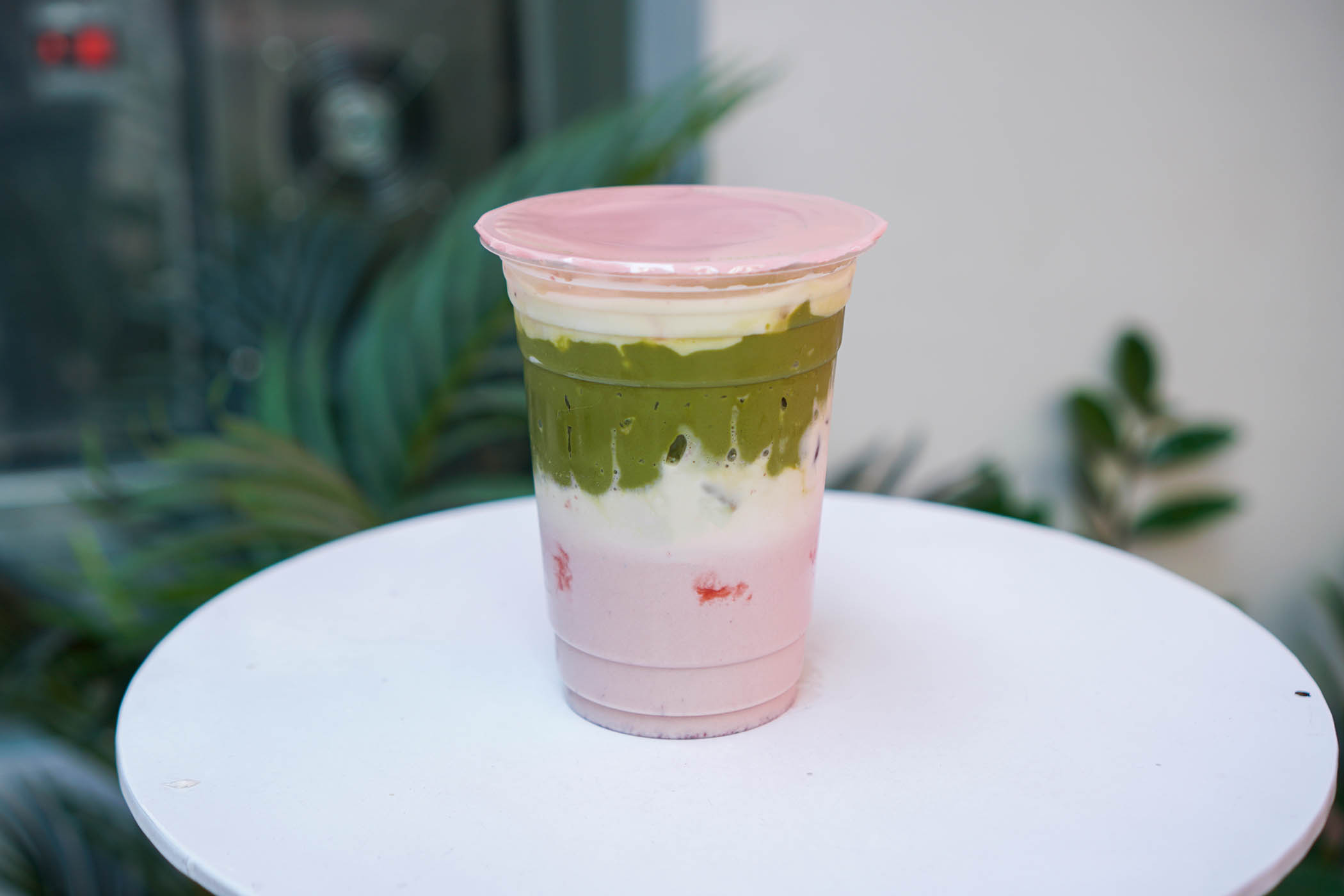
Pink top: a cup of strawberry milk topped with matcha green tea cream
Matcha has been drunk since the 8th century and had a moment in the 16th, when Samurais still strode the earth. But it has never had an especially large fanbase, even in Japan. Most of the tea grown there is sencha, used for whole-leaf green tea. Only around 6% is tencha, the leaf ground to make matcha. There are genuine concerns that supply will be unable to keep pace with global demand, or that the market will be flooded with “batcha”, a lower-grade concentrate. Even if you wanted to expand the fields, Camellia sinensis, the shrub the tea comes from, take around five years to mature.
The matcha story is finely poised: is it the wildest, weirdest food trend of the past decade? Or is it an ephemeral blip that will fade away? On Dragons’ Den, the founders were asked for their long-term vision for PerfectTed, and Poster replied, with a smirk, “World domination.” At the time, it seemed like a joke. Three years on, it sounds more like a premonition.
The PerfectTed offices in east London are very green, as if you have woken up to find yourself living inside a kiwi fruit. It’s the colour of the walls and the banquettes, it’s the colour of the sliders that visitors are invited to slip on when they arrive. “It’s fairly in your face,” Levi Levenfiche, who is 31, admitted when I visited recently. “And this is the pared-back version.” He pointed to a wall across the room, which was painted off-white. “That was meant to be green, too.”
Poster arrived, wearing green fingernails and, in her glasses, green-tinted lenses. “My nails,” she said, “the furniture in my apartment…” all green. “I’m obsessed with matcha. Like, I genuinely think my skin might turn green one day.”

Celebrity fave: Dakota Johnson is spotted rocking double denim and drinking a matcha in New York.
Poster’s personal experience is at the heart of PerfectTed’s origin story. In 2015, aged 18, she enrolled at the University of Pennsylvania, a prestigious Ivy League school. A couple of years earlier she had been diagnosed with ADHD. At university, where she was suddenly required to work late into the night, she developed a serious coffee and energy-drink habit. “The thing with ADHD is it has to do with dopamine dysregulation,” she told me. “And caffeine helps to stimulate the production of dopamine and serotonin and lots of other feel-good neurotransmitters.” She went on, “When I first had it, I liked it. Then I fell into this really vicious jitter-crash cycle, and I just felt like shit all the time.”
Poster tried matcha for the first time at a hipster café in West Philly, and realised “you don’t need to compromise to feel good energy.” Believing that with matcha she had solved her own problem – of needing to be up, but wanting to swerve the crash – she thought she might be able to help other people too. If only she could share her solution.
On her first day at university, Poster was put in an orientation group with nine others. The group included Teddie Levenfiche, who was in the US on a soccer scholarship. “We didn’t get on,” Teddie recalled. “She was this loud New Yorker, I’m this new guy from London. Now we’re best friends. Then she met Levi at a party and they started dating, and the rest is history.”
This is true, but it does an insufficient job of explaining how three Gen Zers with zero food-world experience now run the largest matcha brand in the world. PerfectTed sells in 50-plus countries. Astonishingly, it has been reported that the organisation imports a quarter of Japan’s entire matcha output, though when the business was asked to confirm the fact, they declined to be specific. (Japan exported more than 5,000 tons of matcha in 2024.) After university, all three founders fell into jobs in finance, and Teddie thought about becoming a lawyer. “He’s being humble,” Levi told me. “He got into Harvard Law School, then he turned it down. Humble and handsome. I should leave.”
Sticking with matcha looks like a solid call. The trio now manage a team of more than 40 people, including a unit specialising in AI, which they think is a first in their industry. “We don’t want to conform,” Teddie told me, of the way they run their organisation. I asked him to give me an example of what nonconforming looks like in the matcha business. “When we started, everyone said, ‘Go be in a farmers’ market. Go start in Planet Organic,’” Levi said. “Our first major retail listing was Holland & Barrett” – the big time. “Then everyone said, ‘Start online. Do an E-com business.’ Well, E-com is the smallest part of our business.” He went on, “We’ve built the business backwards. Either out of stupidity or naivety.”
I’m obsessed, I genuinely think my skin might turn green one day
I’m obsessed, I genuinely think my skin might turn green one day
After they filmed Dragons’ Den, but before it aired, PerfectTed wrangled a meeting with the head buyer at Tesco. “She happened to be a young woman in her late 20s who also had some anxiety and looked at the energy drink shelf and felt misrepresented,” Poster told me. “She didn’t feel there was a brand that appealed to her as a woman. They were all hyper-masculine: bulls, monsters, aggressive colours, really harsh graphics.”
Poster has found that the colour green is very good for marketing. “Brown can be beautiful,” she said, of coffee. “It also reminds you of dirt, maybe faeces. But green represents vitality, it represents wealth, sustainability, happiness in some cultures, too. And also, think about how it looks on the feed.”
Tesco’s buyer put cans of PerfectTed in 1,200 stores, and soon after it became the fastest-growing energy drink in the UK.
“It’s a really cool thing when you see your products in the bin. Like, an empty can on the street,” Levi said.
“In the gutter,” Poster said.
“Ideally in a recycling bin,” Levi corrected.
PerfectTed has only scratched the surface of its potential market, its founders believe. “Matcha was always associated with LA Instagram girlies,” Teddie said. “When we talked about it four years ago, it was grouped with things like meditation, manifestation – it was something a bit woo-woo. The target demographic that we were going after was specifically female. Now all you have to do is walk down a London street to realise the target market is everyone.”
Like bubble tea, the Taiwanese beverage that has also become suddenly prevalent in the western world, matcha comes in multiple forms: as the matcha latte, which arrives warm, and the matcha lemonade, which is served cold. There are any number of fruity infusions and iced drinks and milk collabs, including coconut. Certain concoctions have become well-known among consumers because they are so often wielded by celebrities. Harry Styles is known to visit a shop in Notting Hill called How Matcha!, where he orders a Dirty Matcha: a mix of matcha, milk and espresso. How Matcha!, which is expensively appointed in oak and marble, with kintsugi windows, and has a zen space and tatami tea room over three floors, opened in 2024, hosts a monthly running club, and has put on what its founders believe to be the first ever matcha rave.
Nearly every matcha drink presents greenly. And nearly every drink is described as being healthy, to varying degrees. Matcha’s health benefits are seemingly real, though in the way of the wellness industry the list of benefits are usually asterisked with a caveat that more research needs to be done. According to a 2014 study in the European Journal of Nutrition, the catechins found in many green teas can help lower blood pressure and cholesterol levels. A 2021 review in the National Library of Medicine noted matcha’s “high content of antioxidant and anti-inflammatory substances”. Matcha also contains the amino acid L-theanine, which is often associated with improved focus and concentration, and with the production of alpha brain waves, which create the flow state you might hope to experience in meditation, though rigorous trials have not proved the connection.
Matcha contains around 70mg of caffeine per cup, which is more than most green teas, but less than the 100mg found in a typical drip coffee. (A can of Red Bull contains 80mg of caffeine, though it does not contain L-theanine, and so might leave you more prone to crashes.)
In her office, Poster sipped on a can of PerfectTed matcha latte, which has 60g of caffeine, around the same as a single shot of espresso. When I asked how much matcha she drank, she replied, “I get high on my own supply every day.”
In 2015 Keiko Uchida, a long-time buyer for Europe’s Muji stores, decided instead to import matcha to the UK. Uchida’s mother had been a kimono stylist. Her father built tearooms in Japan, and her upbringing was steeped in the world of traditional tea ceremonies. When she began to sell matcha in the UK, she hoped to showcase the best of the drink’s qualities. One of her first import partners was a 300-year-old, seven-generation farm that also supplied matcha to the Japanese royal family.
In 2015, business was not brisk. “When I started, people said I was mad,” Uchida told me recently. “I’m selling this very unknown tea called matcha, and it’s very expensive.” The finest matcha has a shelf-life of just six months. Uchida found she was drinking most of her stock herself.
We were meeting at Uchida’s shop in Notting Hill, less than five minutes’ walk from How Matcha!, and not far from six or seven other buzzy cafés that also sell matcha drinks. The mood here was more sedate: Uchida mainly sells ceramics. She served us both a single-origin matcha that she makes with a chasen (bamboo whisk), and a chawan (traditional handmade bowl). It produced a matcha unlike any I had tasted: smooth, refined, not remotely bitter, in fact almost sweet.
Uchida detailed the painstaking process of growing matcha: how the plant must be shaded from too much sunlight, which is in part responsible for its bright colour and medicinal benefits. At harvest time, in May, only the youngest leaves are hand-picked. Then they are steamed, deveined, dried and ground slowly between granite stones. “It’s time-consuming,” she told me. “Which is why the price is high.”
Matcha has been such an unlikely candidate for a global explosion that no one could have – or did – predict it. Certainly not in Japan, where most matcha is grown on small plots by elderly farmers. When the boom started to gather pace around 2024, there was simply not enough matcha to go round, and unscrupulous manufacturers began to sell ground-up sencha tea as the real deal. According to one estimate from the Global Tea Institute, as much as 90% of powder labelled as matcha is nothing of the sort.
Mostly, Uchida told me, no one notices. For one thing, most matcha drinkers are new to the taste and have little to compare it to. And if the powder is masked with fruit flavours, such as blueberry or passion fruit, it is hard for even a trained palate to discern how high quality the base matcha is. “When you go for the cheap option, milk is not good enough to cover up the bitter flavour,” Uchida said. “So why not put the fruits and jelly in, and charge £3 more?”
Uchida is concerned about the designation of matcha powder. Everywhere she looks she sees powder described as “ceremonial grade”, but nobody in Japan uses the term. “Everybody calls their matcha ‘ceremonial’, so people think, ‘OK, this is the best stuff,’” she said. “But we need to separate matcha and green tea powder. I don’t think everybody should buy the expensive matcha from my shop, though ideally, yes. But I do think everybody should have the proper information. And if it is green tea powder, which is suitable for a smoothie or a milkshake or a cake, they are only happy to buy the cheaper one because they know that.”
PerfectTed is one of those companies that leans heavily on the word “ceremonial”: their best-selling product is what Poster calls the “OG pouch” of ceremonial matcha powder. But the founders fiercely defend the quality of their matcha. Still, there’s an obvious question: how do they sell a 30g bag of this notoriously rare and temperamental product for £9.99?
Poster told me it is because of the scale at which they import, a nod to the fact you can streamline many processes when you buy as much matcha as they do. “No offence to these other players,” Poster said, “but the margins they were making were insane.”
PerfectTed’s founders visit Japan every six weeks, and their direct relationships with farms, rather than middlemen, have protected PerfectTed from shortages and poor harvests that have affected others. “The shortage is real,” Poster said, but she is not particularly concerned, in part because territories beyond Japan have developed interest in growing matcha. Starbucks, which recorded a 40% growth in matcha sales in the first quarter of 2025, now sources its matcha from China and South Korea, as well as Japan.
When Levenfiche and Poster first received the call from Dragons’ Den, they were given five vital days to prepare for the filming of the episode. “We watched every episode from the previous five seasons, because that’s when the same Dragons were on,” Teddie told me. “And we compiled a list of every variation of every question they had ever asked.”
“It would have been great to have ChatGPT,” Poster said.
“So we basically knew what they were going to ask,” Teddie said. “And it followed the script in many ways.”
When I asked about the “world domination” line, there was no backtracking: the founders want PerfectTed to be a unicorn, a start-up company with a valuation exceeding $1 billion. “Sales are through the roof, but we’re not really money-motivated,” Levi said. “We’re motivated by doing legendary things, and by building a household name by just going on an incredible mission and journey.”
I asked if they could take down coffee. “We’ve done the calcs,” Poster said. “I don’t think production will actually ever meet the capacity in our lifetime, unfortunately.” She stopped, and I saw what seemed like a glint in her eye behind the green tint of her glasses. “But who’s to say not in our great-great grandchildren’s.”
Newsletters
Choose the newsletters you want to receive
View more
For information about how The Observer protects your data, read our Privacy Policy