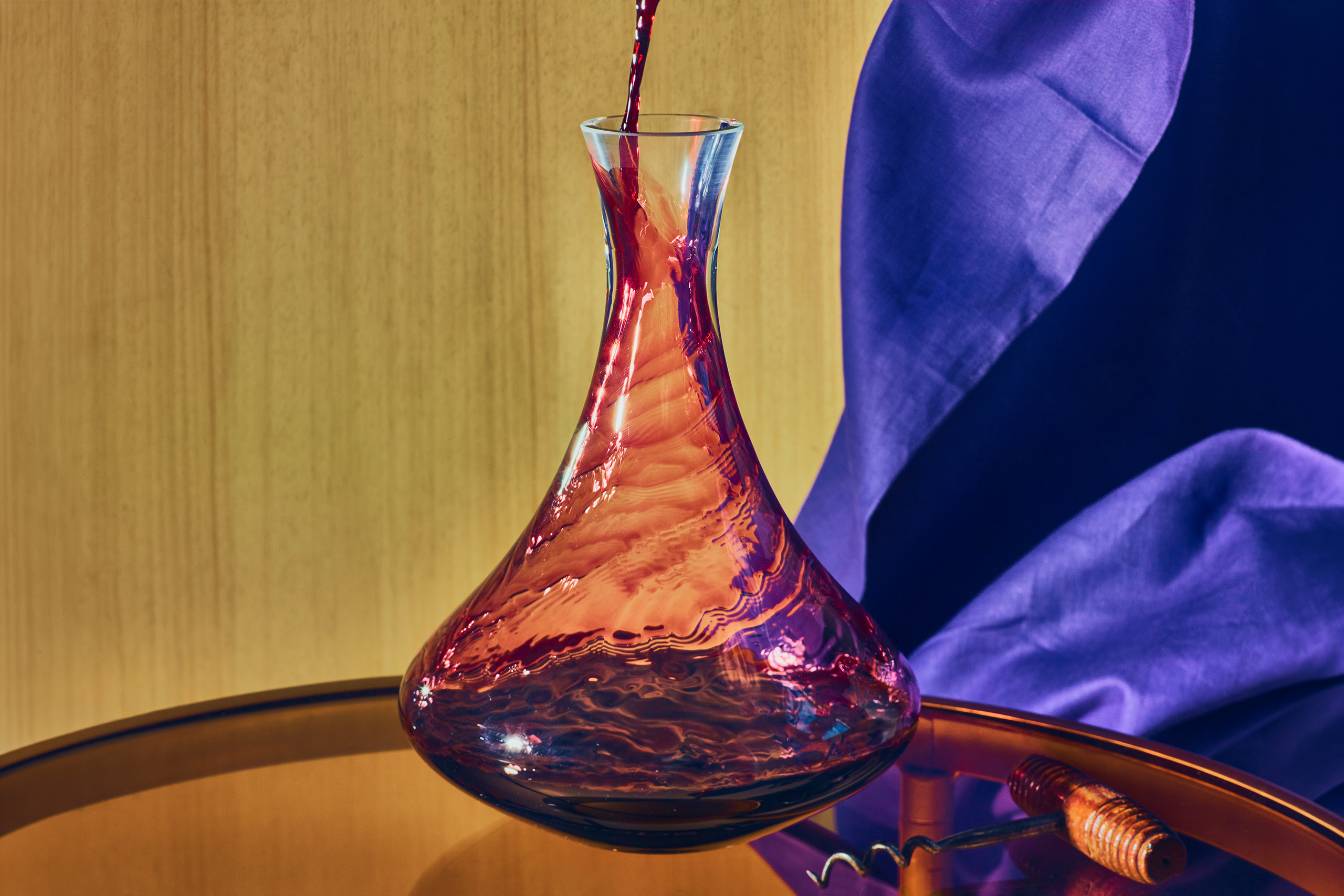




I recently went to Sune in east London, and was greeted by an excited Honey Spencer (co-owner and head of wine there) with an enormous handmade crystalline decanter from Nude Glass. A decanter like this is something that guides the eye and makes the taste buds water in anticipation of something good to drink on the precipice of a heatwave. Honey acknowledged that this one, specifically, with its narrow swan-like neck and grand and curved base, was a little “extra”. Then she noted that, in times like these, God knows we need the extravagance of a small luxury.
She’s right. Like a magnum, a sushi train or a good tidbit of scandal, a decanter is a scene-stealing dinner accessory. While the wine bottle is largely uniform in colour and shape, demurely hiding its contents with dark glass, a decanter is bombastic and stylised, revealing the wine that’s to be drunk and, often, helping us to appreciate it more.
The role of a decanter is not only aesthetic but also practical: greater exposure to oxygen helps the wine to release aromatic compounds, which can be beneficial for wines that are a little old or tightly bound. In this sense, the best decanter will do a similar job to the best glassware. This is why some drinks professionals I know prefer to use a large tulip glass, with a wide voluptuous bowl and a narrow, fine rim. You’re still exposing the liquid to oxygen, still giving it a big swill, still letting the movement and play unlock the drink. Still, if you can’t imagine your dinner party without a decanter, who am I to prevent you?
You think a big fancy decanter, you think red wine, maybe white, very occasionally rosé, right? Well, I was recently informed by Jonny Fowle that he believed whisky can and should be decanted. And, as he is the global head of whisky for Sotheby’s, I can only believe him. Apparently, most whisky companies claim the spirit does not age in the bottle – something he claims to be fundamentally untrue.
Just like wine, whisky experiences micro-oxidisation as it comes into contact with the small amounts of oxygen present in the bottle. This causes development in flavour, often referred to as the “old bottle effect”. So, when we consider that whisky benefits from oxygen exposure, decanting a whisky feels like another step towards unlocking its flavours.
You’ll notice that if you leave a little whisky out overnight, it’ll be murky and sad-looking in the morning, but “decanting a large amount of liquid provides a more stable environment for oxidisation”. Jonny says an entire bottle decanted over 24 hours is no problem. “You can often extend this to five or six days without issue. I tried this myself with a bottle of Longmorn van Wees 1969, which I initially found to be extremely tight and closed off, but after decanting it for 24 hours, it became more expressive while the alcohol became less intrusive.”
Like wine, you can give your finest examples of whisky this treatment, but do bear in mind this will differ from drink to drink. And while it’s always fun to experiment getting the most out of your drinks, I will not be held responsible for any knackered booze.
Newsletters
Choose the newsletters you want to receive
View more
For information about how The Observer protects your data, read our Privacy Policy