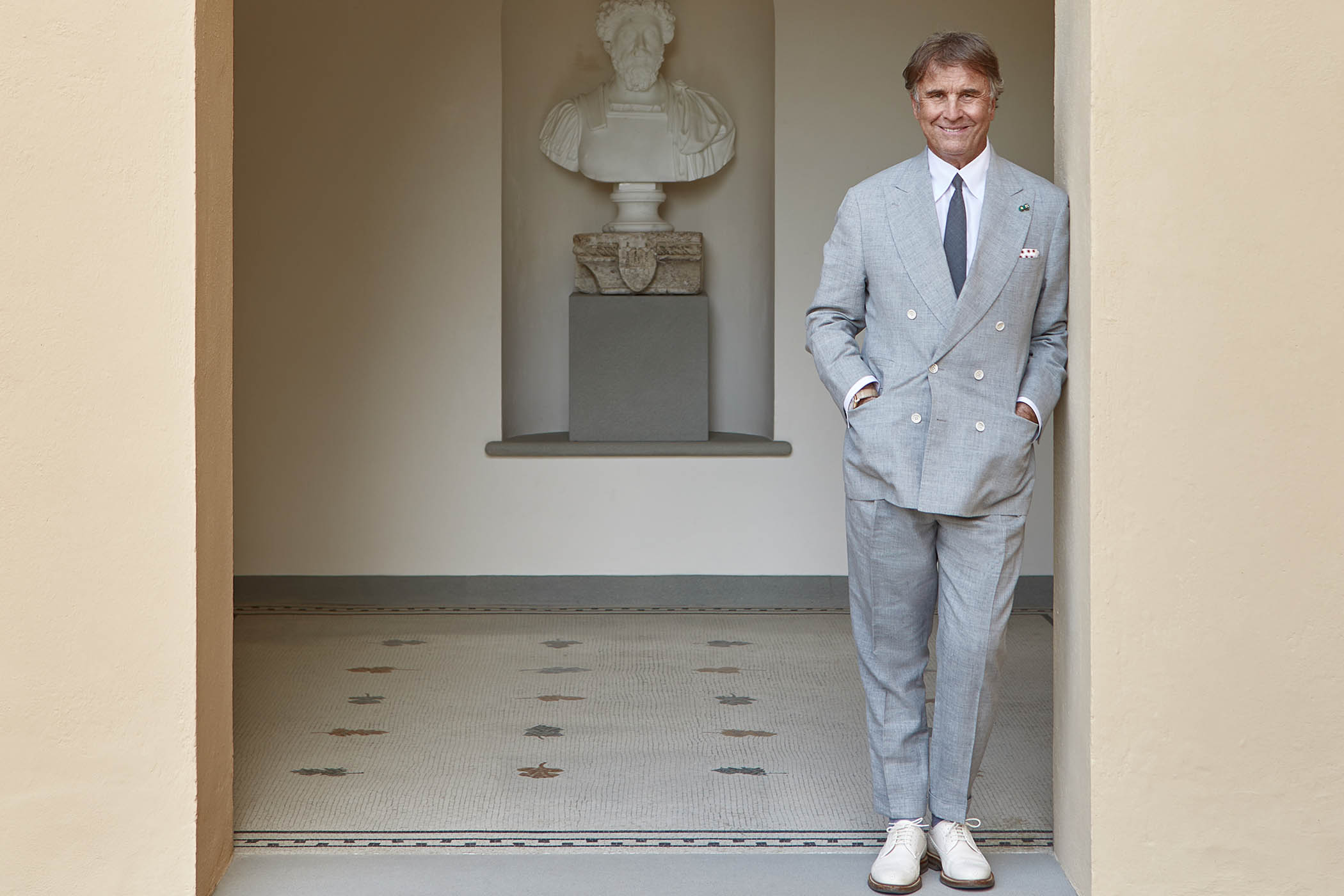

Brunello Cucinelli may be known as the reigning sovereign of slow luxury, but he may have been the busiest man in the fashion business over the last couple of weeks.
The 72-year-old Italian fashion designer and businessman, famed for building a billion-dollar cashmere brand from the 12th-century hamlet of Solomeo, had no sooner unveiled his 42-window Harrods Christmas takeover than he was accepting a lifetime achievement award at the Fashion Awards from Sharon Stone at the Royal Albert Hall. Not 48 hours later, he was in Rome to host the world premiere of the documentary film he had commissioned on his life, Brunello, The Gracious Visionary, at the epicentre of Italian cinema, Cinecittà studios.
We’re talking over Zoom from his office in Solomeo, Umbria, a week before his whirlwind week commenced, but no signs of stress are showing. “Take all the time that you need,” he insists via his right-hand-woman translator, Chiara. “I’m not frenzied or frantic, Scarlett.”
Despite his impressive accolades collected on home turf – the Knight of Industry in 2010, Knight of the Grand Cross of the Order of Merit of the Italian Republic in 2018 and the prestigious Compasso d’Oro Career Award in 2022 – and a casual “few degrees collected along the way” of his 50-year career, it is his FA that he is most proud of.
“Without a doubt, this award in London is the best gift that I’ve ever received from the world of fashion,” he says proudly. “It says it’s for having a specific style identity, but also for the way we work, so this accolade is the best gift I could receive from my world.”
The world that Cucinelli himself has created and which landed him the prize is widely regarded as one of the most impressive in the industry as a blueprint for its altruistic and circular approach. What started with 53 cashmere sweaters in 1978 may have grown into a fully fledged, globally renowned brand, but it remains rooted in the production facilities in Solomeo, the 12th-century hamlet he saved from dilapidation in the 1980s and has revived into a thriving community of Made in Italy artisanship. It’s an approach, he says, that all stems from his childhood.
My father kept hammering the same thing the whole of my life: you must be a good man
My father kept hammering the same thing the whole of my life: you must be a good man
“My father kept hammering the same thing the whole of my life: you must be a good man. Even when he was told I was rich, he said he was not interested in that. He would say to me, ‘Do you want to be the richest guy in the cemetery?’” he says. “The other piece of advice was, ‘Remember that debt works on Sundays, too,’ which means looking at your fellow human beings in a humane way. Because someone standing opposite you might have economic or spiritual problems. This is something that I learned early on – study your fellow human being.”
Despite his glitzy week, Cucinelli is far more likely to be found visiting his factories or working in his book-lined office in Solomeo than rubbing shoulders with the A-list; his is a humble demeanour that comes from modest beginnings. Born in 1953 in a rustic farmhouse just outside Castel Rigone in the Umbrian countryside, Cucinelli was one of six boys who lived with their wider family of 13. The Cucinellis were hardworking farmers who lived off the land. Food was homegrown and lovingly prepared, while entertainment came from playing cards with his grandfather.
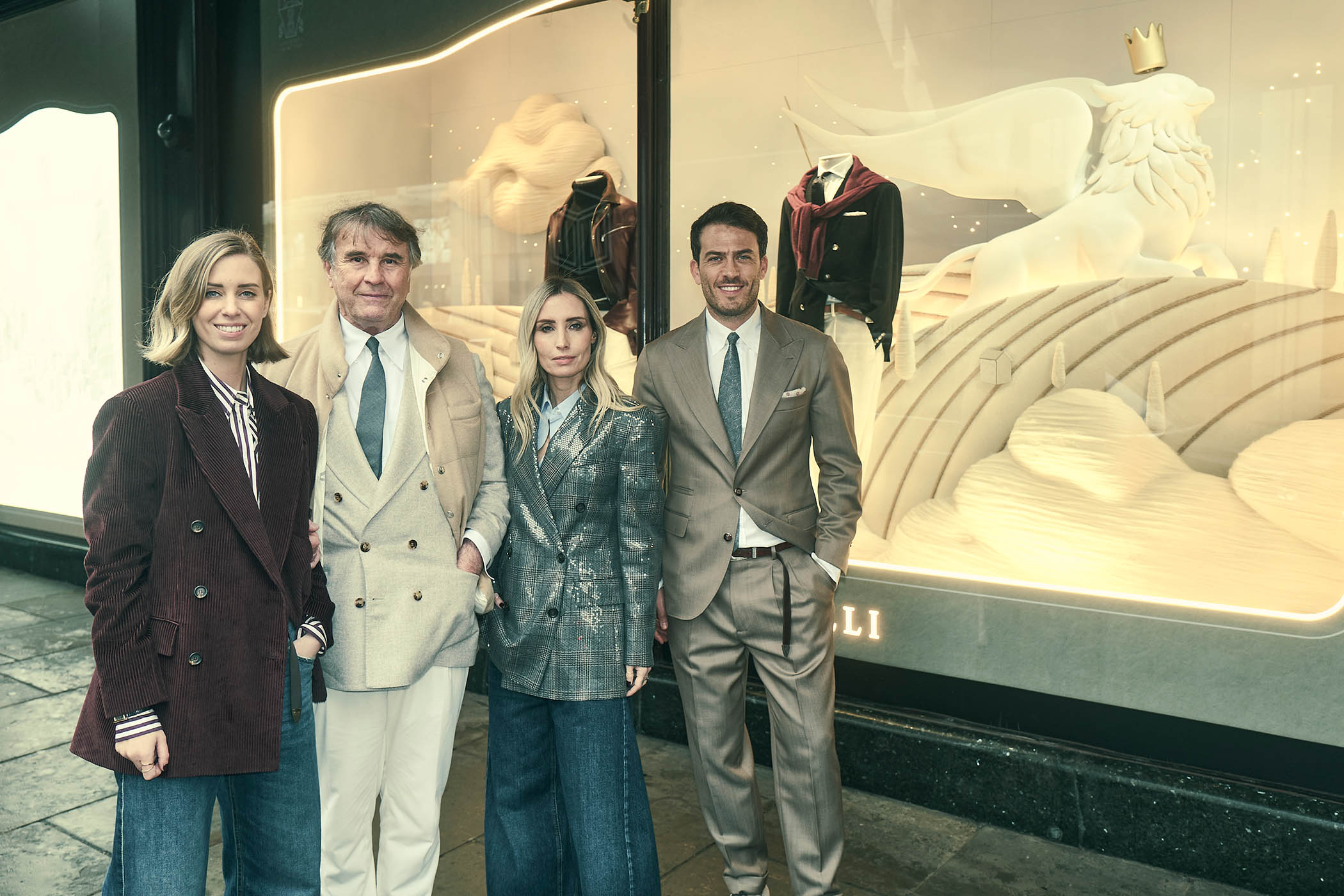
Cool, calm and collected: Brunello Cucinelli at Harrods with daughters Carolina and Camilla and CEO Riccardo Stefanelli
It was here Cucinelli would later say that he learned those first life lessons that he’d carry with him into his business, and where he attributes his lifelong appreciation of nature, beauty and respect. Watching his family give their first bale of wheat to the community on the instruction of his grandfather, he discovered what he calls “the great theme in life: the balance between profit and giving back.”
Cucinelli’s first encounter with fashion was through his wife’s family. They owned a small textiles workshop in Solomeo. Later, after being hired as a model for a sportswear company, he immersed himself in fashion magazines and stayed on top of the trends of the day. When he was 25, he had a lightbulb moment: to create cashmere jumpers for women that celebrated Italian craftsmanship. He bought 20kg of cashmere yarn and dyed it bright colours. Shortly after, the entire collection was bought by a retailer in Bolzano – and the Brunello Cucinelli brand was born.
As unique as his brand is, so is the man behind it. Fiercely independent and rooted in traditional values, Cucinelli quotes Plato, Alexander the Great, and Marcus Aurelius while making his points to the press, and writes poetry for his customers that he shares on his website (in his opinion, poets are the “greatest of human beings”). Rather than read contemporary literature, he prefers to pick up the works of ancient philosophers – “what Socrates states 2,500 years ago is still valid today” – and thinks Saint Francis’s lack of judgment made him “a genius in human relations”.Unlike many of his competitors, he doesn’t hold fashion shows, but presentations of new collections at the Milan HQ that are legendary for their catering (particularly, bowls of tomato paccheri pasta). Nor does he work out of a big fashion capital, but out of Solomeo.
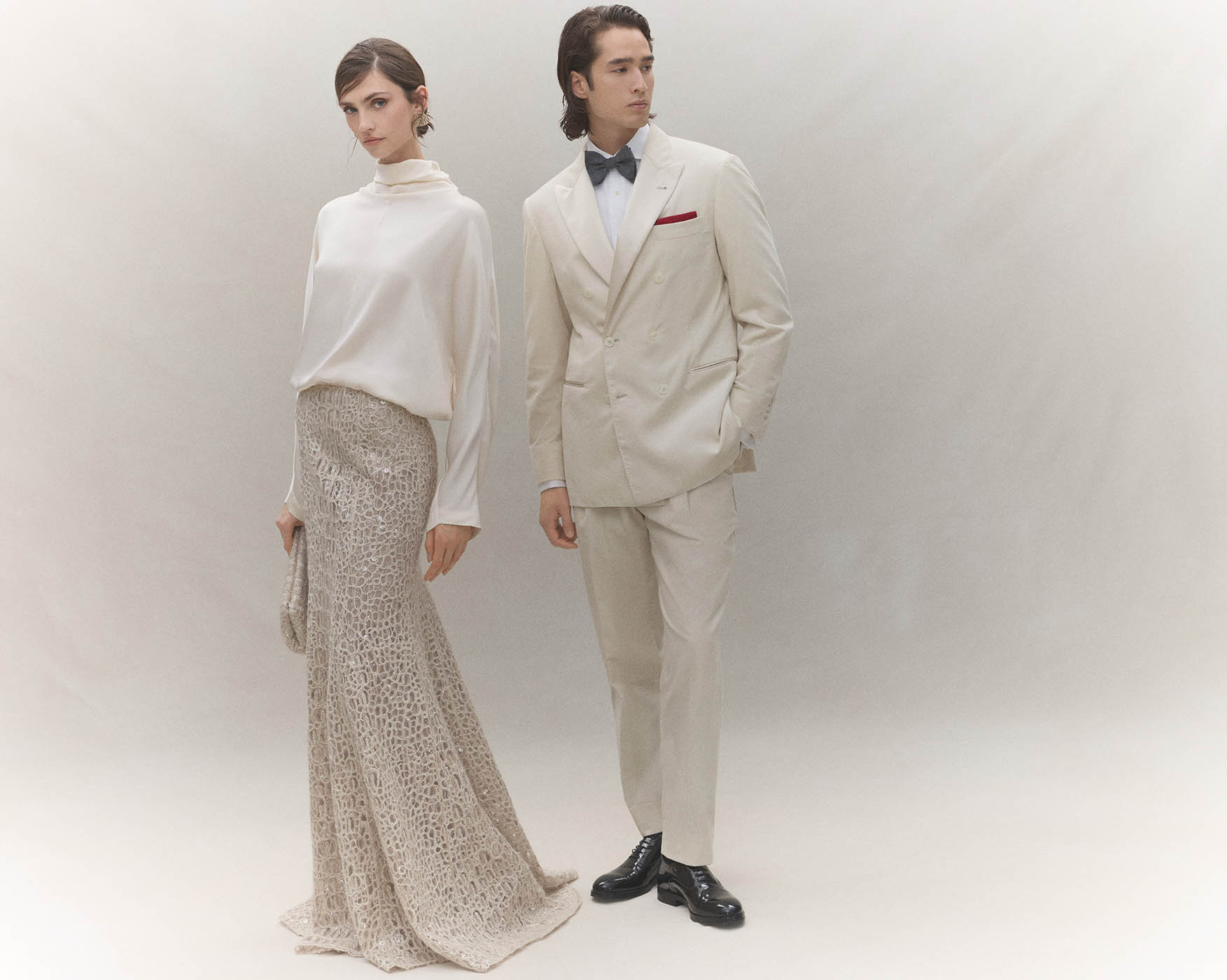
Stepping out in style: from the new Brunello Cucinelli collection at Harrods
“I used to hang out here visiting my fiancé, now my wife, Federica, when it was really run down and people were not really living in the centre,” he says. “So I thought, ‘I want to start from something small.’ At the start it was the HQ of a very small artisanal workshop and t he business expanded, but it’s still the homestead of my soul.”
When the creator of Netflix comedy-drama Emily In Paris, Darren Star, based an entire storyline on the Cucinelli’s home turf, having visited the summer before, Cucinelli embraced the pop-culture moment. “As I watched the scenes where Solomeo is portrayed allegorically, I felt joy and gratitude,” he told his Instagram followers. Did he really mind his home being parodied?
“St Francis taught us a beautiful lesson, Scarlett – he never judged others and this is the way I want to live, he was a genius in human relations,” smiles Cucinelli. “Let’s do away with ego, we don’t really need it, do we? Ego is not a part of me.”
In 2019 the village hit the headlines for what was coined the “Solomeo Summit”, where Cucinelli famously hosted a group of Silicon Valley CEOs, including Jeff Bezos. The group were said to not just be fans of his quiet-luxury aesthetic, but in awe of his entrepreneurialism. Cucinelli isn’t one for letting any of it go to his head. “I feel exactly the same now as I did when I sold the first 53 sweaters. Nothing has changed. Because you see it is not the scale that brings the feeling. The day I started I was resting upon the very same ideals as today. I had 30 employees, now 11,000, but the same feeling. The rules of human relations have not changed.”
Cucinelli is emphatic that there aren’t other industries he would like to pursue. Despite attending the G20 summit in Rome in 2021 at the request of then prime-minister Mario Draghi to talk about Humanistic Capitalism and being vocal in his calls for peace talks surrounding the wars currently waging in Ukraine and Palestine, he says he “has more chance of becoming the Pope” than entering politics.
“No, no, no, absolutely not,” he says. “This is the only job and work I want to do forever. Let’s see, maybe when I’m 80, I might work for 2-3 hours a day because, you know, you have less strength. But I don’t want to devote myself to anything else – this is my job and work – and books, theatre, library are my passions.”
Any signs of slowing down are a while off. His day-to-day, he says, remains the same as it always has. His day starts by rising early, savouring a “typical Italian breakfast of coffee and brioche” before climbing to the top of the Castello tower to spend 40 minutes “thinking about the day and looking for inspiration”. It’s a life-work balance that Cucinelli has always been strict about. “I grew up with Saint Benedict’s teachings, that every day you have to balance out your life and look after your mind for study, then you have to pray, and then you have to work. Everything must have its place; I still live this way.” He has, he insists, made some adjustments to his schedule now he’s in his 70s. “I’ve cut my working hours down from eight to seven, because I am 72 and need an extra hour to keep fit. And instead of playing soccer as an attacker, I play as a goalie.”
The death of Giorgio Armani shone a light on the succession plans for brands such as Cucinelli’s. In a typically prepared fashion, he has already put the wheels in motion and positioned his daughters, Camilla and Carolina, as co-vice presidents and creative co-directors.
“When I turned 50, I decided to live by the teachings of Marcus Aurelius, which is to live everyday as if it’s the last of your life, but plan as if you would stay here forever So, today might be the last day of my life, but there are plans for eternity,” he says. “I already had the idea of establishing a trust for my daughters. Some lawyers said, ‘Why so early? Are you sure?’ I said yes. If you make decisions about your future, it’s better to do it when you are in a sane state of mind.”
During this time of celebration, there has also been time for reflection. “I would be happy to be described as a normal, serious human being. Because it seems to me these days you must be extraordinary all the time. I live in a village, I lead a normal life, we work in a normal way. And we keep respecting human beings,” he says. “What brings me joy is the serenity of life – which is not to be mistaken with happiness,” he continues. “If you live in a serene manner, you also work in a serene manner. And, like the teachings of Marcus Aurealius, living according to nature and going with the flow, you find peace for yourself.”
Newsletters
Choose the newsletters you want to receive
View more
For information about how The Observer protects your data, read our Privacy Policy