

Photograph by Suki Dhanda
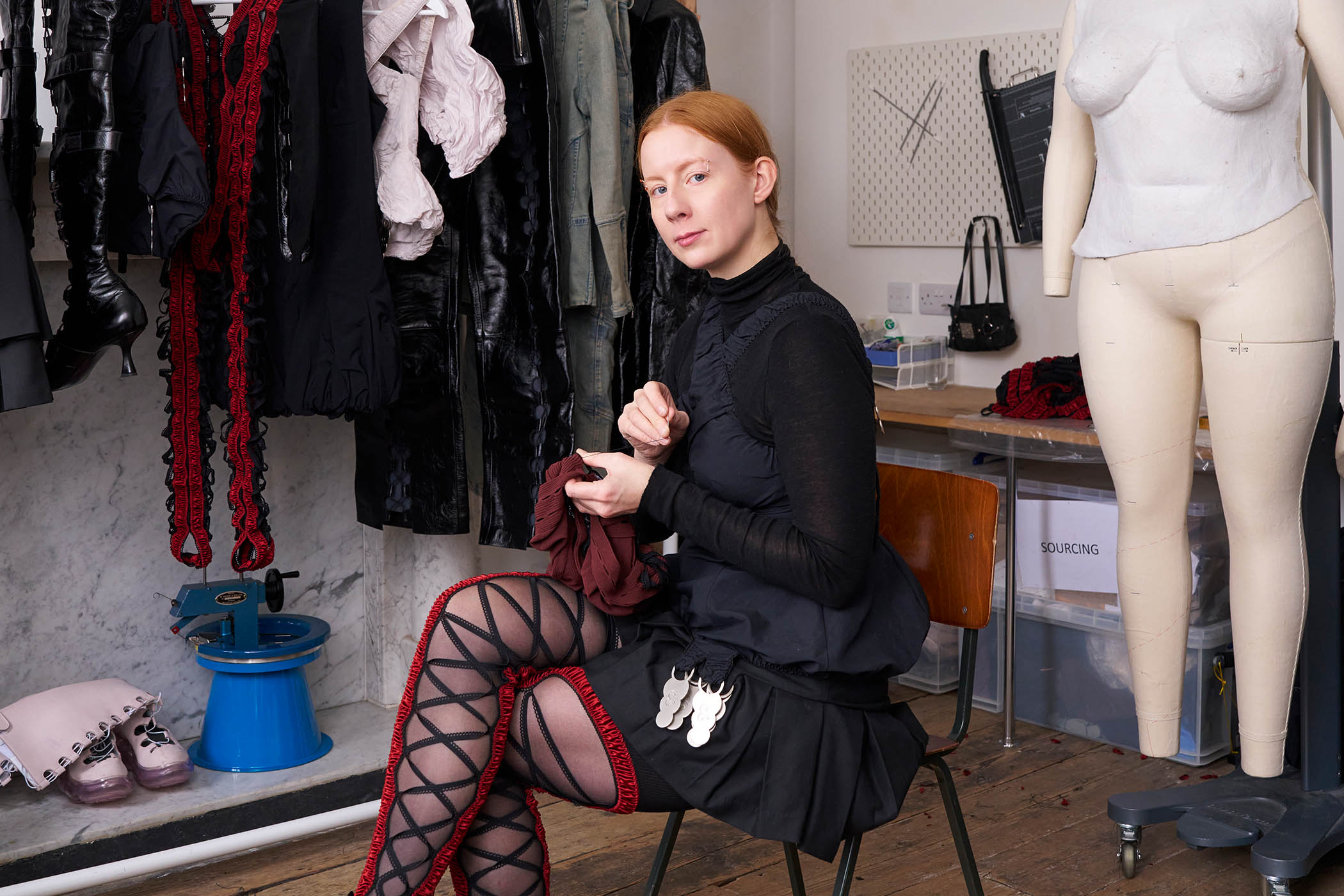
Around the corner from a Sainsbury’s, nestled at the foot of Tottenham Hotspur’s north London stadium, are two Grade II listed Georgian townhouses owned by Sarabande, a charitable foundation established by Alexander McQueen in 2006 to support emerging creatives. Up a narrow staircase in a whitewashed L-shaped room, the fashion designer Sinéad O’Dwyer is still settling into her new studio. Behind her is a small rail of pieces from her current collection, and a mannequin dressed in a voluptuous felt cast.
O’Dwyer’s designs blend the practical with the provocative, melding elements of uniform and classic dress – shirts, trench coats, jeans – with fetish-inspired tropes: intricately knitted shibari bodysuits and harness details. She has become well known for casting shows with plus-size, heavily pregnant and disabled models, and her eponymous label sells items up to a size 24 when most of her contemporaries stop at a 16.
Last year, the fashion industry turned away from using curvy models, instead booking young women who appeared on catwalks with protruding bones and clavicles. In its 2026 Inclusivity report, Vogue noted the number of catwalk models above a size 8 in the previous two years had dropped from almost 5% to 2%. Newly incumbent male designers at Chanel and Alexander McQueen have not continued the preference of their (female) predecessors for using a mix of models beyond sample size, though some female designers are guilty of the same sin.
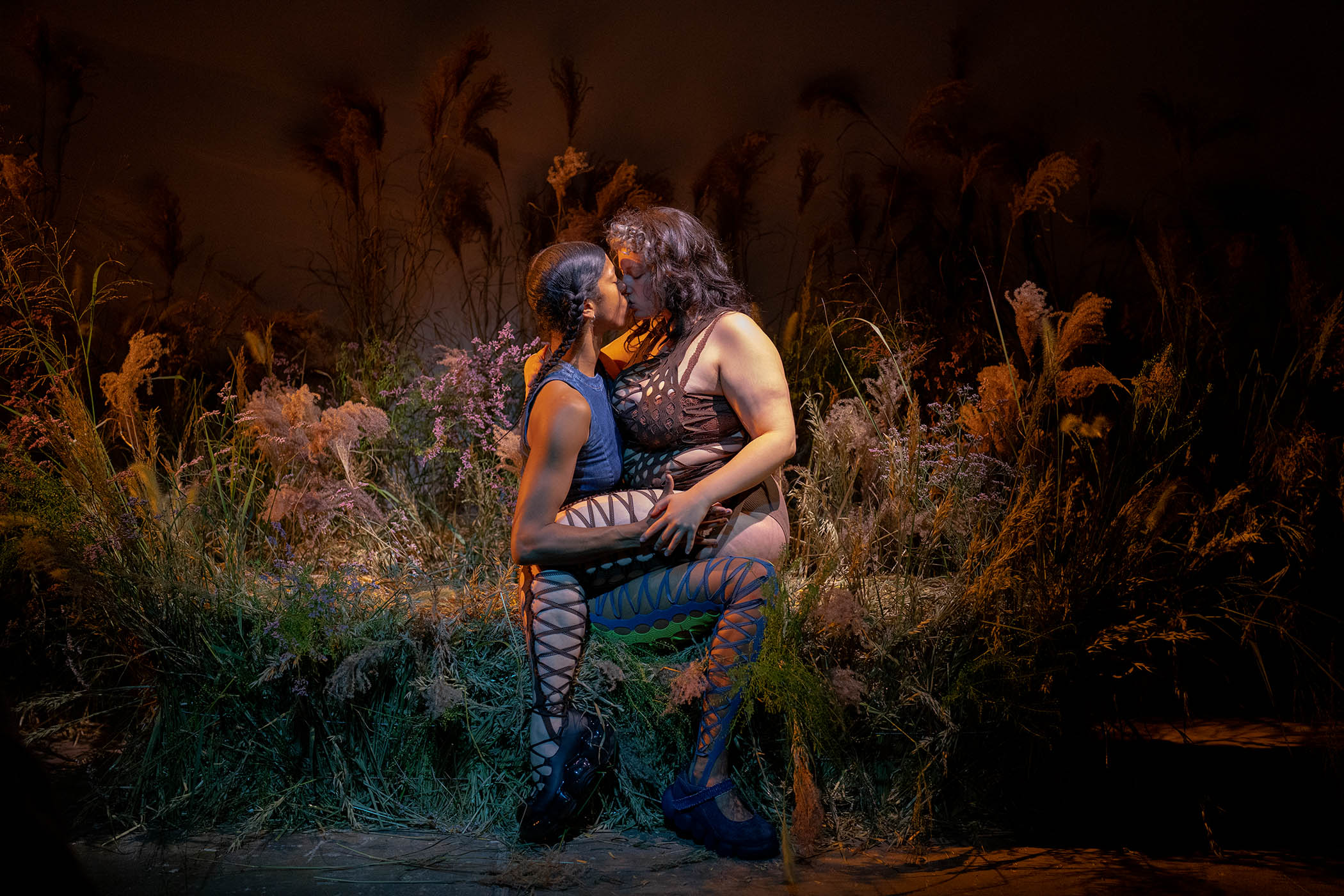
‘By designing for a variety of bodies, you’re coming up with new ideas’: O’Dwyer’s SS25 presentation for London Fashion Week
O’Dwyer believes this rigidly thin beauty ideal is engrained throughout the fashion industry. “I find it so wrong to only cut for one body,” she says. “Just by designing for a variety of bodies consistently you’re coming up with new ideas.” It’s a failure of the clothing industry, not our bodies, that designs don’t fit us, she says. “Luxury is seen as the highest level of design and clothing – but it has such a damaging effect, only being for one body. It’s unethical.”
Instead of a traditional fashion show for her SS24 collection she held a seminar at the Royal College of Art on the complexities of grading clothing (the process of sizing up a piece from the sample), highlighting how at fashion school fledgling designers are tasked with only creating for a size 8. For all the noise around body positivity, most clothing brands, from high-street to high-end, fail to produce larger sizes, and even when they do, retailers are slow to stock them.
Luxury has such a damaging effect when it’s only for one body. It’s unethical
Luxury has such a damaging effect when it’s only for one body. It’s unethical
“The entire brand proposition is uncommercial,” she says, of her own luxury label. Sampling pieces on a broader number of sizes is expensive, as is buying the increased variety of stock. “How will luxury be more inclusive in sizing without developing that customer?” Department store visitors above a size 16 don’t tend to haunt the womenswear floors because there’s little for them to buy. So even if a shop were to stock a few dresses at a larger size, they wouldn’t be found. “I’m interested in challenging the system,” O’Dywer says. “How can we make fashion more inclusive?”
O’Dwyer’s solution has been to develop her own community, with targeted pop-ups (in December she had a residency in Soho), as well as developing bespoke made-to-order and bridal offers, rather than trying to appeal to an obliterated wholesale market that isn’t interested in plus-sized clothing. “How the fashion industry affects people from so young is damaging… Even if they’re not someone who buys luxury, the trickle-down effect is enormous.”
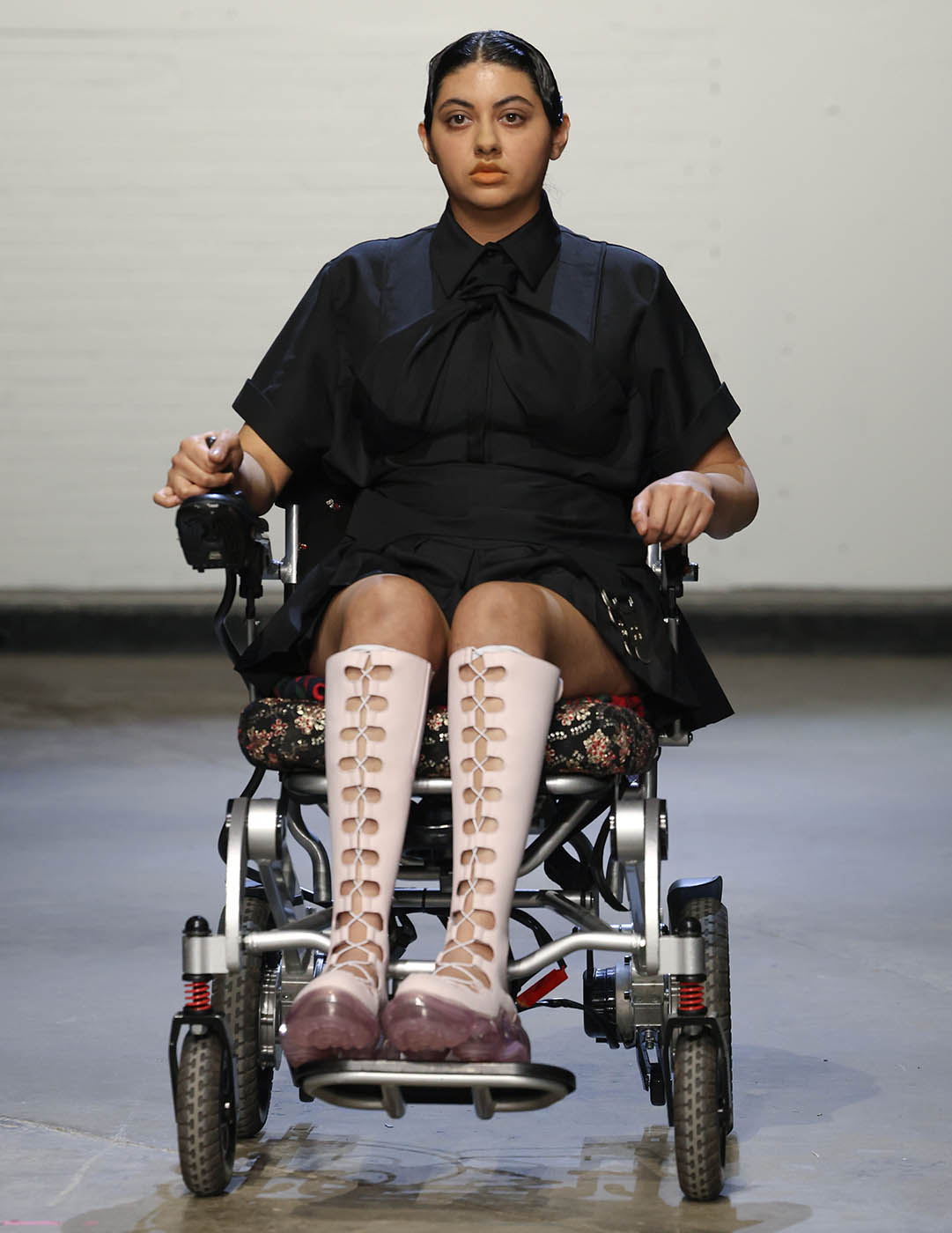
Shape of things to come… one look from the designer’s collection at London Fashion Week 2025
O’Dwyer was successfully accepted into the Sarabande programme on her second attempt. It offers art school scholarships, industry mentoring, and – crucially for O’Dwyer – heavily subsidised studio space. Conveniently, she lives just down the road from her new office, in Seven Sisters, with the photographer Ottilie Landmark, her wife of 10 years. Ten minutes from here is a factory she’s newly working with. “I’m figuring out the next stage,” she says. “The big part of Sarabande is that you can speak to people, reach out, be part of the community.”
The Sarabande support has come at a pivotal moment. The Irish designer has shown her agenda-flexing collections for the past three years at London Fashion Week as part of the British Fashion Council’s prestigious New Gen initiative, whose alumni include JW Anderson, Grace Wales Bonner and Alexander McQueen. And 2025 was a year of critical triumph for the 34-year-old: she was a semi-finalist at the coveted LVMH prize.
Behind us there are boxes filled with her recently launched underwear sets. Nursing a cold and sipping a vitamin-C drink, she’s feeling reflective, surrounded by the unpacked detritus of her fashion brand.
“I had an eating disorder for some years,” she explains. “For a long time I didn’t realise I had one, and that I was so incredibly obsessed. I was too young to really see it and challenge it.” It was while studying in the Netherlands at the ArtEZ University of the Arts, Arnhem, that she began to understand the impact of this. “My takeaway from my BA was being confronted with wanting to be thin enough to be one of the models that other students used, and to be perceived as beautiful. I went into the industry, which is when I realised the effect all of that had on me.” First, in New York working at Alexander Wang, then while completing her MA at the Royal Academy.
In 2018, instead of creating a graduation collection like her peers, she produced a series of silicone body casts, aimed at questioning why fashion didn’t cater to the undulations of women’s bodies and at its endemic, narrow representation.
“I’m very inspired by my mother and sister,” she says. Her mother, originally from Chicago, is a classical musician; her father is a sculptor and silversmith. Her grandmother taught her to knit and sew. “Before I started the brand, I was reflecting on things they would say about their bodies. How do you get to the point where you are so critical of yourself?” It’s an almost universal experience for women, she realised early on, “the process of not finding things that fit you, and putting that back on yourself thinking you were wrong.”
Some of O’Dwyer’s first designs were created for her sister. “She always wanted menswear shirts, but never found ones that worked and that was really frustrating.” O’Dwyer designed one differently, cutting “for a more curvy, three-dimensional body, so that the effortlessness of a straight line menswear shirt can work on someone with big boobs and hips.”
In November, she presented her autumn collection in a provocative show at London’s Barbican. Her sister, also a classical musician, played the viola, while fleshy bodies and orgiastic lesbians created sexually charged sapphic scenes.
The performers were cast as the archetype characters in uniforms which O’Dwyer has continually portrayed in her work: a school matron in a glossy leather cape; domestic workers in white shirting, cut around the body in panels and black mini dresses with crossed straps. Phones were banned to prevent it disseminating online into clickbait. It was the first time O’Dwyer watched one of her own shows.
“I’m always in the back panicking, but it was amazing witnessing it in the room. It was intense and provocative, but in a challenging way.” She pauses, then adds, “there’s a lot of two-dimensional sexy in fashion. It’s like ‘hot girl with a bum’. But this was actual connection, real desire.”
Photographs by Sam Deaman; Getty Images
Newsletters
Choose the newsletters you want to receive
View more
For information about how The Observer protects your data, read our Privacy Policy