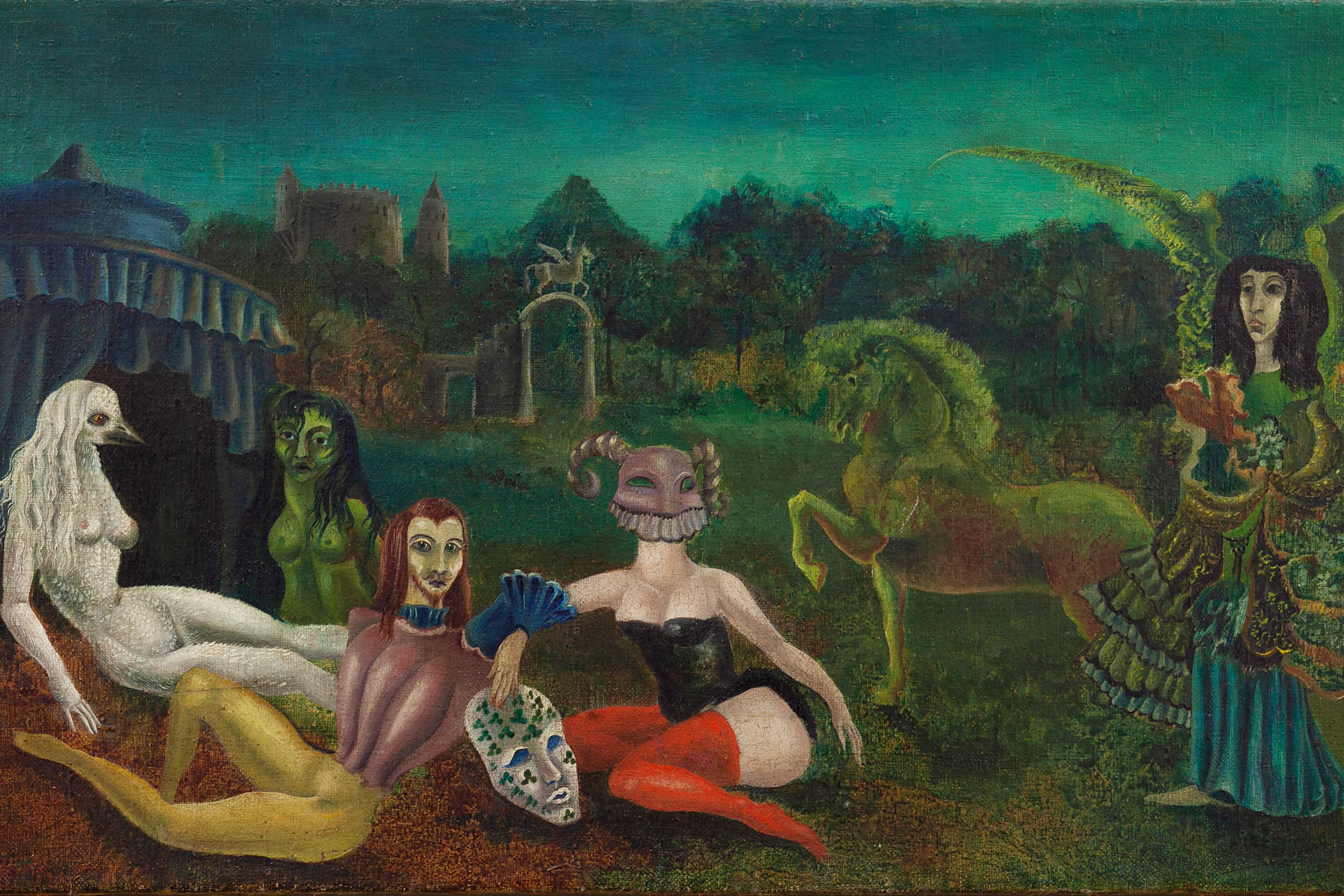

Notebook pages filled with fantastical imagery by the surrealist painter Leonora Carrington while she suffered an episode of mental illness have been gathered together for an exhibition in London next month.
The drawings were made by the Lancashire-born artist during her treatment in a Spanish sanatorium in 1940. They feature her trademark mythological figures but also set out a vision of the Santander hospital as a dreamlike underground world inhabited by horses and full of symbols drawn from alchemy and tarot.
Among the works to be displayed in the exhibition at the Freud Museum, which is housed in the former home of Sigmund Freud, will be Carrington’s major painting Down Below. It depicts a group of hybrid human-animal inmates in the same underworld terrain and will be on show in Britain for the first time.
The reassembled notebooks are now owned by private collectors across the world, and when placed alongside each other reveal the detail of a subterranean world created by the 23-year-old artist.
“In this work produced during the second world war, Carrington gives form to her psychological crises through alchemical symbolism, animal surrogates and underworld mythologies,” said Vanessa Boni, curator of special projects at the museum.
Carrington spent four months in the sanatorium after she escaped from France, where she had been living with the German artist Max Ernst. She fled the country when Ernst was interned by the Nazi regime, but once she reached Spain she experienced a rapid psychological disintegration. In the hospital she was subjected to a strict regime but also encouraged to make daily drawings.
When the artist, who later settled in Mexico, first left the sanatorium she travelled to New York, where she met fellow exiled surrealist painters. While there she gave her sketchbooks to the art dealer Julien Levy, who kept them for 60 years until they were sold off individually at auction in 2004.
Photograph by Estate of Leonora Carrington/ARS, NY and DACS, London
Newsletters
Choose the newsletters you want to receive
View more
For information about how The Observer protects your data, read our Privacy Policy