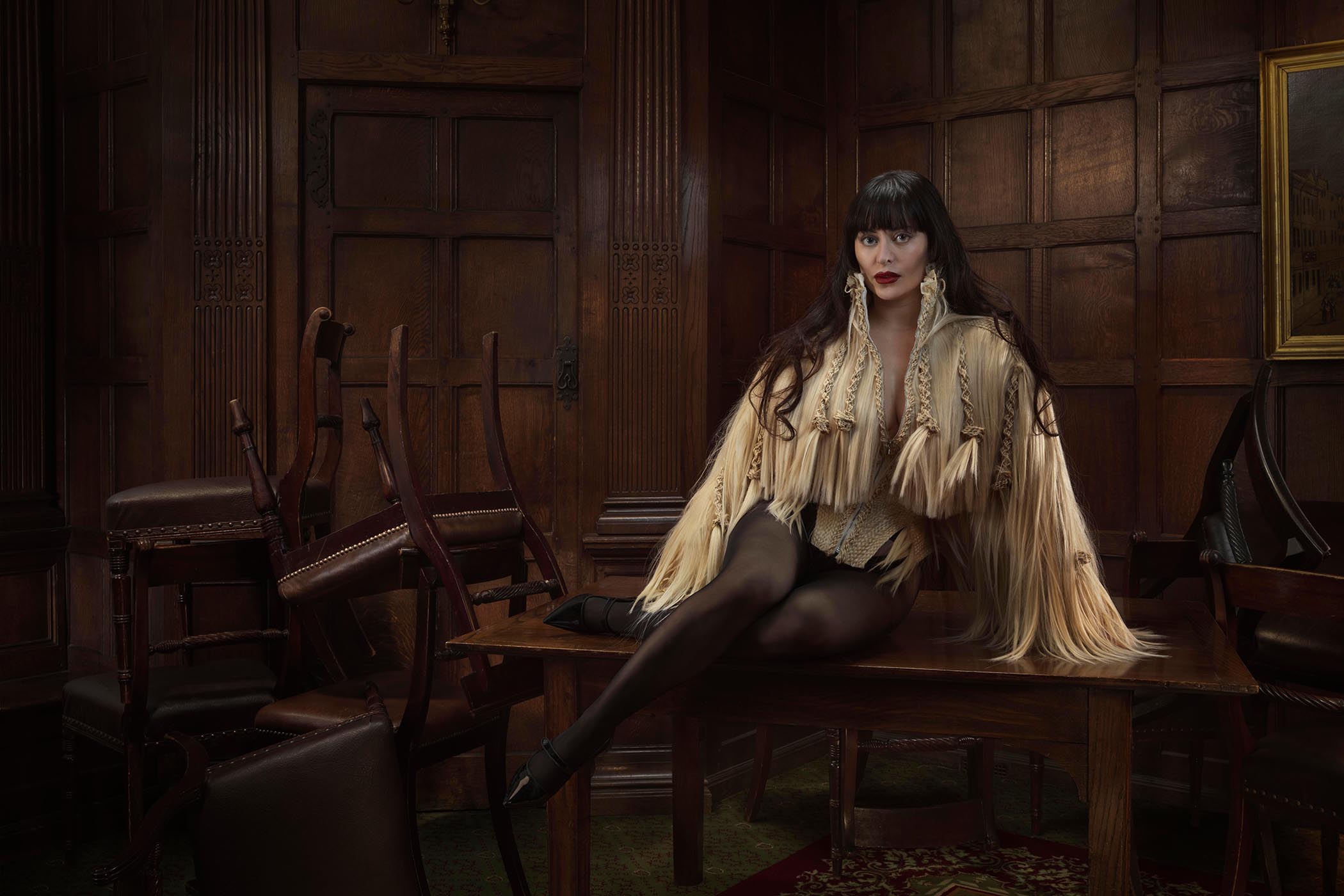

The fashion designer Dilara Findikoglu was sitting by the lake at London’s Barbican Centre on an overcast afternoon, watching a line of workers in waders comb weeds from the water. Their presence disrupted the illusion of the water’s depth: the teal surface – dyed, it turns out, to hide the lake’s shallowness – reached no higher than their knees. Findikoglu was wearing a white fur coat and opaque Celine sunglasses. Her black velvet trousers, slung with a big, silver belt, were neatly tucked into a pair of knee-high mock-croc Vivienne Westwood boots: an ensemble pitched somewhere between pirate and Old Hollywood expat. She was eating from a bag of pretzels, breaking each one into small, mouse-sized bites.
“I’m in my peace era,” she announced, the words at once slightly self-mocking and deadly sincere.
It was a jarringly temperate day in November: sullen skies at odds with the warm breeze. Findikoglu was telling me about her most recent show, staged around the corner at Ironmongers’ Hall during September’s London Fashion Week. Home to the Worshipful Company of Ironmongers (founded in 1463, it is one of the city’s 113 guilds), the building is a warren of wood panelling and thick carpets, dimly illuminated by stained-glass windows and chandeliers. But in September it was briefly transformed into an outpost of Dilara World. Naomi Campbell moved through the gloom in a snakeskin-embossed black dress, tears rolling down her cheeks. Another model appeared with a horse bit between her teeth; yet another wore a gown studded with rotting cherries fashioned from silicone, the fabric blotched pink beneath. The show, titled Cage of Innocence, was framed as an exorcism: a rejection of “the expectation of purity” placed upon women, and an attempt, as per the press release, to “give voice to the women of the past who were denied their own”. Outside, the venue was mobbed, drawing crowds in a way that contemporary fashion shows rarely achieve. Those that weren’t assigned a seat flocked to a nearby pub, which live-streamed the catwalk to a noisy audience.
Nearly a decade into her label, the Turkish-born, London-based designer has achieved something rare: an independent brand recognisable enough to be mononymous. To wear Dilara is to join the ranks of Kim Kardashian, Rosalía, Cate Blanchett, Lady Gaga, Charli xcx, Rihanna, Cardi B and others attracted to her mix of exacting construction and confrontational femininity. As Julia Fox, one of her most devoted wearers, told me, “Dilara is a once-in-a-lifetime kind of artist – you can feel the blood, sweat and tears woven into every piece.” Her clothes aren’t conventionally sexy, though they draw on fetish staples (corseting, leather) and toy with erogenous zones (cleavage, hipbone, lower back). They are gothic without veering into Halloween-hokey, Victoriana with all the appropriate undercurrents of repression, sadism and romanticism.
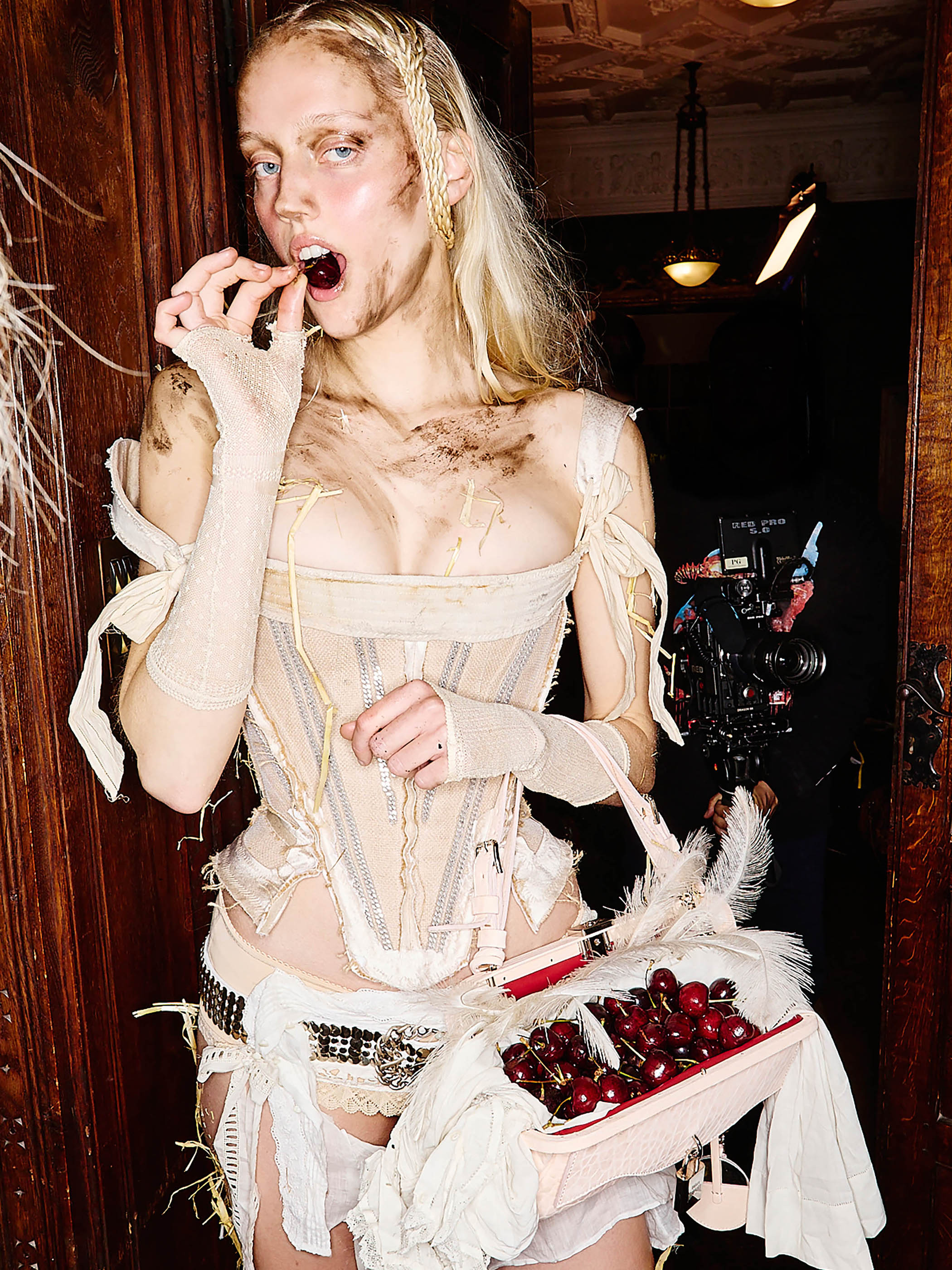
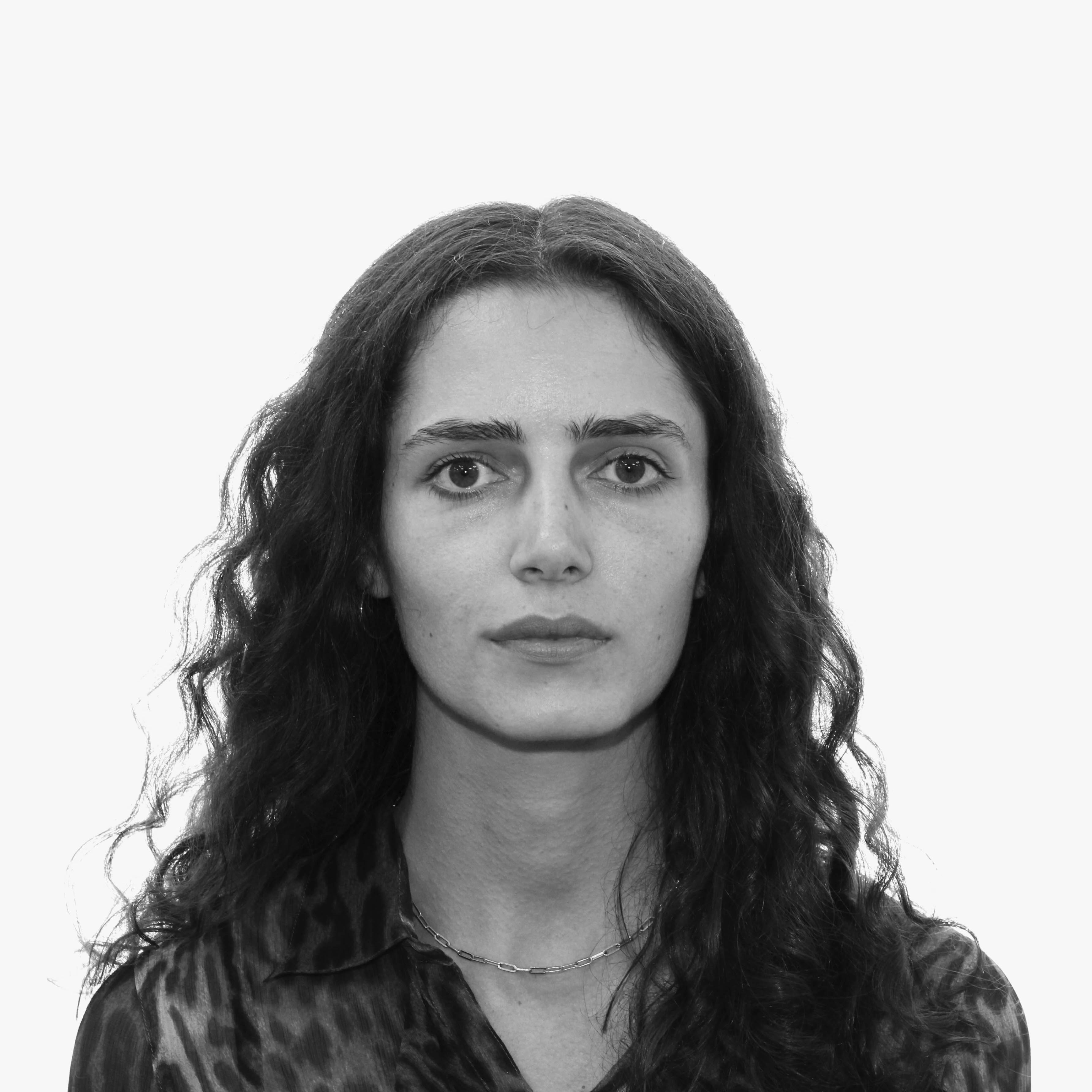
‘We all have insecurities, we’re all human’: a model wearing a look from the Dilara SS26 collection
In person she embodies a similar blend of sharpness and raw-edged candour. Mention of her recent designs immediately expanded into the emotional logic behind each collection. Her previous one, Venus from Chaos, was an attempt to “leave the chaos” of her life behind, she told me; Cage of Innocence was conceived to shed what she calls “ancestral trauma”, the shame and guilt that she felt when acknowledging the ghosts of previous generations of women, constrained by gender and circumstance, hovering at her shoulder.
Findikoglu was raised in Istanbul, subject to what she describes as a “very protective” home life. Her father was a Bulgarian immigrant who ran an opticals factory. And her wider family, from Anatolia, maintained a strict set of expectations that she instinctively chafed against. “I learned to be a woman from a man,” she told me. “All of the women around me didn’t have freedom. I was taking my example from how men worked, how they did their businesses.” Her childhood, as she narrates it, was defined by dissonance. “Since I was, like, one year old, when I couldn’t even speak, I was drawing. I would dress up,” she said. For her, clothing – both the making and the wearing – was a route towards autonomy. “Every day, every night, I would dream about being a famous fashion designer,” she said. She believed she was destined for something bigger not by fate but bloody-minded will. “Not being heard and not being listened to in a traditional family in Turkey, I grew up thinking, ‘I’m going to have more freedom than any of you guys. I’m going to have more money, more power, more more more.’ It was almost this weird rage.”
During our time together, this idea of anger and alienation ebbed and flowed. “I was a very, very rebellious kid,” she told me, when asked to describe her adolescence. “I got my first tattoo when I was 14 and wouldn’t listen to anyone. I wore the shortest skirts at school.” She gravitated towards “controversial things”: reading about serial killers, seeking anything that sat outside the lines. Around the same time that she had her first tattoo, she picked up a copy of Turkish Marie Claire and learned that John Galliano had studied at Central Saint Martins. From that point on, all her energy was focused on treading the same path. She prepared a portfolio, applied, was rejected, reapplied, and got in. Once in London, she maintained her stubborn tunnel vision. “Probably a lot of people found me really arrogant,” she told me, “because I would party for three days over the weekend and then still go to uni and do the project in my own way.” The rage didn’t dissipate once she had graduated. “I think I was a teenager until I was about 30.”
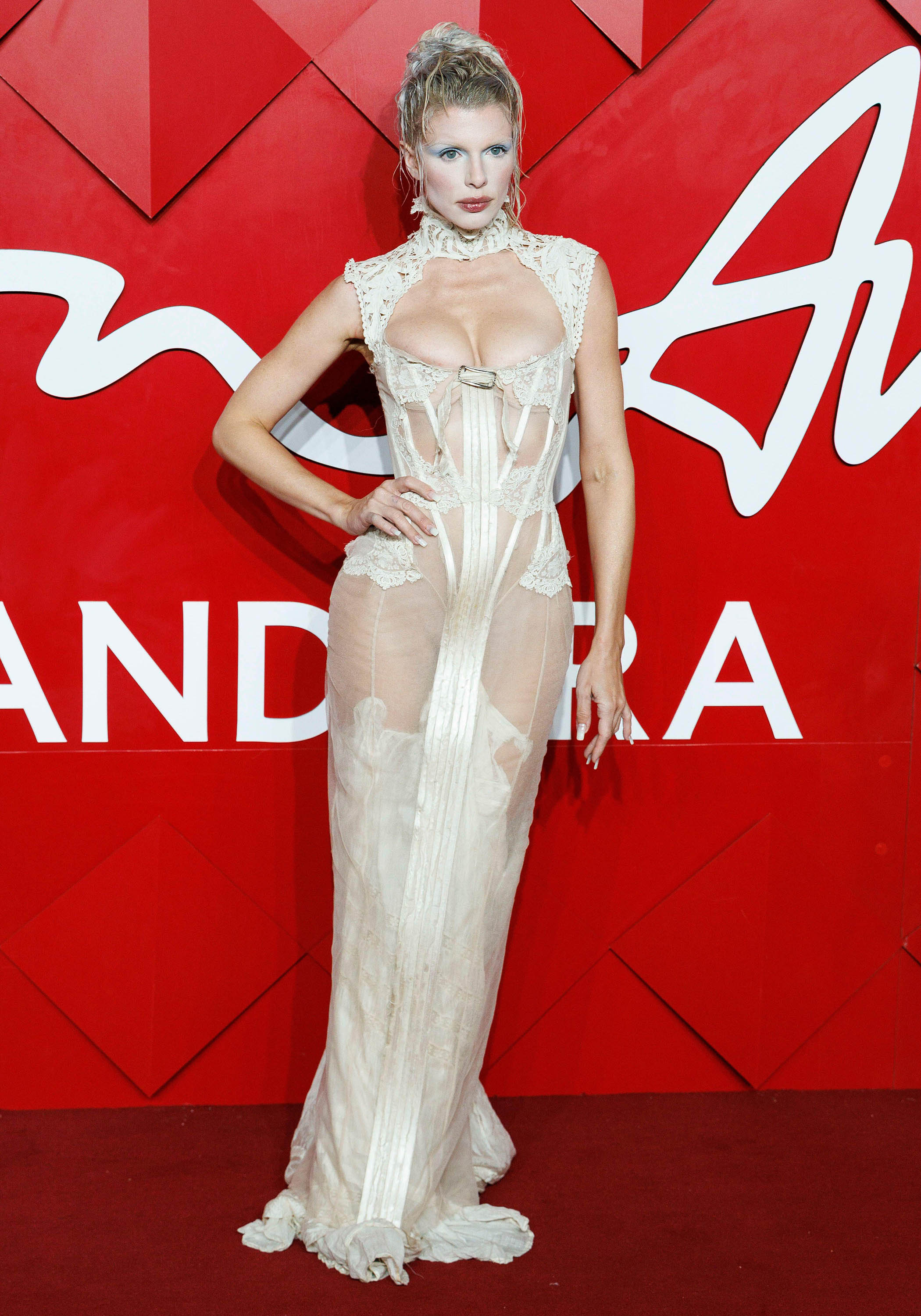
Julia Fox wears Dilara to the Fashion Awards at the Royal Albert Hall in London on 2 December 2024
She turned and looked at me. “I’m really happy that all of these things happened,” she said, voice resolute. “It made me push harder.”
Findikoglu talks quickly and emphatically. She is unembarrassed and occasionally self-lacerating when describing her trajectory. She is, by her own account, “insanely ambitious” – a relentless perfectionist who, in pouring everything into her work, cannot help but take it personally when criticism arises. “I gave everything to a point where I made myself ill,” she said of the last collection. “It’s impossible to not care.”
Her design process begins with a feeling. She names each garment she works on, fleshing out a backstory around the form. Up close, the level of attention to detail is staggering: intricate arrangements of shells and feathers, painstakingly tattooed leather, gowns armoured in Victorian cutlery. In her work the body is not just something to mould and distort but to protect. Like Alexander McQueen, who told American Vogue in 1997 that “I want people to be afraid of the women I dress,” her clothes offer a related kind of untouchability, no matter how much is being exposed.
Newsletters
Choose the newsletters you want to receive
View more
For information about how The Observer protects your data, read our Privacy Policy
‘Blood, sweat and tears are woven into every piece’
‘Blood, sweat and tears are woven into every piece’
Julia Fox on Dilara
Sometimes fairly and sometimes lazily, McQueen is the designer Findikoglu is most often compared with. Not so much for aesthetic reasons, though there is a shared love of theatrics and an obsessive fidelity to material process, but for a philosophical affinity. Like McQueen, Findikoglu approaches fashion less as a site of fantasy and more as a battleground for taking on how women are seen and what they are subjected to. She digs deep into both personal history and the collective cultural psyche to surface ugliness and violence as well as exquisite beauty. The erotic and the macabre are in constant conversation, control always vying with release.
But where McQueen operated at a remove from his work – ever-present but not personified – Findikoglu does the opposite. She is both designer and avatar, the living centre of her brand’s mythology, her own best muse, complete with long black hair and vampy red lips. Her methods, in their narrative intensity and commitment to sartorial world-building, are redolent of an earlier fashion era. Julia Fox described attending Findikoglu’s last London show as “stepping back into a moment I thought the fashion world had lost, when designers were rockstars.”
But designers today are operating in a changed landscape. In 2023, Findikoglu announced she couldn’t afford to stage a show without amounting enormous debt. When I asked her how it feels to be running an independent label in London now, she pulled a face. “I think I should not speak about that because I’m going to break some hearts,” she said. “I’m trying to be more diplomatic.” She paused. “Let’s not get into politics. Everyone expects me to speak up first, but then I’ll be on my own because no one will follow. Whatever I’m thinking, everyone thinks the same. They just don’t have the balls to say it.”
Findikoglu’s reality remains stark: a small studio, no investor, a team that relies on her decisiveness. Some of her most visible successes – famous clients, extensive social media coverage – mask the precariousness beneath. But running the show, in every sense, is also her preference. “If you want to wear me, you have to let me control hair, makeup, styling, everything,” she explained, when I asked her about her approach to celebrity dressing. “People actually love that. They really trust me.” She admires those willing to submit to the full vision. “I love all the women who have the courage to wear Dilara – and kill it.”
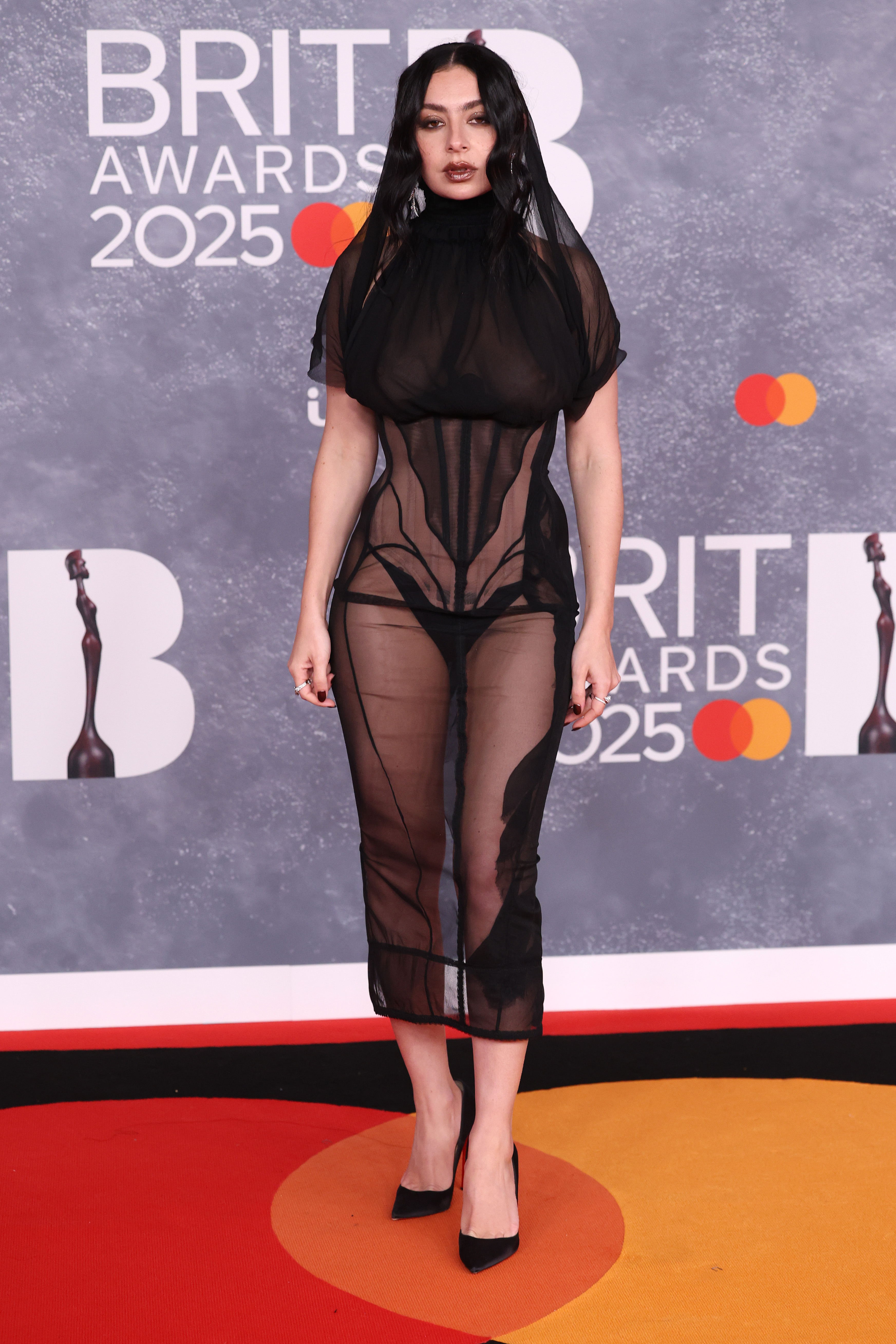
Charli XCX attends The BRIT Awards 2025 at Intercontinental Hotel on March 01, 2025 in London, England.
The respect is mutual. The actor Chloë Sevigny, who wore a custom gown by Findikoglu to 2024’s Met Gala, told me, “I first met her when she came to NYC to dress me and I was instantly struck by her and wanted to revel in her forever.” Made from deconstructed Victorian bodices and skirts, the dress, in its patchwork splicing and visible decay, was more elegiac than many of the other outfits that ignored the night’s theme, based on a JG Ballard short story. “Her charm, her intellect, her talents, her loyalty and ferocity are admirable and goal worthy,” Sevigny said. “Her fingers spin drama and dreams.”
When I asked her to expand on her relationship with these women, Findikoglu described them as something like conduits. “What I weave into the clothes definitely has some kind of magic,” she said. “Not witchcraft. But all the ideas I have, all the things I want to change about the world. It’s going to imprint in them.” She said of Kim Kardashian, who she has worked closely with, most recently on a series of looks for the Skims founder’s 45th birthday, “it’s from a woman to a woman doing whatever the fuck she wants. She’s almost a channel for me to spread that message.” During our time together I tried to pin down this message several times. She alternately characterised it as a form of self-actualisation, an expression of female agency, an attempt to create a better reality, and an antidote to the horrors of society. “It’s almost like stardust,” she said. “When I dress these amazing women, it just explodes.”
Still, she wanted to be very clear that there was nothing more nefarious at play. Two weeks after the show, still depleted, she had dinner with Marina Abramović. She asked the artist how she coped with being called a witch, Findikoglu’s gothic aesthetic and outré shows having often led to accusations of Satanism. Abramović’s advice was succinct: “Listen to yourself, believe in yourself. You know your truth.” Kardashian had offered similar guidance when asked about how she copes with being in the public eye: it’s hard to not care, but you have to just let it go.
The month after we met, other rumours erupted. In the wake of Findikoglu receiving the British Fashion Council’s Vanguard Award, in December, Fashionista published a report alleging that unpaid interns had worked 16-hour days and, at times, covered materials costs themselves, among other things. When I asked her about it, Findikoglu called the claims “false and defamatory,” describing them as based on “a small number of anonymous posts on social media that date back to some time ago”. She said the experience had been “very stressful and upsetting,” citing a burst of “vile” online toxicity and noting that the matter had “gone legal.”
In fashion, where long hours, unpaid labour and blurred boundaries have been industry norms for decades, allegations like these tend to surface in cycles – and attach themselves unevenly. It is a system that often incentivises overwork while placing the moral burden on individuals, especially those pursuing exacting standards with limited resources, rather than the surrounding structures that make such pressures routine.
In the meantime, Findikoglu is forging forward. During our meeting she told me she has a healer, and that she was doing acupuncture. She’s reading Hélène Cixous, Emily Brontë (“If I could do costumes for a movie, that’s my dream”) and Nikola Tesla (“He’s not like other scientists – he works with the spirit as well, and the human body and mind.”) She is trying, in her own words, to become “more high frequency”.
It’s easy to render designers as stock types: the severe minimalist, the scruffy workaholic in jeans, the larger-than-life character. But Findikoglu’s particular alchemy comes from this mix of high drama and emotional transparency, a combination that can look excessive until you see how it animates the work. “We all have insecurities, we’re all human,” she insisted. What frustrates her about designers’ retrospectives is how rarely they acknowledge this. “None of them talk about the ups and downs. I want to know what the fuck the designer was feeling!”
Given the challenges of working independently, could she envisage being a creative director at a bigger label? She laughed. “I’m so open to any offers, obviously, if it aligns with what I want to do.” She was delighted by the recent news that British designer Grace Wales Bonner had been appointed as men’s creative director at Hermès. “It gave me hope about the future of fashion.” Equally, she backs herself as having a vision big enough to expand to a larger brand. “I feel like right now, my ideas as a young woman really align with the world. I speak the language of now – the zeitgeist.”
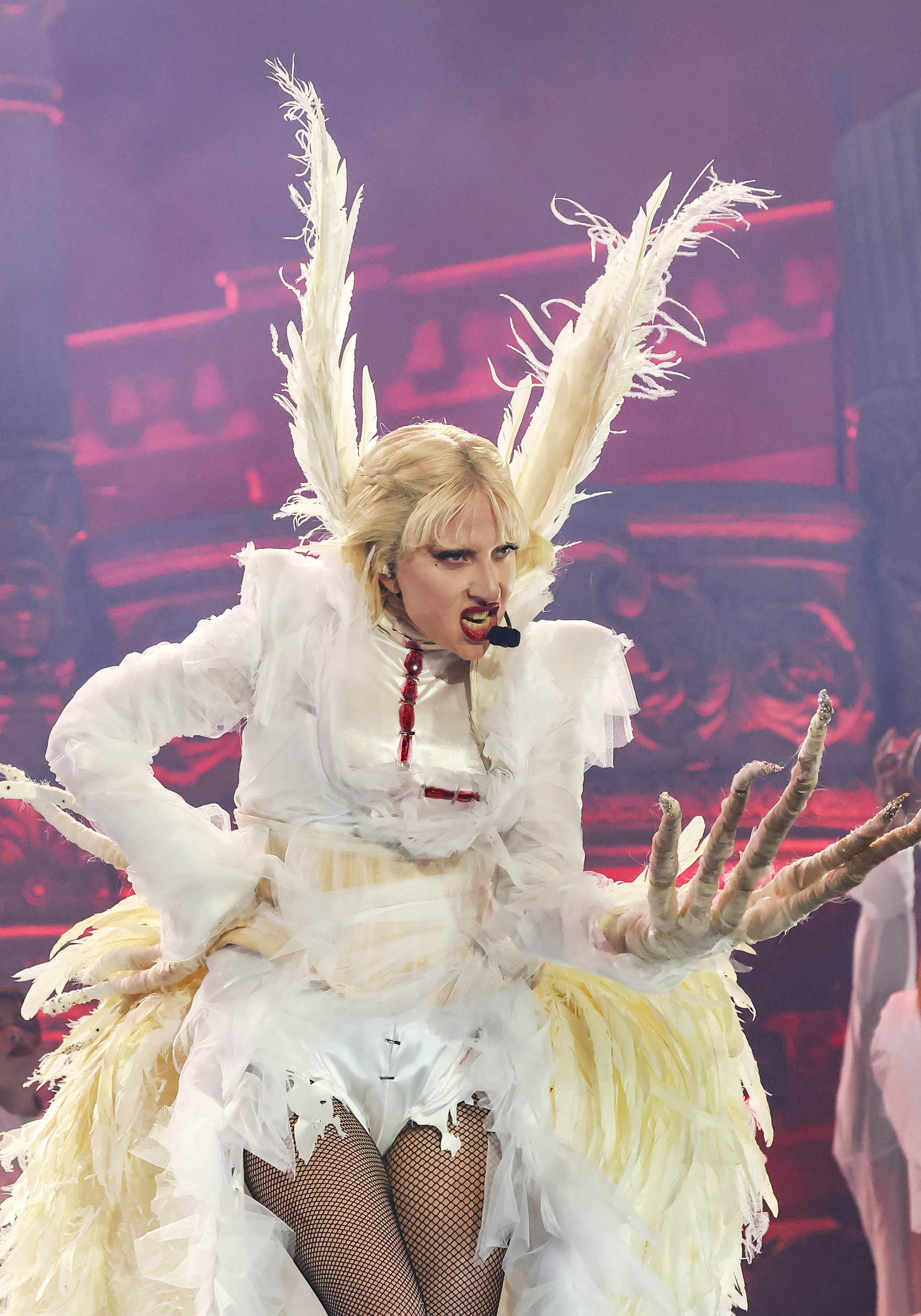
Lady Gaga wears Dilara to perform at Coachella in California on 11 April 2025
The zeitgeist is a thrilling and also uncertain place to be. It is the crest of the wave: high risk, high reward; a place of great momentum that requires skilful navigation. Success in the fashion world means moving with the times, but never falling behind them, creating something singular without letting it grow stale. But Findikoglu was adamant that the horizon could only grow. “I hope that one day I can see a technology where I can build a world and people can dial in. I don’t know, like VR sunglasses, but super-futurist, full-scale Dilara.”
As our time drew to a close, I mentioned how much I loved one of her designs: Joan’s Knives, a cutlery-embellished dress inspired by Joan of Arc. Which other women from history would she have liked to dress? I asked. “Queen Elizabeth I,” she answered without hesitation. “The Virgin Queen. I used to wax my forehead when I was a teenager to make it big and dye my hair ginger so I could be like her.” Marlene Dietrich was on the list, too. And she’s still angling to get Abramović into her one of her designs. “Imagine the three of them here having dinner on the same table.”
The workers were still in the lake, cutting slow arcs through the teal water. Findikoglu pulled her fur tighter and said she was off to find lunch before visiting the Barbican’s Dirty Looks exhibition, where one of her pieces was installed. As we walked back towards the concrete terraces, she cast a final look at the lake – a pool tinted to appear deeper than it is, its surface endlessly tended. Fashion has always lived in the tension between depth and display. We tend to retrospectively reward those designers who dredge deep, whatever the cost to themselves or others. We love the vision, the spectacle, the sense that someone is willing to go further than the waterline. But it’s one thing to push the limits, and another to keep the show going. Findikoglu, for now, seems determined to keep wading.
Main image: makeup by Anne Sophie Costa using MAC Cosmetics; hair by Claire Moore using Christophe Robin.
Photographs by Julia Fullerton Batten, Sonny Photos, Getty images, Wireimage, Alamy