If money and power were the only determinants of popularity, Melania, the $75m documentary gift from Jeff Bezos to America’s first lady, would have romped home at the box office. As it was, its opening week was overshadowed by a low-budget horror film made by the cult YouTuber Markiplier.
Melania grossed just under $11m in its first week, whereas Iron Lung, based on a 2022 video game by developer David Szymanski, was self-financed by Markiplier for less than $3m, and returned almost $25m.
Those kind of numbers won’t go unnoticed in Hollywood, nor will the producer-director-writer’s stripped-down working process. Shot in a moody, post-apocalyptic sci-fi style, the film’s design and themes may borrow heavily from the aesthetic of the Alien franchise, but as a lean, mean project, it pushes the definition of “independent” filmmaking.
Ask most people aged over 40, and they would probably guess that Markiplier is some kind of stationery tool. Yet to a generation of gamers, he has been a major figure for some years, as is indicated by his 38.3 million YouTube subscribers. His online following alone generated enough advance interest to persuade cinema chains to book the film.
Iron Lung’s high yield on investment is bound to send studios, agents and distributors searching the online world for untapped talent. The old romantic route to American film fame once meant heading west to Hollywood. While much about Markiplier – real name Mark Fischbach – is novel, his trajectory followed that same geographical pull.
He left his hometown of Cincinnati 12 years ago because, as he later told Variety, “Pretty much all the opportunities I was getting were out here [in LA].” Back in Ohio he had already made a name for himself in the gaming world with his “Let’s Play” videos – a curated genre of inventive or irreverent commentary to accompany the progress of a video game. His first upload featured the survival horror game Five Nights at Freddy’s, which remains his most watched Let’s Play with 127 million views.
“In the 1970s, 80s and 90s teenagers wanted to become rock stars,” says the writer Simon Parkin, host of My Perfect Console podcast. “These days, young people typically want to become a streamer, playing games for audiences. It offers internet fame and an attainable way to riches.”
For Fischbach that desire became suddenly irresistible after a series of personal crises. After dropping out of a biomedical engineering degree at the University of Cincinnati, he lost his filler job, broke up with his girlfriend, was chucked out of his mother’s house and was admitted to hospital for an emergency appendectomy –during which doctors discovered a tumour on his adrenal gland.
“Loss or pain really paints a picture of what you need to do,” he later told his fellow YouTuber, Anthony Padilla.
With his DJ-like voice and upbeat collegial manner, Fischbach quickly gained traction online. In LA he expanded into making more ambitious sketch videos. Among his collaborators was his girlfriend, Amy Nelson, whom he met on Tinder. The couple married last year after a 10-year relationship, their romance having been well documented by the couple on Instagram.
Newsletters
Choose the newsletters you want to receive
View more
For information about how The Observer protects your data, read our Privacy Policy
It was just one of the many platforms on which Fischbach made known his personality. Over time, he has diversified into a near-constant stream of content. “There’s so much I do that I put out there,” he once said, acknowledging the toll on his social life. The potential problem of online self-invention is clear: out there is infinite, but the self is not.
His relentless work ethic echoes a modern version of the American Dream
His relentless work ethic echoes a modern version of the American Dream
“There’s a lot of burnout,” says Parkin. “With platforms like Instagram and TikTok there is a pressure to post daily and there is an arms race in production values, which keep going up.” Fischbach’s relentless work ethic echoes a modern version of the American Dream, though many have taken similar roads without the same results, ending up broke in obscurity.
In 2015 Markiplier was living with fellow YouTubers Daniel Kyre and Ryan Magee, who ran a comedy-sketch channel called Cyndago, when Kyre took his own life. Fischbach posted an emotional eight-minute video and then went offline. Upon returning a month later, he reflected further on his memories of his friend, and soon after reached 10 million subscribers.
His Stakhanovite workload – writing, directing, producing, editing, acting, co-founding a clothing line alongside podcasting and stints on the board of a comic book publisher – meant that he took almost three years to make Iron Lung, which he worked on at weekends. Fischbach’s success reflects determination as much as fortune.
Born in Honolulu, Fischbach, who turns 37 in June, is the son of a German-American military officer who met Fischbach’s mother, Sunok Frank, while stationed in South Korea. Sunok’s father was a North Korean refugee, a fact that inspired Fischbach’s 2022 documentary, Markiplier from North Korea.
Bullied as a child for being half-Korean, Fischbach felt ashamed of his heritage in his youth. All that changed with the mass fanbase he built online, a homemade celebrity that would have been unimaginable before the age of the internet. Today he embraces his part-Korean identity with pride.
Parkin notes that collaborations with creators such as Ethan Nestor and PewDiePie helped expand his reach – a mutually beneficial strategy common in the online world. From early on in his ascent, however, he had his eyes fixed on Hollywood. “I want to push myself into music and acting – more traditional media stuff,” he said in 2016, adding that he was seeking to develop the “skill set” to appear in a feature film.
But if brilliant careers are there to be forged online, what need is there of recognition from a supposedly dying medium?
“Cinema and broadcast television have a lot of prestige baked in,” explains Quintin Smith, a British YouTuber and videographer. It’s no surprise, says Smith, that someone who is highly successful in a newer medium should want access to that more established status, particularly if they have developed the required skills and know-how to attract an audience.
Mainstream attention that is now focused on Fischbach also confers a kind of reflected glory on his fellow YouTubers.
“I woke up smiling when I heard the news about Iron Lung’s box office performance,” says Smith. “I thought, this is good for all of us.”
Parkin agrees that it’s a breakthrough moment as part of a broader shift already underway.
“You had KSI [the British social media influencer] on Michael McIntyre recently,” he says. “Film and TV want the young audiences these characters attract. They bring a much larger following than, say, some stand-up comic who’s just appeared at the Edinburgh festival.”
Until now, the stars that have emerged from online platforms to gain wider recognition – the likes of the Paul brothers, Logan and Jake, who are sportsmen and influencers – have tended to be characterised more by their abilities as self-publicists than as creative artists. While Fischbach, or Markiplier as he is destined to remain, is no shrinking violet in the attention-grabbing stakes, he obviously has other talents too. Perhaps even the subject of Melania – if not her husband – might concede that much.
Mark Edward Fischbach, aka Markiplier
Born Honolulu, Hawaii
Work YouTuber, filmmaker amongst other pursuits
Family Married to Amy Nelson
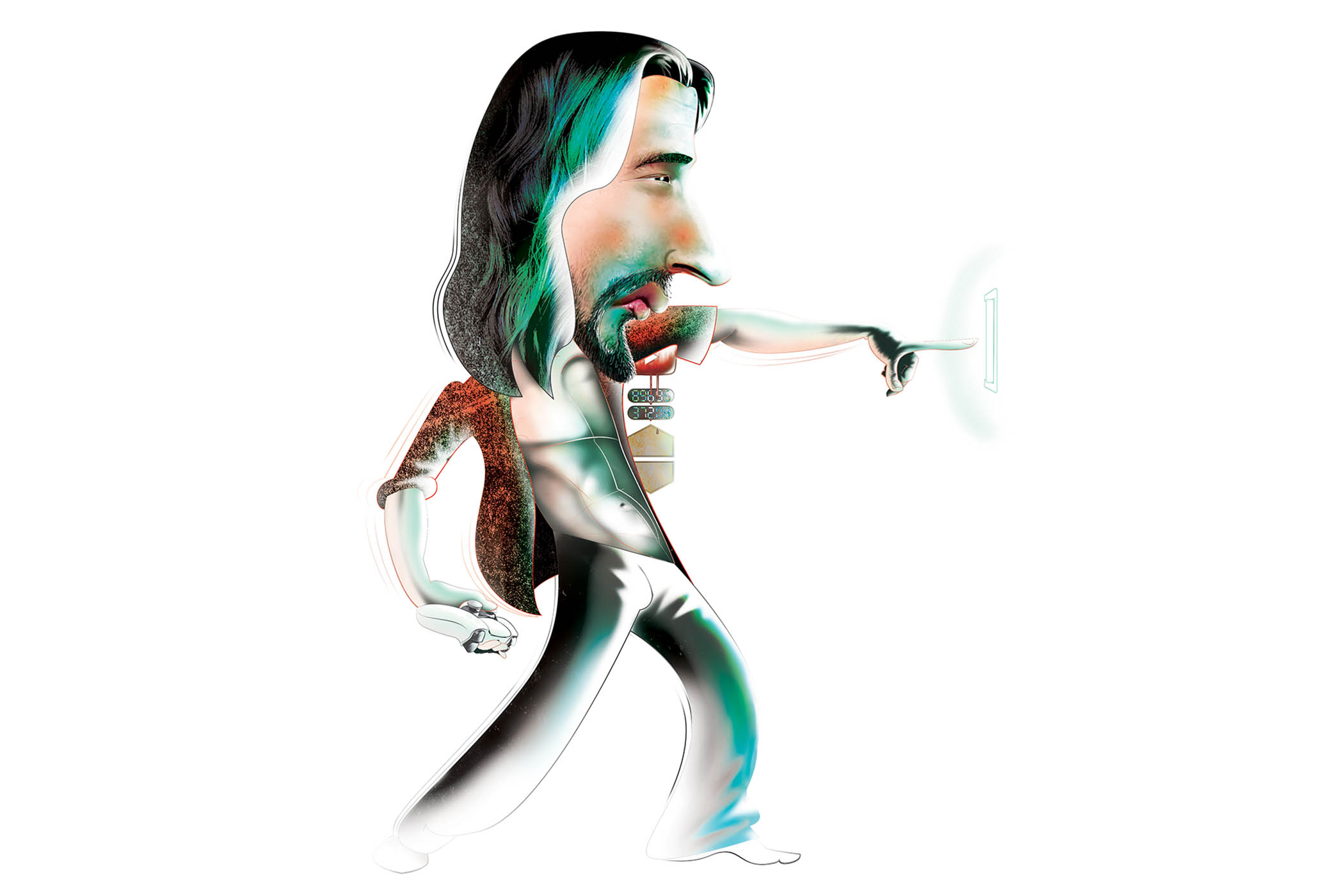
Illustration by Andy Bunday