


In spring last year, the Swedish actor Alexander Skarsgård appeared on ITV’s breakfast show Lorraine in a beige Harrington jacket, white socks, and a pair of tailored shorts so brief that when Skarsgård crossed his legs during the interview, viewers could see almost all of his thighs. Skarsgård was on the promotion trail. His then most recent project, Pillion, a romping tale of gay lust – a “dom com,” in the parlance – had required Skarsgård to do the publicity rounds, and Lorraine was but one stop on his tour. On the programme, Lorraine’s stand-in host, Ranvir Singh, seemed both lightly amused and faintly perplexed by her guest’s outfit. “You’ve got your legs out,” she said, five minutes in. Skarsgård shrugged. “I wanted to be sexy today,” he said. “And there’s nothing sexier than a middle-aged man in a British schoolboy uniform.” When Singh requested he stand up, to better show viewers his look, he performed a kind of curtsy – an action that went viral.
It wasn’t the first time a Skarsgård ensemble had caught the public eye. Over the past year, he has been photographed wearing outfits the fashion industry might label progressive and which you or I might describe, kindly, as unconventional. At Cannes, he wore thigh-high leather boots by the luxury fashion house Saint Laurent; to the London Film Festival he wore leather trousers, a leather tie and a backless halter-neck shirt by the same brand. So long as your algorithm has been fed keywords like “celebrity”, “short shorts” and, I suppose, “dom”, as mine seemingly has, social media is filled with Skarsgård looks. There was a three-week period last October during which I could not escape pictures of the actor wearing leather, which I found to be a not unpleasant experience.
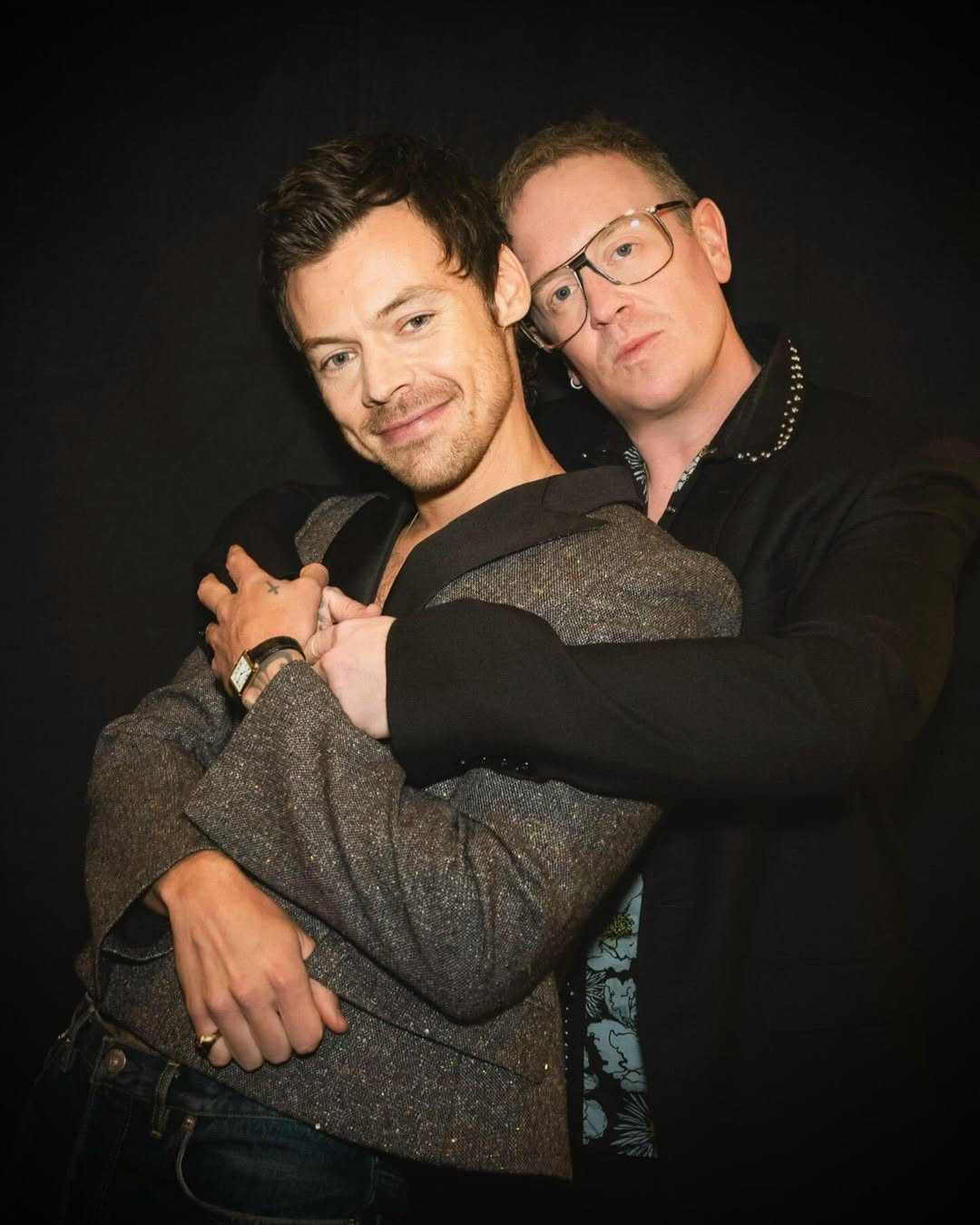
Styles gurus: Styles and Lambert last month
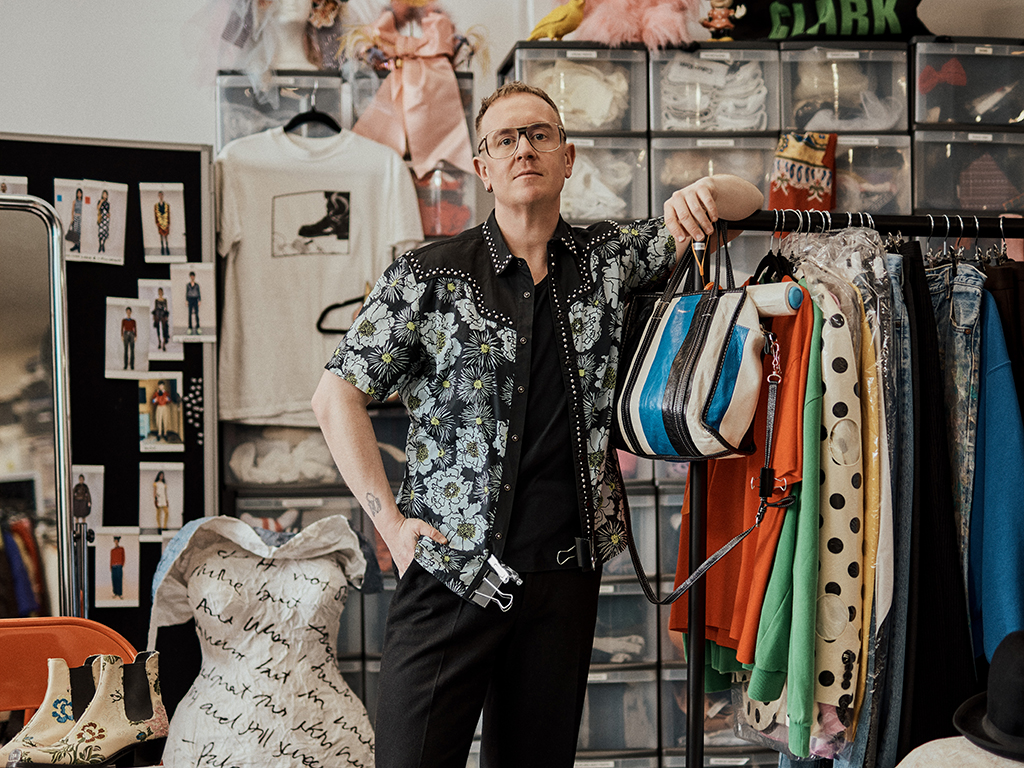
Skarsgård’s outfits were devised by the British stylist Harry Lambert, who has more than half a million followers on Instagram, and who, as the fashion world has become increasingly interesting to so many people, has become a celebrity in his own right. “I would say my job has evolved,” Lambert told me recently, discussing his newly high-profile status. “I don’t know if you’d call it influencing…” We were meeting at his studio, a white-walled space in east London that is filled with memorabilia: Polaroids of models and famous people; photographs of Lambert with his team; various brightly coloured curiosities; rails and rails of clothes. The studio has the feel of a pre-adolescent’s bedroom; during my visit, I counted at least five Labubus. “This is my desk,” Lambert said, taking me on a tour, and pointing at a heap of knick-knacks. “It’s all crap. I mean, it’s not crap, exactly, but…”
Lambert is best known for being Harry Styles’s stylist, a job he’s had since 2014, when Styles was still touring with the pop group One Direction. Lambert first met Styles in a Mexican restaurant in Shoreditch, they had been introduced by a mutual friend. Styles was on the lookout for a new identity, and Lambert and one other stylist were asked to pitch for the gig, in what Lambert described to me as “a style-off”. During their second meeting, Lambert took Styles through “four rails of clothing: rail A, rail B, rail C – and the wild-card rail.” As Lambert was leaving, he let loose the line “Harry styles Harry Styles?!” as both a statement and a question. The next day, Styles messaged Lambert to tell him he’d got the gig.
“For a while it was very remote,” Lambert recalled of their early work. Styles would be travelling with the band; Lambert would talk to him every now and then on the phone. But when Styles began to pursue a solo career, Lambert began to guide his look. To each new event, in each new music video, Styles would wear an outfit devised by Lambert in east London: floral suits and flares, feather boas and blousons – an embrace of the fun and the colourful and the gender-fluid, a lad with a pearl necklace. “When you think of the great pop stars, what immediately comes to mind is an outfit,” Lambert said. “Britney Spears as a schoolgirl. Madonna in the cone bra. Elvis in the white jumpsuit.” He searched for another example. “Mr Bean, even: the suit, the tie, the hair.” Lambert’s work for Styles has involved attempting to create a similarly mind-lodging impact: not just looks, but pieces of pop culture. “I’m not embarrassed to say that I was brought up on Top of the Pops and Smash Hits magazine,” he told me. “The idea of styling talent – it was exciting to me.”
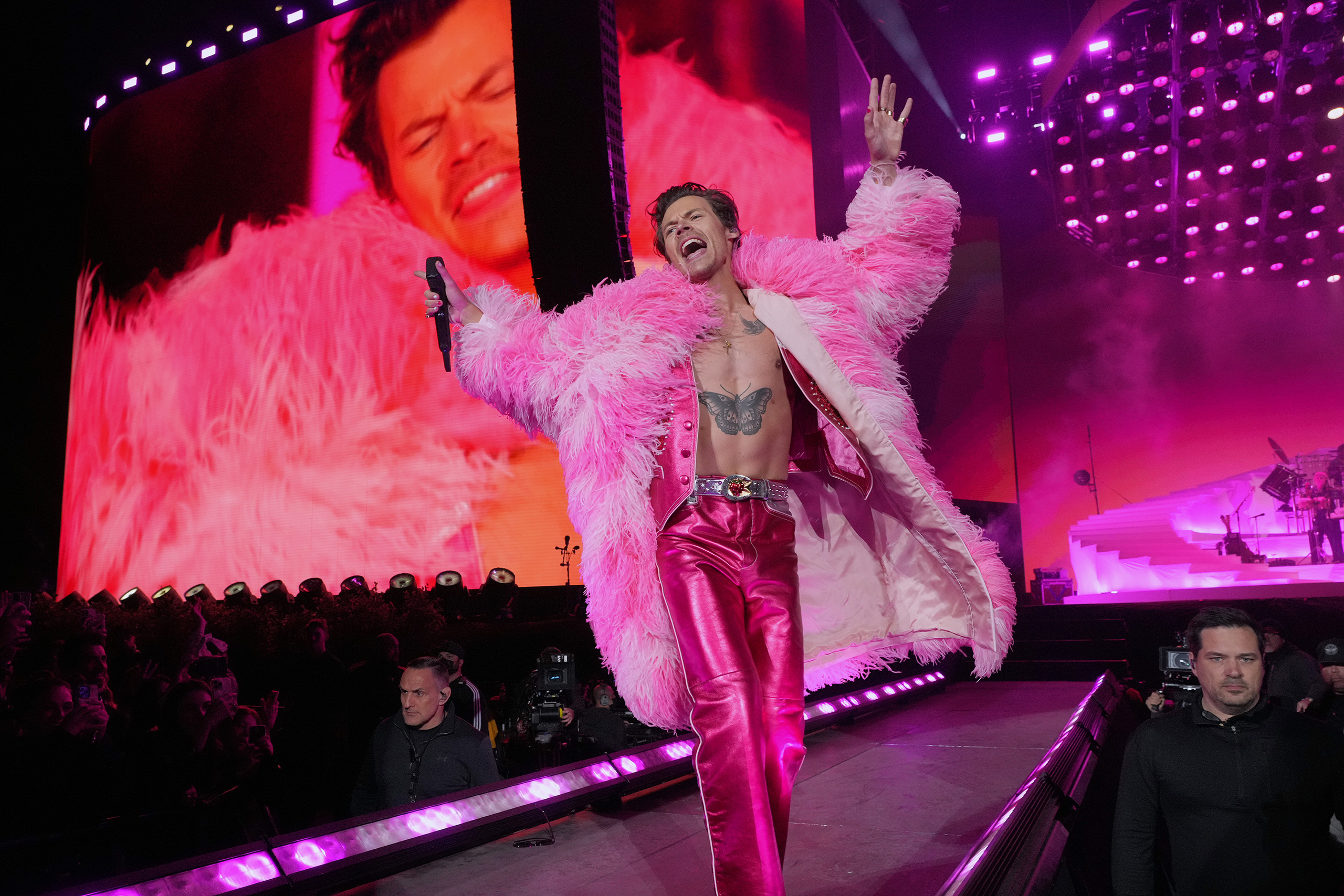
Think pink: Harry Styles performs at Coachella in 2022
When Lambert began in the industry, he briefly worked at Asos, styling 80 to 100 items a day, a job that required him to learn “time management,” while also pursuing editorial work. When he agreed to style Styles, talent dressing was considered second-rate. “It was an American thing,” Lambert said. “It wasn’t a thing people talked about.”
In the past decade, that has changed. As well as Lambert, countless other stylists have become famous. The actor Zendaya remains far better-known than her stylist, Law Roach, but still, Roach has 1.8 million followers on Instagram and has appeared on multiple television shows. (Incidentally, Roach describes himself as an “image architect”.) When the pop star Charli xcx turned up on a 2025 cover of the Hollywood Reporter, she did so alongside her long-time dresser, Chris Horan. When Lambert first became a stylist, fashion was “a mysterious industry,” he told me. “The people were mysterious.” Now we all know who edits Vogue and who designs at Dior. And at least some of us know who dresses our favourite celebrities.
The upshot of the public interest in Lambert’s work is that he has become not just a stylist but a creative director: an arbiter of taste hired by large organisations, including Zara, Disney, eBay and the jewellery brand Pandora, to manufacture new and specific visual worlds – outward expressions of his own personality. To fulfil these obligations, Lambert employs three women full-time, and when I visited his studio I was introduced to each of them in turn. Naomi Phillips, who has been working with Lambert for five years, was sitting on a couch, doing something on a laptop. Ella Bacon, who “we stole from British Vogue,” Lambert said, was working at a desk, every now and then asking questions of Phillips. Zaza McDonald, who has worked with the group since the end of last year, was steaming items of clothing that were hanging on a rail. When I asked Phillips what Lambert was like as a boss, she said, “I mean, he’s the best boss,” before adding, “I think all the girls would say that Harry looks after us.”
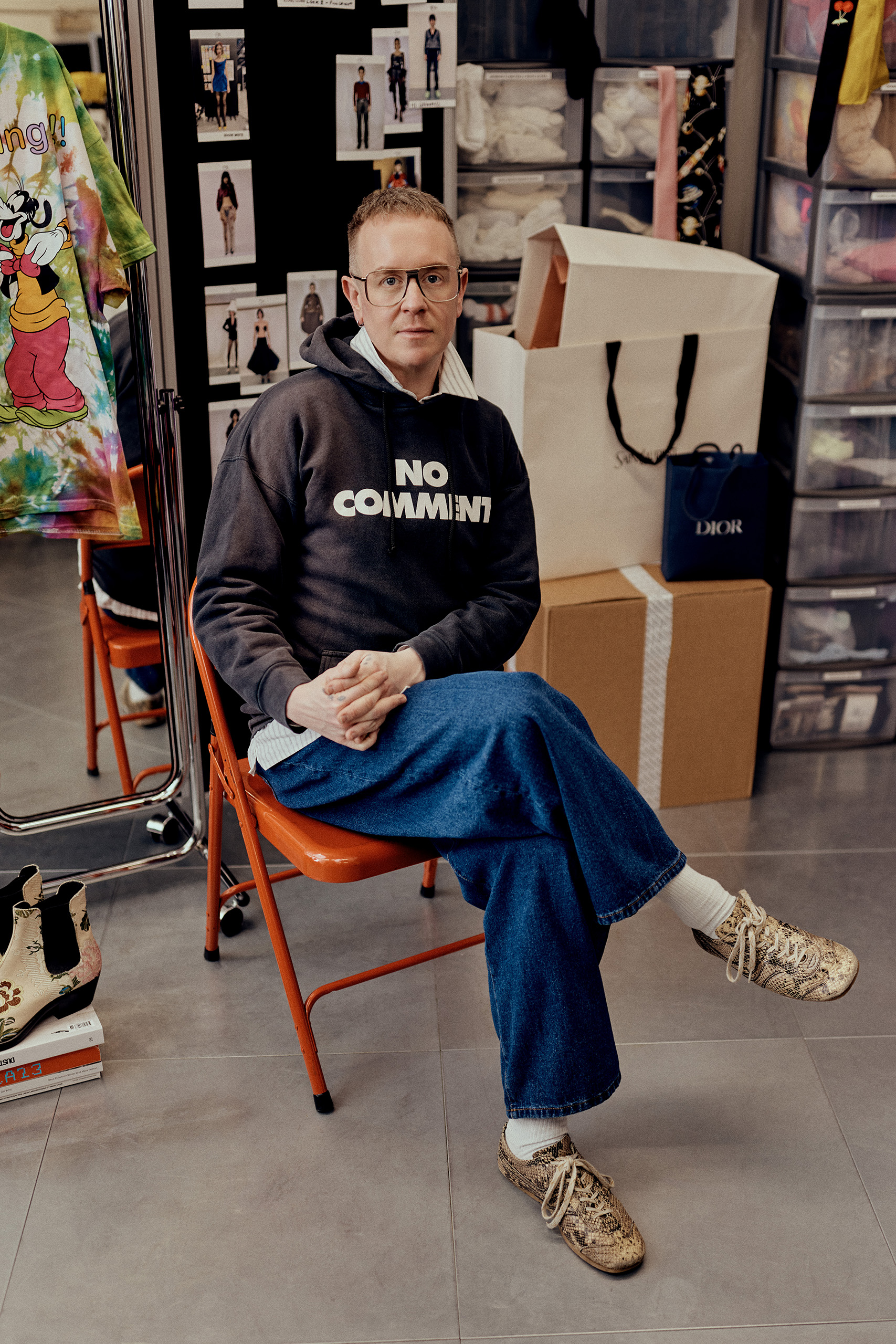
Lambert's white-walled studio space in east London is filled with memorabilia
Lambert was listening in on the conversation.
“It’s a team of girls,” he announced.
“Boys don’t work,” Phillips said.
“We had boys before,” Lambert said. “Didn’t work.”
I asked why.
“We’re powerful women,” Phillips said, and everyone nodded.
Of the girls, Lambert told me later, “God, I love them so much.” Still, things are not always easy. At the end of last year, Lambert began having panic attacks, which he put down to his team taking on too much work. “I’m, like, pretty chill,” he told me. “Like, I can do a lot of work, juggle a lot of things, I have a great team who can take a lot… But at the end of last year I was like, this is too much.” As well as working with brands, Lambert was styling nine celebrities, a list he decided to chop to three: he retained Styles, Skarsgård and the actor Emma Corrin, with whom he has worked since Corrin appeared as Princess Diana in The Crown, in 2020. “You start to lose your creativity,” he told me, of overworking. “I love everyone I work with, and I want to give people my best. But if you’re stretched too thin...” Lambert’s roster of celebrity clients had included the actors Dan Levy, Emilia Clarke, and Josh O’Connor. When I asked him how he chose who to cut, he demurred. “It was like breaking up with friends. Not that we’ve broken up. But it was hard.”

Heads-up: clowning around at Lambert's studio
That it was Lambert who fired six very high profile celebrity clients and not the other way around gives a sense of how far his own star has risen (Lambert himself would never use the word “fired”). His work now regularly slips into the public consciousness, where it is met with all kinds of opinion. When, 10 years ago, a popular television host commented that a floral suit worn by Harry Styles “looked like a couch”, Lambert in fact quite enjoyed the attention, preferring to see any kind of publicity as proof his work meant something. “If the work is 100% loved,” he told me, “it means it’s boring – it’s neutral” (he said the word “neutral” with some disgust). “If there’s no debate, you haven’t done anything.”
Lambert’s work is not 100% loved. “He’s good at what he does, I just hate it,” one stylist told me, adding that Lambert “dresses everyone like Laurence Llewelyn-Bowen,” the flamboyant interior design personality. Lambert’s preference for fun and playfulness can sometimes come off as clownish – the balance between chic and costume can be difficult to strike. “When people come to me to style them, they know they’re going to get a form of fun or silliness or dressing up,” he told me in his office, and “it’s a fine line between what is too much and what is not enough.” He added later, “My fear is you never want it to feel gimmicky.”
Lambert is 39. He grew up in Norwich, alongside a brother who now teaches golf in Qatar and is married to an Egyptian TV presenter. His father was a policeman. His mother was a nurse and later a phlebotomist and then a reflexologist. The fashion world was so far away from Lambert’s upbringing that he didn’t even know it existed. He didn’t hear of the fashion brands Prada or Gucci until he was 20, when he went to university to study photography and began styling for fashion students as a sideline, which became his gateway to the industry. Until then he shopped at Sports Direct. Still, “all I wanted for Christmas was clothes,” he told me. Every so often Lambert’s parents would oblige, but in a relatable piece of family lore they would inevitably choose the wrong things. “I’d hate it all,” he told me. “But the point was I could go back in and swap it for something I did like.”
Lambert met Styles in a Mexican restaurant. When he left, he said ‘Harry styles Harry Styles?!’ as both a statement and a question
Lambert met Styles in a Mexican restaurant. When he left, he said ‘Harry styles Harry Styles?!’ as both a statement and a question
Lambert was bullied as a child. “Every day someone would say something to me,” he recalled. Either that he was overweight, or that he was uncool, or that he was gay, which he was told repeatedly by other people from the time he was seven years old, but which he hadn’t yet processed himself. (He came out late, at 27.) For a while, Lambert worked at a corner-shop near to his home, and customers would pass comment on his bearing. Once, when he had just completed his driving theory test, two local girls congratulated him on passing his “fairy test” (“very old-fashioned,” Lambert told me). He went on, “I remember this alcoholic would come in to get her wine, and one day she was, like, ‘Are you gay?’ And it was the worst thing ever.” Though he came from a successful middle-class family, he wasn’t thinking too much of his future. “We were from Norwich,” he said, a little dramatically. “You went and worked at the university union. Or the big Tesco in Sprowston.”
Lambert’s parents were endlessly loving and supportive. Once, noticing their son’s lacking confidence, they enrolled him in a Saturday drama class, where he made “these other friends”, including the actor Rebecca Humphries, who later appeared in The Crown. The pair have remained in touch. When I spoke to Humphries recently, I told her of Lambert’s perceived lack of confidence, and she laughed. “What I remember is not a shy person,” she told me. “Harry arrived at that class fully formed.” Both Humphries and Lambert considered their Saturday classroom a safe space. “In many ways a lot of us were targets,” she said. “Nerdy theatre kids who were flamboyant. And Harry was gay, so there was this extra target on his back.” That Lambert has become so well-known sometimes surprises him, but it does not surprise Humphries. “We’re all thrilled,” she told me. “The person who never had a bad word to say about anyone, who was endlessly sunny and joyful, has proven it’s possible to be like that and be successful.”
When Lambert and I spoke about his childhood, he seemed defiant. “I’m not saying bullying’s for everyone,” he said, in his office. “But I wouldn’t change it. It gave me a thick skin.” The drama class, too, allowed him to develop the skills that have become crucial in his workplace. “So much of this job is about presenting,” he said. “Talking to people, being confident, standing up and explaining the work: a wardrobe, an idea.” Of his parents he said, “It was the best thing they gave me,” before adding, “they were always there when I needed something.”
A few days after Lambert and I met, I watched an episode of Mastermind in which Lambert appeared as an answer, which I took as surefire proof he has broken through into mainstream consciousness. (The question, “Which British personal stylist, described by Vogue as Harry Styles’s long-time fashion mastermind, has helped the singer create many of his subversive looks?” was answered correctly).
I texted Lambert. “Did you know you were an answer on Mastermind?” I wrote.
“I did,” he replied. “Haha!” Then we arranged to meet again near his studio a few days later.
Lambert had continued to be extremely busy. When I arrived, and we’d settled into a café, he listed the projects he had been working on since we last talked, which included a music video for Styles’s new album, campaign work for Pandora, two fashion shows for fledgling designers Lambert has recently been supporting, and editorial work for magazines. “Sometimes I wonder what other people think,” he said. “Like, we work in this little bubble. Is it too much?”
I asked Alexander Skarsgård, what is your process? ‘We get together, drink chilled rosé, and peruse gossip magazines’
I asked Alexander Skarsgård, what is your process? ‘We get together, drink chilled rosé, and peruse gossip magazines’
I told Lambert that since our last meeting I’d spoken to several people about him, including Alexander Skarsgård, Emma Corrin and Chioma Nnadi, the editor of British Vogue, who told me, “First of all, Harry is an absolute joy to work with,” before celebrating his “sense of fun, boundless energy, curiosity and childlike wonder” (Corrin was similarly enthusiastic).
When I mentioned Skarsgård, Lambert seemed surprised.
“You spoke to Alex?” he asked.
I told him that he had sent me an email.
“What did he say?” Lambert asked.
“Harry and I met on a Juergen Teller shoot for Interview Magazine a few years ago,” Skarsgård had written.
Lambert nodded.
I went on: “Harry brought a custom-made T-shirt with ‘Alexander Skarsgård is a sexy bitch’ printed in large letters across the front. I immediately knew we had very similar taste.”
Lambert laughed. “That’s very Alex,” he said. “What else?”
I said that I had asked Skarsgård to describe their working process, and that he had replied, “Our process is very labour-intense. We get together, drink chilled rosé, and peruse gossip magazines to see what the cool kids are wearing.” Lambert laughed again.
“Is it true?” I asked.
Lambert explained there was much more to it than that, of course: the pulling of clothes, the commissioning of custom pieces, countless fittings with models and Skarsgård himself, plenty of back and forth on which outfits the actor was happy to wear and which he wasn’t, and so on. But he also pulled a face that made me think there was at least some truth in the joke. When Lambert and I had sat down in the café, he’d pointed to another table, where there were two empty wine glasses, and admitted that in fact one of them was his. A client had flown in from the US, and the pair had just been catching up over lunch. “We thought, why not have one drink,’” Lambert said, and smiled.
While Skarsgård was on the Pillion press tour, he appeared on The Graham Norton Show, wearing a T-shirt by the London artist Joe Sweeney that said “Hot Buffet”, alongside Miriam Margolyes, and the pair had a back-and-forth about being gay. Skarsgård, who was touring a gay film, is straight, a fact that seemed to surprise Margolyes, who has been “enthusiastically gay for a very long time,” she told viewers. But Margolyes’s surprise implied a larger issue: that the way Lambert dresses men could be considered queer-baiting, a practice that hints at LGBT identity for personal gain – in a celebrity’s case, for greater fan engagement – without offering explicit representation.
When I brought this up with Lambert at the café, he was aware of the criticism, and for the first time during our meetings he seemed perplexed. “I can’t say I’m clued up on gender conversation,” he said, “even as a gay man. But queer-baiting suggests that you think being queer involves one identity, which is something I was told as a kid.” Lambert believes queerness to be about freedom – who are we to say what someone can and cannot wear? “I’ve never put someone in clothes and said, ‘You know what, you’re going to look really gay, and people are going to love it.’”
In a recent interview, Harry Styles said of the way he dresses, “I learned that dressing up can be fun, that I like wearing a suit and I like trying new looks,” and that when he and Lambert started working together, he felt that Lambert “didn’t take it too seriously,” which he considered “refreshing.” When the pair first met, they did not instantly manufacture a strategy to subvert masculinity. “It was organic,” Lambert said. “It was instinct – it felt honest.” It was not a premeditated statement. “I find with my work that people try to politicise it, which isn’t necessarily a bad thing, but they’ll be like, ‘Oh, you’re trying to subvert masculinity’, or ‘You’re trying to make a comment on what men should and shouldn’t wear.’ Maybe I am. But that is not the goal of the work, to challenge the way people look at men or women. The intention of my work is to make something memorable. Or joyful. Or fun.” He went on, “I do think fashion is important. I do think it’s political. But I prefer that being a by-product.”
He lent back in his chair, and for a brief moment our conversation paused. Then he shrugged. “I’d rather there be hundreds of Alexander Skarsgårds and Harry Styles running around at Halloween,” he said. Pop culture kids dressing up as their idols.
Photograph: Kevin Mazur/Getty Images
Newsletters
Choose the newsletters you want to receive
View more
For information about how The Observer protects your data, read our Privacy Policy