
This was the first time it’s happened I swear. The first time I’ve seen a photo and felt my eyes pop, conical, out of their sockets, felt my jaw clatter, gadonk, to the floor, my tongue clang down and unroll ahead of me like a carpet, heard myself bellow the word “AWOOGA!”
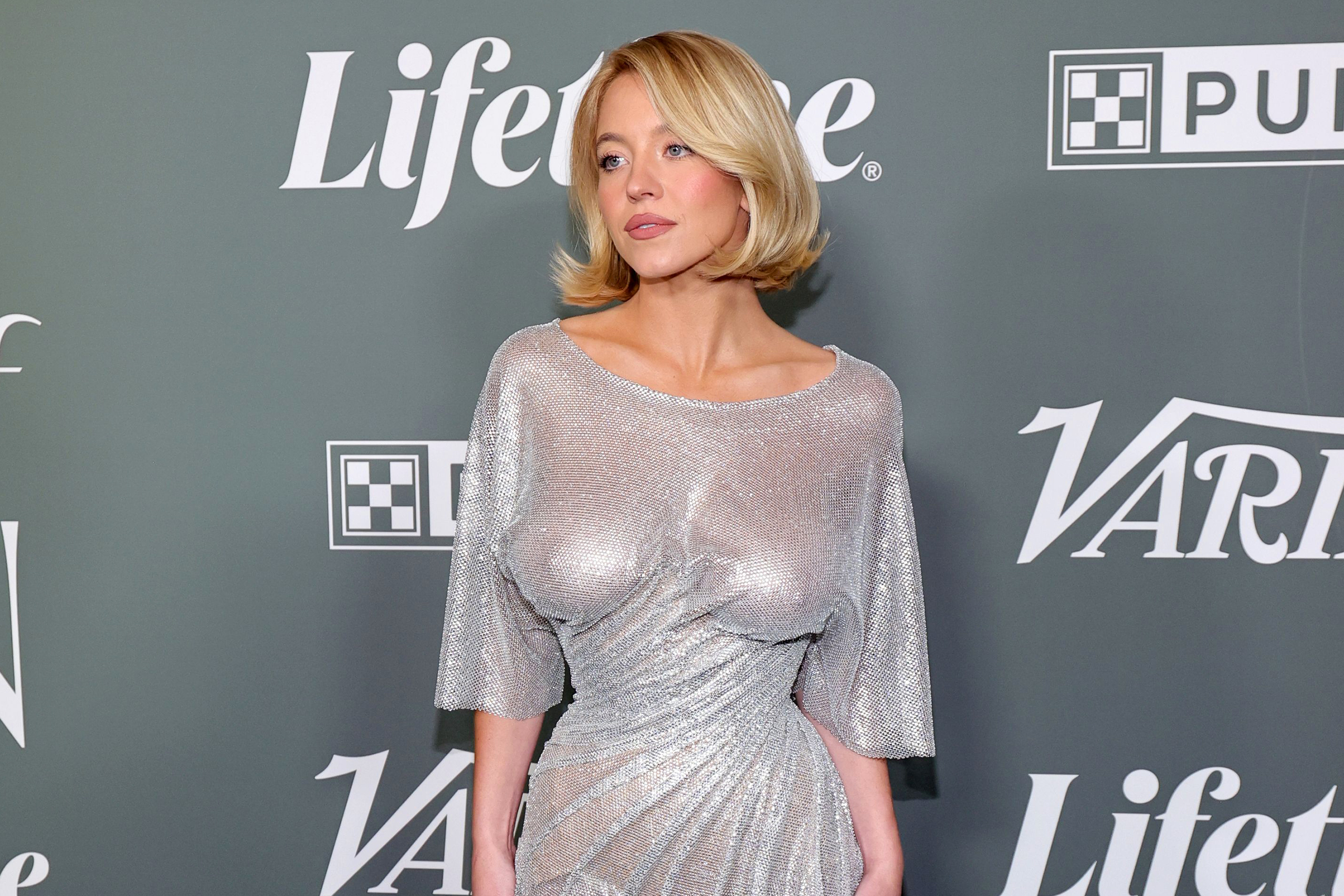
Sydney Sweeney was wearing this dress.
OK, how to describe, how to paint a picture of this gown in only words. Yes, it was covered in CRYSTALS. Yes, it was SHEER, and twisted at the waist to give a CINCHED result. Yes, she wore it without a bra. But that doesn’t really do justice to the power of the spectacle. It was as if a goddess had emerged from the sea, but a goddess drawn by some boys in Year 9. It looked like a wet T-shirt from space is what it looked like, and the effect was that she looked naked-er than if she hadn’t been wearing it at all.
This is the power of the naked dress, a trend that arrived in the 1800s (Marie Antoinette popularised the chemise during a revolution), which peaked again in the 1920s as fascism began to crawl across Europe, and has returned today, our rulers hardening, our award shows paved with flesh. Last year, in response to these sheer fabrics and sideboobs, the Cannes Film Festival changed its dress code, banning nudity on the red carpet. But still the trend persists.
Lily Allen collected a whole “revenge wardrobe” of naked dresses soon after her divorce album had permeated the culture. There was her sheer Dior knit that revealed a black thong, and later a white perfunctory bralet. Jennifer Lawrence wore just a constellation of embroidered Givenchy flowers to the Golden Globes, where Jennifer Lopez posed in sheer mesh with the briefest nipple appliqué. Vogue said attendees here “redefined naked dressing,” while at the Grammys last week Fox News saw what it described as a “spectacle of nudity, combined with a clown aesthetic”. Chappell Roan wore a chiffon burgundy Mugler dress suspended from nipple rings as if clothes pegs, Heidi Klum a nude latex mini-dress with sculpted bust, arse and belly button indentation.
Kanye West was not invited after last year instructing his wife Bianca Censori to “drop it” on the red carpet. Censori dutifully removed her fur coat to reveal an entirely see-through sheath. Magazines primly blurred all genitalia.
‘It feels slightly “dead cat strategy” where attention is diverted by chucking a cat on the table, or in this case perhaps, a pussy’
‘It feels slightly “dead cat strategy” where attention is diverted by chucking a cat on the table, or in this case perhaps, a pussy’
Was this naked dress a sign Censori was being coerced? Or, with her blank expression and deathly earnestness and crucially, that booming silence, was she simply committing to the bit? After her first few outings, I started to wonder if Censori’s deadpan nakedness was less hostage-situation and more protest. It reminded me suddenly of FEMEN, who march topless for women’s rights, or the “Naked Athena” who stripped down to her mask during a Black Lives Matter demonstration to “confront” the police with her nakedness.
A naked dress contains more meaning than it does fabric. But that meaning is sometimes difficult to parse – it shifts, doesn’t it, according to who is wearing it: their size, their skin, and also, according to who is looking. A wearer can feel liberated then objectified in a single camera flash.
Sweeney wore that gown to Variety’s Power of Women gala, where she gave a speech directed at young women. “You don’t have to wait for permission to be brave,” she said. The dress, then, was intended as a statement of empowerment. Did it land? I was too busy staring to decide. Chappell Roan, responding to critiques of her Grammys gown (including those who shuddered at the thought of someone stepping on her train and accidentally ripping off a tit), said that the outfit was simply “fun and silly”. The thing these women share is a desire to provoke and, in a soup of stars and beauty, to be seen.
While often gorgeous, some of these dresses feel like a distraction, especially when they are more transparent than their wearers’ politics. When a naked dress goes viral, papering your social media so exhaustively you know its wearer’s pudenda better than you know your own, you start to wonder what you’re not seeing. It feels slightly “dead cat strategy” where attention is diverted by chucking a cat on the table, or in this case perhaps, a pussy.
What I do like, though, as well as all that slippery mesh, is the way a naked dress insists we think about the body as taboo: what is fetishised, what must never be seen, why. At this year’s Met Gala, guests will wear outfits that talk to the “relationship between clothing and the body’’, a particularly fraught conversation right now, of course, one performed in stage whispers as weight-loss drugs chip away at celebrity silhouettes against a landscape of conservative ideals. While the naked dress is a veil over trim limbs, the vogue for a naked dress veils a more complicated fashion trend, which is that of the shrinking body itself.
Photograph by Getty Images
Newsletters
Choose the newsletters you want to receive
View more
For information about how The Observer protects your data, read our Privacy Policy