
Related articles:
Photographs by Alice Poyzer
Day one: Hounds and terriers
Midway through my interview with Owen Sharp, chief executive of Dogs Trust, I fall backwards into a memory. Suddenly, I’m eight years old, walking with the family pet, Willow, a haphazard English setter with big, bright, watery eyes. I’m wishing Willow could speak to me – that he could be more than a dog. But then I think deeper. What would he say? Would he cry out in pain? Would he ask me why dogs are essentially slaves, or worse, accessories, bred into odd shapes, castrated for their own good? Would Willow, gentlest of creatures, hate me if only he knew who I really was?
The question – too disturbing for my eight-year-old brain – was stored away. Unfortunately for Owen Sharp, it’s come back. We’re in the press room of the Birmingham NEC, having had, until this point, a fairly normal discussion about canine welfare.
“I’ll have to sleep on that,” Sharp says, when I ask if he wishes his dog could think like a human. “I’ve never been asked anything like that before, but my immediate instinctive answer is no.”
Why?
Sharp replies that he likes the “simple sentience” of dogs, that the world is “not always a wonderful place” and knowing that is “not always a great thing”.
He’s right. More than 2,800 miles away, Tehran is on fire. In the other direction, the Wall Street “fear index” is getting restless. But outside the door and across the hall a sea of immaculate jack russells scamper hurriedly to their mark and an 11-year-old pomeranian crossbreed named Trip Hazard dons a shiny red bow tie for a rendition of Chim Chim Cher-ee.
This is Crufts. “The world’s greatest dog show.”
Related articles:
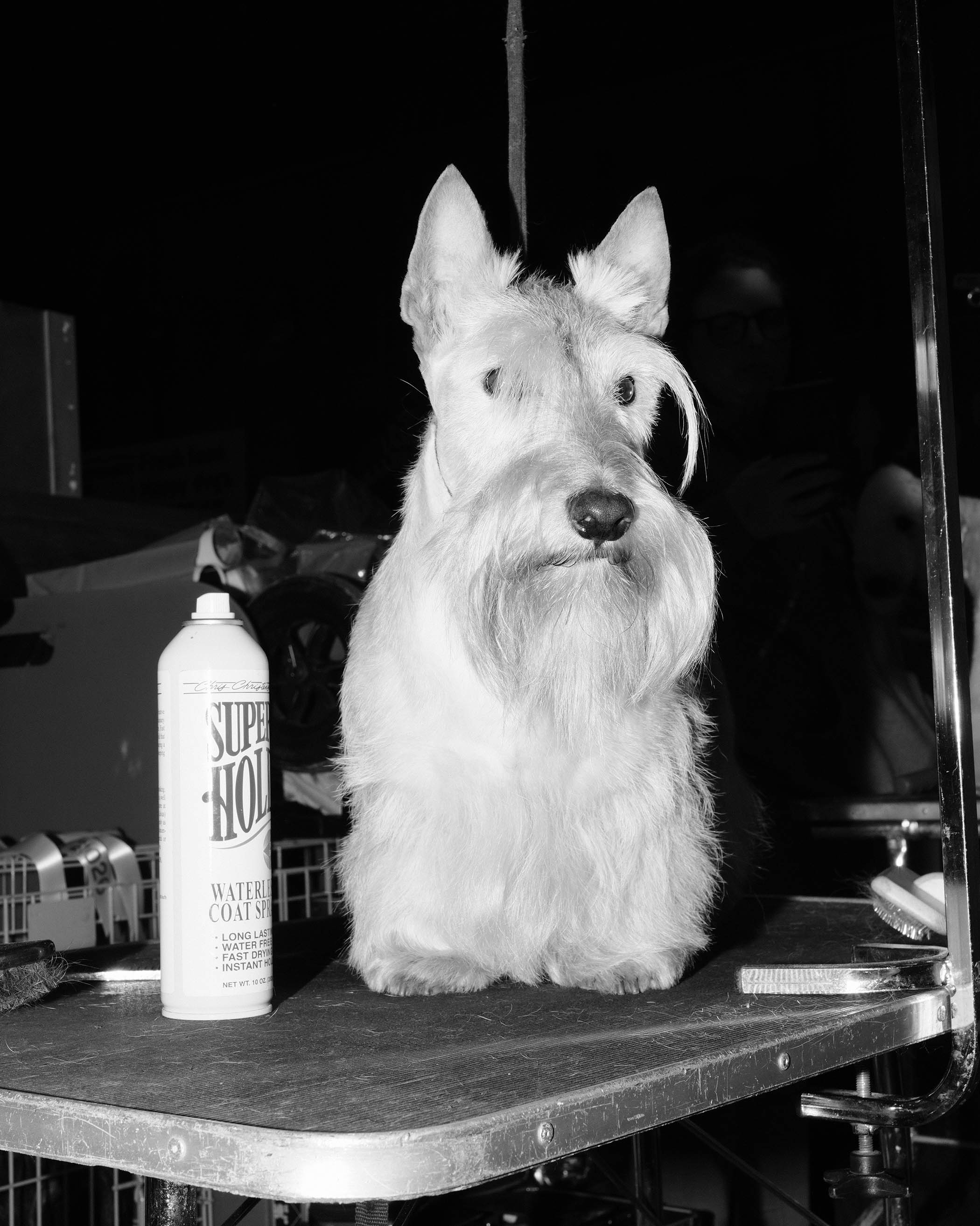
A white Scottish terrier in hair and makeup
First, the stalls. Crufts was conceived in 1891 by a biscuit salesman as a way of flogging dog products. And, yes, there are dogs, more than you’ve ever seen before – at least 20,000 of them. But, always and for ever, the show remains true to Charles Cruft’s original hypothesis that dog owners – perfectly frugal outside this context – will buy almost anything for their pets.
Among Crufts’ 500 or so stalls, you can acquire lifesize sheep toys, nine-inch mega tennis balls, orthopaedic dog mattresses, ear cleaner, ringside grooming tables, luxury dog baths (£900 RRP) and a converted van for dog agility teams, complete with cages and beds (£19,995 plus VAT). You can also make bookings for a dog-friendly private jet service operating between Europe, North America and Dubai. Skoda is the official partner this year. Beneath its corporate posters, there are identical, smaller ones at dog height. For a little under £30 you can buy a dehydrated skinned rabbit. Most of the canine treats have been taste-tested by humans. There’s dog popcorn made from cheese, pantry-fresh dog supplements and wagyu beef lollipops.
One woman used to spoil her chihuahua Mickey, and when his body began deteriorating, she decided to treat him to a “real” cake for his final birthday. Mickey passed away but his legacy persists as Adored Pets Cuisine Ltd. I stand for a long time surveying the savoury frosting on its multi-tiered chicken and carrot birthday cakes.
I’ve never seen that dog before but when that man presented that dog to me, that dog said: ‘Here I am’
I’ve never seen that dog before but when that man presented that dog to me, that dog said: ‘Here I am’
The last stall I visit sells genetic tests to breeders looking to mitigate the hereditary health conditions inherent to pedigree breeding. In 2008 a BBC investigation alleged that breeding standards by the Kennel Club – now the Royal Kennel Club – were undermining the welfare of dogs. Among other creatures, the investigation followed a cavalier King Charles spaniel whose skull was too small for its brain. This led to the BBC, the RSPCA and Dogs Trust severing their relationships with Crufts, though this year Dogs Trust has returned, citing improvements to breed standards, and the show is broadcast on Channel 4.
Nonetheless, the woman at the Animal Genetics stand paints a stark picture of the biological realities threatening the world of show dogs: boxers with heart conditions; border collies with glaucoma; pugs that can’t breathe. It’s worth remembering that many of the breeds you encounter at Crufts were Frankensteined into being during the last three centuries for practical uses on estates or farms.
Crufts is probably the only place in the world where a sentence that contains the words “as a result of František Horák’s selective breeding programme during the 1940s” is received well.

There are dogs, and there are people. And the people are disappearing into their dogs, becoming – as they like to put it – dog people. The latter don’t have much to say that isn’t about their dogs, or someone else’s dog, or dogs in general.
The crowd is largely women. There are men too, of course, but many of these fall into a bespoke category: the Crufts husband. This breed is often hidden away, but you still catch him sitting at his allotted stall, surrounded by snacks and scrolling on his smartphone. It’s his job to drive, wait around, carry things and drive home. The return deal for the Crufts husband is unclear. There are also Crufts wives, and a few Crufts teenagers, but these are less common.
Crufts revolves around extreme British propriety. Everyone wants the most proper dog. And the Royal Kennel Club is the most proper dog institution. This is also potentially the whitest gathering in Britain – whiter, even, than the Reform UK conference that took place here last September.
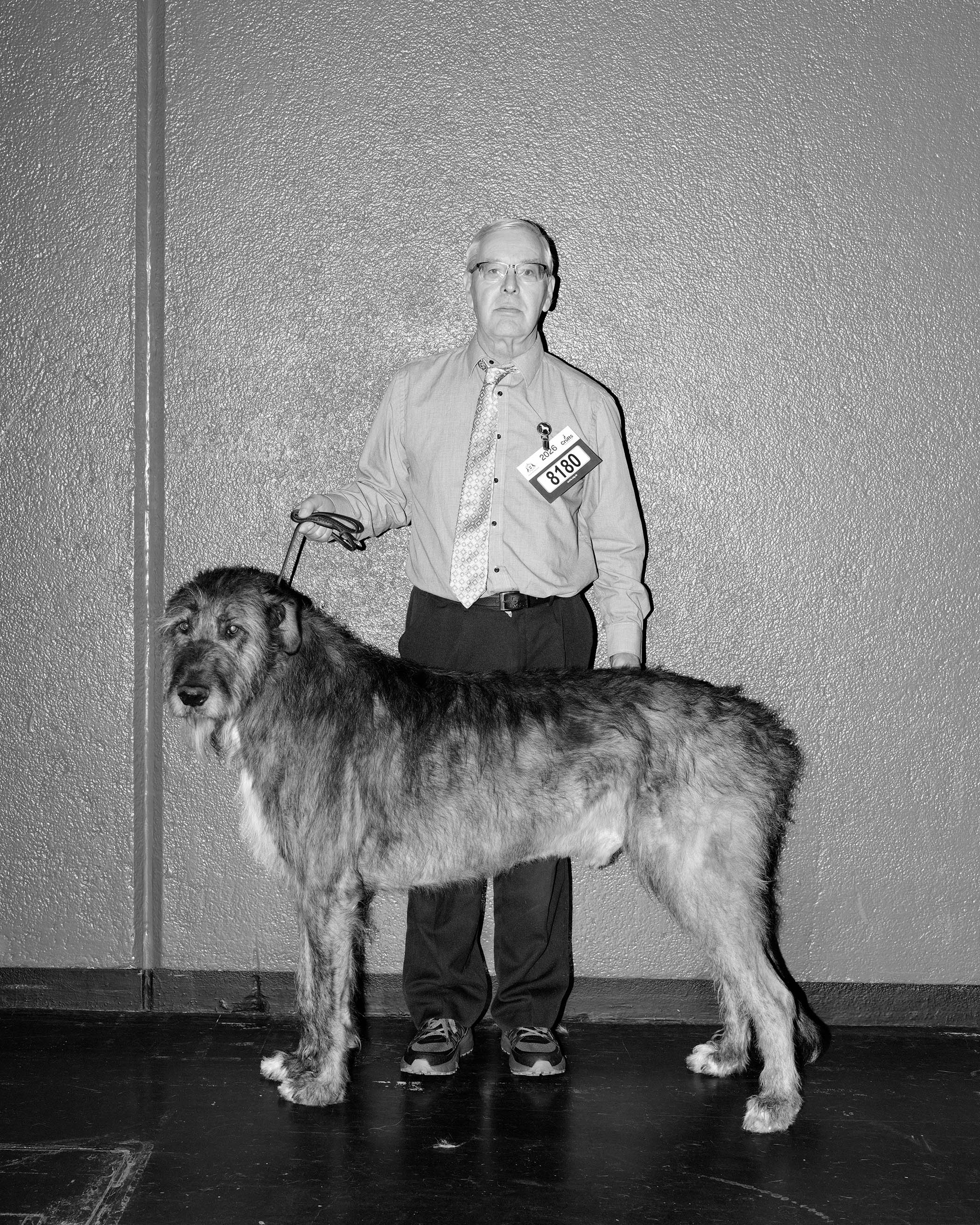
Irish wolfhound Reebus with his owner
Amid the hound group you will find people such as Michaela Kamenárová, a tall Slovakian woman who breeds tall Ibizan hounds and surrounds herself with a cadre of smaller women who all seem to fear her.
Kamenárová is pissed off because everyone here speaks English too quickly. I ask her if the dogs speak English and she looks at me with mocking disgust. “No…”
The terrier people are different and like to see themselves as tenacious. Hailey, a dog person from Cork, shows Lorcan, a Scottish terrier who looks a bit like a young Fyodor Dostoevsky. Hailey chose Lorcan because she loves an animal that “will tell you to fuck off”, and she doesn’t mind that she’s become an accessory to his needs. At the end of our chat, she proudly pulls up his beard, revealing his teeth.
His breed, Hailey exclaims, has the largest bite for any dog relative to its size. Like the dachshund, the Scottish terrier traditionally worked under the ground in the dark tearing at badgers.
The day continues with the somewhat unsettling spectacle of watching dogs approximate the quintessentially human act of dancing. Dogs cannot dance.
Late in the afternoon, I get my first glimpse of triumph. A staffordshire bull terrier belonging to a young Dubliner named Lauren has won best of breed, which means her staffie is the most staffie of all the staffies and can progress to compete for best in group, which seeks to find the most terrier of all terriers.
If it wins that, it’ll go through to the final, competing for best in show – the dog of all dogs. Lauren’s family crowd around her. Her father, who showed dogs before her, but has never won at Crufts, brings out an enormous cake.
About an hour later, I’m sitting in the arena, hoping the best in group judge, Colin Powell, will take Lauren further still. An Italian journalist next to me suddenly breaks the code of conduct and shouts: “Awful!” towards a sealyham terrier she dislikes for some reason. Powell inspects the dogs as if he’s checking for concealed explosive devices.
When the decision is made, I can just about make out the disappointment on Lauren’s silhouette when she realises her dog, which looks dotingly up at her, wasn’t deemed quite good enough.
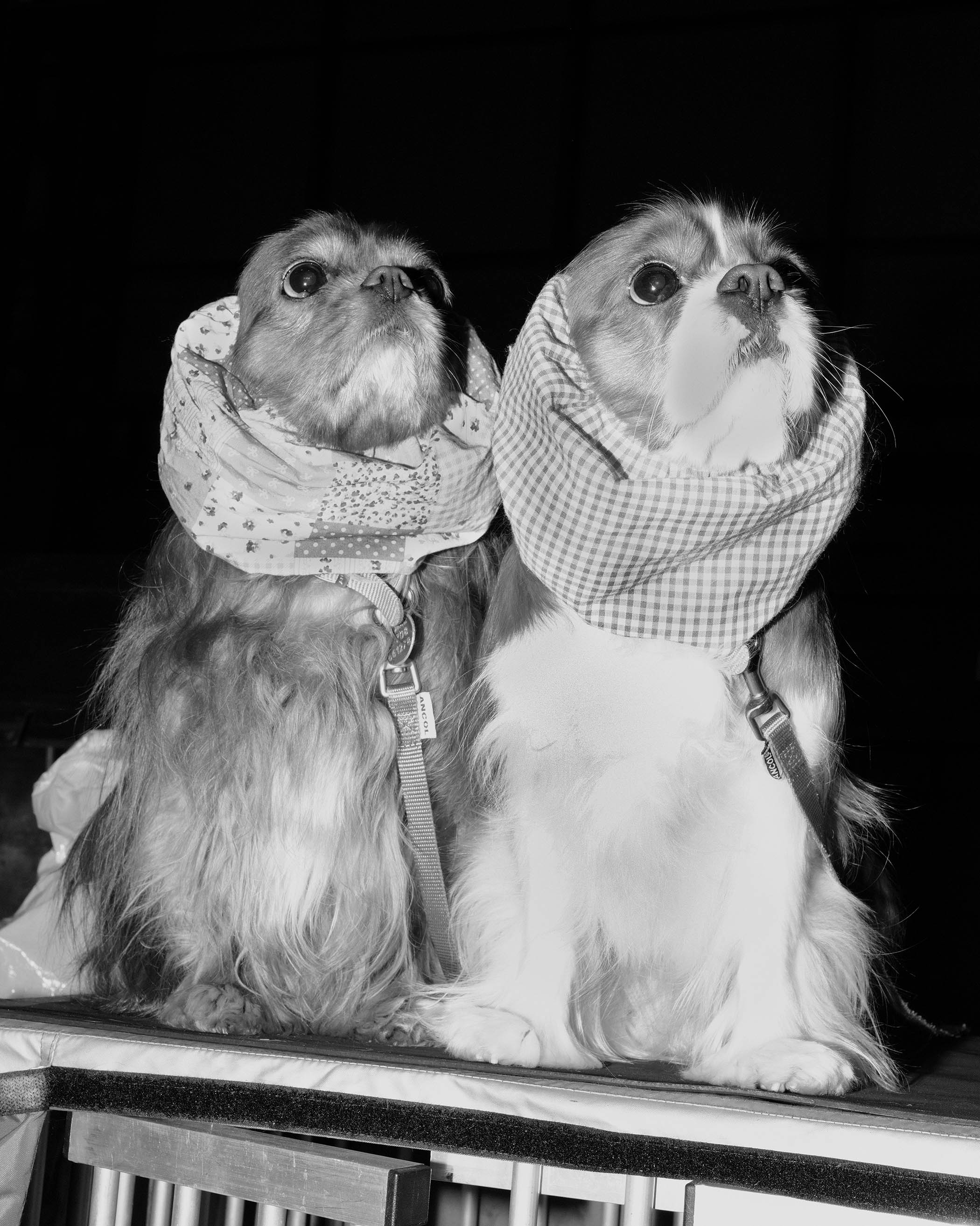
Liberty and Phoebe, cavalier King Charles spaniels
Day two: Toys and utility
Day two begins on the train. A gaggle of Birmingham City fans are on the piss ahead of their away game at Charlton. “Tell you what – I’d prefer watching the dog show than watching your boys,” one of the women next to them says. “Not much difference in it these days,” a man responds. The women alight with a parting warning: “Be a good boy!”
It’s toy day and the yapping is endless. A coton de tulear growls at me while its owner arranges its hair into a top-knot. A few stalls down, I try to pet a pomeranian that turns out to be a stooping woman’s hairdo. I hurry on. There is nothing quite so awful as the bark of an indignant shih-tzu.
According to Bruce Fogle’s book Dog: The Definitive Guide for Dog Owners, evidence was published in 2004 that “showed that three out of four modern dogs share their mtDNA [mitochondrial DNA] with a single female ancestor”, the harbinger of a “defining genetic event in which a line of wolves adapted to a life of cohabitation alongside humans”.
If this cosmic dog mother is looking down at Hall 5 of the NEC from the great kennel in the sky, then what does she make of the maltese or the volpino Italiano with their ridiculous, tiny features? Would she mourn the rejection of her wolf kingdom, a realm that’s largely crumbling but has, at the very least, retained some semblance of dignity?
I do enjoy the Yorkshire terriers with their traditional red velvet boxes that double as plinths. Their owners often sport beehives. One such owner, Marjorie from Falkirk, deeply resents films such as Beverly Hills Chihuahua and Legally Blonde for portraying toy dogs as fashion accessories. “It should be a pet, a part of the family,” she says.
Toy day brings a dramatic influx of Crufts husbands. One of them sits on a camping chair with a yorkie on his lap, reading the Daily Mail. He’s earned this: his work is done. I ask if he looks after the dogs at home. “When forced,” he replies. A few dogs over, a distinctly bored-looking Polish husband listens to Formula One while his wife grooms a maltese.
In order to deter dognappers, no show animals are allowed out of the hall until 4pm. Naturally, upon learning this, I wander over to the woman sitting at the information desk and ask, hypothetically, if I were to steal a dog, how I might go about it.
“You see,” she says, “to get out, you have to have all the requisite tickets.” She mentions several “dog doors”. “But I dare say…” she suggests, “You [could] just wait until there’s a crowd and rush out with it.”
Shortly after that, I’m marched out of the press room by security and have to spend 10 minutes convincing the guards that I’m not actually going to steal a dog – a defence that sounds increasingly suspicious the more vociferously it’s repeated.
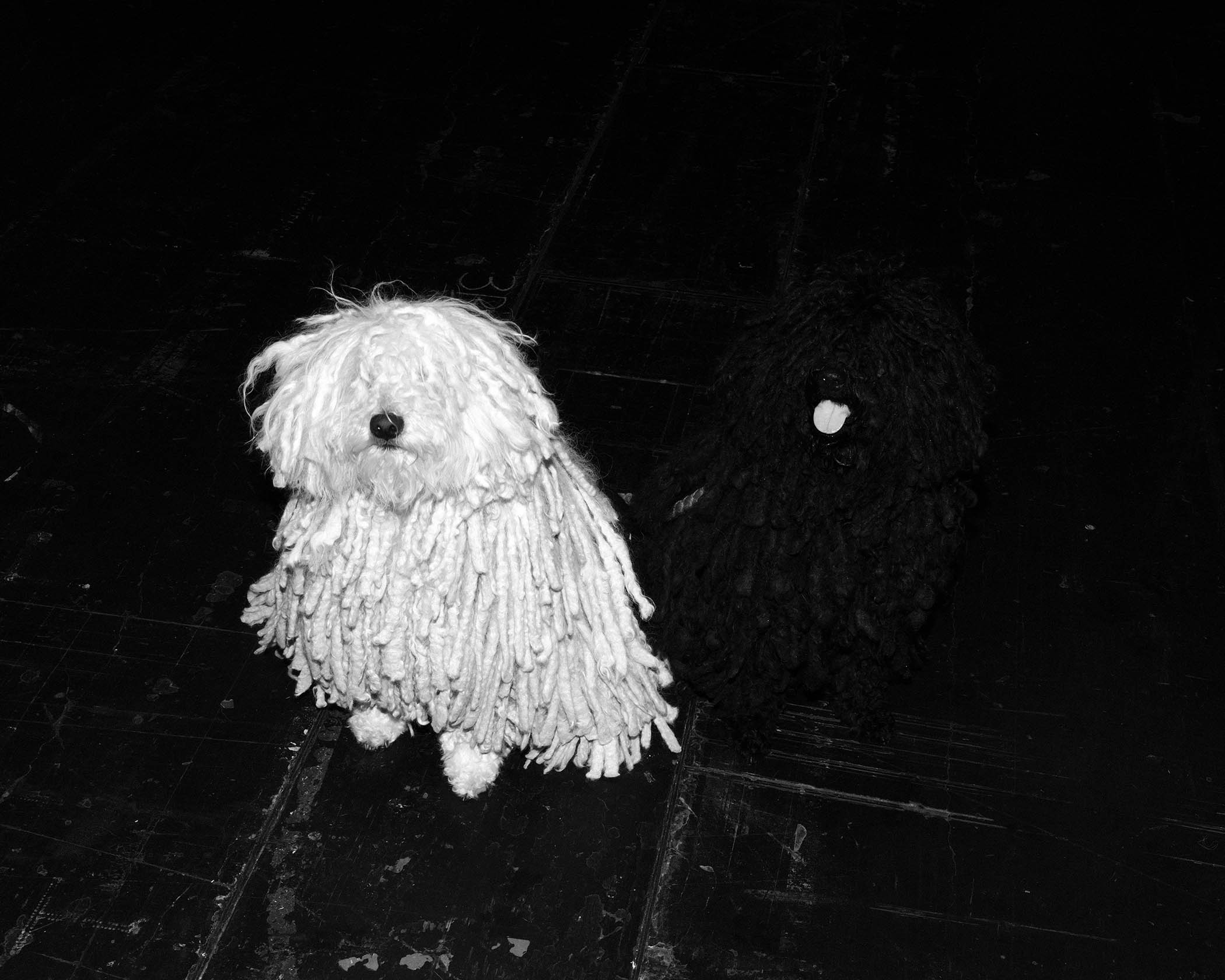
Two mop-topped Hungarian pulis
In Hall 1, there are the poodles and the scent of hairspray. Even my nose, human nose – more than 10,000 times less powerful than a dog nose – struggles to pick up anything else. For dogs (assuming they interpret the world synaesthetically), this hall must be one flat, all-consuming colour – I assume pink, or possibly turquoise.
Poodles were bred for fetching ducks; their fur gives them buoyancy. After the second world war, a toy poodle won at the 1956 Westminster Kennel Club Dog Show and helped fuel “poodlemania”. Now they’re laden with connotations of high-society, glamour and even snobbishness and sycophancy (to call someone a “political poodle” implies humiliating subservience). Poodle owners will tell you that their animals are misunderstood, but I still dislike them, no matter how muddy they get.
“This is Solomon,” says Jason, a bald man from Kentucky in his early 40s, who doesn’t seem like he wants me too close to his dog. Jason won best in show a decade ago and Solomon is that winner’s cousin.
“They’re super intelligent …” he says of his favourite breed. “They have such a presence … They’re almost like people … They kind of have a reputation of being like a frou-frou dog … yappy … all hair … but they’re working dogs.”
I ask how they got that frou-frou reputation.
“Err… maybe the haircut.” Jason replies. All around us, poodles are being blow-dried, brushed, curled, clipped and sprayed, their eyes like tourmaline. There’s a little sandy island at the side of the hall where they can urinate.
Dogs are often associated with the threshold between two worlds. A three-headed dog guards the entrance to the ancient Greek underworld. Similarly, in Egyptian mythology, a man-dog hybrid protects Duat, the realm of the dead. Cats have an innate understanding of what the next life will look like; they can look into the future. But a dog resides in the present moment, and, when the time comes, will greet us at the doorway to another realm.
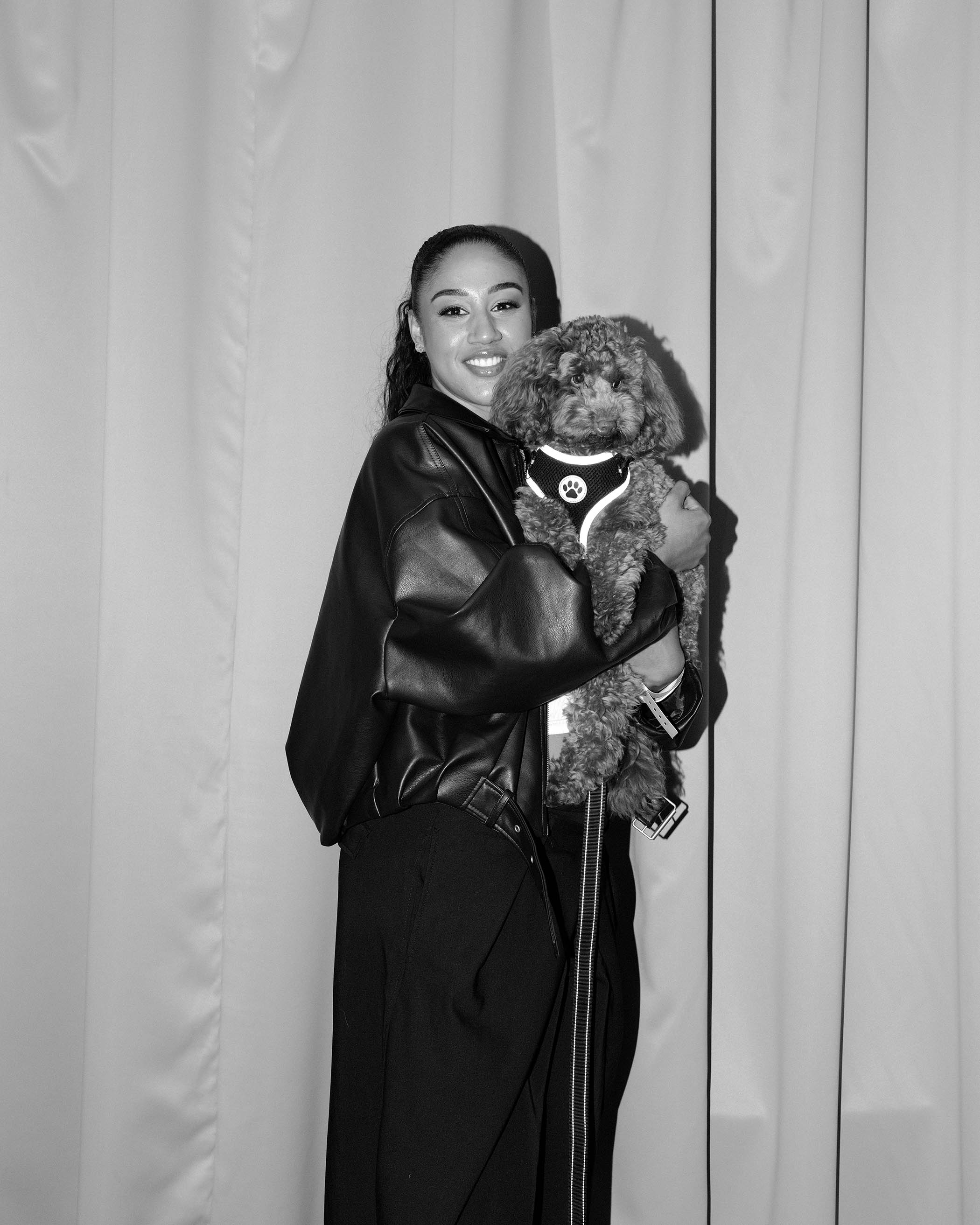
Manchester United player Gabby George with her dog Ralph
“So how are you preparing for the cup final?”
I’m interviewing the Manchester United defender Gabby George, who’s come to Crufts with her dog, Ralph, promoting a joint venture between the Women’s Super League and the Royal Kennel Club. I haven’t really drafted many football questions. And the ones I have drafted get strictly football answers.
“It’s international break at the moment,” George says without a pause, “so there’s only a few of us in. We’ve been working really hard on improving ourselves as individuals. And then, when the girls come back in, it’ll be full focus on the final.” George is a lovely person and a brilliant athlete, but I get the feeling neither of us quite knows what to say next.
I’m about to ask George to weigh in on the animal rights versus animal welfare debate, and whether she and her publicity team would consider eating a dog if it was free range but, before I get the words out, little Ralph leaps with his front paws on my knee and the foresight a seasoned PR could only dream of. (Ralph was sadly not present on the first day to stop me putting this same question to Owen Sharp of Dogs Trust at the end of our conversation. The chief executive replied that he would not consume dog meat, even if the animal lived a good life and if refusing to do so was contextually impolite.)
Day two ends for me watching the dogs leave. Everyone queues up in a long line of prams and cages. Some prams contain babies, but most contain dogs. You get used to this, but often you’ll approach a pram expecting to see a baby and then reel back in horror when a pekingese leers up at you. After the doors open, a pack of dalmatians traverse a zebra crossing and the zebra crossing and march towards the car park.
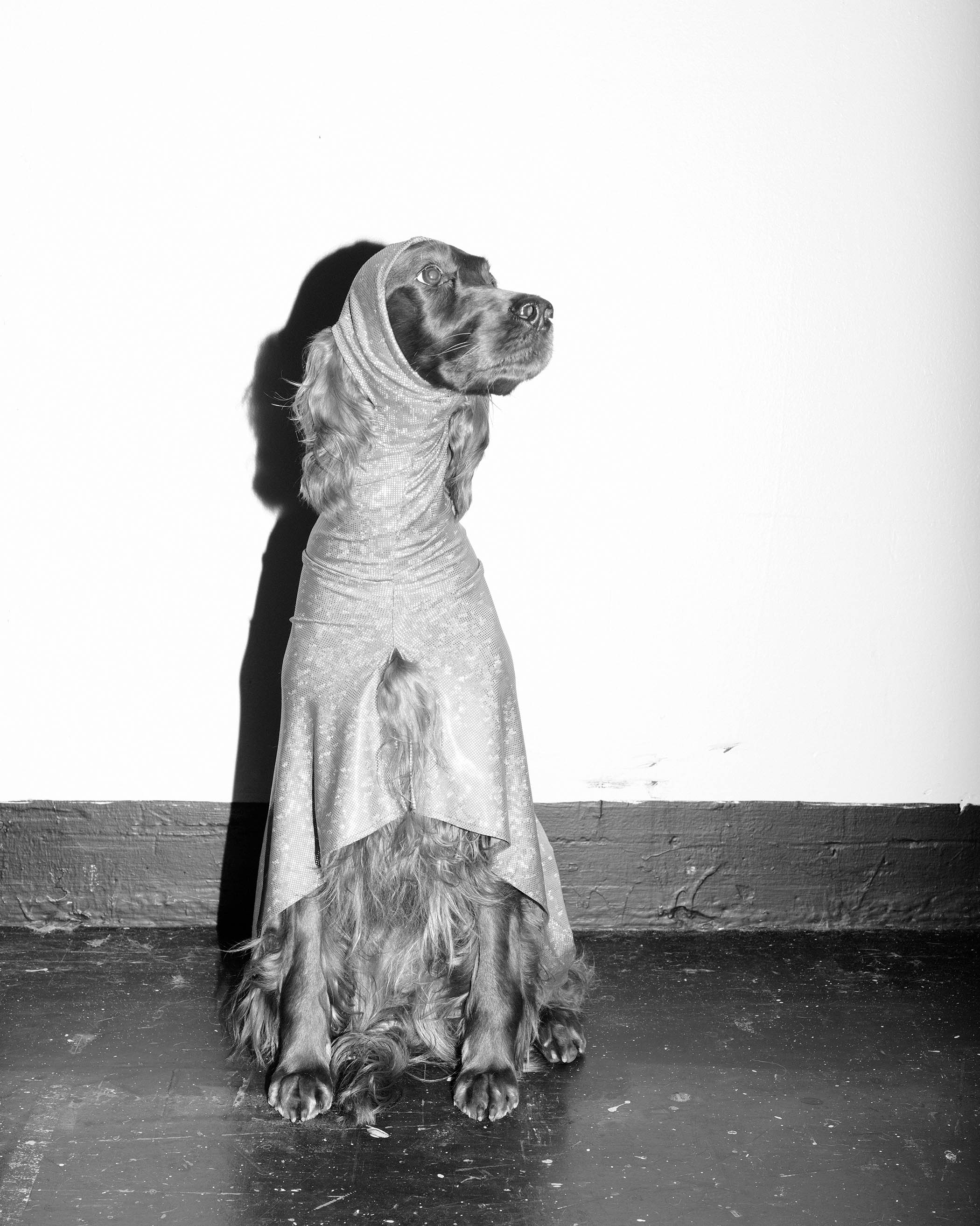
An Irish setter, all dressed up
Day three: Gundogs
Why do people do it? The winner of best in show – perhaps the most prestigious show dog award on the planet – will receive just £200, barely enough to cover the mileage and lunch. But still, people wake up early, spend hours grooming and driving. “Dogs are confirmation of how you see yourself,” a Dutch judge tells me after thinking on it for a while. “We live for our dogs. We are dog people.”
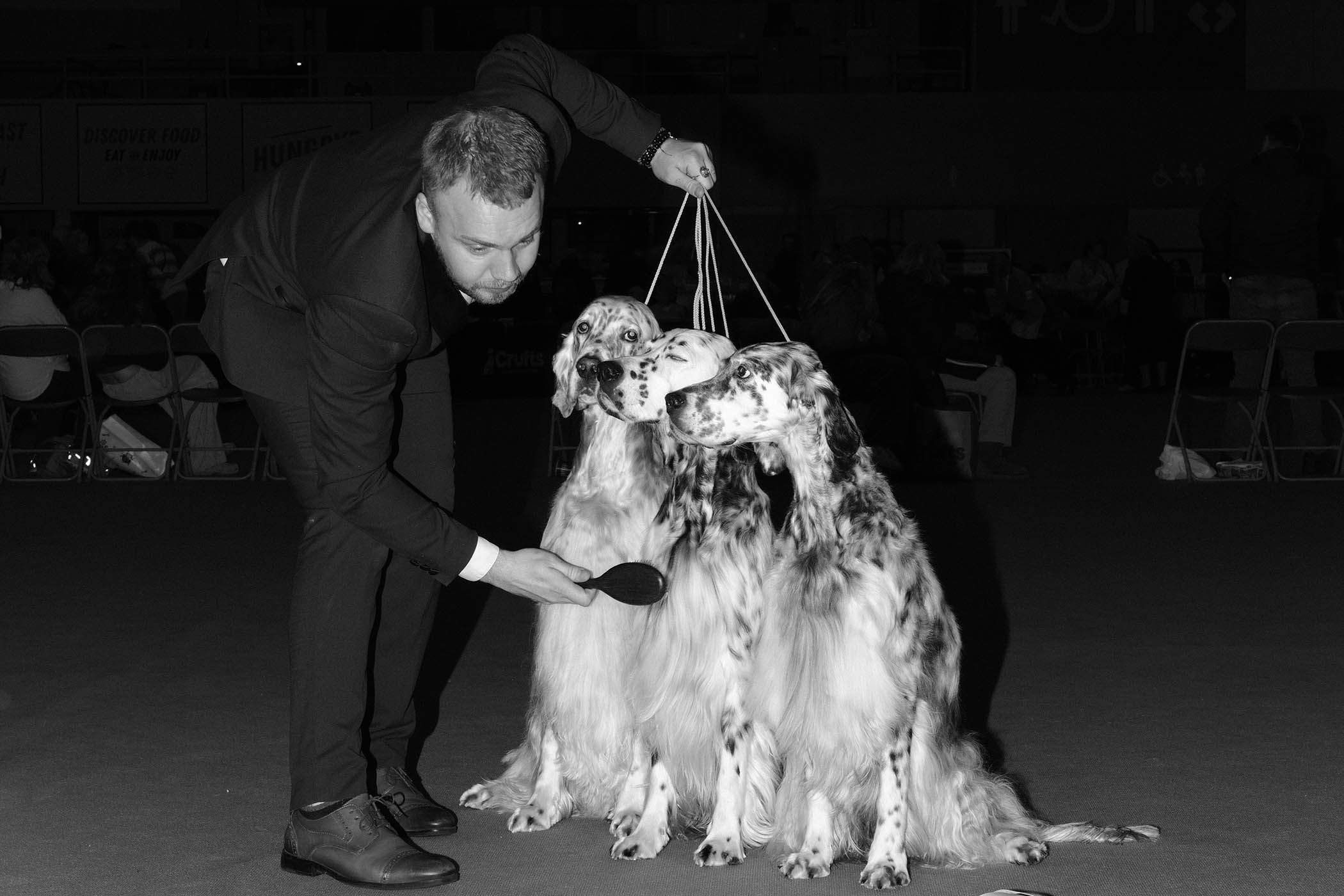
This all seems a bit unnerving but then I see the English setters, and 100 Willows and I go native. I feel like I’m in some sort of dream. Suddenly, I’m rolling around, becoming a child and the dogs are jumping up at me, licking my face, speaking to me with their big, bright watery eyes telling me: “It’s OK! You’re not a bad person, Miles!” The entire morning is spent like this, drooling and nostalgic.
I eventually come to looking at the English setter judge, Peter Upton, a bald man with images of the breed on his trousers. He explains that such a dog has to have the right-shaped head – the same length as the muzzle – and that its tail must be no higher than the level of its back.
He is convinced that the dogs not only know who the judge is, but also understand the concept of a judge. “They do – I swear they do,” he says, pointing to an orange belton he’s just awarded a rosette. “That [dog] came from overseas. Now, I’ve never seen that dog before in my life … but when that man presented that dog to me, that dog said: ‘Here I am.’”
I have a theory about Andrei Tarkovsky’s 1979 film Stalker. The movie, if you haven’t seen it, centres on a mysterious zone in which the rules of reality are different, and inside this zone, there’s a place they call “the room”. Inside it, your deepest desire is granted; not your conscious wish, but the thing you really want. In this way, the room is dangerous. One man who enters, we’re told by the eponymous guide, becomes rich, but kills himself after realising his shallow, materialistic nature. In the end, the film’s three protagonists, having thought about it, choose not to enter the room.
But there is a dog in the zone too, a black German shepherd that isn’t named and keeps its distance. In the end, we see the dog has escaped the zone and is adopted by the main character’s family. But what if the dog it had entered the room? Does the world of Stalker chart a shift between the world desired by man and a new world unconsciously dreamed into being by a stray dog? And what would the brave new dog world look like?
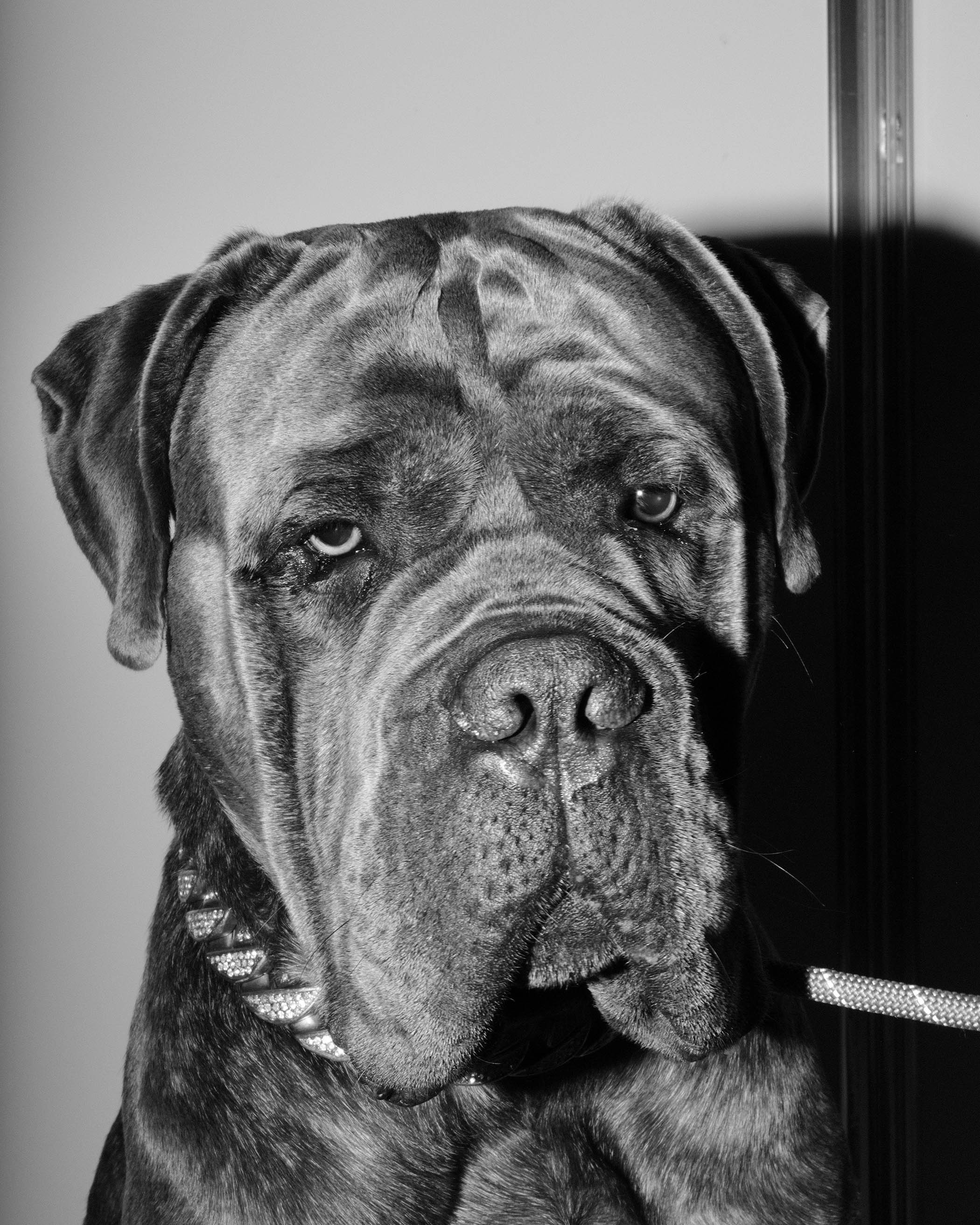
Shadow, a mastiff with a sunny disposition
A huge roar goes up for the representative from HM Prison Service as he enters the main arena. “The Prison Service has just over 780 dogs,” he explains via the PA system. These include the “advanced tornado dogs” that are trained to neutralise violent targets. The service has gained a special dispensation to show these dogs off at Crufts.
For the next 20 minutes, tornado dogs simulate tearing into violent inmates by attacking men in specialised canine-proof vests. During one demonstration, the supposed inmate is having what appears to be a nervous breakdown in his cell. When he smashes a chair, the dog leaps up and essentially tries to rip his arm off. Tornado dogs target the triceps area. The crowd loves it. People enjoy a dog with a job.
Before the final stages of the show, I visit the “discover dogs” section of Crufts. This is more like a zoo than a dog show. Almost every breed is present in little enclosures for passersby. The range of sizes and temperaments is dizzying. A sea of hands reach towards the chihuahuas and cocker spaniels. Two enormous, docile bullmastiffs named Gavin and Stacey stare at me with folded faces. Bullmastiffs were bred to grab, bite and sit on poachers. Although the biting has mostly disappeared from their genetic memory, they retain an innate need to sit on people.
People bought a lot of dogs during Covid. The number of household dogs in the UK has risen by about 3 million since 2019 to an estimated 13 million (one for every three households). But the pandemic wasn’t good for dogs. According to Dogs Trust, an increasingly large proportion of British canines suffer from poor socialisation and separation anxiety. One bull terrier breeder – a well-built man with a sleeve tattoo that reads “We will never surrender” – tells me that there was also a boom in “backyard breeders” during Covid, something the Bull Terrier Club knuckled down on by stabilising the price.
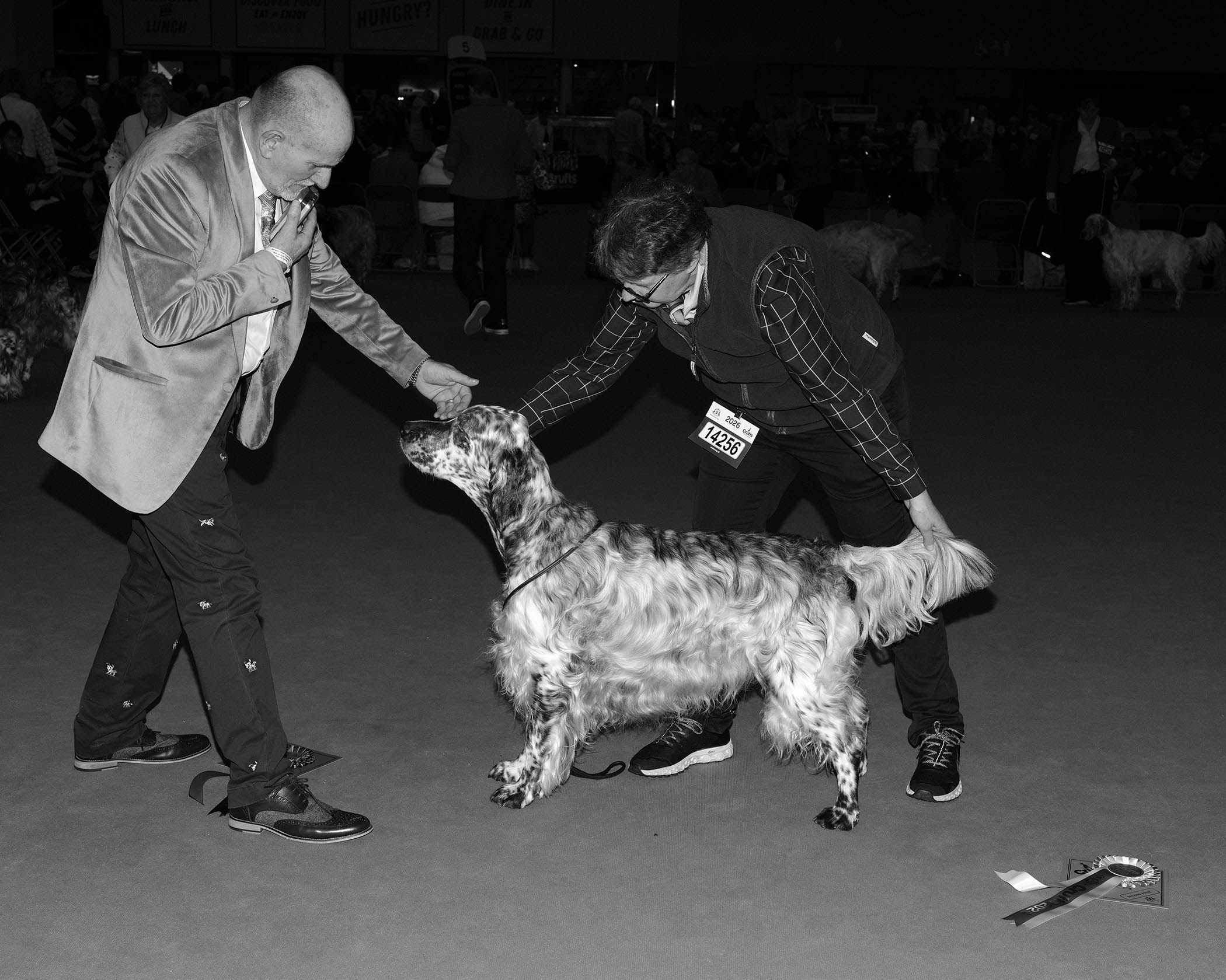
Judge Peter Upton inspects Piper, the smart English setter who won the post graduate dog class
Best in show, the apotheosis of Crufts, is preceded by a gundog display, during which a cocker spaniel named Sherlock nervously shits on Crufts’ famous green rug. This is forgiven by the announcer, and I watch a stagehand run into the arena holding a wad of tissues.
The final heat is judged by a man who bears an unfortunate resemblance to Andrew Mountbatten-Windsor. One by one, he inspects the dogs. There’s a plodding Tibetan mastiff; an excitable corgi; a moustachioed lakeland terrier from Malta; a basset griffon vendeen – a breed I’d never heard of that is said to be unrivalled at scenting; a miniature schnauzer with the eyebrows of an angry, determined man; and a somewhat ridiculous-looking cavalier King Charles spaniel.
In the end, the prize goes to an irresistible Clumber Spaniel named Bruin, who seems very personable and lumbers up to the podium with a cartoonishness only a dog can pull off. What we don’t know yet is that Lee Cox, Bruin’s owner, is about to make headlines for having been fined £5,000 25 years ago for mistreating a cocker spaniel. Because for now we are all cheering for Bruin, for what Bruin means to us, for the schlubby and the lovable, winning out over the pristine and immaculate. And because this is Crufts, the greatest dog show in the world.
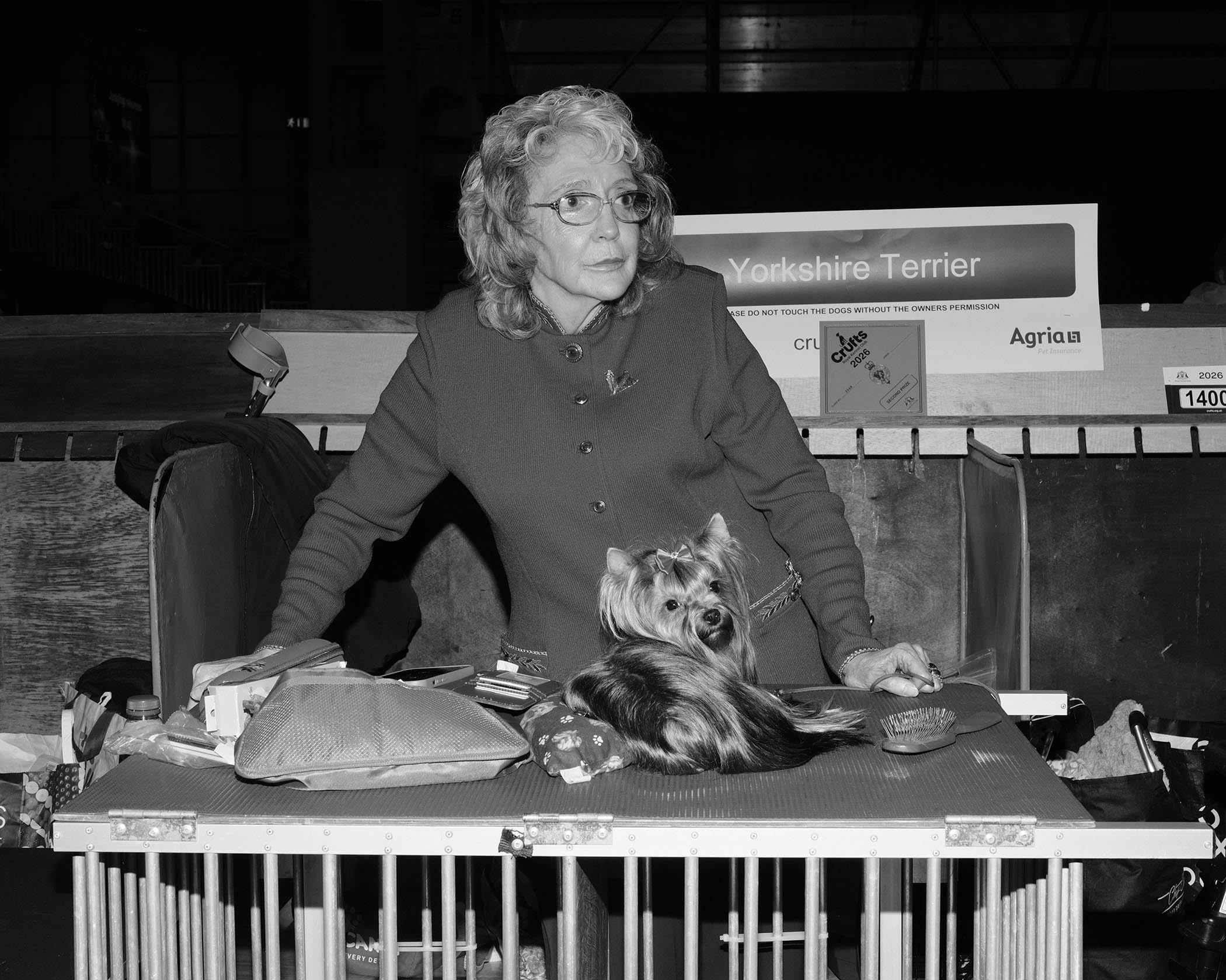
Breeder Janice Parvin with her Yorkshire terrier