There we were, two members of an esoteric sect and me, in the drab, ground-floor office of a three-storey Victorian home behind a high fence fitted with security cameras. The gloom didn’t stop at the door. Though it was midmorning in Vancouver, a heavy half-light hung over the city. It felt like the prelude to a weather emergency or an apocalypse.
“We can change everything by changing our name,” said the beautifully named Dhorea Delain, a 70-something whose elegant purple dress and white pearls offered a small rebellion against the bleakness.
“Not only can we, but we should!” added her colleague Don Maxwell, who had a comparatively pedestrian name and outfit. Tall and lean, a few years younger than Delain, he wore grey trousers and a brown sweater, the yin to her yang.
Maxwell and Delain are longtime members of the Kabalarian Philosophy, a fringe, transformation-obsessed spiritual group with branches in Canada and the Netherlands. I didn’t plan to join. Instead, I’d come to Vancouver to learn more about name changes, which sit at a curious crossroads: a bureaucratic flick of the pen that can set off an identity quake.
The Kabalarians are authorities on the subject. Since the group’s founding in the early 1930s, tens of thousands of people around the world – most of them unaffiliated with the movement – have paid the group for help choosing or changing a name. Some are parents searching for the “right” fit for a child; others want a new identity to reflect a life transition. Delain, the group’s senior naming specialist, has been guiding these decisions for nearly five decades. She may have helped rechristen more people in more countries than anyone alive, a distinction she is too modest to claim.
Ours is a boom time for the renaming business. In addition to the Kabalarians, many naming experts have hawked their services on TikTok and in every corner of the internet where reinvention sells. There’s been no shortage of buyers. As the self has become more like a remix than a statue, people across Western countries have shed names that felt like hand-me-downs from another life and chosen ones with a charge that fits.
People rename themselves for a long list of reasons. They’re starting over, standing out, blending in, claiming their past, fleeing their past, finding religion, leaving religion, swapping nationalities, making a political statement. A new name is a versatile tool. It can summon a new life, but it can also signal the achievement of a desired identity, marking what might be called the completion of change. Sigmund Freud recognised this weight when he wrote that a person’s name was “perhaps a part of his psyche.”
Sigmund Freud wrote that a person’s name was ‘perhaps a part of his psyche’
Sigmund Freud wrote that a person’s name was ‘perhaps a part of his psyche’
Those in power have long understood this, wielding name changes as tools of domination and erasure. Nazis, owners of enslaved people, and colonial missionaries stripped the vulnerable of their names, an act writer Julian Brave NoiseCat likened to “the deletion of identities from the historical record and eventually from all human memory.”
But renaming can also be an act of self-definition and renewal – a leap of faith, a bet that language can remake you. To the Kabalarians, a new name isn’t just symbolic, it’s surgery for the soul. Drawing from numerology, their system assigns numerical values to letters and interprets the total in relation to a person’s birth date. As they see it, a “balanced name” depends on a “divine Mathematical Principle.” Each letter creates a vibration akin to a key on a piano.
“Through a change of name,” they promised in their written communication with me, “one can completely change one’s nature, one’s thinking, one’s actions, and one’s whole life.” They insist everything hinges on what we call ourselves: “All our happiness and sorrows, hopes and despairs, health and sickness, successes and failures are instilled in us by our individual names and nicknames.”
Newsletters
Choose the newsletters you want to receive
View more
For information about how The Observer protects your data, read our Privacy Policy
It’s an audacious claim, ignoring as it does the many other factors – poverty, trauma, disease – that can shape lives far more than a moniker can. But maybe it’s not that audacious? Names, as novelist Mary McCarthy wrote, have “a queer kind of sorcery.” Much like the Kabalarians, most of us don’t just hear names. We interpret them, project onto them, and often link them to faces, temperaments, and life stories.
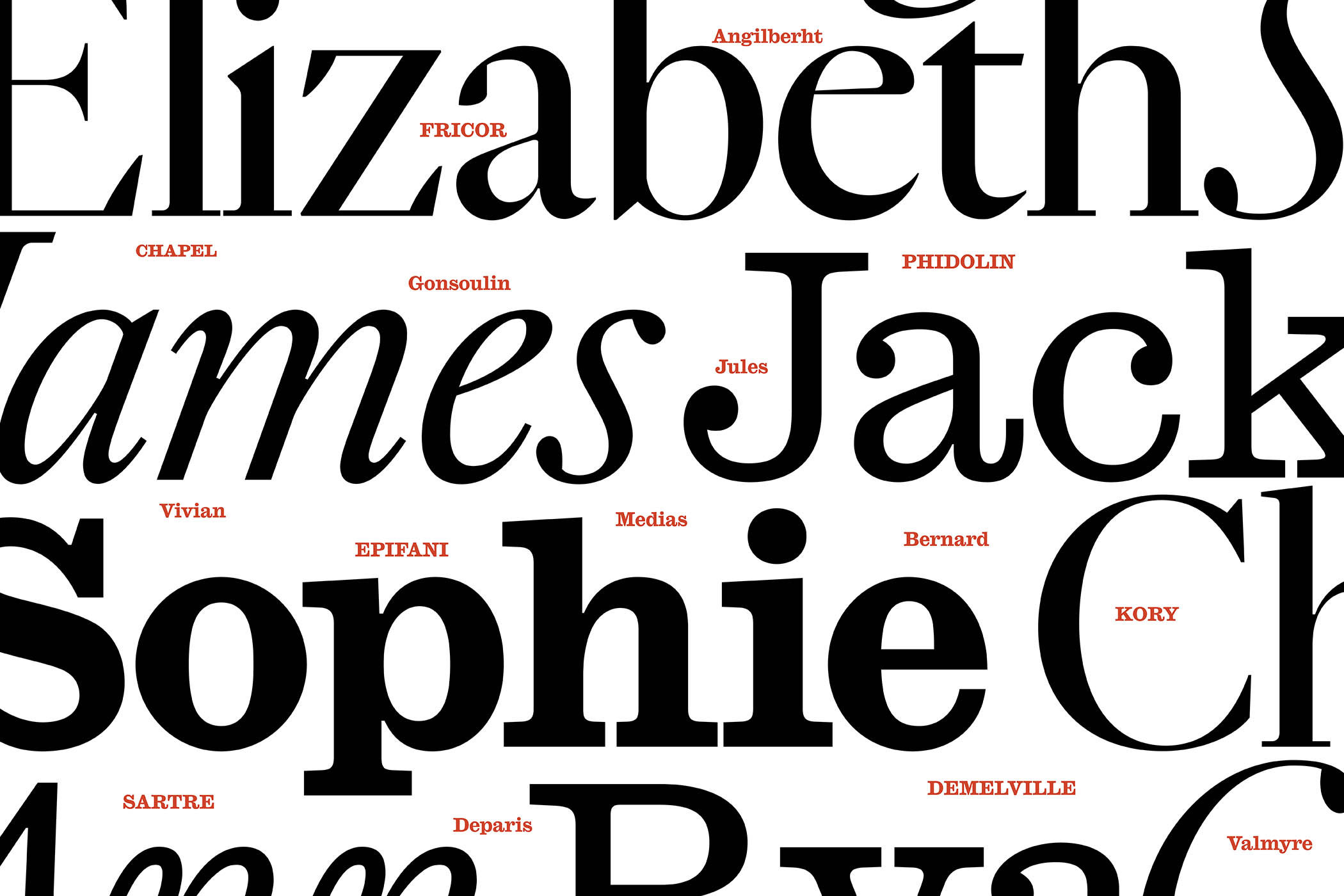
When participants in a British survey were asked to rate common names for success, luck, and sex appeal, sharp patterns emerged. Elizabeth, Caroline, and James ranked high in names most likely to lead to success, probably thanks to their royal associations. Katie, Jack, and Lucy were seen as lucky, Helen and John unlucky. The names Sophie and Ryan had sex appeal; Ann and George didn’t, a finding that ignores the Clooney-shaped exception.
But perception may not be the only thing names influence: research suggests they can also shape how we literally look. In one study, participants matched strangers’ names to faces at rates well above chance. Another found people might “grow into” their names, gradually adjusting their appearance to fit social expectations, a phenomenon dubbed the Dorian Gray effect.
And then there’s the way people name their children as if laying out a blueprint. To name is to try to control the narrative of a life. It’s a two-pronged identity exercise, “a social act which is very much about expressing [parental] identity – who they are and who they want to be – and constructing a hoped-for identity for their child,” according to one linguist who specialises in the study of names.
Parents agonise over baby names not just for sound or family legacy but for symbolism and aspiration
Parents agonise over baby names not just for sound or family legacy but for symbolism and aspiration
Parents agonise over baby names not just for sound or family legacy but for symbolism and aspiration. Lewis Ellison named his son Ralph after the philosopher and abolitionist Ralph Waldo Emerson; he was one of countless parents who understood what his son – later a literary luminary – called the “suggestive power” of naming. Even if many of us don’t believe names shape destiny in the rigid way the Kabalarians suggest, we often act as if they do.
An unlikely source had recommended I visit the Kabalarians: a former group member named Beverlie Gensler, who, when we spoke by phone, flatly called the group a cult – an opinion in fact echoed by the Supreme Court of Canada. But during her 24 years with the Kabalarians, Gensler said she watched herself and others change for the better after embracing a new name. Her older brother did it first. When he announced he was changing both his first and last names, their typically placid father erupted and started trying to punch him. But the rift didn’t last. Before long, everyone in the family had embraced a new identity.
“I don’t think [Kabalarians] are wrong about the power of what we choose to call ourselves,” Gensler told me. She also agreed with the group’s assessment of my decidedly unusual name: Benoit Lancelot Denizet-Lewis.
It might, she said, be due for a revision.
Socrates considered naming to be “no light matter,” which is especially true when soon-to-be parents can’t agree on the kind of person they’re hoping to manifest.
As with most things in my parents’ marriage, they disagreed about what to call me. My dad wanted a sensible name for his child, one unlikely to attract attention or lend itself to an unsavory nickname. My mum wanted a French name for her French-American son. She loved the name Benoit, not because it was the masculine version of her French name, Bénédicte, but because it carried echoes of her childhood. She’d spent two years at a boarding school in the small French commune of Saint-Benoît-sur-Loire, where her godfather, a Benedictine monk, took her on weekly walks along the Loire River, enchanting her with stories of Jesus and the apostles.
My dad didn’t dislike the name but worried – rightly, it turns out – that Americans would struggle to pronounce it. While “politicians and car salesmen know how essential it is” to get a name right, as Justin Kaplan and Anne Bernays point out in The Language of Names, the same can’t be said of the hundreds of people who’ve called me “Ben-oight.” (It’s pronounced “Ben-wah.”)
I have the women’s liberation movement of the 70s to thank for my hyphenated last name. Back then, some women were beginning to keep their maiden names after marriage, and giving the mother’s name to a child was a small but potent act of feminist resistance. A self-styled liberal, my dad grudgingly agreed when my mum insisted I carry both surnames.
Lancelot is undoubtedly the most outlandish part of my name. Dad told me he thought it was “nutty,” but my mum had been charmed by Lancelot while reading King Arthur and His Knights of the Round Table during her pregnancy. “I thought that for a middle name, we could go a bit wild, since it is rarely if ever mentioned,” she told me years later. “I hope it is not too heavy to bear for you, and that you will forgive me for this bit of eccentricity.”
I don’t mind it. In fact, my name is one thing about myself I haven’t wanted to change. I like its uniqueness. There is no other Benoit Lancelot Denizet-Lewis – or even a Benoit Denizet-Lewis – in the world.
But when I spoke with Gensler, the former Kabalarian, she surprised me by asking, “Does your name represent who you really are?”
I’d never considered the question before. My name certainly feels like me, but maybe that’s because I’ve spent years answering to it. Repetition has a way of making familiarity seem like truth. Represent me? I’m not so sure. If I didn’t associate the name with myself, I might picture an annoyingly refined person with an extensive scarf collection and a distaste for sport. I own one scarf (my mum knitted it), and I’m not especially refined. I also love sports. All of which is to say, I like to think of myself – and this could be a blind spot, to be sure – as less pretentious than my rarefied name might suggest. I used to joke that being half French and half American made me half snob and half idiot, but I don’t actually think I’m a snob.
I paid £100 for a Balanced Name Recommendation packet, which included 30 potential first names
I paid £100 for a Balanced Name Recommendation packet, which included 30 potential first names
Still, both Gensler and Delain had suggested I change my name. Delain was unequivocal: it attracted “tragedy and losses,” could lead to “nervous disorders,” and had prevented my “full potential to express”. Ahead of my Vancouver trip, I paid £100 for a Balanced Name Recommendation packet, which included 30 potential first names. The choices were eclectic, ranging from relatively normal (Jasper, Kory) to delightfully unhinged (Epifani, Angilberht, Fricor, Valmyre, Medias, and Phidolin). My surname apparently needed changing too. Options included Chapel, Demelville, Sartre, Gonsoulin, Bachelin, Deparis, and Bos.
When I asked Delain and Maxwell why they included so many unconventional choices on my list, they insisted they were simply giving people what they wanted. “Many clients are after names that are wild, different, unusual,” Delain told me. The trend reminded her of another busy renaming decade: the 1970s, an era of reinvention. There’s no single reason people decide to change their names, Delain said, but over the past decade, she and Maxwell have increasingly encountered clients looking to stand out. “They’re desperate for attention,” Maxwell told me. “Especially on social media.”
Gensler, the former Kabalarian, was less of an alarmist than Delain and Maxwell about my full name. After crunching the numbers (she sent me an email explaining her process, little of which I understood) she recommended I keep my last name – “There’s nothing wrong with it and lends itself to an air of sophistication”– but swap my first name for Benard and my middle name for Lance. She assured me the change would deliver “a very stable and much more desirable destiny.” The problem with Benoit Lancelot Denizet-Lewis, she explained, is that someone with this name fears confrontation to an unhealthy degree – a diagnosis I also received from the Kabalarians, and one that rang true.
Gensler assured me that changing my first name to Benard, a variation of Bernard (a once-common French name with roots meaning “brave bear”), would make it easier for me to speak my truth and stand up for myself. She was blunt in her assessment of my weakness: “You will notice that having a spine is a new sensation.”
For a few hours one day, I practiced thinking of myself as Benard, going so far as to demand my husband call me by that name. He eventually humoured me.
“Where are you, Benard?” he called from another room.
I surprised myself by standing up straighter at the sound of it.
While a new name wasn’t a priority for me, it’s an imperative for most transgender people, for whom a name change is often both an act of self-recognition and an urgent plea to be seen.
That was particularly true for a young trans woman named Vivian I visited several years ago in a suburb of Detroit, where she was working as a waitress, and sharing a one-bedroom apartment with her partner. On a glacial winter morning, we defrosted together in the Self-Transformation section of a local bookshop.
“So many ways to transform!” she declared from inside a red puffer jacket, her long brown hair spilling from the back of a purple-and-yellow baseball cap.
We were indeed surrounded by literary optimism: Infinite Potential, Infinite Possibilities, Ask and It Is Given, The Book of Manifestations, Freedom for All of Us. And if change required divine intervention, we were also in the right aisle. I spotted A Course in Miracles, A Course in Miracles Made Easy, Living a Course in Miracles, and A Year of Miracles. Possibilities, manifestations, miracles – they were all of interest to Vivian, who’d changed in ways she never could have imagined back when she was a nihilistic teenage boy who went by another name.
I’d first come across the then 23-year-old on an internet forum where she regularly contributed to threads on naming and gender identity. They amounted to a chorus of self-making. Many posters described searching for names in baby books, video games, and films, looking for small constellations of meaning by which to rechart themselves. Some turned to friends who offered names like blessings; others reclaimed the names their parents had reserved for a child of a different sex.
Still others described a kind of epiphany – a name that seemed to rise up to meet them. “It had to be mine,” one woman wrote of the name Emlyn, “it was too perfect not to be… Like a warm blanket around my soul.” Others tried names on, circulating them within trusted circles before committing.
Vivian told me she took her name from a character in Paper Mario, a Nintendo game she’d adored as a child. The character was trans in the original Japanese version and had been Vivian’s first glimpse of the possibility. For a time, she considered the name Emily, but her closest friends agreed Vivian – sometimes Viv – fit best.
Her forum profile described her as a “young trans woman, feminist, and civil rights advocate” who didn’t “know very much about most things” but knew “a lot about a few things.” By turns earnest and sarcastic, helpful and dismissive, Vivian engaged with even the most doltish questioners, a tendency she blamed on boredom and a distaste for misinformation. When faced with the question “If anyone can identify as anything, does gender even mean anything anymore?,” she responded with impatience: “If anyone can be named anything, do names even mean anything anymore?”
I had what I hoped were meatier queries for her. Should we understand the unhappy teenage boy she’d been as Vivian – just with a different name? Or had she been a kind of living sleepwalker, essentially unknowable until awakened by a thunderbolt of self- awareness?
“If I knew you back then,” I asked her in the Self-Transformation aisle, “who would I have known?”
She considered the question. “Me, I think?” But then she reconsidered. “Except not entirely me. I’m also clearly different. New name, new gender identity.”
“Those aren’t insignificant things,” I said.
“They’re not,” she agreed. “But they’re also not everything about me or my personality.”
The back-and-forth reminded me of my conversation with a bully-turned-Buddhist, who said he’d simultaneously changed and stayed the same. “So you’re still you and also not you?”
Vivian gave me a knowing smile. “Maybe,” she said, “we should move to the philosophy section.”
Like many trans people, Vivian referred to her birth name as a deadname, a term that gained traction in 2015 and is heavy with meaning for those who see renaming as a kind of rebirth. For trans people early in transition or those who experience intense gender dysphoria, being called by their given names can feel like an existential undoing. The writer S. E. Smith has called her deadname a “tool of active abuse,” describing it as something “shucked, left behind, representing a person and past that are now dead.” One forum poster used the analogy of “killing the girl” for his transition; another said she wrote a eulogy for her past self.
For trans people early in transition, being called by their given names can feel like an existential undoing
For trans people early in transition, being called by their given names can feel like an existential undoing
But some trans people can’t so easily divide their selves into old and new, past and present, dead and alive. After coming out as trans in 2019, one writer suggested that a deadname “implies a person I’m eager to put behind me, but by virtue of everything that led to me being able to come out as trans, I have to acknowledge the self that I was.”
In My Undead Name, the trans historian Jules Gill-Peterson explained why she doesn’t want her previously published books reprinted under her new name, and she questioned whether names need to “die” at all: “If I die tomorrow, take this as my explicit instruction: do not misgender me in my obituary, but do not re- release my old work under my current name, either. My old name is not dead. It’s just not my name anymore.” (She also advanced an additional critique of the term deadname – it reinforced a rigid gender binary, imposing linearity on transformations that were often anything but.)
For the minority of trans people who detransition – meaning they stop or reverse aspects of a gender transition, sometimes adopting a different identity altogether – the concept of a deadname becomes even more complex. How does one rescue a deadname or a dead self after symbolic extinction? It can be a difficult and politically charged endeavour. Families of trans people also struggle with the implications of deadnames.
Even supportive parents who use their child’s chosen name and pronouns may balk at what they feel erases their child’s prior self, as if everything before had been a lie. By contrast, those who come out as gay or lesbian often reassure their families with a “Same old me!” narrative. This framing, while politically useful, also softens the adjustment for loved ones by presenting identity as an unveiling rather than a remaking.
For her part, Vivian didn’t want to erase the memory of her past self. Nor could she. She considered her personality – curious, playful, strong-willed – relatively unchanged. At the same time, she saw herself as fundamentally transformed. Her shift was internal and profound; she believed she became kinder, more thoughtful, more generous. A “better person,” she said.
How this happened was an open question. It coincided with her gender transition and new name but also with what she remembered as a conscious decision to change how she engaged with the world. There were a series of psychedelic drug trips during this time, too, deeply moving experiences she believed altered her understanding of what might be possible in her life.
With that much happening at once, it’s probably a fool’s errand to determine a single catalyst for change. But Vivian knew one thing for sure: she wasn’t depressed or suicidal anymore. Before transitioning, she would sit in her room all day smoking weed and posting online about two favourite subjects of many unhappy people: the ignorance of others and the terribleness of the world. “I was basically, like, ‘There are no rules, life sucks, people suck,’” she recalled. “It’s pretty depressing living like that.”
The Kabalarian Don Maxwell told me, ‘Nobody gets to tell you who you are’. But plenty of people do
The Kabalarian Don Maxwell told me, ‘Nobody gets to tell you who you are’. But plenty of people do
As she began to transition at 20, being a full-time angry person on social media lost its appeal. She developed a pagan spiritual practice, and her politics, which sat somewhere in the centre, shifted leftward. While most political identity changers claim ideological consistency, Vivian recognised that her changing life affected her politics. She was not alone in becoming more liberal after coming out as trans. Rare is the person who joins a new community while simultaneously objecting to its predominant political beliefs.
Vivian’s transformation unfolded as a layered, sometimes ambiguous process, and when I caught up with her last year, she had good news to report. She’d married her partner, and they were raising their one-year-old child. I was struck by how fully she’d stepped into the life and identity she’d imagined when she chose the name Vivian. “I’m a wife and mother now,” she told me with pride. “That’s the most gender-affirming thing I could possibly be.”
The Kabalarian Don Maxwell told me, “Nobody gets to tell you who you are.” But plenty of people do. Battles over names have become a proxy for broader cultural conflicts over identity, raising contentious questions about not just gender but also sexual orientation and race.
Who decides whether a new identity is valid? And what happens when change is framed not as self-realisation but as reckless delusion, one with social and political fallout? Those who attempt to reinvent themselves face not only their own doubts but a world that asks, Are you sure? and sometimes warns, Your identity change is dangerous.
Benoit Denizet-Lewis’s new book is called You’ve Changed: The Promise and Price of Self-Transformation