

In the weeks leading up to the publication of my second book, Don’t Forget We’re Here Forever, I entered a sort of prolonged slow-motion meltdown state. What unnerved me was how I’d become, inadvertently and only for a short space of time around May last year, a spokesperson, or even a poster girl, for Christianity in Britain.
The book is an investigation into the relationships various young people in Britain have with the religion. But it is also about my own relationship to faith, so I ought not to have been surprised that on podcasts and radio shows (some Christian, some secular), I was repeatedly asked, “But are you an actual Christian now?”, before being strafed with more particularised questions like, “Do you believe in the Annunciation, the Resurrection, in heaven?” At which point I would enter a semi-aphasic state, incapable of producing any answers beyond a tentative and what I hoped was a little enigmatic, “Sometimes?”
This satisfied no one, obviously. And I could not fail to notice the irony: I had spent the past four years asking other people to make manifest the substance and parameters of their Christian belief, to reduce it all down into mere words. Only now was I discovering first-hand how awkward and inelegant a process it is, to attempt to translate what is primarily an internal, extra-linguistic experience into verbal expression.
While I was conducting research for the book, between 2021 and 2024, almost no one outside the Church seemed all that interested in Christianity in Britain. As per the 2021 UK Census, the religion’s trajectory seemed set: in England and Wales the number of people who identified as Christian had dropped below half of the population for the first time since records began; rural parish churches were closing fast enough to risk becoming an endangered species; the decline of the religion here appeared a done deal.
But then, in conjunction with my book’s publication, in 2025, there was a sudden and unrelated flurry of interest in Britain’s Christian future. This was in part thanks to a survey conducted by YouGov, given the title The Quiet Revival, which suggested that between 2018 and 2024 church attendance in England and Wales had against all odds rocketed among 18 to 24-year-olds – rising from 4% to 16%. And also in part thanks to the unexpected adoption of Christianity by a surprising number of characters from Britain’s far-right movement, a trend whose apex was the Unite the Kingdom rally in London last September, where on stage and among the crowds there was a slew of Christian nationalist symbolism, mostly Crusades-themed paraphernalia. The rally was organised by Tommy Robinson, who had converted to Christianity before being released from prison last May. Echoing the YouGov survey, he called it a “Christian revival”.
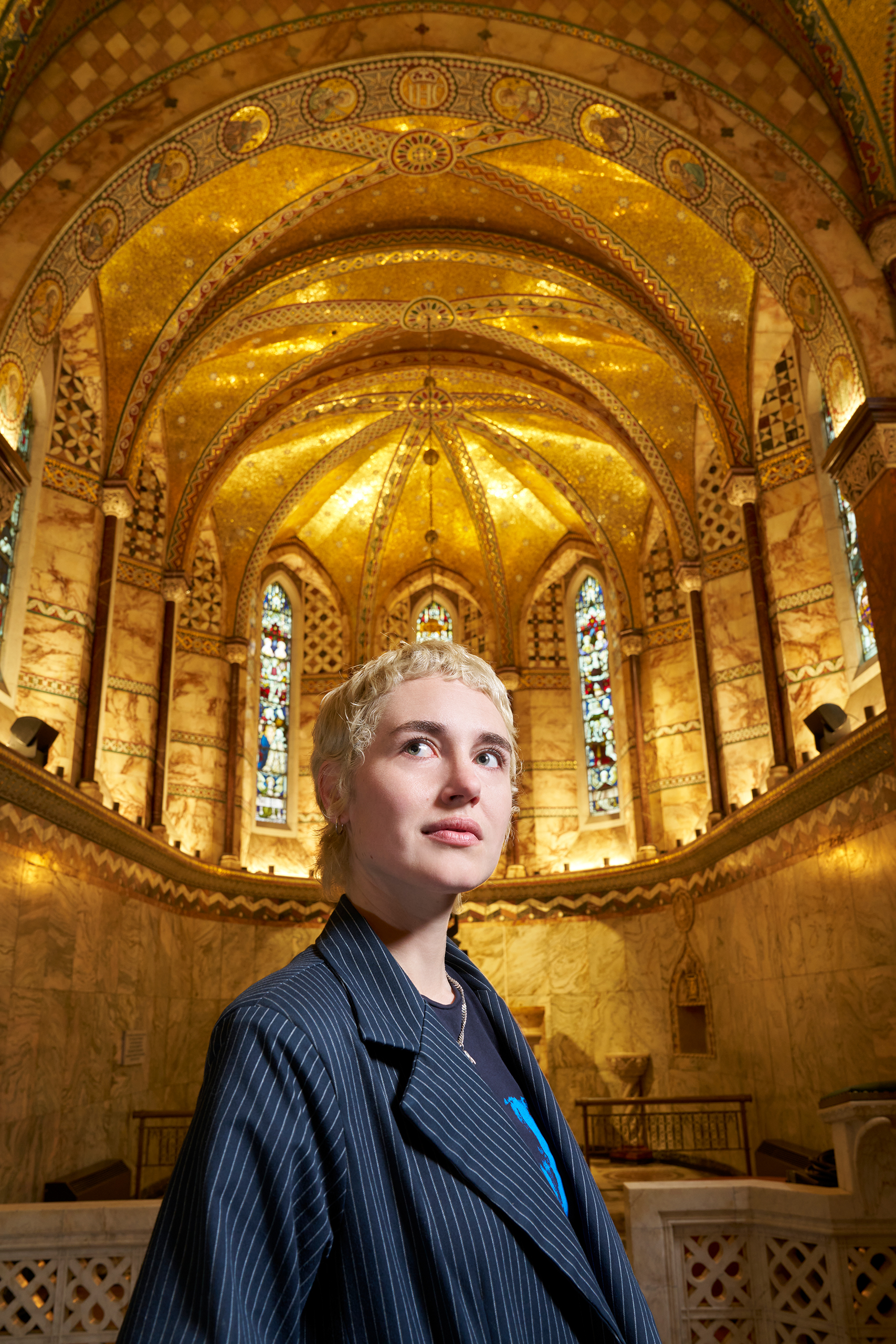
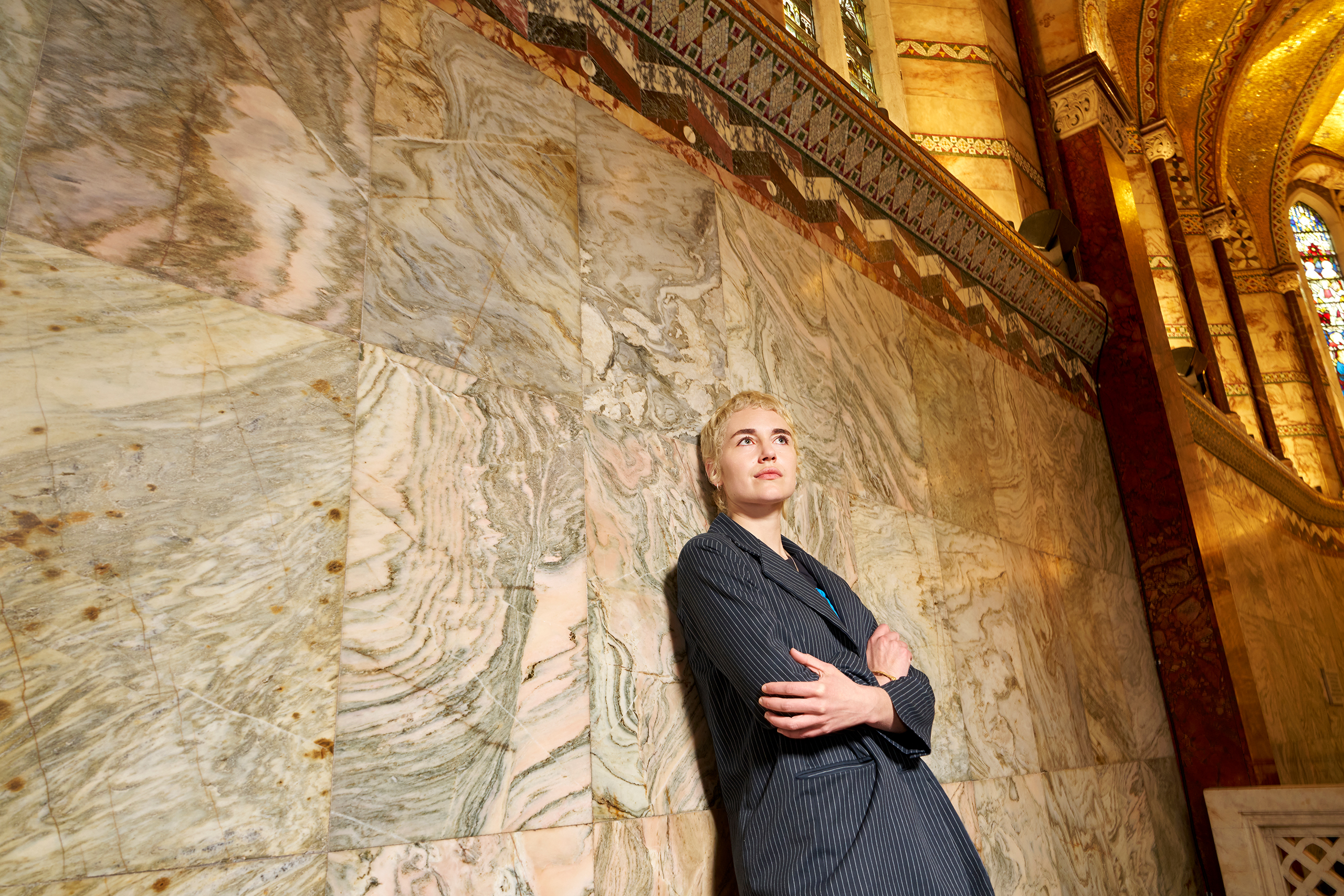
Say a little prayer: Lamona Ash, author of Don’t Forget We're Here Forever, at the Fitzrovia Chapel, London
Around that time, I was getting calls from journalists asking either if I could explain why Gen Z was becoming more religious (I’m not Gen Z. Actually, the higher I climb into my 30s, the more distant I feel from the generation below mine), or why the far right was allying themselves with Christianity. I had no definitive answers. I did have several years’ worth of interviews and stories from young Christian converts across the political spectrum, all of which suggested to me that the polyphony of world and local crises into which young people were now coming of age bore some relationship to their decision to explore the possibility of religious belief in their lives. I was grateful for the chance to dig deeper into the subject. On finishing my book, I had the distinct sense that where I had alighted was not really an end at all but a start. And yet, an unanticipated consequence of this modicum of exposure was the effect it then had on my own faith.
For more than a year, I had been attending either an Anglican church or a Quaker meeting house every Sunday. Both were close to my flat in north London, and both functioned for me as ports of solace into which I could bring all the knotty, novel feelings around belief that my research was stirring up in me and quietly, privately wrestle with them. Attending these serious houses on serious earth began to mean much more to me besides. My period of visiting them coincided with one of the hardest episodes of my life so far: a concatenation of heartbreaks, family illness and grief, all those challenging and ordinary life experiences you start to suffer through more regularly as you leave behind your youth. Within those places of worship, I found I was able to slow down, return to the root of myself and then look out once more at the world beyond the walls housing my own troubles. Most importantly, at church and in Quaker meetings, I discovered how to pray. And, whether or not I believed my prayers might reach God, whether or not I could consistently discover belief in God, the ritual of prayer (which at its most crystalline form looked like a plea for mercy: for myself, for my loved ones, for the world) helped me.
Church-going offered me all of this. But as soon as my work required me to start speaking publicly about Christianity, I stopped showing up entirely. Suddenly faith felt too freighted, too charged a subject for me to engage with personally. The more openly I talked about it, the more I was privately overwhelmed by doubts. I’d wake up on Sunday morning with the best intentions and find I could not bring myself to make the short walk over to either church or meeting house. Eventually, I decided I had no energy left to wrestle with belief, and conceded the fight. To make this renunciation more marked, I took off the St John’s Cross I had been wearing since buying it in 2023 in the port town of Oban on the way back from a Christian retreat on the Inner Hebridean island of Iona (the birthplace of Christianity in Scotland). I stashed it at the back of a jewellery box in my room. And for a while, that was the end.
I use love as an analogy because I’ve more practice in loving than believing
I use love as an analogy because I’ve more practice in loving than believing
Several months later, in the last gasps of a strange hot summer, I attended Greenbelt, a left-wing Christian festival held on an estate in the Midlands, where I had been invited to participate in a couple of talks. It was the first time I’d been in a religious environment in a while, and I didn’t know how I should go about discussing Christianity with all these committed believers without sounding like a total phoney – whether to admit to them that what little faith I’d accrued was lost.
But then, on my first night, I fell in step with a large intergenerational gang of festival-goers from the Anglican church I used to attend, at a pop-up pub named, of course, the Jesus Arms. Somehow, in my time apart, I’d built up in my mind how certain in belief a person had to be just to participate in the rituals of religion. And yet here was a bunch of gentle, generous people who grappled daily with their faith. Alongside them, for those few days, belief felt more plausible, understandable, less terrifying to me again.
I left soon after the sun had set following my final talk. For what felt like hours, and in an unusually meditative state, I flew along dark lanes listening to a Radio 1 late night drum ’n’ bass show. For the first time in a long time, over the music, under the cover of darkness, I imagined arranging my thoughts into a form resembling prayer, thoughts directed not to the earth but upwards. “Hello,” I began. “It’s been a while…”
For a time I returned to church. And then I dropped out again – I could not make it stick. My faith felt neither habitual nor strong enough to withstand my only occasional engagements with it, as though church was a petrol station,and now I was beached on the hard shoulder, my tank run irrevocably dry. This was in spite of the fact that I had by then met so many Christians whose faith depended neither on attending church nor even calling themselves believers, but instead flowed out through their lives by way of their actions and interactions, like those Quakers whom I would walk in silence beside at protests who wore pins declaring “DEEDS NOT WORDS”.
I arranged my thoughts into a form resembling prayer, thoughts directed upwards. ‘Hello,’ I began. ‘It’s been a while…’
I arranged my thoughts into a form resembling prayer, thoughts directed upwards. ‘Hello,’ I began. ‘It’s been a while…’
And then a few weeks ago, my relationship to faith altered once more. Perhaps this ebb-and-flow motion will never cease for the rest of my life. Perhaps I am, through birth and circumstance, the kind of person who will never manage a steady sort of faithfulness.
It happened at a small Christian retreat close to Birmingham, where I’d been invited to speak as part of a conference run by a group of Anabaptists. Sometimes it hits me suddenly on entering such places how different my life now looks because of my several-year engagement with Christianity – my friends now responding to my texts announcing I am away at some Christian festival, giving a talk at a cathedral in Essex, hanging out with some Anabaptists in Birmingham, with a quick, teasy “Of course you are…” In this small way at least, I am changed from who I was before all this began.
The retreat was held at a large house close enough to the M5 that our days and nights were accompanied by a constant roaring score. All the Christians present existed at the fringes of their religion, in its margins. As I got to know them, I realised I could find no better way to describe their way of engaging with the world than Christ-like – a word I would never have used previously, but which now feels uniquely placed to describe the remarkably generous and self-sacrificial ways in which some people feel called to live. What I am saying is that these guys were good: they acted out of a kind of love that seemed excised from selfishness.
I was there to run a session called How Faith Changes Us? (in the event programme they’d added that handy question mark to the title, which suited me). When I began, I admitted I felt so far from faith that I wanted to start instead by considering how love does or does not change us, then see if that might open up some further thoughts about the relationship between love and faith. I always seem to fall back on love as an analogy for faith. I guess because I have more practice in loving than in believing, and because I think the leap required to pursue both romantic love and religious faith have something in common, as well as the continual leaps required to maintain either.
The house was at the mercy of the weather. Throughout my session the winds rattled its large windows and shook the large plane tree in the grounds. I read to a crowd some of American cultural theorist Lauren Berlant’s thoughts around romantic love – how love can never be an “entirely ethical” or “purely political” concept due to its relationship with desire: our attempts to love well get polluted by all the other grotty, often unconscious human needs and wants we come to one another with. We must recognise that love is a “mess-making force”, Berlant wrote, and that such a force “does not clean up the world well”. Like love, faith is also, more often than not, a mess-making force. Lived out by human beings, how could it not be?
At the same time, Berlant suggested love is also “one of the few situations where we desire to have patience for what isn’t working”. I find that beautiful. These days we are so impatient about most aspects of our lives, requiring those things we want to appear in front of us already resolved and refined. When it comes to love, though, patience is mandatory because none of us turns up in a loving relationship already sorted, perfected – nor will we ever get there. Instead, we must hope for enough patience that together in love, over time, we might build something strong enough at least to weather a little wind and rain.
All this reminded me of what a priest I met while writing my book had told a young person who turned up at his office one day. “I’ve been trying to go to church,” the young person confessed. “But I’m finding it really boring. It’s hard to commit and I feel like it’s never going to work on me.”
“Well, of course,” the priest replied. “You have to give it at least 20 years before anything actually happens to you.”
After reading at the house on the M5, I confessed to those present I had not waited 20 years – I’d given up already, and so lost my faith. They asked what I meant. I explained I’d stopped going to church and so now felt like a phoney. They looked at me like I was someone very young, which I suppose to many of them I was.
“When you don’t have a person to love,” they said, “you don’t lose your capacity to love: it just gets directed elsewhere. Perhaps faith is a little like that, too.”
I had assumed that each time I took leave from church, I lost the right to call myself a person with any faith. And yet, when I have no one to love, I never imagine that my capacity to love has disappeared, that there is no residue of love left in me. I only realised in the moment of hearing it from the Christians at the retreat near Birmingham that the faith I’ve felt move through me in certain moments during the past few years has already altered who I am. It may be only a partially new, and often a little smeary lens that I’ve gained, but that still affords me a slightly altered view of things – and isn’t that all we’re hoping for when we set out on any journey of exploration? To see where, if anywhere, faith might take me next, all those ebbs and flows to come, it just requires a little patience.
Don't Forget We're Here Forever by Lamorna Ash (Bloomsbury, £10.99). Order a copy at observershop.co.uk for £9.89. Free UK delivery on online orders over £25
Newsletters
Choose the newsletters you want to receive
View more
For information about how The Observer protects your data, read our Privacy Policy