
The restaurant critic AA Gill once admitted that while he always booked under a false name, he never wore a disguise. Reviewers who altered their appearance to dine anonymously were, he wrote, weird, self-obsessed and probably American. Which meant that, peering out from a restaurant’s pass – where photographs of London’s great critics were often tacked for reference – chefs usually knew when Gill was “in”, and felt a quiver of anticipatory grief. He wielded his columns like sabres, slicing through reputations for sport. “Inedible unless you are as drunk as everyone else in the room,” he once wrote of the food served at one Notting Hill restaurant. Later, he described a meal served at Café Royal as “depressing and uncongenial” made “even more wrist-slashingly ghastly” by “the sad and silent ghosts of a century of culture and élan and bibulous brilliance”. His pans were designed to wound, entertain and, of course, sell newspapers.
This figure of the glowering critic – peering dubiously at a plate of pasta through his pince-nez, waving away an overattentive waiter as though dispersing an aromatic belch – was once so fixed in the western imagination that Pixar could build an entire film around him. In 2007’s Ratatouille, the food critic’s carapace of hauteur cracks only when the scent of a red sauce carries him back to his mother’s cooking. In hindsight, that should have been the warning: the restaurant critic’s power was already waning. The film nudged audiences towards a gentler, more psychologised reading of criticism, one that suggested old-school hardliners might have been successful influencers, had only they bothered to get some therapy.
By the time the pandemic took hold in 2020, the appetite for the gleeful barb appeared to have vanished. Harsh reviews began to feel not just ungenerous but unethical, as restaurants limped through lockdowns and staffing crises. A decade of swimming in algorithmic tides had seemingly trained audiences to trust enthusiasm over judgment. And as London’s cultural media has contracted, the power a critic once wielded feels ever more like a period fantasy. They don’t write them like that any more and, even if they did, who’s reading?
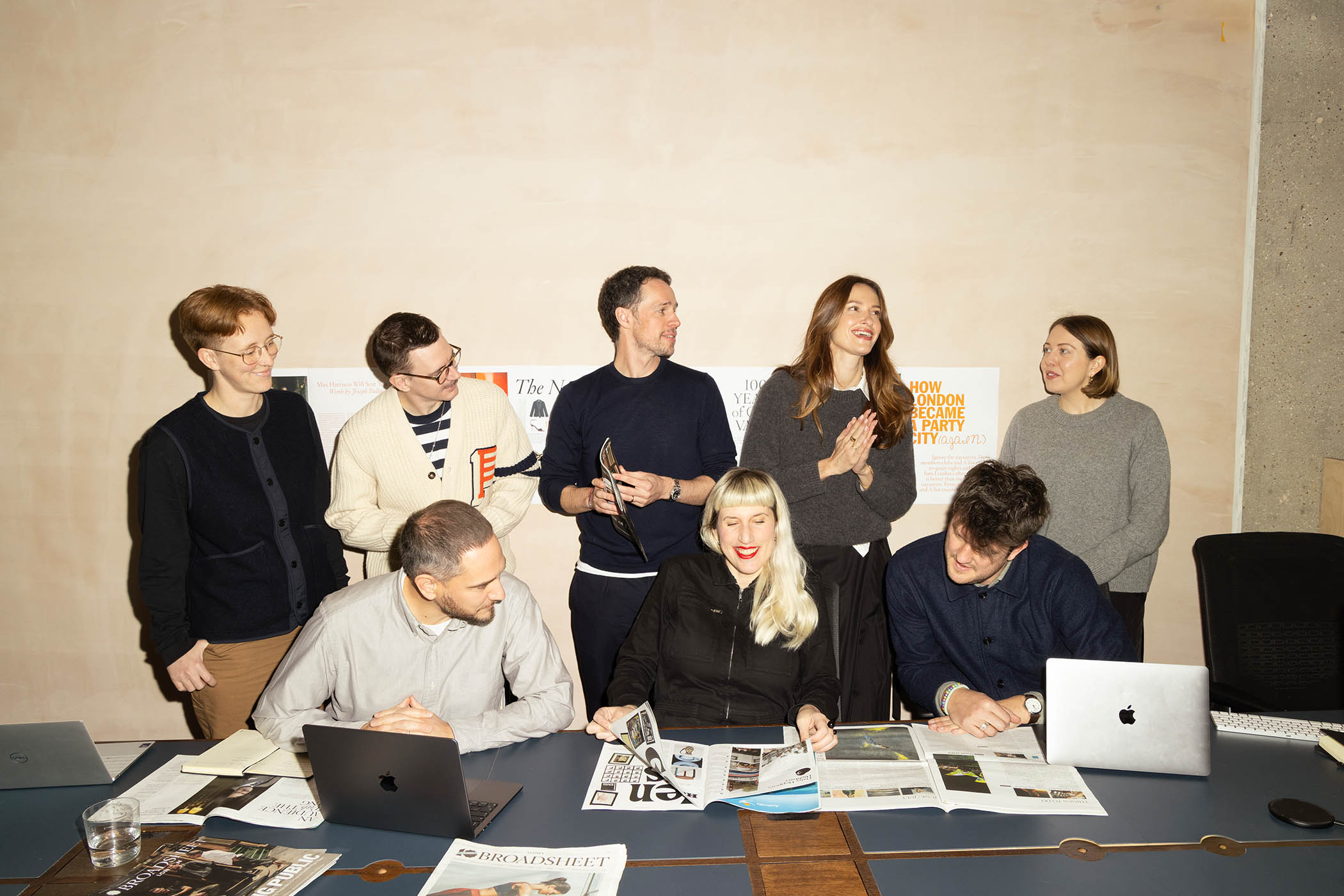
It’s into this transformed landscape that Broadsheet arrived in September: an Australian import with the name of an old-guard newspaper and the temperament of a lifestyle feed, promising a new way of engaging with the city’s cultural life – or perhaps the final mutation of an old one. The publication, which comes as an email newsletter, a website, a constellation of social channels and a free, quarterly print magazine, makes its ethos clear not only through its coverage but also through its obvious omissions. Broadsheet doesn’t just avoid publishing scathing reviews, it evades any shade of negativity, adopting a “highly curatorial” approach, in the phrase of its founder, Nick Shelton. “We only write about what we like,” he told me recently. “We don’t waste anyone’s time on a bad review.” The mantra for Broadsheet’s writers is simple and unwavering: “Be enthusiastic; be positive; celebrate.”
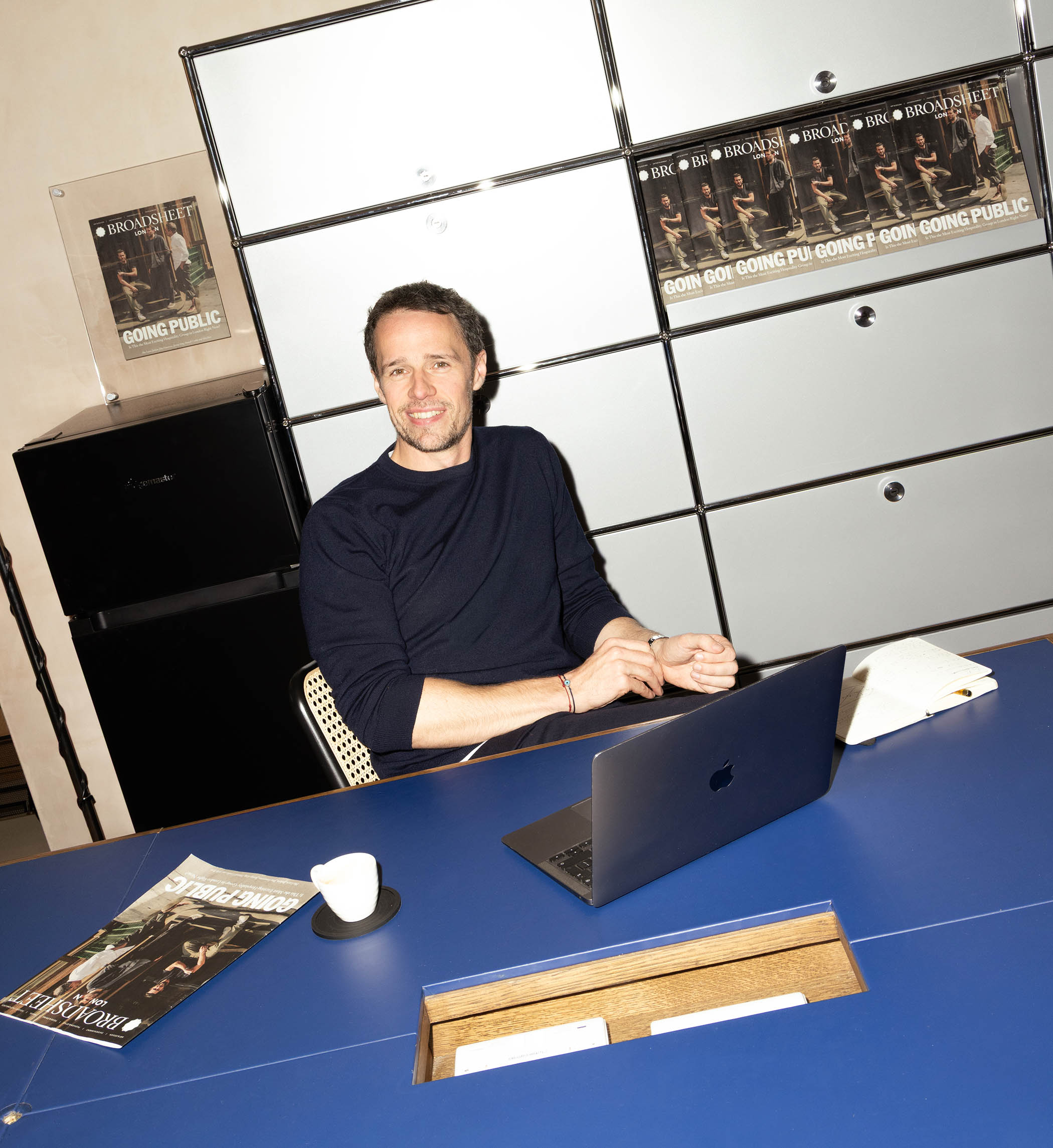
Nick Shelton: founder and publisher of Broadsheet, in his London office
I met Shelton for coffee on a cold November Monday at Toklas Bakery, a short distance from the outlet’s new London base at 180 Strand, a cavernous brutalist block near King’s College, now home to a growing colony of media outfits. Shelton, gym-trim at 41, had a restless intensity common to many founders. He spoke softly and cautiously, and dressed in wealthy understatement.
Shelton was born in Melbourne, but spent his childhood shuttling between cities – New York, Toronto, then back to Australia – following his father’s work as an investment banker for JP Morgan. After he graduated university with a degree in politics and film he moved to London, pulling espressos in a café off Soho, enjoying the long nights of his early 20s. “I found the city incredibly exciting,” he told me. “But I had no idea where to go or what to do.” If you wanted to find a restaurant, you waited for the Sunday supplements, he recalled. The broadsheets typically offered a single pick, a lone anointed spot, often expensive, usually irrelevant to a young barista living in a share house in Earl’s Court. London offered a diverse cultural feast, but no one seemed to be keeping a map.
When Shelton returned to Melbourne, the city’s food culture had begun its own transformation. By the mid-2000s, speciality coffee, small-plates dining and no-reservations restaurants were burgeoning. “This cultural shift was in the zeitgeist, but there was no coverage in the media,” he said. So, with the unearned confidence of a 20-something, he decided to build the thing he’d searched for: a daily, digital guide to the cultural life of a city. With the help of a school friend and a $20,000 overdraft guaranteed against his parents’ house, he launched a blog in 2009, coaxed a handful of freelance writers away from newspapers, and called it Broadsheet: a name that, amid the eruption of new web-based media, combined light irony and borrowed grandeur. “We wanted something that sounded high-quality, but irreverent,” he told me.
Broadsheet earned its revenue from “integrated partnerships” and “branded content” – what is often sniffily called advertorial – working with top-tier multinationals like Mastercard, Disney and Mercedes-Benz, as well as local outfits, including a surfing museum. The model worked. Broadsheet soon expanded to Sydney, Brisbane, Adelaide and Perth; today it’s Australia’s second largest independent publisher. Its signature was its sense of experience: not just where to eat, but what it felt like to eat there. Its photography was warm and atmospheric. Its writers were well-sourced; some were embedded as chefs or bartenders themselves, experience that gave them, Shelton said, “true insight”.
Some saw the outlet as prioritising style over substance
Some saw the outlet as prioritising style over substance
In 2015 the Guardian wrote about the “Broadsheet effect”, whereby a restaurant mentioned in the morning could have a queue around the block by the afternoon – a claim that reads a bit like online grooming for people who work in food PR. Still, at the time, Broadsheet’s reputation was uneven. In the early days Australian freelance writers complained of lowball word rates. (Shelton insists this was in the “pre-revenue” days. The publication now pays some of the higher word rates in the UK, even for less experienced writers). And some saw the outlet as prioritising style over substance. A food writer recalls visiting a restaurant in Sydney that had been recommended by Broadsheet. The food looked appetising, but tasted bland. “Oh yes,” a local writer remarked, when the visitor shared their experience. “We call that a Broadsheet: looks great, tastes awful.”
Shelton will admit he is interested in how food tastes, but only to a point. What truly animates him, then as well as now, is everything around the plate: the décor, the lighting, the music, the choreography of staff and clientele. “I’m not asking [our writers] to tell me if the pasta was overcooked or unsalted,” he told me. “I want them to tell us whether the experience is worth a person’s time.” In Broadsheet a place can be recommended because it was fun, or because the cocktails were great, or because it offered something – energy, intimacy, novelty – that made it worthy of someone’s evening.
Newsletters
Choose the newsletters you want to receive
View more
For information about how The Observer protects your data, read our Privacy Policy
Sonya Barber, Broadsheet’s London editor, told me later, “They’re not reviews.” Most Broadsheet pieces are, in fact, news-led: an opening announcement, a chef profile. And they are chosen because the team believes in them. The positivity isn’t naive but strategic, perhaps humane, Barber said. “There’s so much negging on the internet now. The world’s kind of a horrible place. It’s nice to celebrate what people are doing, instead of someone whanging on about having a shit dinner.”
This is an ethos born of experience: Barber worked for Time Out for years, Broadsheet’s commercial director Paul Davison was formerly a VP at Vice, while editorial director Katya Wachtel holds a double master’s from Columbia Journalism School. Their choice to lead with positivity is an editorial response to the fact that traditional outlets are mostly in retreat. The Evening Standard has folded its daily print edition; Time Out has withdrawn to an online-only model; while the much-loved Eater London – which delivered canny, characterful food writing threaded with wry scepticism – closed in 2023. The Observer is yet to replace its star critic, Jay Rayner, who left the paper earlier this year.
The choice to lead with positivity is an editorial response to the fact that traditional outlets are mostly in retreat
The choice to lead with positivity is an editorial response to the fact that traditional outlets are mostly in retreat
Some independent newsletters, digital titles and podcasts have filled the void – Vittles, London Centric, The Londoner, The Fence, The Slice, the Ruth Rogers’ podcast Ruthie’s Table – but influencers better adapted to the algorithmic economies of social media now govern cultural attention around the city’s restaurants. On Instagram, TopJaw – fronted by Jesse Burgess and Will Warr, who present as genial lads-about-town with cinema-grade cameras – has almost 1m followers, an audience that now outmuscles the circulation, if not the readership, of many newspapers.
Whether our capital needed another guide is debatable. What’s clear is that Broadsheet sees an opening, a loosened seam in the cultural fabric where a new narrative might take hold. “We think London is the most exciting cultural city in the world right now,” Shelton told me. Not despite the last decade, but because of it. “It has been through Brexit, the cost-of-living crisis, Covid. But often after things get tough, you get this fizzing cultural energy.” He described to me a city renewing itself from the grass roots: young operators opening restaurants, new fashion studios and theatre companies, ideas flowing in from Europe and beyond. “We’ve been inundated with stories of people doing genuinely interesting things here in food, drink, fashion, design, art. And we don’t think London has the media it once had to capture that.”
The scarcity of London media has produced its own unlikely solidarities. Joanna Taylor, who spent five years reviewing restaurants at ES Magazine before she was “flung into freelancer life” when it closed, told me, “It’s nice, in an industry where so many business owners are struggling, to actually big up the small independent people doing interesting things rather than trying to land the zinger.” Joseph Mackertich, editor of Time Out London, who is sanguine about Broadsheet’s arrival, said, “It’s always great to see new editorial brands pop up in London. Anything that creates new jobs and opportunities in UK journalism is absolutely fine by me.” You would imagine that the editor of Time Out London would consider Broadsheet a direct competitor. But in an industry this depleted, it seems collegiality is no longer optional.
Londoners are allergic to anything too slick, humourless, or self-consciously cool
Londoners are allergic to anything too slick, humourless, or self-consciously cool
In private, however, there is cynicism from those who have worked at the hard edge of food and lifestyle publishing in recent years. One editor I spoke to wondered whether Broadsheet’s gloss could survive contact with the city. “Londoners are allergic to anything too slick, humourless, or self-consciously cool,” he said. “Especially something that already looks like an advert.” He also questioned whether an aspirational brand could feel authentic when its staff are “a handful of 30s-somethings in Walthamstow writing about a world that isn’t really theirs”. Readers can often sense when a writer is performing a higher-earning lifestyle rather than inhabiting it, he suggested. In London, where class signals are read with forensic acuity, there is a fine line between aspiration and cosplay. And beyond tone, there’s the economics. “These things are expensive to run and not profitable for ages. So, they’ll be understaffed and under-resourced for a while. Which is fine if your brand is a scrappy underdog, but less so if you’re going for something highly aspirational.”
Despite these concerns, Broadsheet’s arrival seems to chime with a broader generational shift. Gen Z came of age in an online world saturated with scathing takedowns, rushes to judgment, the hot-flush righteousness of mob-cancellation (sometimes justified, but often with the unpleasant aftertaste of a puritanical witch-hunt). “Be kind” emerged as the corrective refrain, acceptance and affirmation the preferred stance. Against this backdrop, the Gill-like critic began to feel not merely outdated but indecent. We are now far more attuned, thanks to TikTok reveals and behind-the-pass confessionals, to the anxieties of the chef watching timorously from the kitchen, and the pot-washer, whose rent money depends on the chef’s reputation.
“Immediately post-Covid, food media became acutely aware of the precarious circumstances restaurants were in,” said Matt Buchanan, the former executive editor of Eater, now food editor for the San Francisco Chronicle. Even critics who prided themselves on a strict separation between journalism and the industry they covered found themselves hesitating. How do you fairly review a restaurant running on one server, a skeleton kitchen and QR-code menus? How do you grade a dining room still metabolising the trauma of a near-death experience?
In that climate, something like an informal ceasefire emerged. Star ratings were suspended; outright pans evaporated. Publications of all sizes adopted the same calculus Buchanan described: don’t punch down. Even corporate chains, where tough critique has always felt more like public service than cruelty, were spared negativity. And woven through all this was a sharpened class consciousness that had already been rising across digital media in the 2010s. Restaurants weren’t abstract cultural objects any more, they were workplaces, often staffed by migrants and hourly workers. Writing a takedown suddenly seemed less like a witty flex and more like kicking out a support beam in a fragile ecosystem.
Post-Covid, the food media became acutely aware of the precarious circumstances restaurants were in
Post-Covid, the food media became acutely aware of the precarious circumstances restaurants were in
For Adam Coghlan, editor of restaurant reviews at Vittles, the death of the pan predated even the pandemic. At Eater London, which he edited from 2017 until its closure in 2023, traditional reviews were never part of the project. “There’s this sense that all restaurant coverage is the restaurant review,” he said. “But we wanted to treat the restaurant industry as an industry, not as entertainment.” Eater’s tone came from early-2000s New York and LA blogging culture – “upstarty,” sceptical, structurally anti-grand – and its features did the narrative and contextual work of criticism without the adversarial set-pieces.
After Covid, Coghlan noticed not so much a retreat from criticism as a reckoning. “There’s a generosity. A sense of responsibility to an industry struggling perhaps more than it ever has,” he told me. When the subject of criticism might not survive, he asked, “what’s the point of a pan?”
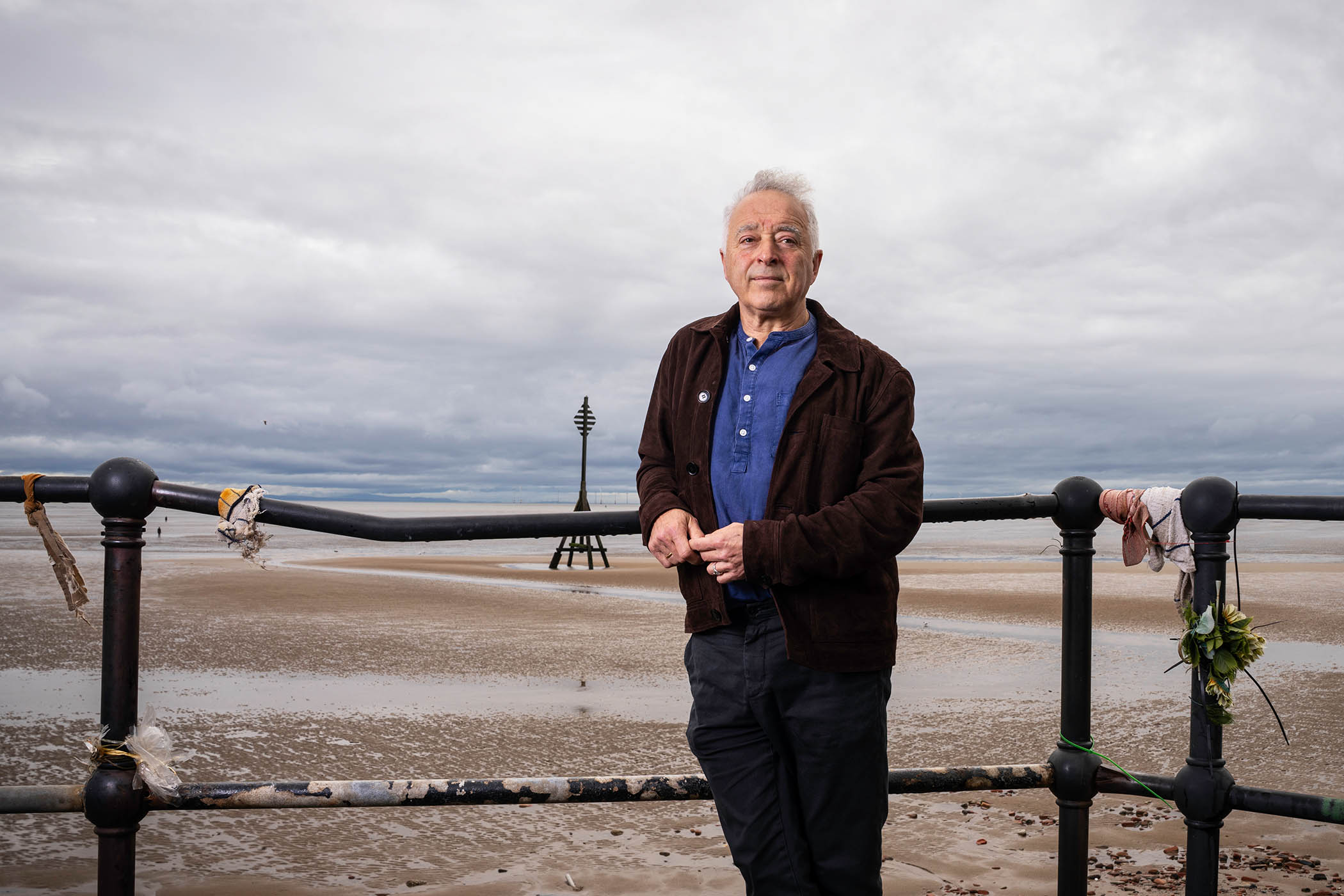
But Jay Rayner, who after 25 years at The Observer became the Financial Times’s restaurant critic earlier this year, bristled at the idea that the pandemic softened critics’ spines. In his view, it merely clarified their responsibilities. “I said at the time that I wouldn’t be publishing negative reviews for the foreseeable,” he recalled. “Did I really think readers wanted to see a small struggling place get a kicking?” Instead, he reserved ire for the overcapitalised and the absurd. The point, for him, was less about kindness than about service: not killing a neighbourhood restaurant that might fold under the weight of a printed barb. “I went somewhere recently,” he said, “and if I’d said what I was really thinking, I’d have killed the business dead. Better to leave it to itself.”
Terri Mercieca, who runs the London ice-cream company Happy Endings, has watched this fragility play out in real time. “A critic can destroy someone’s business in five seconds,” she told me. “People need to understand their responsibilities with that. Whether you like the place or not, those people are working hard. Their families think they deserve to be there.” For Mercieca, food media has always been a system rather than a hierarchy. “If Time Out, Eater, or London on the Inside hadn’t written about us at the start, we wouldn’t have survived.” But she has also felt the disruptive force of the new regime. A few months ago, a micro-influencer bought Happy Endings ice-creams, filmed a 15-second taste test and posted it to TikTok. “It went mental,” Mercieca said. “More than half a million views. That one video gave us more coverage than anything.” To Mercieca, virality rarely correlates with quality. “Sometimes something blows up and you try it and it’s shockingly bad. I can’t understand some of the stuff that goes viral.” Her point, ultimately, was ecological rather than nostalgic: a healthy food culture depends on a plurality of voices, of critics, newsletters, influencers, editors, and not on a single algorithmic gust of good fortune.
Whether you like the place or not, those people are working hard
Whether you like the place or not, those people are working hard
Even as the industry recovers unevenly (buzzy openings packed, mid-tier independents still struggling), the old appetite for the gleeful barb hasn’t quite returned. Buchanan suggested the first truly negative reviews in the US only began reappearing in late 2023, and even then, were wielded with unusual restraint. In this post-Covid landscape, Broadsheet’s cheerfully unilateral positivity doesn’t feel like an outlier so much as an endpoint: the logical extension of a moment in which tough criticism became not only unfashionable but morally fraught.
In London, however, the old guard (and their sharp elbows) hasn’t disappeared entirely. The city still has its standard-bearers in Rayner (59), Grace Dent (52) and Giles Coren (56), the trio of critics who retain the rare privilege in British media of eating on an outlet’s expense account, and whose verdicts can still jolt a restaurant’s bookings. Some influencers, consciously or not, attempt to mimic the posture of the traditional critic. “A lot of them want that old-school clout,” said Taylor, citing TopJaw’s Burgess, whose fans treat his pronouncements with the kind of reverence once reserved for broadsheet reviews. It is a reminder that while the tone of criticism may have softened, the desire for arbiters and, especially, the power that comes with being one, remains active.
Perhaps in this spirit, Broadsheet London has put Jimi Famurewa on the books. The former Evening Standard food critic and occasional MasterChef judge is an experienced, thoughtful writer, attuned not only to flavour and technique but also to the cultural and social forces that shape a meal, sometimes across generations. His remit, Broadsheet’s editor Barber told me, is a weekly column in which he can write more expansively about the food and hospitality industry. “It’s not going to be all Pollyanna stuff, whereby everything’s amazing,” she said. “Obviously the restaurant industry is struggling. Our other cultural institutions are struggling. He’ll be addressing that.”
Famurewa is clear-eyed about how restaurant discovery has migrated to TikTok clips and Reddit threads, but he told me that the authority of the traditional critic has not disappeared so much as narrowed into a different kind of power. Diners may find places online, he said, but restaurants themselves still crave the imprimatur of a trusted voice. “You only need to look at the day after a restaurant review comes out,” he told me. “Chefs are holding aloft physical copies of it. It becomes their pinned post. They print it out and put it in the window.” For all the atomised chatter of social media, this literal brandishing of a critic’s words reveals where symbolic capital still resides. Influencers can deliver millions of views, but only a critic can confer standing: a sense that a place is not just popular, but worth something.
They were reading for the writing – for the vicarious pleasure or displeasure
They were reading for the writing – for the vicarious pleasure or displeasure
If some of the old-guard of critics seems embattled by the rise of TikTok arbiters and Instagram taste-makers, Rayner, who categorises Broadsheet as “service journalism”, also appears unmoved. The idea that influencers have displaced critics, he argued, misunderstands the entire ecology. “The people who like reading old-school newspaper-style restaurant reviews are not going to migrate off in a different direction,” he said. “They were reading for the writing – for the vicarious pleasure or displeasure.” Influencer channels such as Eating With Tod, he noted, have created new audiences, not cannibalised existing ones. “There will always be others who read our columns for the writing. Who like the turn of phrase,” he said. “Nobody watches Eating With Tod for his turn of phrase.”
The two modes serve different appetites, he said, one narrative and literary, the other immediate and visual. “It’s only a problem if it’s better than what we do,” he shrugged. “If the stuff on Instagram or TikTok is more informative and more entertaining, then we will die – and we’ll deserve to. But I still think there’s a place for us, if what we do is different.”
The retreat of the pan is not just a restaurant story but a cultural one. The scathing review has thinned across much of culture (12 of the Guardian’s 18 zero-star reviews were published in 2010 or earlier), replaced by more holistic appraisals. Or, perhaps, just more compromised ones, revealing a loosening of the old boundary between critic and subject, opinion and advert, journalism and marketing. We now live inside a media ecology in which everything looks faintly sponsored, where enthusiasm reads as authenticity, and where it is increasingly difficult to tell whether you’re reading an appraisal or an endorsement, whether a glowing write-up is independent judgement, paid collaboration, or something in between
That blurred proximity hints at a philosophical tension running not only through Broadsheet, but through this moment in media. What happens when a publication that looks like a broadsheet behaves more like a booster? Can positivity be a principled stance rather than merely a lucrative one? These are questions that, perhaps, the team at Broadsheet won’t have to answer. London’s food and creative industries have greeted its arrival warmly. The era when a review could empty a dining room is almost gone; the city no longer stiffens at the flash of a critic’s pen. It is too busy consulting Google Maps, parsing half-star increments in search of an infinitesimally superior bowl of ramen, according to the wisdom of the anonymous.
“Critics criticise so that everybody else can get on with enjoying themselves,” Gill once wrote. “We are civilisation’s traffic wardens.” Today those old wardens are few, and the billboards are taller than ever. Whether this transformation signals a gentler metropolis, or merely one more susceptible to suggestion is, for now, impossible to say.