
Related articles:


Monica Wilde’s kitchen shelves are crammed with all manner of medieval-sounding ingredients: acorn meal, pendulous sedge flour, beefsteak fungus wine. “People come to my house and they’re, like, ‘Oh, it’s a witch’s cave,’” Wilde told me recently. I’d arrived at her home to find dried mushrooms and seaweed in glass jars and the cold store filled with mysterious ferments and pickles. There was a room for brewing mead, cider and elderflower wine; a pantry with a dehumidifier full of acorns; a chest freezer packed with pigeon, roe heart, tubers, sloes and elderberries. These were not ingredients necessary for spells, but the fruits of extreme foraging. Almost everything in Wilde’s kitchen had been wild-harvested, except for a few staples, such as olive oil, butter and oats.
Wilde goes by Mo. She lives in a hamlet 20 miles west of Edinburgh, in a self-built, four-bedroom wooden home surrounded by trees. Aged 62, she is the godmother of the UK’s wild-food community, with 63,000 followers across Instagram, Facebook and Substack, where she writes a wild diary of sorts. Her kitchen is reflective of both nature’s bounty and Wilde’s passion for it. During my visit, it was difficult not to marvel at the hours that must have gone into the processes required to eat food harvested from the land: the drying, shelling, milling, fermenting, pasteurising, canning.
Wilde is best known for her year of eating wild food during lockdown, which she wrote about in her award-winning book, The Wilderness Cure, published in 2022. Her housemate, Matthew Rooney, a 63-year-old ecologist and fungi expert, joined her on the challenge; her other housemate, Geza, a 48-year-old Hungarian programmer, did not, though he helped build the house in 2013. (He was away during my visit.) “People always assume there’s some sort of polyamorous intrigue going on,” Wilde told me of her housemate setup, her voice briefly tinged with irritation. “We’re just three friends. These guys are my family – I love them to bits.”
Wilde made “lawn tea”, a “medicinal” mix involving honeysuckle, red clover flowers, rosebay willow herb, rose and water mint, and we sat and drank it at her kitchen table. Ahead of her year of wild, she had anticipated scarcity, especially in winter, but the experience proved that “we live in a place of abundance”. By the end, Wilde and Rooney had eaten 300 plant species, 87 different fungi, 20 types of seaweed and an astonishing 44 animal species, including wasp larvae, mussels, and squirrel, which tastes “sweet and nutty,” Wilde told me, and is “great for tandoori kebabs”.
What was also remarkable was how well they felt. After nine weeks, Rooney, a mild-mannered man of few words and big, re-wilded hair, had reversed Type-2 diabetes, and he felt “more healthy, more alert”. Wilde, who suffers from lipoedema, a condition that can make weight-loss difficult, dropped 30kg. Their success inspired Wilde to launch Wildbiome, a citizen science project that galvanised the foraging community into eating wild for one or three months at a time, in order to measure the health benefits. The food journalist Dan Saladino, who has covered Wilde’s work, introduced her to Professor Tim Spector, who provided the 24 Wildbiome volunteers with free gut-health testing through his supplement company Zoe. The results were encouraging: volunteers experienced a decrease in blood pressure, blood-sugar levels, inflammation – and perhaps predictably – weight, while vitamin D levels increased, possibly from all the outdoor foraging.
When Wilde shared the results online, “all of a sudden, people started messaging, saying, ‘Can I do this, too?’” she told me. Wilde obliged. More and more messages arrived. At her home, she showed me a freezer dedicated to the Wildbiome project, which contained 250 stool samples – the literal output of WildBiome 2, conducted last year, with 102 foragers. The samples will remain in the freezer until she can raise the £8,000 needed for testing.
Wilde has also worked with archaeologists at the University of Bradford. “The excitement for us is in having a group of highly dedicated people, led by Mo, that can give us a window into eating as past populations would have,” the lead scientist Dr Hannah Koon told me. By past populations she means pre-agricultural hunter-gatherers, who emerged about 1.8m years ago. The university’s 2025 pilot, which tested hair samples from nine foragers, found a reduction in inflammation and BMI in trailists, though also showed “some participants going into starvation, which isn’t ideal,” Koons said. They plan to do more testing this summer.
Wilde will be busy. In September, she will run a one-month Wildbiome programme, inviting participants to camp on her four acres. “It’s much easier working together,” she told me. “Some might go to the coast for seaweed, some to the forest for mushrooms, some might cook. It all happens organically.” Wilde enjoys gathering fellow foragers. “I’ve always liked living in community,” she said. “It’s how we evolved. It’s how I grew up.
Related articles:
Wilde was raised in rural Kenya, where her father worked as a barrister, and the local children were “fairly unsupervised, climbing trees, blowing up termite mounds,” and being dispatched on foraging missions by a village elder, a herbalist. She was sent to boarding school in Sussex, aged nine, where she found refuge in books – not “boring Darcy and drawing rooms” but Little House on the Prairie, Annie Get Your Gun and Women of the Oregon Trail. Reading “about what people foraged for or used as medicine was realising, ‘Oh, yeah, that’s like us,’” she said, and “I would try to follow their recipes.”
When her parents separated, Wilde, then 14, moved to Malawi with her father, and became “mother” to her five siblings. “I had to grow up quickly,” she said. She was often found carrying a copy of The Malawi Cookbook; chapter five, on insects, proved handy when war in neighbouring Mozambique caused “huge food shortages” across the country, “though even in Kenya we’d fry up flying ants with salt and pepper”. In Malawi she turned to herbal medicine. “I remember setting a friend of mine’s broken ankle when I was 15,” she told me. The man was in his early 20s; he’d fallen while swinging from vines on a group trip to the countryside. “I set it with leaves and brandy,” Wilde said. “Put a poultice on, bandaged it up.” The group didn’t return for another two or three days, “but when we did, he had an x-ray and was put in a proper cast, and they complimented him on whoever had done the first aid.”
Newsletters
Choose the newsletters you want to receive
View more
For information about how The Observer protects your data, read our Privacy Policy
After school, Wilde returned to the UK, went to art school, worked in theatre design, and, at 23, relocated with her future husband, a Scotsman, to the West Indies, to be nearer her mother. After nine years and three children, the couple separated. “He didn’t want them brought up English,” Wilde said, “so I was like, ‘Fine, I’ll go to Scotland.’” In 1995, she and her children, then aged one, three and seven, arrived in Edinburgh, which Wilde describes as “a big enough city to get a job, but not far from the countryside”. As an “unsupported single mum” she foraged to keep everyday costs down. The family ate a lot of seaweed; wild meat was rebranded as “chicken”. Ever optimistic, she’d spin the hardship into a fun challenge: throughout her children’s early years she was fond of saying, “Let’s see how long we can go without going to a shop.”
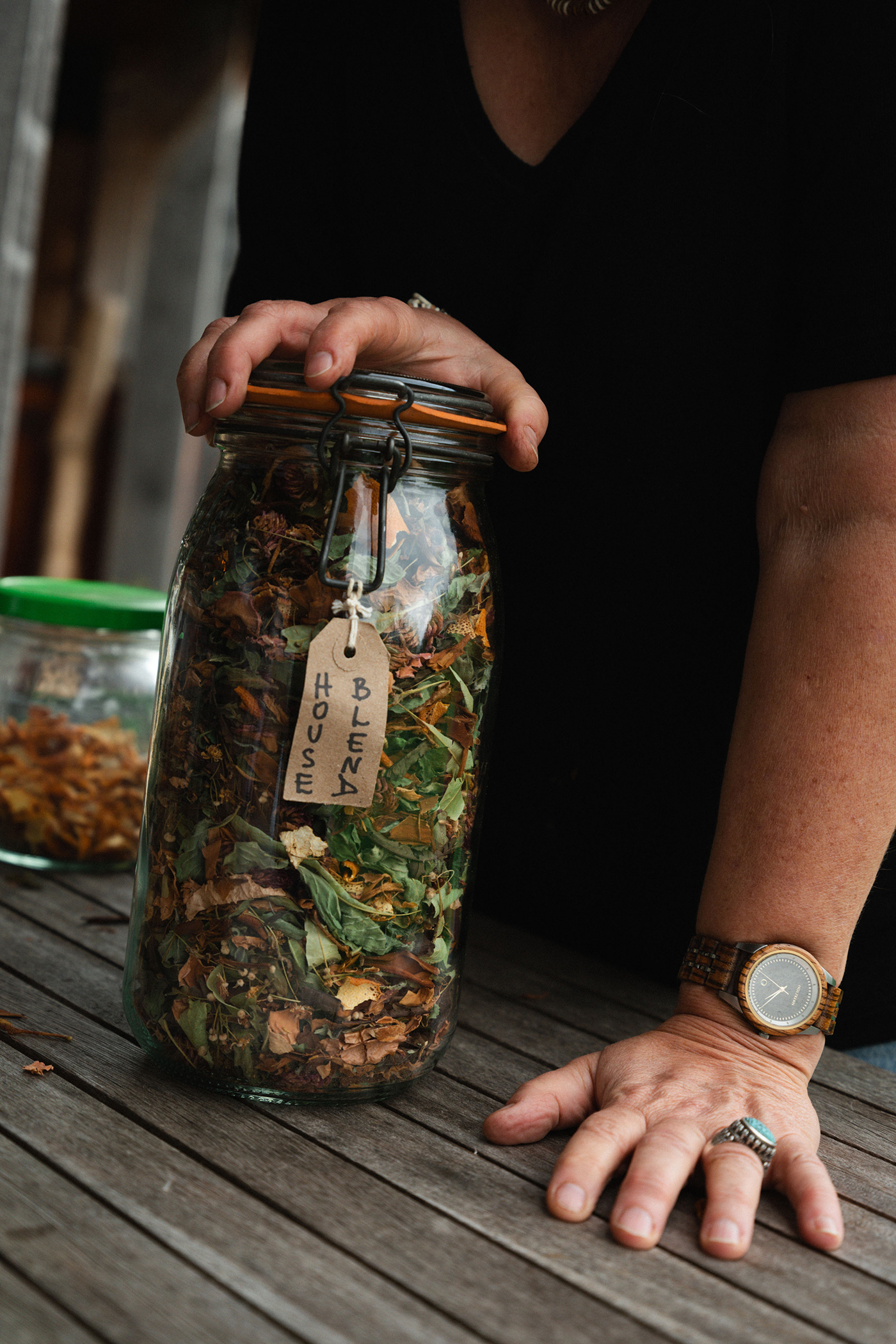
A tea blend of hawthorn, honeysuckle, red clover, watermint, and more
In 2008, a friend asked Wilde to run a foraging class for the Forestry Commission and as it grew more popular she realised she needed to “up her game” and began educating herself; she’s been teaching ever since. Her house is an autodidact’s dream – every spare wall is lined with books on nature, health, geography, history, anthropology and sociology. At 50, she completed an MSc in medical herbalism and now also works as a herbalist, specialising in chronic illness. In 2015, she co-founded the Association of Foragers, to “serve as a coherent voice to promote and support responsible foraging”. Last year, Simon & Schuster published her second book, Free Food: Wild Plants and How to Eat Them, written to help readers “identify the plants, seaweeds, nuts and spices that are safe (and delicious) to eat.” Like The Wilderness Cure, it became a bestseller.
At Wilde’s home, Rooney briefly went out to the garden and returned with a pretty basket of foraged leaves: primrose flowers, sweet cicely, garlic mustard, pink purslane. “We should eat supper so that the meat doesn’t get tough,” Wilde said. She brought a tray of roast goose breasts to the table. “We should always remember to thank the goose and to thank the land,” she said.
“Thank you,” we chorused.
Rooney’s leaf salad, topped with a ground ivy vinegar dressing, was delicate and balanced, with hints of aniseed and pepper. “I long for these salads in the winter,” Wilde said. The pink-footed goose, shot legally by a neighbour, was more challenging: dense, dry and unappetisingly dark-brown, it was baked in a paste of ground hogweed seed, which tastes like coriander, and Alexander seed, which tastes like fennel.
The absence of carbs on the table was intentional. “Because everything is always available in supermarkets,” Rooney said, “people forget that staples like wheat and rice are actually seasonal.” Pancake day, he added, should be our cut-off for wheat: “You wouldn’t have any more flour until autumn.” Before industrial farming, dairy and sugar were also seasonal, he added; foraging, by definition, brings a commitment to eating seasonally in a way that buying in-season strawberries from the supermarket can’t surpass. The public health nutritionist Dr Lucy Williamson, who cites Wilde’s “truly groundbreaking” Wildbiome project in her forthcoming book, Soil to Gut: How to Regenerate Your Health, told me that “because foraged foods are always seasonal, they’re at their most nutrient-rich, meaning they contain maximum antioxidants, which supports a thriving gut microbiome and helps to protect against inflammation”.
At one point during my visit, I asked Wilde why she didn’t always eat 100% wild, given its apparent benefits.
“It’s not the best use of my time,” she said. “And it makes it hard to travel,” Rooney added. “You can’t just stop at a service station and pick up a bunch of nettles.”
Most extreme foragers – including those in Wilde’s household – eat “wild fusion,” which includes “farmed ingredients” like “eggs, butter, oil, maybe some flour and sugar, ginger and garlic,” and is a diet which Wilde advocates. Sourcing wild fat is especially hard. “In spring, a roe deer probably gives a tablespoon,” Rooney said. But roe deer is a good source of protein. Wilde will eat culled animals as well as road kill, though she will only eat run-over herbivores and only if they are found in the morning. (The meat tends to be fresher as most animals are run over at night.)
Wilde has an air rifle for shooting rabbits and squirrels, which is legal if she does so on her own land, and she and Rooney do all the skinning and butchering themselves, though with flint knives, which “turns an act of butchery into an act of reverence, because you’re doing it more mindfully”.
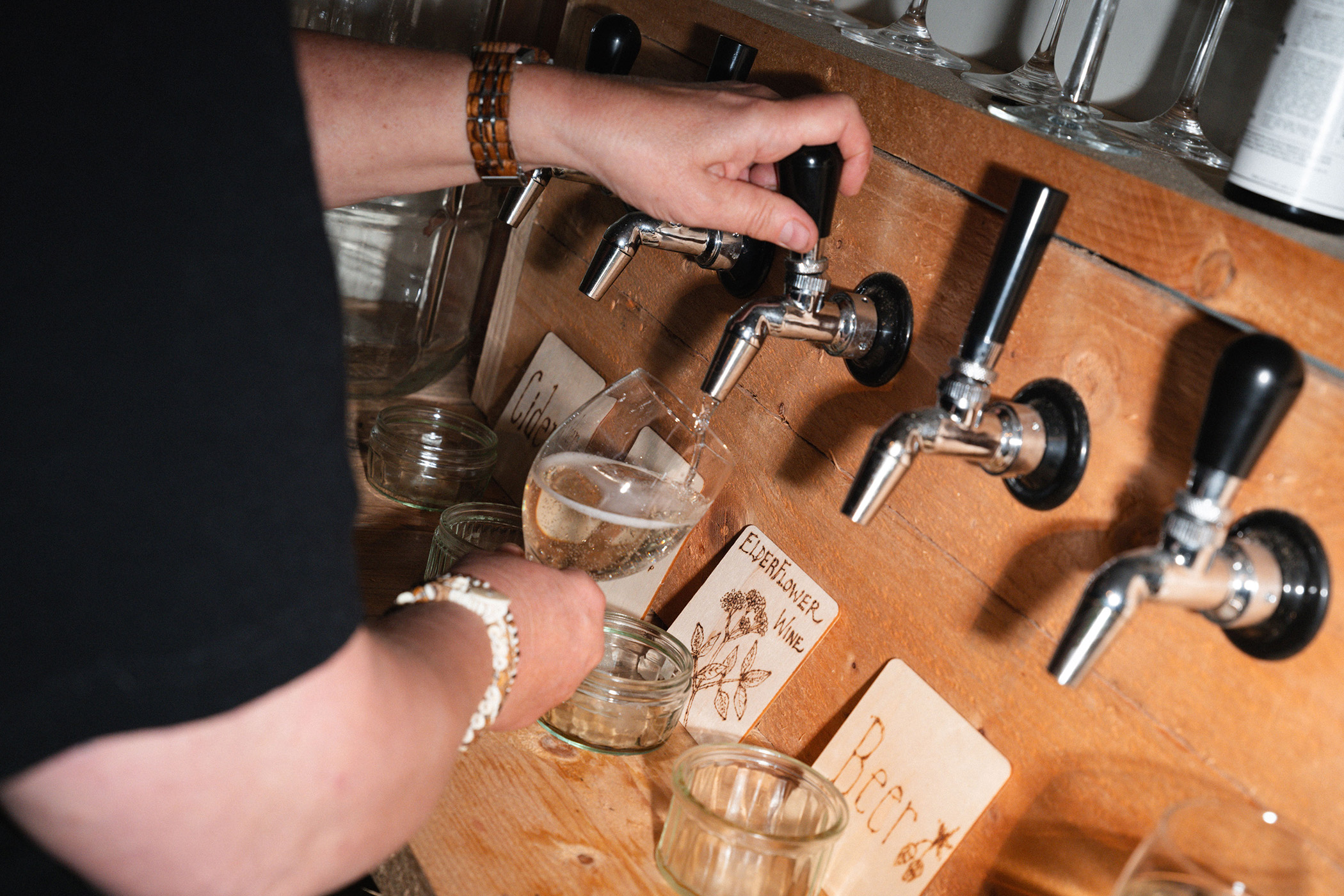
‘We have elderflower wine on tap from a barrel we made last year’
Wilde’s house is full of hunter-gatherer objects she has made herself: baskets woven from de-thorned brambles, shoes and bags fashioned from deerskin, a bow drill for starting fires. “It’s not that we want to return to a Stone Age way of life,” she said, “but I do passionately believe that you can combine living with some technology with a more sustainable way that doesn’t require buying everything.” Wilde is also passionate about “the pleasure you get from making your own basket, or foraging your own food – you feel free and peaceful. It’s how people have felt for hundreds of thousands of years.”
That evening, when the sun began to dip behind the hills, Wilde quickly turned in. She lives by the sun, she told me – she wakes naturally at sunrise, whatever the season, and goes to bed when it turns dark. “We’re constantly overriding our bodies with electric lights,” she said. “And jobs.”
The foraging trend is not new, particularly among professional chefs – foraged foods have existed on haute cuisine menus for decades. And yet it remains a niche activity among the general public. A 2020 survey covering 28 European countries found that only 8% of UK households reported collecting or using any of the 45 most commonly wild-harvested products – berries, nuts, mushrooms – compared to a European average of 25%. And yet the interest grows. A 2023 study found that almost three-quarters of adults would be keen to forage, if only they were taught how to do so safely.
Much of the increased interest in foraging has emerged in response to the world’s ongoing problems, including the Iran war, which has significantly impacted global food supply chains and, in the UK, the precipitous rise in the cost of living. Foraging, or at least the adoption of a wild- fusion approach to eating, where some items are foraged and others bought from a supermarket, can provide valuable cost savings. (When you’ve toiled so hard to put food on the table, you’re also less inclined to tolerate food waste.) Academic research published last year showed that foraging’s popularity was growing in cities, though often only among specific socioeconomic groups: foragers often identify as both “middle class” and “non-conformist” – for many, wild eating is a subtle form of resistance to a dependency on conventional food networks, a welcome exit from food globalisation and the carbon-intensive methods of Big Ag, and a stand against long- distance importing.
The same research indicated that foragers are “motivated by health, nature connection, individualism and environmentalism”. Wilde is motivated by all of these things, though she is particularly driven by health. Part of her thesis is that “50% of the world’s daily calorie intake comes from just three species: wheat, corn and rice,” which is terrible for our gut. It is also terrible for the environment. “Most six-year-olds can identify the same number of plants as an adult,” Wilde wrote in the Guardian last year, adding that “the inability to name fruit and vegetable species is a reflection of a wider decline in familiarity with the natural world” that “goes along with the growing inability to identify trees, birds, butterflies and insects.” She went on: “The loss of names translates to a loss of awareness, which blinds us to species decline and extinction. We don’t miss unnamed, vanished species until it’s too late – whether in the outside world or inside our guts.” At her home, Wilde told me that more and more foragers are young people who “feel that our social, economic and political structures are not going anywhere for them, so they’re trying to re-engage with the natural world. Foraging is just one part of that.”
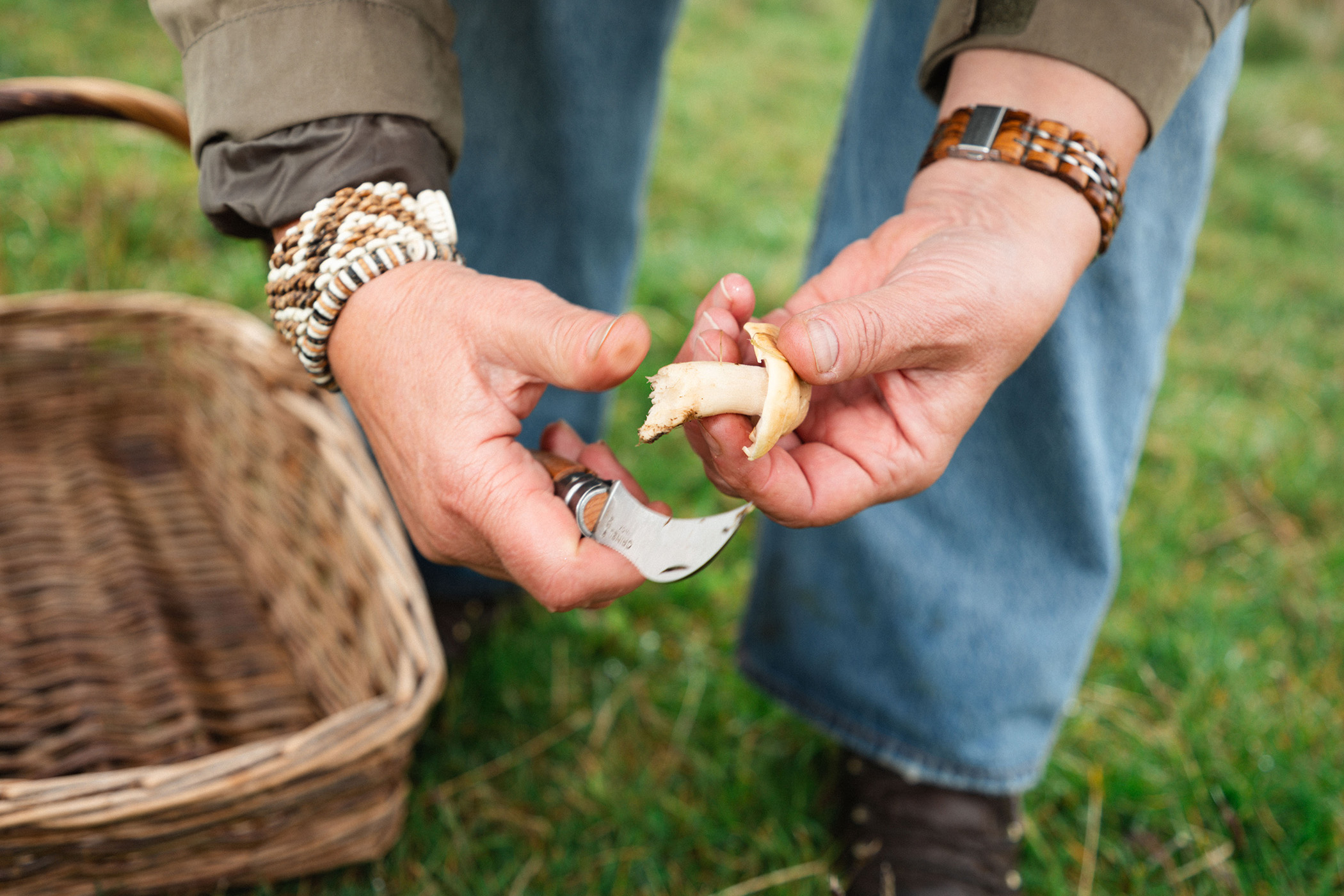
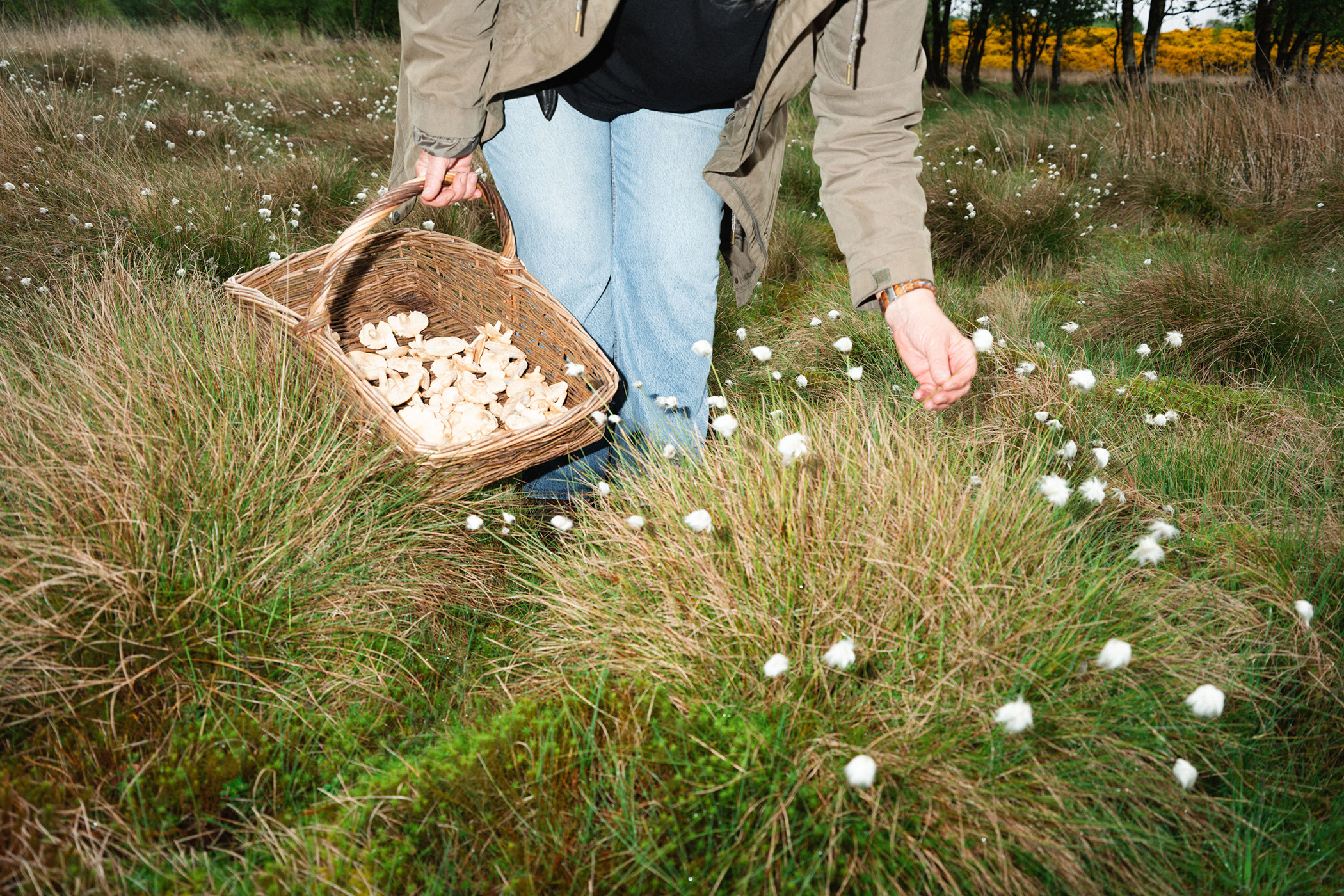
Picking mushrooms for supper in a ‘wet heath’ bog, which has its own ecosystem and fauna
Wilde’s mornings often start with “mushroom yoga”, which she and her housemates do daily. “Everyone needs to stretch!” Wilde said happily the morning after I arrived, while she led me through a short series of poses inspired by, say, the inkcap (head bent over feet) or the golden spindle (standing, arms above the head). “And then we’ve got to do our beauty treatments!” We moved to the kitchen table where there were dock leaf shoots, which we squeezed to produce a clear gel with the same constituents as aloe vera. Wilde has been using it “to stop the wrinkles” for 15 years, she told me, and her smooth skin is an advert for its efficacy. “Try not to leave bits of leaf stuck to your face,” she chuckled. “It makes you look a bit mad, which is how they describe me around here: strange – but harmless!”
Wilde cooked breakfast: wild-caught lemon sole, bought from the local fish van and flavoured with tangy sea buckthorn berries, accompanied by wild salad and meltingly moreish butter-fried hogweed shoots, the conventional equivalent of which might be kale chips. Wilde had invited me to stay for a few days, to see how she ate and lived, which, as you’d expect of a forager, includes plenty of time outdoors. After breakfast, Wilde and I spent the morning foraging and tasting at Almondell & Calderwood Country Park, a natural woodland tucked into a river valley. The valley is a short drive from Wilde’s home; she makes the trip in a tiny Honda. On our visit, the woodland was heaving with natural bounty: wild garlic flowers, jelly ear mushrooms, wild leek bulbils, hogweed shoots. Wilde moved carefully across the land, sampling only every now and then to minimise overpicking.
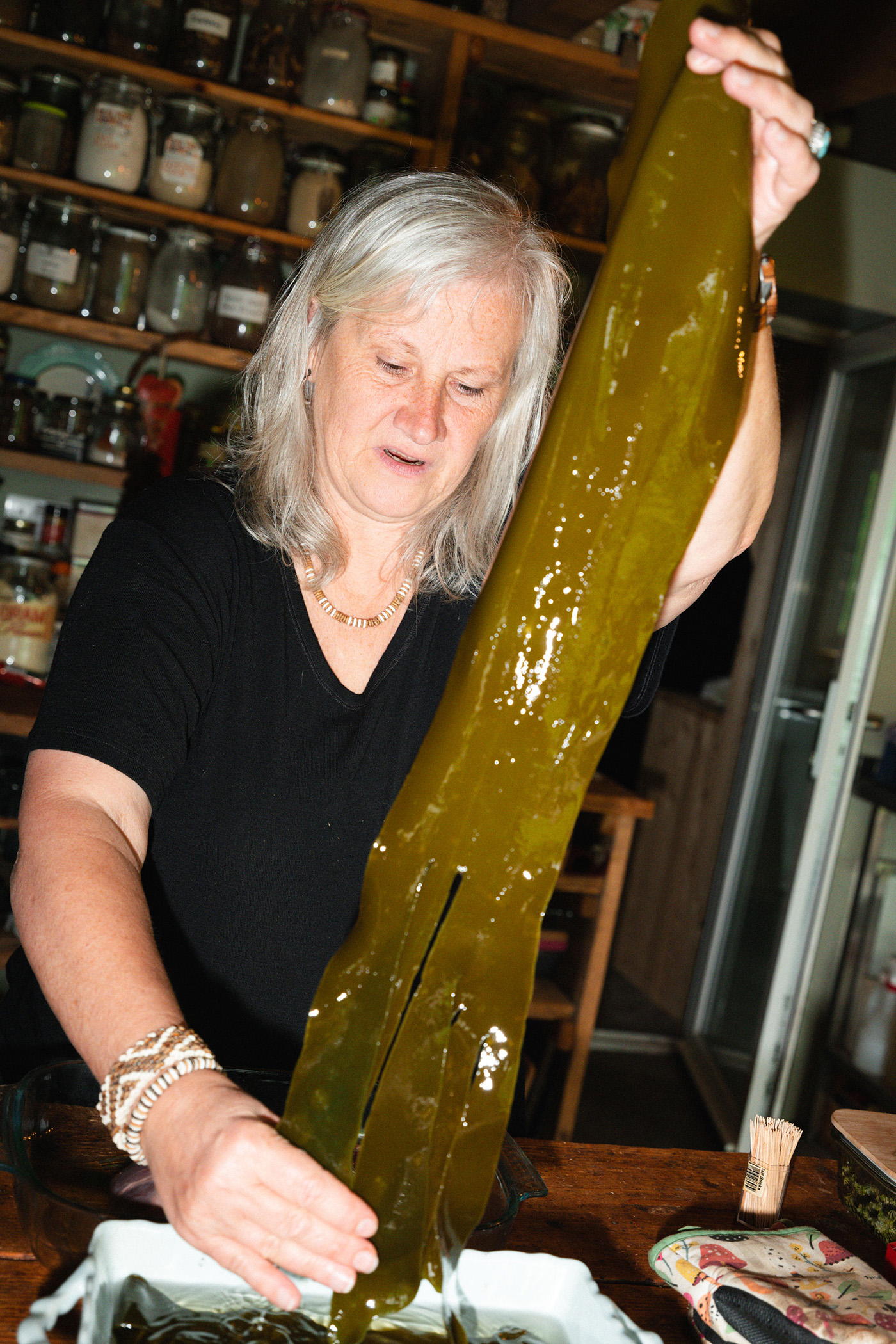
Mo soaks oarweed seaweed in water to wrap a haunch of venison in
In the years since she began to forage in Scotland, Wilde’s taste buds have adapted and I noticed that she loves tastes I found difficult. I tried berberis, a shrub berry, which to Wilde tastes of lemon sherbet, but to me tasted like tongue-curlingly sour capers. “You see, the wild puts stress on plants and they respond with flavour chemicals,” she explained. Bitterness features heavily in the wild-food taste profile. “It primes our digestive system by encouraging the production of enzymes and acids,” she said, though it can also signify poison.
Our visit to the woodland was a showcase of Wilde’s prodigious plant expertise. On a phone call after my visit, Dan Saladino praised Wilde’s “hard-won knowledge of plants as both food and medicine – knowledge that humans would have needed to survive, and which we now know we need more of.” Few of us “would ever want to or be able to embark on this kind of lifestyle,” he conceded, “but if we bring just a tiny portion of what Mo’s work has demonstrated, we’ll all benefit.”
Wilde wandered through the woodland for the entire morning, bending over in the ink cap pose, hands to the ground, happily snipping away. It dawned on me that the chores so many of us would consider tiresome – the days-long process of making acorn flour, driving to the coast for seaweed instead of visiting the supermarket for pasta – are to Wilde utterly edifying and address so much of what so many of us consider wrong with modern life. Our work-spend cycle is at odds with her foraging and crafting. Our separation from nature and the seasons is at odds with her immersion in them, our social atomisation is at odds with her community, and our addiction to convenience is at odds with her preference for friction-maxxing.
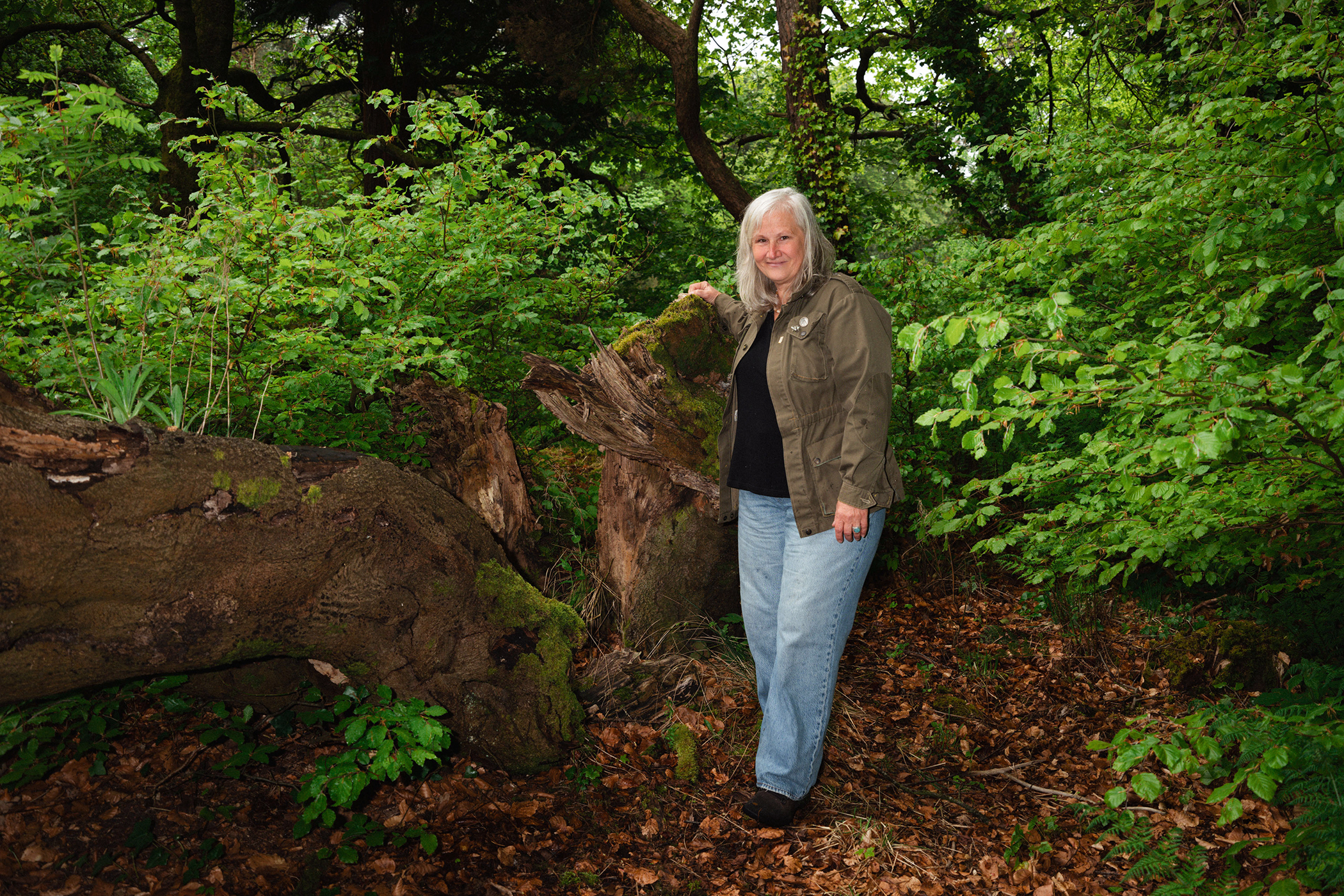
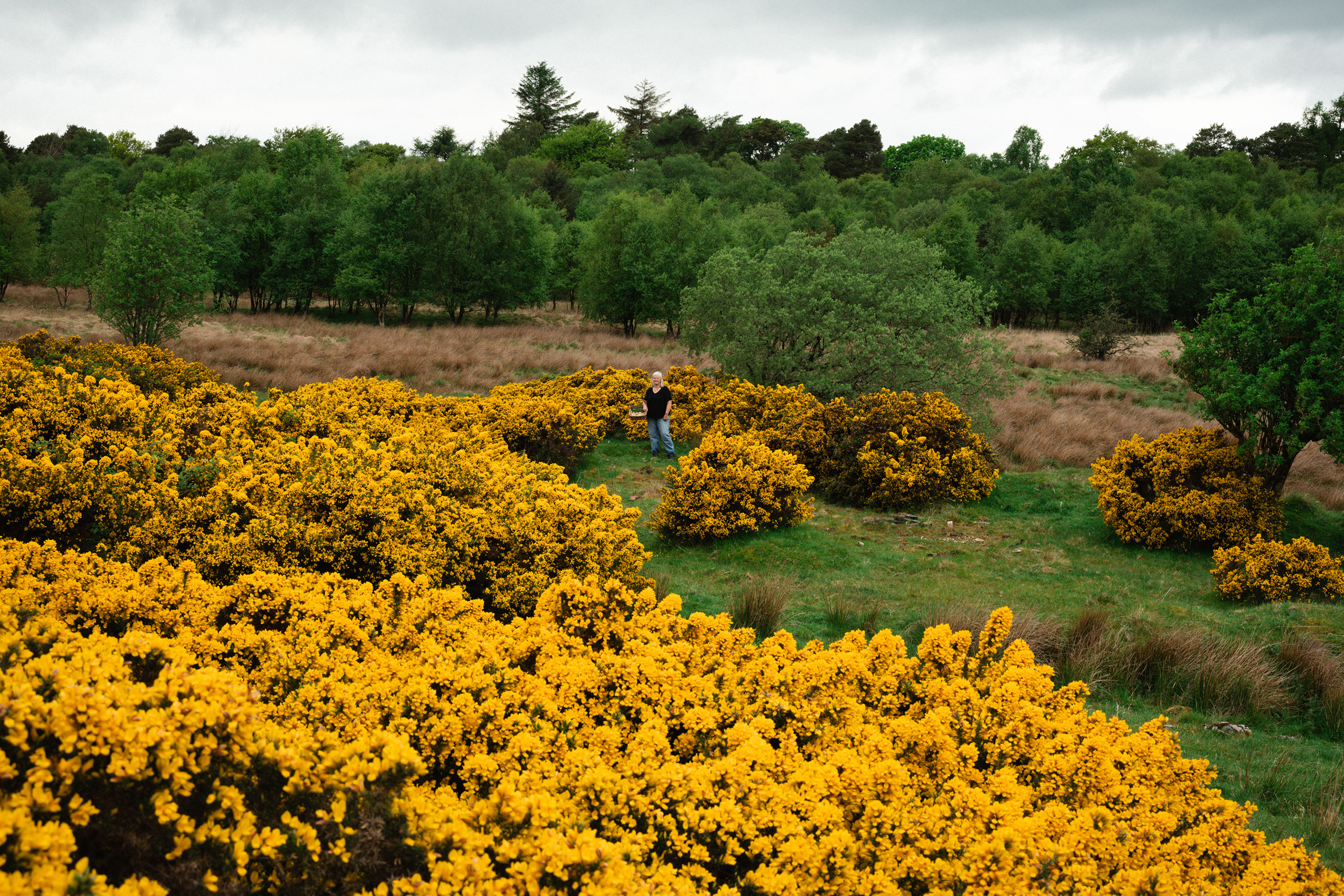
Foraging in the woods near her home, which is about 20 miles outside Edinburgh
Wilde has worked “damn hard” for the freedom to live this way, she told me. She bought the land and building materials for her house after selling her half of a business that makes coloured-flame candles, a striking example of can-do-ism for a single mother with no prior knowledge of chemistry, patents or manufacturing. The housemates have all given up nine-to-five jobs in order to find “time to enjoy being alive”. The group keeps costs down by having no plumbed hot water. There is one electric shower in the house and an electric dishwasher, which is only used overnight.
At Wilde’s home, we ate a final lunch of wild garlic omelette – she keeps four chickens, for eggs – before engaging in more labour. I learned to pickle wild garlic flowers and then to make a “lacto-fermentation” of its leaves. We pickled together around the kitchen table, talking, which felt an agreeable way to spend an afternoon, before Wilde suggested some “quiet time”, adding that “the few indigenous people that are left spend a lot of time relaxing and napping”.
When it was time to leave, Wilde drove me to the train station. “Look at all this food,” she said as we motored down the country lanes. I saw verges and hedgerows. She saw supper: cow parsley, nettles, hawthorn leaf, hedge garlic, few- flowered leek. Wilde seemed already to be considering the meal she was about to make and I felt sad to be missing it.
To learn more, visit foragers-association.org