
In his 1907 memoir Bohemia in London, the writer Arthur Ransome recalls a night he spent in Chelsea, introducing his readers to literary and artistic life in the capital at the turn of the century. An acquaintance took him to the home of a young woman who hosted a weekly open party for poets and painters. As they approached the door, Ransome glimpsed through the window “a weird room in shaded lamplight”. Someone was singing inside. The door swung open, and a “little round woman, scarcely more than a girl” stood before them. Dark, not thin, and dressed in an orange coat and green skirt adorned with tassels, the woman – known only as “Gypsy” – “looked as if she had been the same age all her life, and would be so to the end,” Ransome writes. He describes her “peculiarly infectious” smile and “twinkling” eyes, those of a “joyous, excited child meeting the guests of a birthday party”. As she appraised them on the doorstep, “she welcomed us with a little shriek. It was the oddest, most uncanny little shriek, half laugh, half exclamation. It made me very shy. It was obviously an affectation, and yet seemed just the right manner of welcome from the strange little creature.”
This woman was Pamela Colman Smith: artist, occultist, poet, and the little-known designer of some of the most recognisable images in western iconography. Though she has never been a mainstream figure, Smith created the images for the Rider-Waite tarot deck, still – by far – the most popular deck in the world.
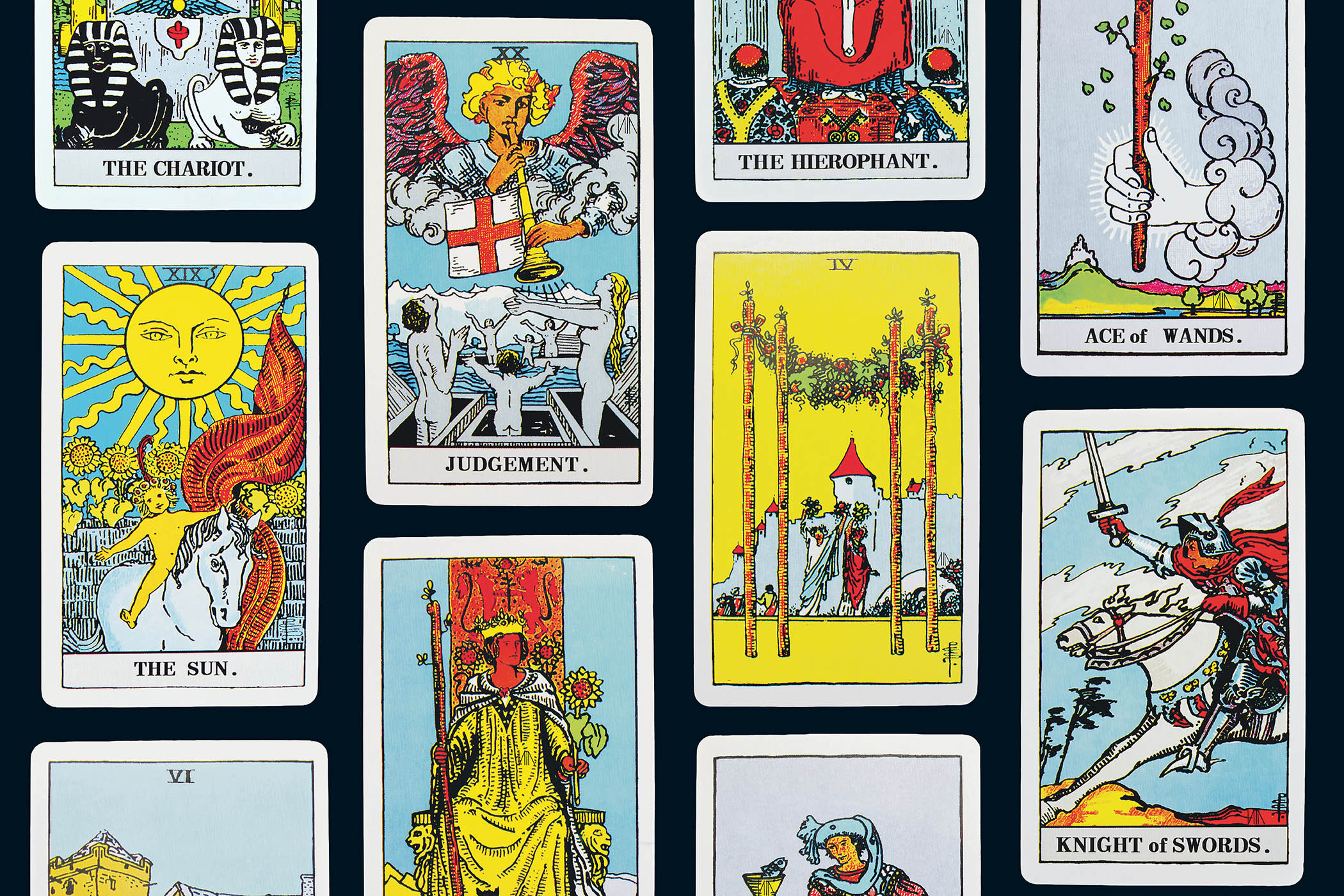
Tarot cards have a number of purposes: they are most famously used for fortune-telling, but are also often used as prompts for meditation or introspection. They are split into the Major Arcana – which includes figures such as The Fool, The Lovers, Justice and Death – and the Minor Arcana, which is made up of four suits: cups, swords, wands and pentacles (as in a traditional pack of cards, each suit contain numbers 1-10 and a jack, queen, king and ace). The pictures, in a bold colour palette of sky blue, yolk yellow and scarlet red, blend Italian Renaissance imagery with Art Nouveau style, depicting strange, symbolic scenes that draw from Christian narratives, Greek myth, Celtic folklore, the Zodiac and more. A man sits up in bed, weeping, in front of a wall bearing nine decorative swords; a lobster crawls out of a river, framed by two wolves, two towers, and a large yellow moon; three young women in flowing dresses and flower crowns raise three gold goblets to the sky.
Appropriately, myths and legends surround Pamela Colman Smith. Her contemporaries believed she was Jamaican, or Japanese. People thought she was psychic, or, as Ransome puts it, “god-daughter of a witch and sister to a fairy”. “There is not a page of her life,” read a 1904 article about her in the Brooklyn Daily Eagle, “that is not overflowing with romance.” She was known as Pixie, and often dressed as a Gypsy-like character when she told folk stories from Jamaica, where she had spent some years as a child. She never married, and lived with a woman for most of her life; many suspect she was a lesbian. She had synesthesia, and could see sound as bright colour.
Ransome describes her early 20th-century studio as “a mad room out of a fairytale”: dark green walls adorned with vivid drawings, etchings, pastel sketches and a giant sword; shelves cluttered with pottery, loose sheet music, books and ornaments, and a table piled high with painting inks, paperweights, and ashtrays. He writes of her singing old songs and telling folk stories from the “Indes”. Friends who attended her gatherings, and left messages in the “visitor’s book” she kept from 1901-1905, included the actor Ellen Terry; the actor-manager Henry Irving; the novelist Bram Stoker, whose last book was illustrated by Smith; the photographer Alfred Stieglitz; the playwright JM Barrie; and her friend the poet WB Yeats, who introduced her to the secret occult society the Hermetic Order of the Golden Dawn, where she would meet Arthur Edward Waite, who commissioned her to produce the tarot illustrations.
The deck was published by William Rider & Son in 1909, and has since become the default tarot card set, produced in a variety of editions. Estimates suggest more than 100m copies of the deck circulate across more than 20 countries around the world. But Colman received only a flat fee and no royalties or copyright for her drawings. When she died in 1951 at the age of 73 in rural Cornwall, she was virtually penniless. In the decades since her death, attempts have been made to rescue her from obscurity by feminist artists and tarot scholars. Today, every pack of the Rider-Waite tarot deck currently published includes a card with information about Smith’s life, and it is increasingly referred to as the Rider-Waite-Smith (RWS) or Smith-Waite deck. Exhibitions of Smith’s work – tarot illustrations and beyond – have been held in London and New York. And a number of recent books have sought to bring her into the light – including Pixie, a new novelisation of her life by the writer Jill Dawson.
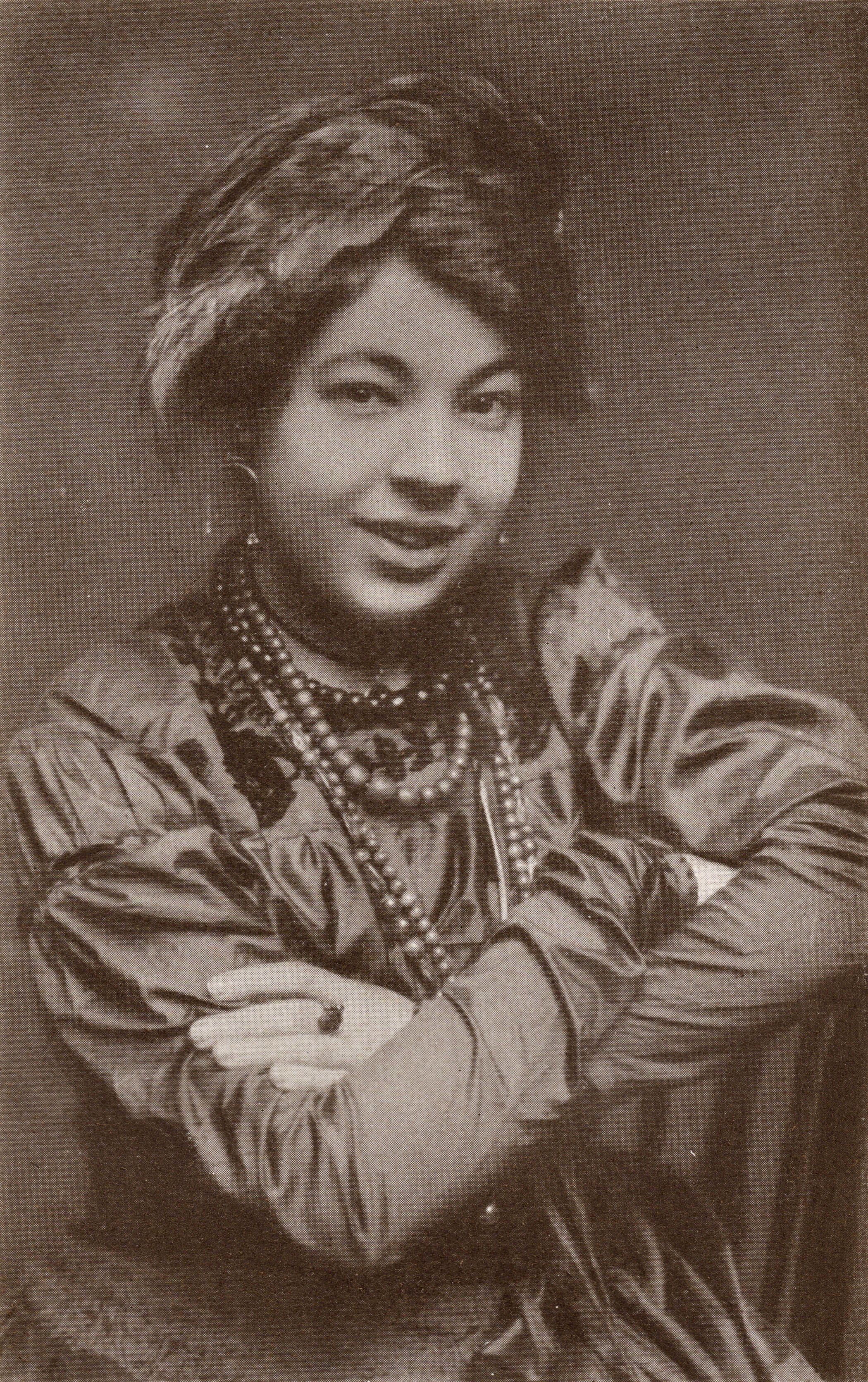
Pamela Colman Smith and, main picture, a selection of the cards she designed for the Rider-Waite tarot deck.
Dawson, 64, told me last month, from her home in Ely, Cambridgeshire, that she has been interested in tarot since the 1980s, when she first had a reading. She is now a qualified Jungian tarot reader (rather than fortune-telling or game-playing, this involves asking people to respond to the images in order to understand their own subconscious through their associations with the cards). “But like a lot of people, I didn’t think about who did the designs,” she says. She heard about Smith through the author and self-described witch Pam Grossman, and began researching her life: visiting her birthplace in Pimlico, her home in Bude, Cornwall, where she died, and the Pratt Institute in New York, where she studied. She read Smith’s letters, and got a sense of her character and voice. (“She wrote things like, ‘publishers are pigs’ or ‘Yeats is a rummy critter’. She didn’t suffer fools, and I loved that.”)
And she visited a spiritualist church near her, as Smith’s longtime “companion” or partner, Nora Lake, was a spiritualist. “I don’t know how much I want to say about this,” Dawson says, smiling, over a video call, “because people will think I’m a nutcase.” On her first visit, a medium stood up in front of the congregation of 12 and said: “I’m sensing a person, an artist, she’s surrounded by paints, she’s wearing stripes and stars, and she lives by the sea.” The figure, to Dawson, was clearly Pamela Colman Smith. “I thought: someone wants me to do this.”
Dawson’s novel is written in a chatty, spirited voice that developed out of Smith’s letters, moving from girlish naivety to maturity. Dawson felt it was ironic that the woman who designed a deck used for divination had so many mysteries of her own. “There is a lot of interest in pinning her down: was she gay, straight, bi-racial, Asian, Gypsy? She seemed to play up to all of those identities if it suited her. At her salons, she had a sort of Gypsy character… she drew herself as ‘Pixie Pamela’,” she says. “But it was on her own terms. She was playful, and much smarter than people gave her credit for.” Dawson notes: “When she was asked about her family background, she used a very modern phrase: ‘it’s complicated’.” The question of her sexuality was more straightforward: “She lived with Nora up to her death. She left everything to her.”
Dawson’s book begins with the death of Smith’s mother in Jamaica in 1896. Shortly afterwards, Smith’s father decided to stop sending her to the Pratt Institute, where she was the youngest ever student to be admitted at 15 years old in 1893. But Smith persisted with her painting in London in the early 1900s, joined the Hermetic Order of the Golden Dawn, and established her studio. She produced illustrations for books by Yeats, Terry and Stoker, wrote and illustrated two books about Jamaican folklore (Annancy Stories and Chim-Chim: Folk Stories from Jamaica), designed commercial posters, produced theatrical sketches, and launched her own magazine, The Green Sheaf.
Her friend Alfred Stieglitz owned a gallery on Fifth Avenue, New York, and in 1907 agreed to exhibit her work there. On the first day, she sold four watercolours for a total of $175. The show became so popular that its run was extended by eight days. The New York Sun critic James Gibbons Huneker declared: “Pamela Colman Smith is a young woman with that quality rare in either sex – imagination”, adding that even Edvard Munch, “a master magician of the terrible, could not have succeeded better in arousing a profound disquiet” as Smith did in her black and white watercolour Death in the House. He suggested that she stood alongside “William Blake and his choir of mystics”. The critic Benjamin De Casseres went further still, writing: “No more curious and fascinating exhibition has ever been held in New York… a wizard’s world of intoxicating evocations.”
Was she gay, straight, bi-racial, Asian, Gypsy? She seemed to play up to all of those identities if it suited her
Was she gay, straight, bi-racial, Asian, Gypsy? She seemed to play up to all of those identities if it suited her
In November 1909, Smith wrote to Ransome: “I’ve just finished a big job for very little cash! A set of 80 designs for a pack of tarot cards.” Scholars have noted that several of the tarot images resemble Smith’s previous works – the Four of Swords card, for instance, echoes her 1902 picture The Lady of the Scarlet Shoes; while the influence of her drawings for the theatre are evident in the stage-like platforms added to cards such as the Seven of Swords – suggesting she conceived of, as well as executed, the designs. It is likely that she was influenced by the 15th-century Italian deck the Sola Busca tarot, which was exhibited at the British Museum in 1907, and possibly by WB Yeats’s designs for a deck in his unpublished Golden Dawn notebook. “Pamela’s deck is endlessly interesting,” Dawson says. “Sometimes it looks like a stained glass window. There’s Kabbalah and Christian imagery that people might not know about, but they’re still responding to.”
Dawson believes she may have acquired 190 original sketches for Smith’s deck – more than one of each card – long considered lost to history. The final illustrations, glass plates, were given to Stieglitz, and supposedly lost in a fire in the 1940s; most books on tarot simply said of the earlier sketches, “no record of these preparatory drawings exists”. But Dawson suspected some might have survived. “I know from a copy of her will that all of her belongings were taken by the inland revenue.” One day, Dawson typed a simple search into Google “original drawings by Pamela Colman Smith”. “And I found some. It was so easy,” she says. “It was a very odd experience.”
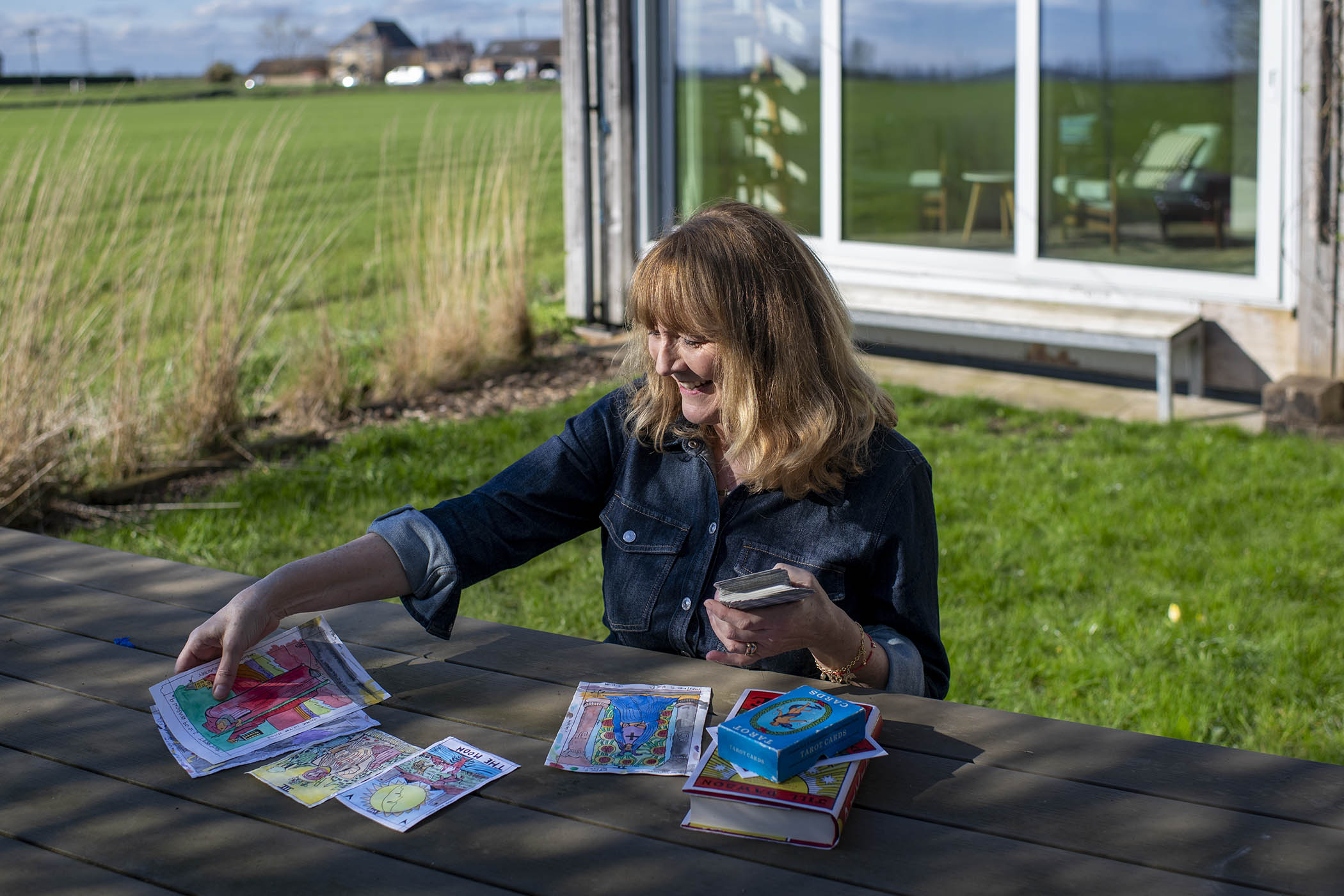
Author Jill Dawson at home in Ely.
In 2023, Dawson came across a mysterious man, who referred to himself as “Dr Cornelius” or “The Magician”, selling original drawings by Smith on Etsy. She shows me a few through the screen – the drawings look “cartoony”, almost amateurish. “They’re rough, sometimes they’re bad… sometimes the drawings are crude,” she says. “I do wonder what on earth they are. They’re funny things because they’re clumsy with errors.” Dr Cornelius would only sell them to her in batches of five because the rest were in storage, and whenever she asked to come to his storeroom to see more, he would say he couldn’t – it would be a health and safety risk.
Still, Dawson was persuaded by a letter of provenance from 2000, and notes scribbled on the back with historically accurate dates, places and names. She had the ink and paper carbon dated by Cambridge’s Fitzwilliam Museum, which confirmed that both date back to the right period. Visiting Smallhythe Place in Kent – Ellen Terry’s former home where Smith spent the summer of 1909, now a National Trust property – Dawson was shown some of Smith’s other drawings discovered by an archivist there, in a similar naive style – “vividly coloured and funny little faces,” she says. Though she is still unable to get the drawings officially verified, she tells me, “to me, they’re precious, almost regardless of what they are.”
Smith’s letter to Ransome suggests she was paid very little money for the cards. But no historian has been able to find an exact figure. On her final day of working on her novel, Dawson found herself turning over the question in her mind – what was Smith paid? The doorbell rang shortly after, as the postman delivered the final batch of drawings Dawson had ordered from Dr Cornelius. She turned one over, and saw a number: 17 pounds, 11 shillings and sixpence. “The Justice card,” she explains. “I know she had a sense of humour.” Again, there’s no way of knowing if this figure is an accurate representation of what Smith was paid for the commission – but Dawson decided to include it as the fee in the novel. “Who knows?”
Dawson’s novel ends in 1909, the year the deck was published. A few years later, the first world war broke out, and Smith failed to find the same success she had enjoyed at the start of her career. After the war, she converted to Catholicism and moved to Cornwall with Nora Lake, where she ran a retreat for priests. Despite the success of her tarot deck, she lived the rest of her life in poverty, and died in Bude in 1951. “She was forgotten, which is many people’s story, or many women’s,” Dawson says. But she hopes her novel, and the work of scholars, biographers, and fans of the tarot, will ensure Smith isn’t forgotten again.
The story of tarot
• Tarot decks have their origins in the mid-15th century, when they were hand-painted and known as Trionfi, and intended for game-playing rather than fortune-telling. The earliest evidence of a tarot deck being used for cartomancy dates to about 1750, and the French occultist Jean-Baptiste Alliette published one of the first decks designed for divination in 1789.
• The most expensive tarot deck in the world is a rare example of the 15th-century Visconti-Sforza deck, valued at $2m. In 2021, Sylvia Plath’s deck of tarot cards sold at auction for £151,200 – more than any of her books have ever sold for – despite being valued at only £5,000.
• For the new age movements of the 20th century, tarot became increasingly used for self-reflection over divination. The psychoanalyst Carl Jung was interested in tarot as “psychological images, symbols with which one plays, as the unconscious seems to play with its contents”.
• Other notable writers and artists interested in the cards include Cormac McCarthy, Shirley Jackson, Leonora Carrington, Yoko Ono, Cher and Stevie Nicks.
• The popularity of tarot readings surged during the pandemic. Today, on TikTok, the hashtag #Tarotreading has more than 9m posts and tens of millions of views.
• In May 2025, the Pew Research Centre estimated that 30% of Americans consult astrology, tarot cards or fortune tellers – though most of those people say they do so just “for fun”, rather than for insights or guidance on life decisions.
Pixie by Jill Dawson is published by Bloomsbury (£16.99). Order a copy from The Observer Shop for £15.29. Delivery charges may apply
Photography by Alamy, Wikipedia, Ali Smith/The Observer
Newsletters
Choose the newsletters you want to receive
View more
For information about how The Observer protects your data, read our Privacy Policy