

The first time I ever dressed myself to go to work, I chose an outfit that might be described, with charity, as intense. Grey nylon shirt. Jet black tie. Caterpillar boots. Shiny bomber. Completing the vision with a Casio wristwatch, I arrived looking something like a Bible salesman, or a junior aviator on my way to a funeral.
I was 15. The job was at the Catalogue Bargain Shop on Palmers Green High Street in London. There wasn’t an official uniform and the only mandated bit of costume I can remember being asked to wear was a yellow-and-blue name badge that had to be pinned, distractingly, over my sensitive left tit. I was let go from the Catalogue Bargain Shop after three or four shifts. When I asked why, the boss said that I didn’t look welcoming. Customers were spooked. I’ve never dressed for work with any sort of formality since.
Work uniforms, should we be lucky enough to get to choose and curate our own, are hard to get right. It might be half a lifetime’s project. In my late teens, studying abroad, I took work as a waiter in a California members’ club. That meant a polo shirt, clean chinos, the closest I’ve come to the Abercrombie & Fitch ideal. As a floor-filler in police line-ups in Sheffield, there was a condition of employment: don’t draw attention to yourself, don’t dress to impress. I used a matted zip-up fleece. For a little while I chopped herbs in the kitchen of a London pub. I got to wear a borrowed, heavily starched, incredibly cool smock for that. I was neither a patient nor passionate chef, but I sincerely considered hanging around as a kitchen boy for love of the gown.
None of these jobs, none of these quasi-uniforms, lasted long. I was fated, or doomed, to be a journalist, and I never seriously pursued any other line of work. I wangled my first magazine job at the age of 21, in the towering headquarters of Time Out on Tottenham Court Road. Employees did sometimes wear blazers and collars there, but anything much more officey would have been considered suspect. The late proprietor, Tony Elliott, wore jazzy paisley. There was psychedelic carpeting on every floor in bright, lava-lamp colours, which seemed to free up almost any bad choice in terms of attire. At Time Out, I was affirmed in a habit of duvet-day casualness that has been hard to shake.
Because I dress down, down, down, my work uniform has evolved over time to include a thicker skin
Because I dress down, down, down, my work uniform has evolved over time to include a thicker skin
These days, when I talk to journalism students or younger reporters, they sometimes ask about clothes. How should they present themselves for a sit-down interview? What are the expectations at press conferences, on reporting missions? I preach blandness, low effort, forgettability. You learn over time that in interviews, as in life, to approach another human with excess flash makes a lot of simple things difficult. Journalism is a job in which conspicuousness can be a nuisance, an overbearing nature a handicap. In all sorts of ways I try to be a path of low resistance. There I am, huggable and benign in autumnal high street, obscure as a stagehand in monochrome H&M, paying attention behind the beige.
Because I dress down, down, down, my work uniform has evolved over time to include a thicker skin. Louis Vuitton cocktail party, Rue de la Comète, 2023. There were about 100 immaculate Parisians in attendance, plus me in the corner wearing pre-Covid drainpipes by Lee, and a jumper, Jacamo mail-order, that wouldn’t hang right. Long night, that. But for the most part I’m steely when it comes to feeling out of place. There’s even a bit of a sick thrill in seeing how much dissonance I can tolerate.
A couple of years ago I interviewed the owner of an Italian football team. Lui: tailored Savile Row. Mi: an ensemble from the red-sticker rail at Uniqlo. Our interview was on neutral ground. It went well. Did I want to join the director that evening for a Champions League match? David Beckham and Thierry Henry, walking gods of male fashion, would be in attendance. I did want to join, very much, but I thought it was only fair to warn this well-dressed man that I had precisely one outfit with me, my interview outfit, a hoodie in sick-pigeon grey. The director’s gesture in response was wonderful. He glanced down, all the way to the peeling soles of my charcoal Converse, as if having been too polite to do so already. Then he met my eye and shrugged, as if putting down my life choices so far as forgivable mistakes.
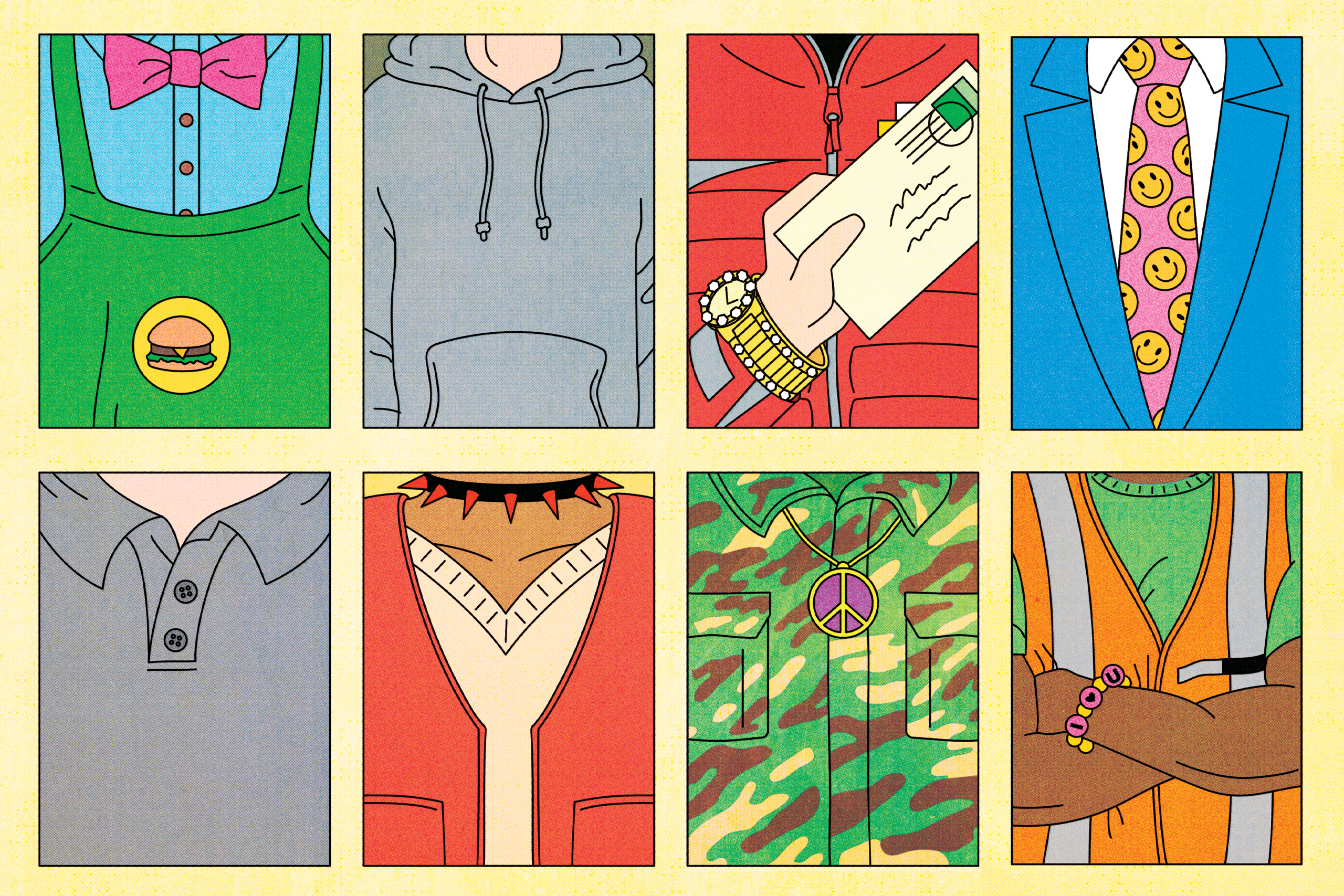
On roads, in transit, out in public, I take note. I’m interested in what other people wear while they work, how free they are, how limited, what liberty they’re able to find within the limitations. I think it takes real talent – genuine force of personality – to bring to heel the bright shade of red that has been standard for Post Office employees since the 2010s. Adding AirPods, plastic wristbands, lip stud and face tats to the official polo shirt and combat shorts, the dude who delivers to my road makes the Post Office uniform wear him.
I know teachers who dress to armour themselves, police officers who find that the twill helps them into character
I know teachers who dress to armour themselves, police officers who find that the twill helps them into character
I know teachers who dress to armour themselves, police officers who find that the twill helps them into character, soldiers who feel denuded in their civvies. I love a work uniform that’s counter-intuitive. At my grandparents’ retirement home, the carer who is often on pill delivery wears an angry red vest – indication that she’s not to have her gentle assignment disturbed. In language, we assign the colour green to inexperience, callowness, a lack of qualifications. Enter a hospital and it means seniority. Uniforms categorise. Uniforms comfort. Uniforms intimidate.
Anna Wintour exists to make judgments of style. She is asked, constantly, to express her taste. The trademark sunglasses buy Wintour a little extra time. Paul Levesque, the corporate face of World Wrestling Entertainment, is a muscular, dragon-like former wrestler. Watch him on telly. Whenever Levesque shoots the cuffs of his bulging suits, you glimpse colourful friendship bracelets on either wrist – gifts from his kids, I suppose, that also serve as handy props, softening the overall impression.
Pep Guardiola broke ground in football as a knitwear guy. Chloe Kelly helped England to championship glory wearing custom shinpads that were decorated with photos of her wedding kiss. Pep’s uniform says, “I’m cuddly after all,” and Chloe’s, “This sport can still be fun.”
For selfish reasons, I’m always interested in what uniforms people wear when nobody’s looking, when nobody cares.
A journalist friend has a special method for dealing with looming deadlines. He wakes up, showers, puts on smart clothes, maybe a shirt and tie, proper shoes – a full outfit. Then he sits in an empty bedroom and writes until he’s spent, at which point he undresses, gets back in the shower, puts on different clothes and shoes and starts again.
In this age of the video call, many people will lean in the opposite direction – barely putting in any effort at all below the digital crop line. David Cameron, first thing, used to do some light prime minister-ing in his pyjamas. Mark Twain wrote in a nightshirt, a habit we know about because there are photos of him writing almost horizontally in bed.
Why not? Books take so much time to complete. The labour to finish one is private and undersupervised. When I took on a book-length project a few years ago, the temptation was very great to think, yeah, I will have a no-trousers week actually… You try to fight that. You try to stay dignified. If you’re lucky enough to finish a book, and lucky enough to have it published, you emerge from months or years in a hole and you are asked to become a salesperson overnight. This transition, from something like a hermit to something like a politician on the stump, is disorientating.
An older novelist, a veteran of the process, told me that it helped him, mentally, to separate his writer self from his author self, keeping up a firm wall between practitioner and promoter.
I have tried to follow this advice. I have some new-ish outfits that are labelled, in the wardrobe of my mind, “For use when standing up in front of people” or “For use when you only need to fill the digital square of a Zoom call.”
Today, I don’t have to do any talking or selling. Today, the only bit of work I have to do is this piece. Today it’s seven-pocket cargo shorts, ankle socks, one of my nicer white T-shirts that came out of the dryer with horizontal burn scars the colour of tea.
Newsletters
Choose the newsletters you want to receive
View more
For information about how The Observer protects your data, read our Privacy Policy