
Before I knew it was drawing
Photographs by Suki Dhanda for The Observer
I always maintained that I knew nothing about art while I was growing up in Guyana. But now that I’m a very old man looking back, I realise that arts and crafts – drawing, measuring, cutting out and making – were very much part of my childhood. It all starts with my mother, Agatha Elizabeth Franklin Bowling, who was a dressmaker, a seamstress and milliner. She had six Singer sewing machines in the house, pleating gear, embroidery machines – the whole operation. And as a small boy, it was my job to brush the mosquitoes from her legs while she sewed right through the night. I watched her hands, the needle finding its way through fabric, making a pattern out of nothing.
When I was a teenager, my mother put me to work as a huckster – a travelling salesman – cycling on a carrier bike along the coast of Guyana, hawking fabrics and threads, and taking orders for dresses and saris. I was deep inside the world of material, of texture and colour, and the way things are made. And then she sent me to work in my uncle’s cabinet-making workshop as an apprentice, and that’s where I learned about geometry: how you could put a circle in a square, or use intersecting triangles to make rock-solid furniture. I picked up carpentry skills too from the road workers who came and went through my mother’s yard, and from them I learned how to use a theodolite, a level.
At school in Berbice, we did technical drawing: plan and elevation, the logic of the drawn line, how it could describe a three-dimensional thing on a flat surface. Three-dimensional drawings were my forte. We were also made to draw the map of Guyana freehand. Over and over. You were supposed to get it right; that particular coastline, those particular rivers. I never quite did. It left a kind of agony in me that I did not understand until decades later, when I was in New York making map paintings and found South America appearing in the stained canvas on the floor – unbidden, unplanned, just there – and the feeling that came back was that childhood agony, that trying and trying to get the shape right. Suddenly, the shape that had tormented me was the shape I was claiming. Drawing the map of Guyana freehand as a boy turned out to be one of the most important things I ever did. I was drawing before I knew I was drawing. I have been drawing ever since.
Sir Frank Bowling RA OBE ARCA, 6 June 2026
______________________________
Paint, PVA glue and insect toys: a day in Frank Bowling’s art class for children
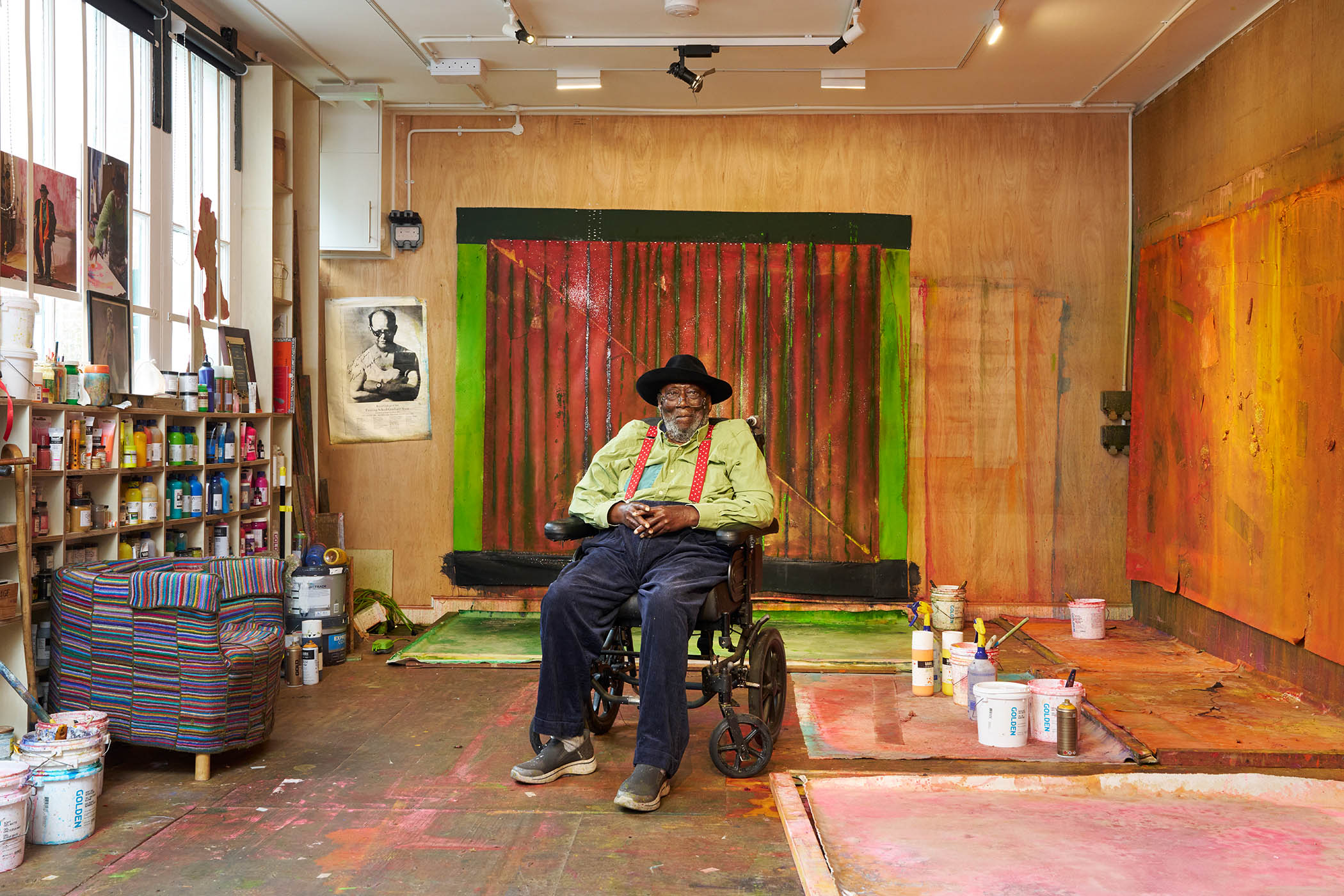
A splatter of bright purple acrylic paint drips on to the floor, inches away from a newly stretched Frank Bowling canvas that is stapled to the wall. The idea of hosting a children’s art workshop in the middle of a renowned artist’s studio, surrounded by his work, feels like a paint-spill disaster waiting to happen. However, to Ben Bowling, the artist’s son and chair of the Frank Bowling Foundation, that is exactly the point. He laughs: “It doesn’t matter,” Ben insists, watching a toddler freely tip a jar of silver glitter everywhere. “Frank would love this. This is how he works.”
Last weekend, the doors of Bowling’s south London studio in Kennington, where he has worked for most of his career and still paints every day at the age of 92, were opened to the public. Visitors were invited not only to explore the space where some of Britain’s most celebrated contemporary paintings are made, but also to take part in hands-on workshops inspired by Bowling’s experimental approach to making art.
The open day is a curtain-raiser for an exhibition at the Royal Drawing School, Frank Bowling: Driven to Draw, which will cover more than 60 years of the artist’s work, including preparatory sketches and collages drawn from his archive, alongside completed works on paper and paintings.
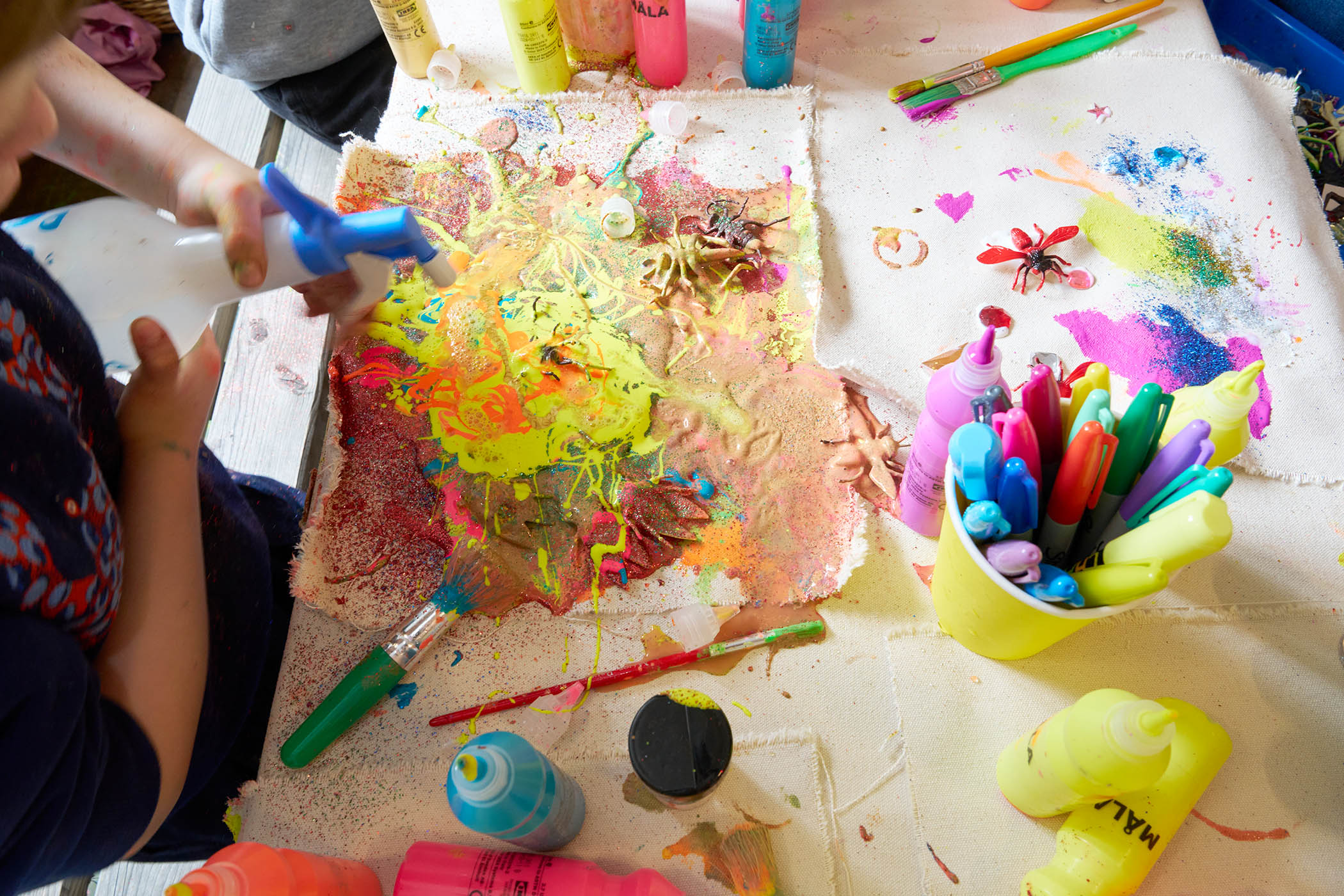
At the centre of the studio today sits a workshop table strewn with paint, PVA glue, glitter, plastic insect toys, spray bottles, brushes and an assortment of art materials. Over the course of the weekend, participants range in age from 18 months to 72 years old. Before picking up a brush, they are encouraged simply to touch the small fabric canvases they will be working on. The textured surface has been chosen to offer something entirely different from the smooth sheets of paper children are typically handed in school. Rather than being given a subject to draw or a set of instructions to follow, they are free to experiment with materials and discover their own ideas through making.
The workshops are one of the many initiatives run by the foundation, which aims to preserve and build upon Bowling’s artistic and educational legacy. Ben believes this work is more important than ever at a time when art in schools is becoming increasingly constrained by rigid lesson plans and assessment criteria. Too often, he argues, it is taught within the same binaries as maths and English; the focus on getting the “right” answer or drawing something perfectly is, he says, “stifling children’s creativity”.
Newsletters
Choose the newsletters you want to receive
View more
For information about how The Observer protects your data, read our Privacy Policy
This is something Ben remembers from his own experience at school. Having grown up as the son of the late artist Claire Spencer, who attended the Royal Academy of Arts before becoming an art teacher, his earliest memories are of drawing alongside her. In a folder where he has kept many of his drawings from childhood, he notes they are “progressively less interesting” the further he went through his education and was taught art.
Ben says his British-Guyanese father has always been a passionate advocate for art education. After teaching for more than 20 years at Camberwell School of Arts and Crafts – now Camberwell College of Arts – Bowling has continued working closely with schools throughout his career. His foundation has worked with more than 20 schools across London and has provided at least 7,000 children with free art supplies. Ben thinks there is the “potential for a revolution in art education”, something he believes the foundation can help bring about through its educational initiatives, which have the sole purpose of enabling young people to experience art, whether by visiting museums or through workshops delivered in schools.
Every museum show or commercial exhibition his father undertakes is paired with a not-for-profit educational programme, from the Fitzwilliam Museum in Cambridge to Hauser & Wirth in Hong Kong, where Ben and his wife, Susi, flew out last week to deliver a workshop.
Watching from the studio edge is Eileen Quirke, whose 11-year-old son, Ben, is deep in concentration. As a mother of 10, Quirke has watched a slow erosion of creative education over the last quarter of a century. “My eldest son, now in his mid-30s, had a dedicated art teacher,” she reflects. “Now, Ben’s exposure to art in school is rare. His lessons mainly focus on maths and English in preparation for SATs, and when he does do art, it is usually just tacked on to the back of another lesson.”
While she praises galleries and museums as great spaces for children to interact with art, she says those spaces can feel quite detached from their reality. Whereas being in here – the belly of a working artist’s studio, where the floors are caked in paint and the air faintly smells of turpentine – inspires children to be as free and creative as they want.
Next to Ben Bowling is his father’s eight-year-old great-grandson, Nye, who uses a water spray – as Frank does in his large-scale paintings – to manipulate the paint on his small canvas, creating a pool-like effect. Looking at Nye’s finished work, I can see that he has embedded a paintbrush directly into a thick layer of orange and silver paint. On the wall opposite him hangs a new piece by his great-grandfather in which, buried deep in the rich blue acrylic, I spot another paintbrush – just like Nye’s.
Frank Bowling: Driven to Draw is at the Royal Drawing School, London EC2A 3SG from 25 June to 22 August. The Drawing School is offering seven free places on its Young Artist’s programme (ages 10-18). For details on how to enter, see here. Entries close 28 June.