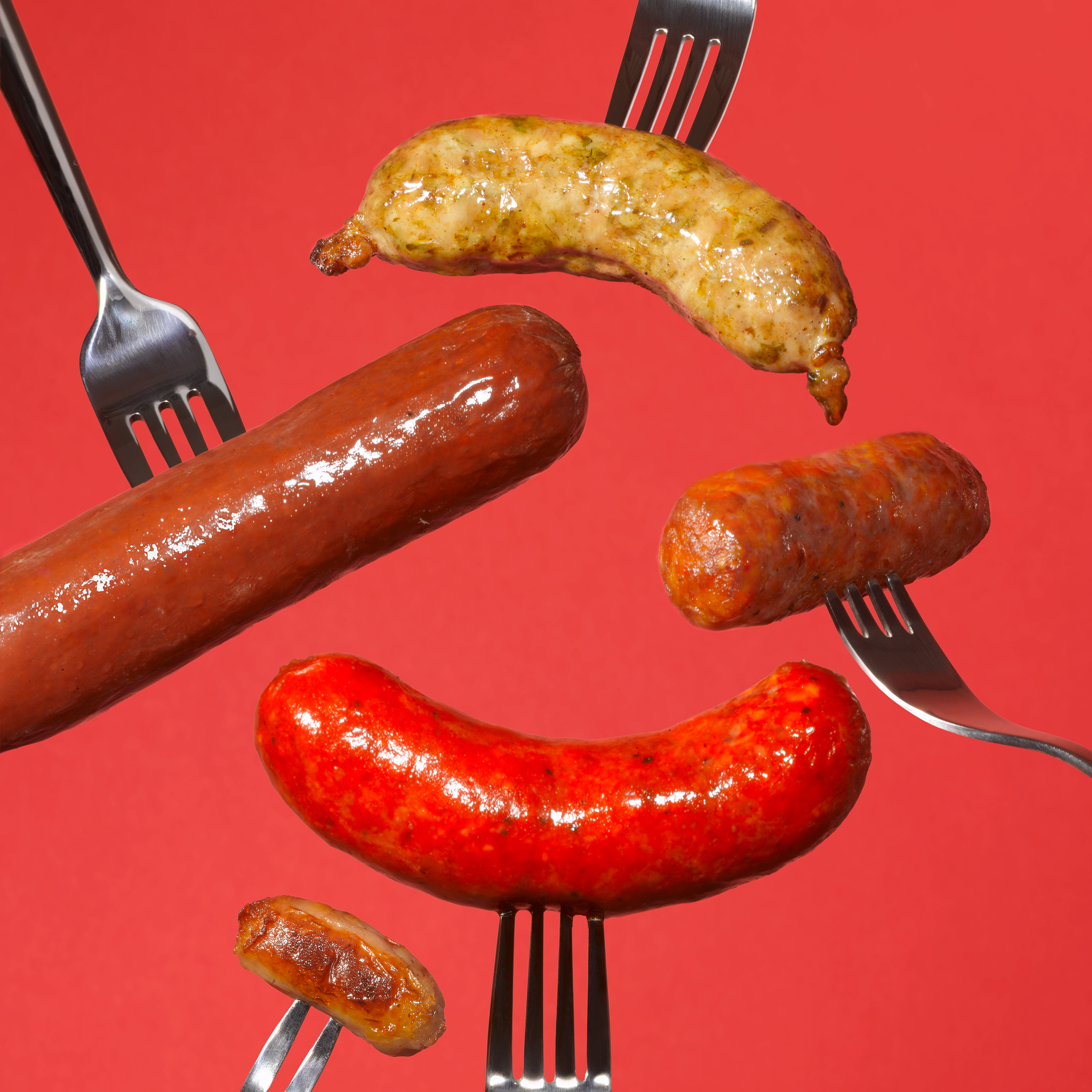


If you’ve been thumbing through Instagram recently, you may have had your scroll stopped by a sausage. Perhaps you’ve seen black-gloved hands bend a taut tube towards the camera until its straining hinge breaks and spurts a constellation of hot fat and juices. “Corrrr!” its creator will say. “Check out that snap!” and the spent sausage lingers on screen for a second, steaming. The “sausage snap”, as it’s known online, is a form of way-too-literal willy waving designed to advertise the innards. But under the skin and the slightly uncomfortable bro humour lies skill. Currently, the craft of sausage-making is enjoying a renaissance among chefs keen to display their butchery chops. No longer a way to disguise undesirables, this new wave of bangers is premium.
Owen Barratt of Owen’s Sausages & Hams, in Frome, has dedicated himself to a sausage in desperate need of PR: the frankfurter. Speculation about “mystery meat” has long been the curse of the emulsified sausage category (any sausage where meat and fat is blended to create a uniform texture). Frankfurters are having a refresh. Having found inspiration in Sweden, where “the sausage culture is different… it’s not a joke product,” Barratt is using high-quality pork and bringing a serious, craft approach to production. He sells them at his “sausage bar” on the back of an industrial estate, but not without a playful nod: each Sunday, there’s a “silly sausage” special, already loved by the people of Frome. Previous silliness includes a hot dog with beef shin ragu and fried pasta, and Barratt’s favourite: sauce gribiche and Pom Bears arranged in a row, like holidaymakers on a banana inflatable.
The uniform tube of the sausage offers a way for people to enjoy things they might usually be too squeamish to consider
The uniform tube of the sausage offers a way for people to enjoy things they might usually be too squeamish to consider
Sausages are also breaking free of their “with mash” pub-grub box and are increasingly seen on restaurant menus: in London, find a stuffed-neck sausage at offal-tastic Camille; across the Thames, Singburi’s take on sai ua (northern style Thai sausage); in Manchester, the Spärrows flies the flag for Germanic smoked sausage. Mike Davies, chef-owner of London’s Camberwell Arms and co-owner at Farmer Tom Jones butchery, knows bangers may look prosaic, but getting them right takes work. “Making sausages requires a lot of idiosyncratic knowledge and skill,” Davies explains. He chats through the importance of myosin (a protein matrix that traps moisture and fat), heat distribution and ingredient suspension.
Davies and his chefs practice whole-carcass butchery, a natural path to sausage production. “It’s part of good husbandry,” he says. For every steak or “prime” meat section, you’re left with a lot of smaller bits of meat and fat – what butchers call “trim”. “If you’re going to break down a whole animal, you really need a plan.” His current summer sausage is sweet and spicy, made with floral, fierce Scotch bonnet chilli, brown sugar and garlic.
“There’s real sensitivity and insight to be gained from the making of sausages,” says Flossy Phillips, a butcher and self-taught chef who runs offal-focused pop-ups. “Understanding the anatomy of an animal and what it means to not waste meat.” This is, of course, the sausage’s ultimate purpose: maximum value. But an industrial revolution and two world wars have meant highs and lows for the banger. Not until the early 1990s did the sausage begin to rise again, against the backdrop of pivotal restaurant openings such as Fergus Henderson’s St John, with its nose-to-tail approach.
But while Henderson’s vision was “take it as it comes”, the uniform tube of the sausage offers a way for people to enjoy things they might usually be too squeamish to consider. “It gives you a different way of showcasing the meat,” says Chris Leach of London’s Manteca. Putting rabbit sausages on the menu means customers are less likely to think fluffy bunny, and more delicious mouthful.
The Texas hotlink, a staple of the US barbecue scene, has become the canvas of choice for others. Alasdair Clark of online shop Sosij produces hotlinks stuffed with everything from cheddar and jalapeño to blueberry waffle. He dislikes promoting his wares via “sausage snap” Instagram reels, but it’s a marketing tool too valuable to sleep on. “If I post a sausage snap with cheese in it, it’ll hit 3m people,” he sighs. Barratt feels his fatigue on the viral moment, saying that in his world, it often is the sign of a badly made banger: if there’s too much oozing, it’s a sign the sausage isn’t emulsified properly.
Perhaps part of the reason sausages feel so adaptable is that every country has one. “I love that [a nation’s] people, practices and ideas are encompassed in an intestine,” says Phillips. While creativity, thrift and a certain hunger for nostalgic tastes are driving the resurgence of sausage-stuffing, most chefs say their motivation begins with an enjoyment of the craft – a meaty backlash against the march of mass-produced slop. In Frome, Barratt draws a parallel with our increasing desire to return to a more analogue lifestyle: the shift towards more tactile, slower-paced endeavours.
“I wish people would make things more,” he says. “It’s a sort of survival instinct – against the march of the computers.” Silly little sausage, or ambassador for a different way of living?
Newsletters
Choose the newsletters you want to receive
View more
For information about how The Observer protects your data, read our Privacy Policy