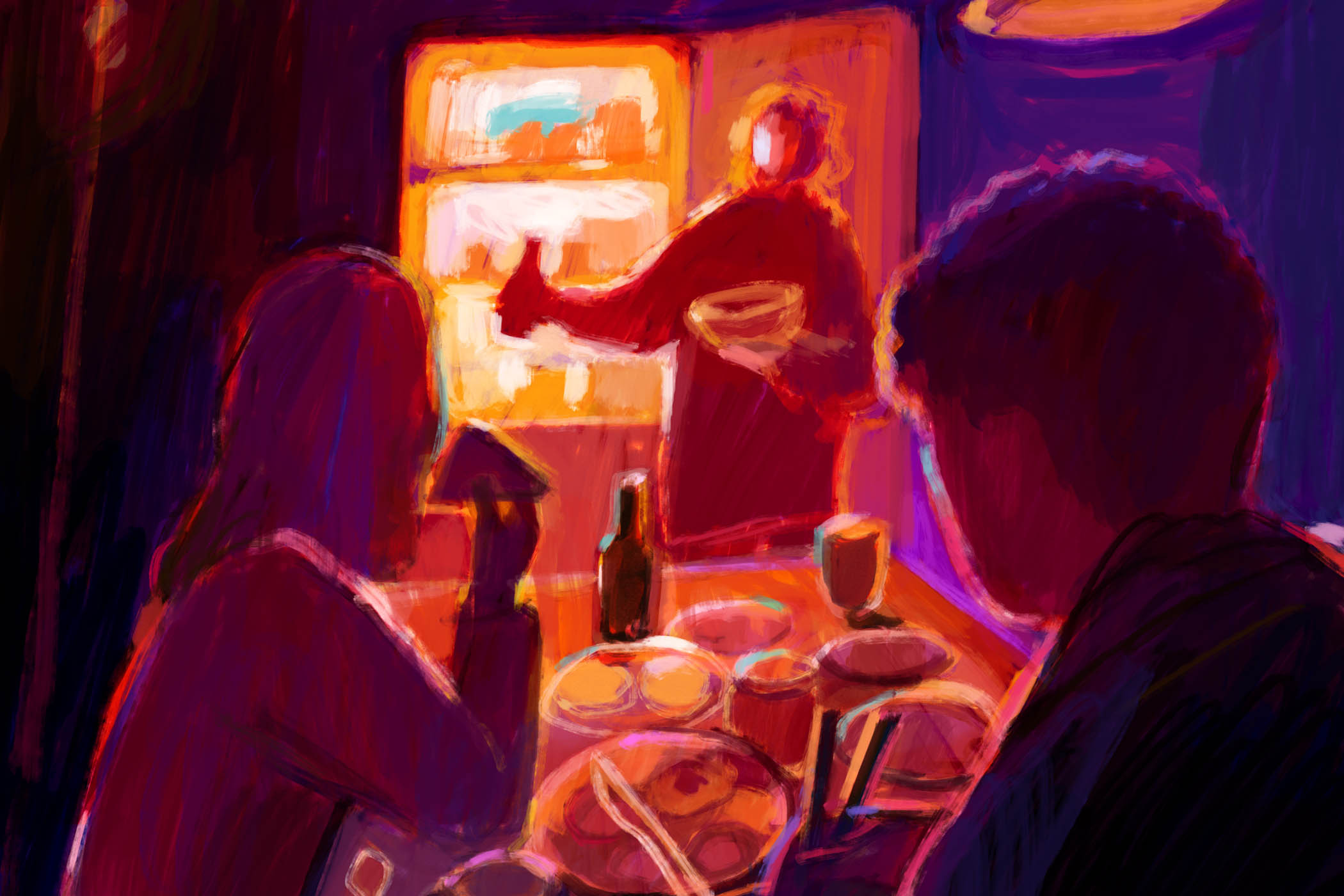


The last train from London arrives into Stroud station at 00.09. If it’s been a long time since we’ve seen each other, there’s a chance I’ll be waiting on the platform, The Railway Children’s Bobbie running towards you with a cry of delight. But if we see each other regularly – if you coming to stay is already soft and familiar – I’ll be waiting upstairs in my kitchen. I’ll be preparing us a midnight feast.
To welcome a friend late at night is a joy, an excuse to be cooking and feasting and chatting when I would otherwise be in bed. The food I prepare won’t be fussy: it might be dumplings from the freezer, or various bits on toast, or a bowl of ramen topped with something crisp or fiery or pickled. It’s possible I’ll have baked; it’s a guarantee I’ll have the kettle on. We might have celebrating, or commiserating, or catching-up to do; wherever we’re both at, it’s unlikely we’ll be sleeping anytime soon.
I have written about midnight feasts in my Little Library cookbooks – about being a child in Australia devouring novels set in English boarding schools, dreaming of tuckboxes and shared dormitories. It was nice to think about, I suppose, nice to lie on the bottom bunk and imagine being there instead. I still love to come across a midnight feast in a novel – to see Sarah Waters’s Kitty and Nan, home late from the theatre to welsh rarebit in Tipping the Velvet; or Jilly Cooper’s Rivals, drunk and scheming and eating Taggie’s shepherd’s pie; or August and her Brooklyn family ordering pancakes in the early hours in Casey McQuiston’s One Last Stop. I love it for precisely the same reason it captured me in those boarding-school novels: it’s delicious fun, the illicit thrill of feasting at midnight.
A midnight feast is just that: not a midnight dinner or a late supper. It suggests a knowing nod to fantasies of unwrapping food in a dormitory after lights out, an acknowledgement of the satisfaction of a meal when you should be in bed. The fact that the midnight feast exists outside of the breakfast-lunch-dinner standards means it arrives without the weight of purpose. This isn’t food for sustenance, food that cares about biological need. This is food purely about want, about delighting in precisely what it is you want to eat. Eating at midnight can’t help but feel like a feast. Complex planning or cooking is not required for your meal to earn the moniker.
Except, of course, if you’re Martha Stewart. My introduction to her recently rereleased 1982 cookbook Entertaining was thanks to a perfect chapter in Ruby Tandoh’s All Consuming on the TV show Come Dine With Me, hosting and dinner parties. Tandoh’s book is a fascinating, funny romp through the past century of food culture, and I’ve since read Stewart’s truly bananas masterpiece cover to cover, poring over 300 recipes and three dozen parties.
There’s a midnight omelette supper for 30 guests: various omelettes – creamed spinach, red caviar, curried chicken – that she suggests you start cooking from 11pm. On the buffet table for later are lemon-curd tartlets, chocolate mousse and brown-sugar cookies. You’d need close to 200 eggs to make the party happen. Then, past the tempura party for 16, before the country-house lunch for 175, Stewart writes of another late-night soirée: a band, 200 guests, 30 puddings on a linen-covered table, more than 100 bottles of champagne. Don’t be put off! Stewart reassures you that it merely inspired the recipes that follow, which are for “a more manageable group of 40”. She suggests you limit yourself to eight or 10 of the recipes: baba au rhum, kiwi tartlets, floating islands, coconut cake, meringue kisses, a grape tart and an almond torte. She encourages a dress rehearsal with your table to ensure you can fit everything on it.
Martha Stewart’s life is – in ways more numerous than I have space to communicate here – not my life. She knows this. Her book is aspiration and inspiration more than direct instruction. I dearly love to have people round, but even for me this is never the midnight hosting I am doing. I can’t imagine anything that would compel me to bring out an enormous assemblage of desserts to place on an extravagantly laid table at 10pm. At a party I like to be in the company of only my best and dearest around midnight, everyone who requires effort and active hosting long gone.
Maybe your date has gone precisely as you hoped, and you’re back late
Maybe your date has gone precisely as you hoped, and you’re back late
But, in the same way that candlelit feasts in boarding schools and midnight pancakes in American diners and welsh rarebit and dancing after the theatre are nice to think about, Stewart’s feasts are nice to think about. They’re lovely to read as fiction, to gawp in awe and to imagine what it would be like to be there.
And for those best and dearest whom I am feeding at midnight, the pressure is off. When my pals and I finished the 12 Pubs of Christmas, a December crawl across our Gloucestershire town, I loved that ours was the house we went back to. I’d had a warming whisky at each stop – no small amount, but not so much that I couldn’t cook for the final six of us when we arrived home. The details are, perhaps unsurprisingly, a little hazy, but there were plenty of eggs and a loaf of good bread, and every condiment we had went on the table. Red caviar omelette or meringue kisses and champagne it was not, but midnight feast it certainly was.
I don’t imagine you’re regularly inviting 40 people round to yours to enjoy a midnight feast of puddings either. We’re adults, sadly, no longer children up after lights out. There’s work in the morning, or kids who’ll wake us early, or an inability to keep our eyes open after 11pm. The appropriate time for an evening meal invitation seems to fall somewhere between 7pm and 8.30pm. In my experience, a midnight feast is rarely a planned party.
Newsletters
Choose the newsletters you want to receive
View more
For information about how The Observer protects your data, read our Privacy Policy
But it is also true that you might find yourself the host of one. Maybe the last kebab place in town has closed, and you need sustenance. Maybe a friend who’s coming to stay is arriving on the last train. Maybe your date has gone precisely as well as you hoped, and you’re back at yours after midnight.
The key to making your kitchen work for you in these scenarios, long after the supermarkets have shut, is having useful, nonperishable essentials to hand: ramen, freezer dumplings, frozen paratha. A packet of crumpets, which toast well from frozen. Jars of pickles and ferments in the fridge. Useful sauces and seasoning in the cupboard. They’re what I turn to most, when that 00.09 train delivers me a friend – or when I’m home late after a gig, as I so often am lately.
I’m about as far from your classic Saturday-night raver as it’s possible to be. I’m more of a dinner parties and “popping round for a cuppa” kind of person; I love telly, and BBC Radio 3. I acknowledge that there are other people in whom the raver and the cosy girl converge. She is not me. I could not have conjured up a world in which my late 30s saw me voluntarily surrounded by strangers dancing to electronic music. It’s just not my scene. But then I fell in love with a DJ.
And so I do the door at her gigs, tick names off lists and adorn the cheeks of ravers with stickers. I look out for people who need a cab, or a minute outside. I hang out at the back and sneakily read Agatha Christie on my phone while I groove (that’s the wrong word for it, probably, which might give you a picture of the ways in which I don’t quite blend in). On particularly wild nights, I’ve been known to drive inebriated partiers safely home. And then, once we’ve cleared up the glowsticks, I’ll cook for us back at mine.
She’s still wired after having performed, in need of a good couple of hours to wind down. So when we get home, w e head to the kitchen. W e’ll toast crumpets and eat them topped with Marmite and peanut butter and kimchi. We’ll make noodles with tahini and soy and a sharp vinegar, or with vegetables from the fridge door and plenty of pickles. I’ll make biscuits or brownies and a couple of cups of tea. We retire to the sofa, and we feast. We talk and we eat, hours after I’d normally be asleep. It’s just us and the quiet, late-night hum of the town outside my window. Not exactly the picture of midnight feasting I had in mind as a child, and yet still that same sense of sheer delight – the pure illicit, should-be-in-bed-already thrill of it.
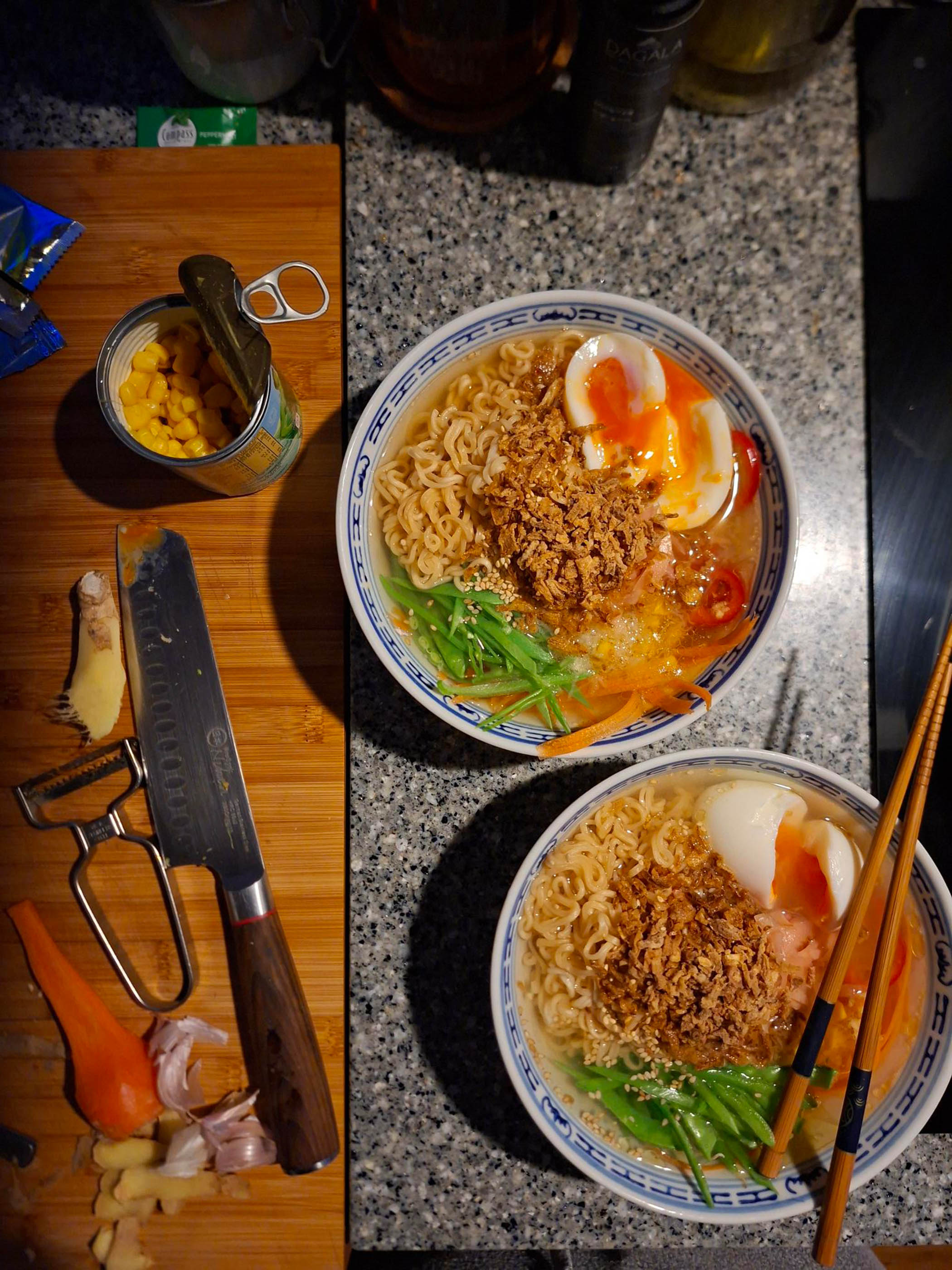
VEGETABLE DRAWER RAMEN
My collection of ramen noodle packets is extensive. They keep for ages and I hate to run out. They’re delicious even if you just follow the instructions, but the additions here turn a quick snack into a proper midnight feast. All in little more than the time it takes to boil the eggs.
Serves 2. Ready in 10 minutes.
vegetables anything that’s hanging around that won’t need cooking: tinned sweetcorn, carrots, pepper, mangetout, frozen peas
ginger a thumb, grated
garlic 2 cloves, minced
white miso 2 tbsp
ramen 2 packets, including sachets
eggs 2
pickled ginger, crisp onions, toasted sesame seeds, chilli crisp to serve
Boil the kettle. While it heats, prep your vegetables: julienne carrots (I use a little julienne peeler – you can ribbon them with a regular peeler if that’s easier), finely slice the pepper and mangetout, open and drain a tin of sweetcorn, defrost some peas in a sieve. This is entirely flexible and to your taste – aim for things with texture that won’t turn to mush in a broth.
Divide the grated ginger, the garlic and the miso paste between 2 deep bowls. Add the contents of the sachets in the ramen packets. Pile the vegetables into the bowls, too, leaving a large spot for the noodles.
Put some of the kettle-boiled water in your smallest saucepan, set to simmer over a moderate heat, and lower in the eggs. Set a timer for 6 minutes; once it goes off, leave the saucepan where it is but scoop the eggs out with a spoon and run under cold water. Drop both nests of noodles into the still simmering water.
When tender (about 2 minutes), drain the noodles and divide them between the bowls.
Peel the eggs, add 1 each to the bowls, and then pour water from the kettle into the bowls, until it sits just below the height of the noodles and vegetables. Top with pickled ginger, crispy onions, toasted sesame seeds and chilli crisp, all to taste. Give it all a good stir before serving, to incorporate the flavourings from the base of the bowl.

LATE-NIGHT SPICE COOKIES
There are these cardamom-fennel-tahini spice cookies in my first book, The Little Library Cookbook; they’re something I adore and often return to, especially when I know people are coming to stay. Recently some friends dropped by after the shops had shut. I was out of eggs and butter, so I messed around with the original recipe and made these instead. No eggs, no butter, no ingredient with a short life – everything always present in my cupboard. The flat smelled glorious, and we finished the whole batch.
Makes 12. Ready in 20 minutes.
light brown sugar 100g
granulated sugar 80g
extra virgin olive oil 70ml
tahini 3 tbsp
oat milk 2 tbsp
plain flour 220g
baking powder 1 tsp
bicarbonate of soda 1 tsp
ground cardamom ½ tsp
salt 1 large pinch
chocolate 180g, chopped
fennel seeds 2 tsp
Heat the oven to 180C/gas mark 4. In a bowl, stir the sugars, olive oil, tahini and oat milk with a spoon until combined.
Mix in the flour, baking powder, bicarb, ground cardamom and salt, stopping as soon as everything comes together into a crumble dough. Add the chocolate in. Roll into 12 roughly even balls, space out on a greaseproof paper-lined sheet pan, squash the balls a little and sprinkle the top of each with fennel seeds. Bake for 14 minutes until set on top but still a little soft, and then allow to cool a little on the tray before eating.