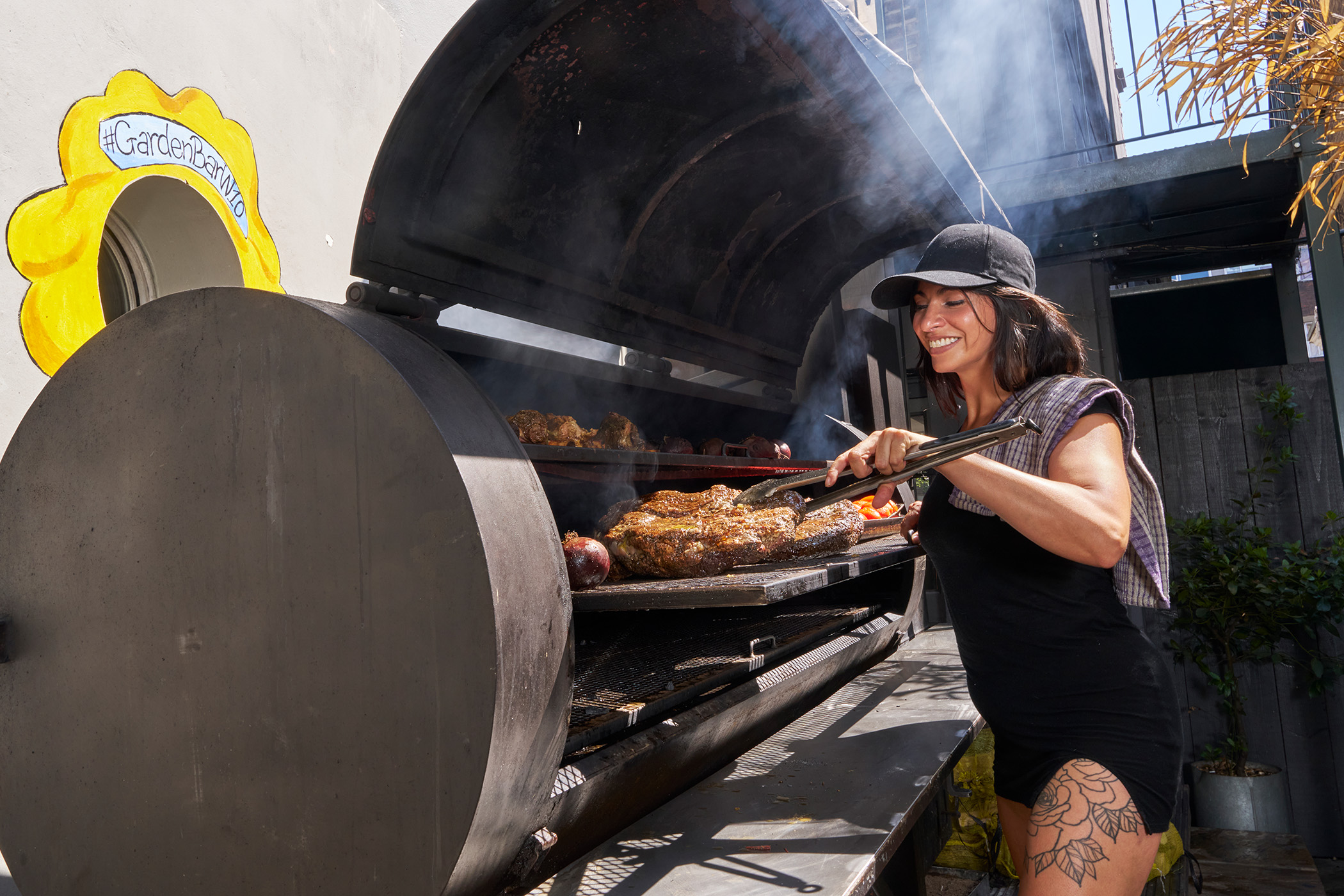

Like voting, education, and sport, men tried to keep barbecue for themselves. Getting territorial over tongs goes hand in hand with cans of IPA and three-quarter-length shorts. A stereotype, sure, but gendered roles persist. And this one is particularly odd, when women are – historically and still, in many cultures – responsible for the majority of cooking. Why are men drawn, like moths, to the flame? Consumer marketing promoting suburban, patriarchal family “ideals” is partly to blame, but the heteronormative hubris of the current barbecue scene has much to answer for.
“It’s an invisible filtration system at the door,” says Melissa Thompson, barbecue chef and author of Fired Up. “Men head towards the fire, beer in one hand, the other in their pocket. The women go indoors to look after the sides and kids.”
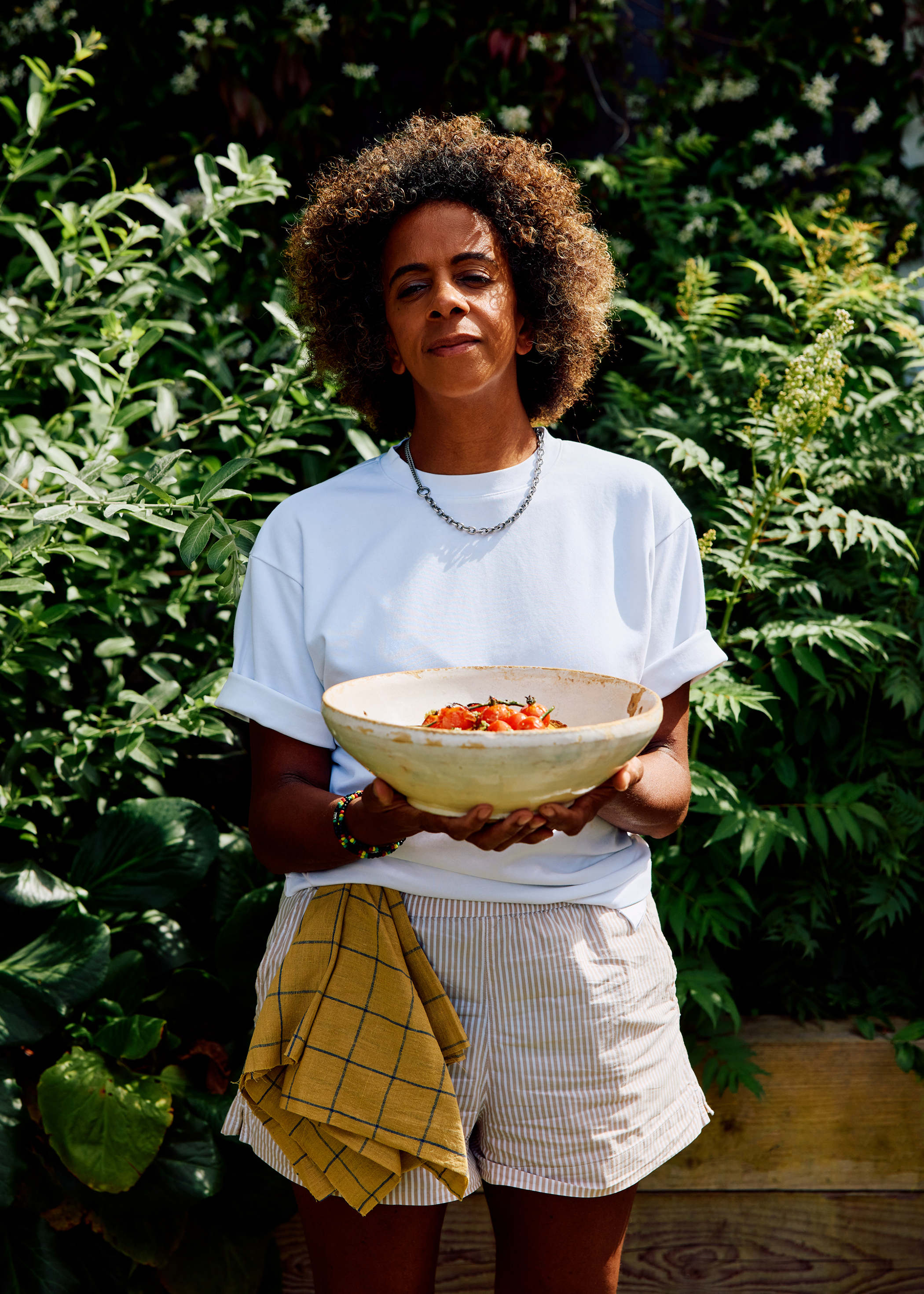
Melissa Thompson
Interest in live-fire cooking has snowballed since the opening of North American-style restaurants Bodean’s (2002) and Pitt Cue (2012) in London. The latter was a cult food truck which evolved into a tiny restaurant beloved of critics, bloggers (yes, they were still a thing) and punters who queued around the block. A wave of blokey openings followed, including the brooding Smokestak, famous for brisket, and Temper (from Pitt Cue’s ex-head chef Neil Rankin).
Now, barbecue festivals such as Meatopia and Fume cater to growing appetites. Meatopia had 13,000 visitors in 2025, while Fume saw 17,000 cross the threshold into Twickenham’s Allianz Stadium. Netflix’s BBQ Showdown and Jamie Oliver’s Ultimate BBQ (Channel 4) have nudged outdoor cooking into the mainstream, with Oliver keen to highlight women cooks, including Thompson, who featured in Episode two. “Women have been cooking over fire for millennia,” he says; they are the “true guardians of the hearth, feeding their families and passing down technique after technique.”
‘Women have a level of creativity in the live-fire space that men don’t. We’re rebuilding the scene in our own vision’
‘Women have a level of creativity in the live-fire space that men don’t. We’re rebuilding the scene in our own vision’
While fire-focused events tend to focus on American-style ’cue, barbecue is global – something women in the UK are bringing to the fore. “At the beginning of the UK’s barbecue revolution, everyone was cooking American-style, low and slow… that made it unattainable for a lot of people,” says Thompson. North American barbecue deals in slabs of muscle that take an age to cook and are notoriously tricky to master. The style has its own vocabulary, with terms like “the stall” (the point at which the temperature of meat temporarily stops rising) and “Texas crutch” (wrapping meat in foil) perfect for slinging back and forth in forums. “There’s an inherent machismo to cooking with big cuts of meat,” says Thompson. “But barbecue doesn’t always have to be this massive fucking occasion where you’re nursing the coals for 12 hours.”
Barbecue food is bold by nature: smoke and char bring bitter edges, caramelised fats and acidity in dressings and sides, but that doesn’t have to mean endless racks of ribs. “Women are more inclined to cook vegetables over fire, cook fish, cook smaller bits of meat,” says Thompson. Genevieve Taylor, a live-fire cook, author and teacher, says that women’s food is “more colourful” with more “lightness and freshness.” She views a plate of barbecue food “like any other meal” with one centrepiece element and a few “vegetable-heavy situations.”
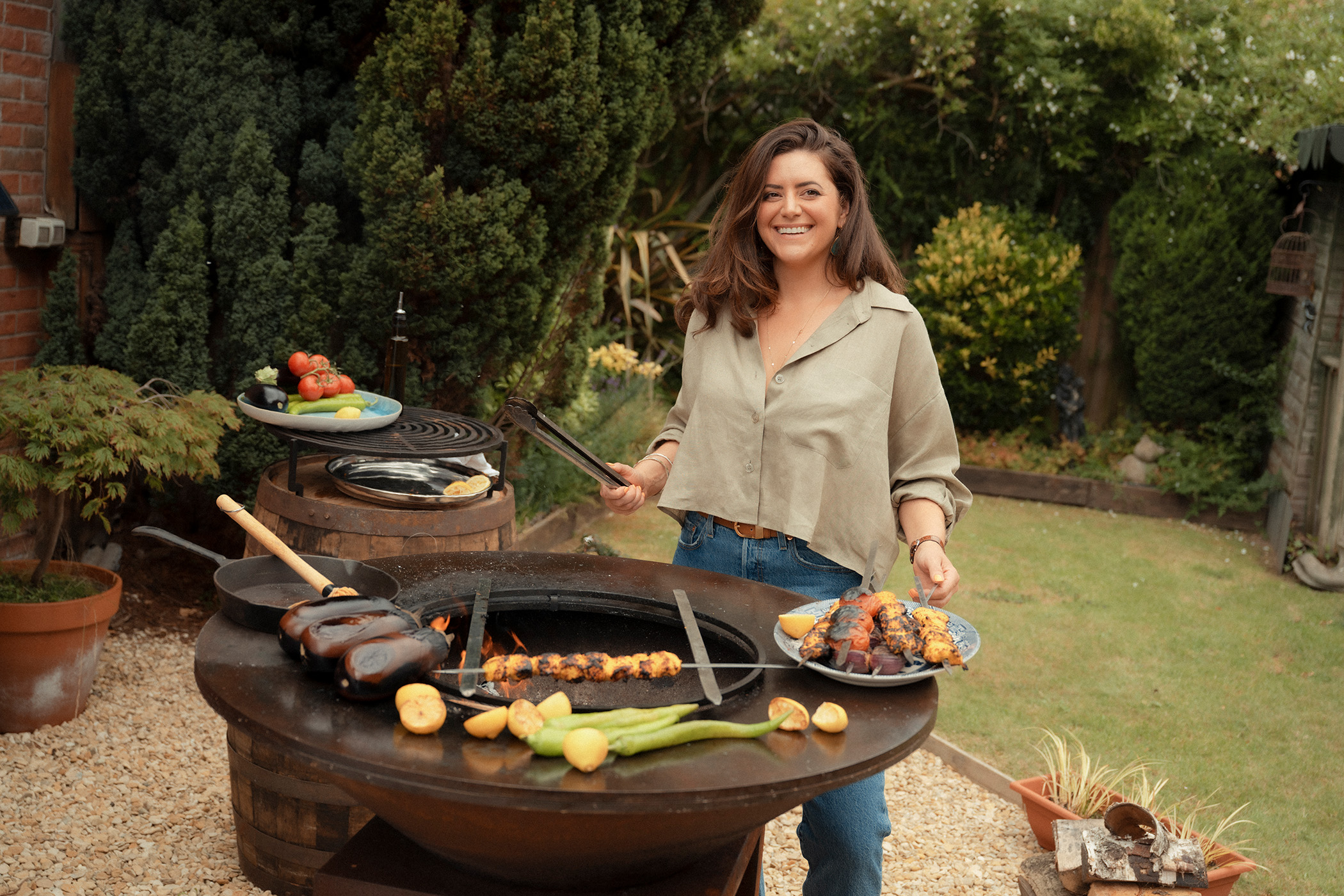
Leyli Homayoonfar
Leyli Homayoonfar founded Bab Haus, a street food concept fusing traditional Mexican dishes with Texan techniques and Iranian influences from her heritage. Brought up on “traditional Persian barbecue” she was seduced by the challenges of the Texan approach, but has now come “full circle” and fallen in love with Middle Eastern and Persian techniques. On the plate, this looks like the abundance of pickles, fresh herbs and condiments typical of Iranian cuisine. While her signature birria quesa tacos are a mixture of short rib, ox cheek and brisket, the salsa roja, coriander and salads feel like an integral part of the dish.
Ana Ortiz – co-founder of Fire Made, a bespoke fire-kitchen maker – grew up in the Galapagos, where cooking outdoors is the norm. Her uncle, a fisherman, would provide his catch for regular picnics on a beach which involved cooking lobsters over volcanic rock – more reminiscent of a scene from a survival show for the average UK patio cook. Her focus now is fresh fish and vegetables: “smoking garlic, grilling onions, grilling peppers.” Balancing multiple techniques, she chars on the grill, roasts in the embers and simmers slow-cook dishes, such as fritada – a dish of pork confited in its own fat until crispy – gently in brass pans.
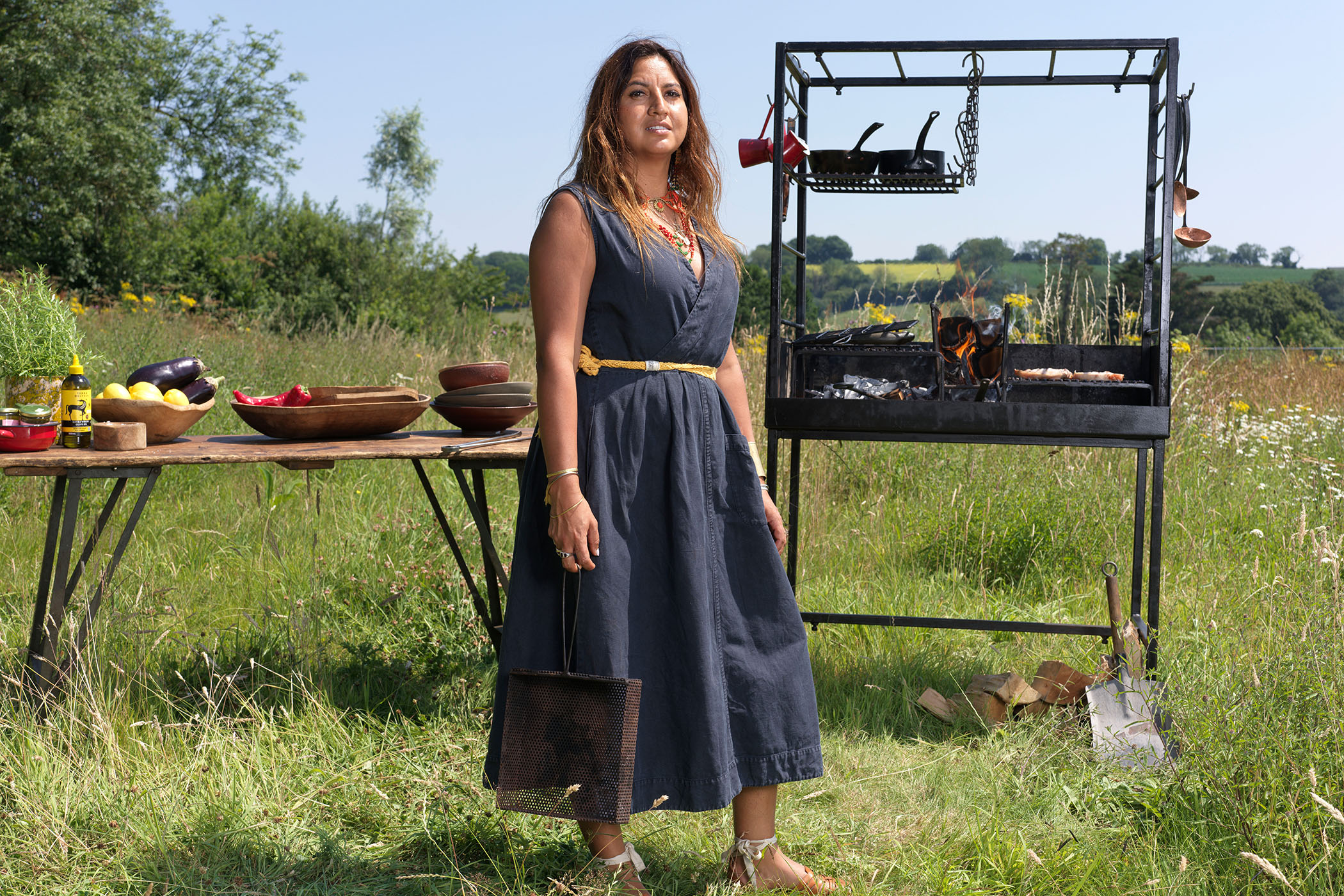
Ana Ortiz
Oliver, speaking to Times Radio on the release of his book BBQ: Easy Grilling, Big Flavour in April, said that “women have an innate ability to cook over fire.” Ortiz agrees: her kitchen staff is 80% female, with support structures which allow a balance between work and childcare needs. “I’ve worked with some amazing male chefs,” she says, but “women have more passion for food.”
“Women cook with more love,” says Maureen Tyne, a Brixton-based Caribbean cook famous for her jerk chicken. “Men can cook really well, but when a woman gets [a dish] good? No one can beat them.” Maureen started selling her food after finding the balance of motherhood and work outside the home didn’t meet her needs. “My son just cried and cried when I left him,” she says. She now cooks at home, and customers come to her. She also has cooked at London’s Meatopia with Thompson. “Nothing flaps Maureen,” Thompson. “She’s really instinctive on the grill… in Jamaica everyone cooks over fire. I’ve learned a lot from her.”
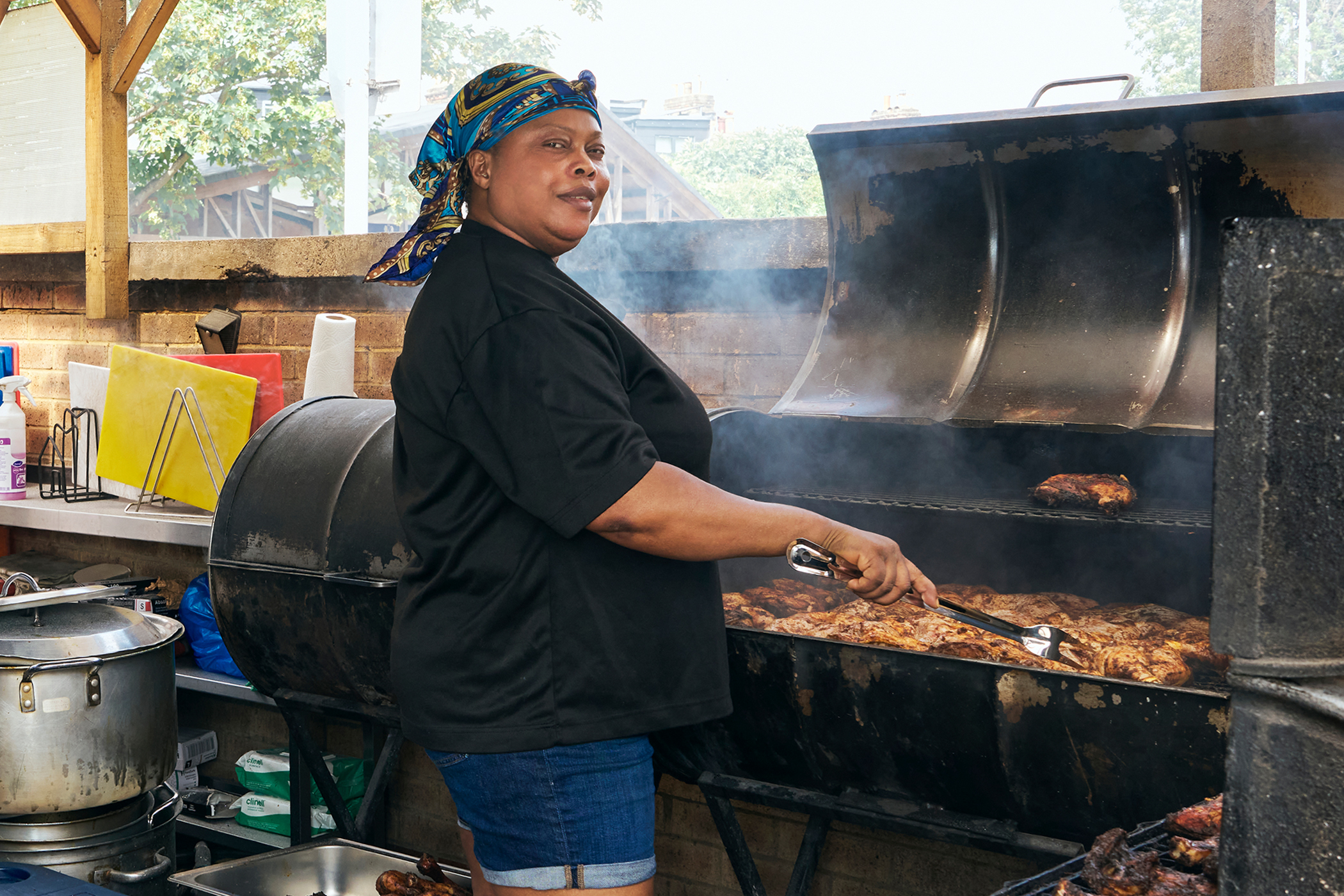
Maureen Tyne
That Tyne found a way to earn money from cooking on her own terms is significant given the categorisation of feeding a family as women’s labour, while men outnumber women in restaurant kitchens, and barbecue is often categorised as “fun”. “We’ve always been told we’re the people that cook, but we don’t dominate that space,” says Mursal Saiq, chef and co-owner of Cue Point, an Afghan-Texan restaurant. The food at Cue Point merges influences from Saiq’s Afghan heritage with classic Texan techniques. On the menu: borani kadoo (smoked pumpkin with onions, chilli and turmeric), oak-smoked lamb shank with Kabuli pilau and borani banjan (aubergine curry) with Texas naan.
It’s Saiq’s quest to “deconstruct” the current barbecue landscape, despite meeting resistance among male colleagues. “I’ve got shit for the 10 years I’ve been in barbecue. I know that when I step in a kitchen people are gonna go, ‘Oh my god, her vagina is getting in the way of her steak,’” she says. “They say ‘don’t do a tomahawk like that’. I get the mansplaining.” Women are not just reclaiming barbecue “but re-learning how hands, food and fire resonate with them.”
The “bro-becue” scene’s aesthetic leans towards flame motifs, black gloves and dad rock, and Saiq has noticed that a woman’s willingness to identify with this image equates to being taken seriously – something she’s determined to change. “If [a woman] wants to wear a burqa, do it,” she says, “if you want to wear a fucking bikini, fine. Don’t break any laws, but wear what you like.” Ortiz agrees: “I’m not interested in wearing a leather apron and dressing all in black… I want to cook like my grandmother did, with her dress on.”

Genevieve Taylor
These observations speak to something fundamental about women’s approach to barbecue – a breath of fresh air when the scene is a hotbed of style-over-substance. At the big events, barbecue as performance has become the norm, with multi-meat skewer “swords” and ever-growing smokers. Men like to make barbecue “more show-offy,” says Taylor, “but it’s like, lads: all you’re doing is cooking dinner?”
“When we do any event, it’s a huge sausagefest,” says Homayoonfar, “but I approach it saying I’m going to make the best, tastiest dish I can…we’ve never had gimmicks; we let the food speak for itself.”
“Women have massively changed the game in this country,” Thompson says, “we are changing the dynamic.” A broader range of styles, better consistency and technique, and an innate fire-handling ability may all be contributing factors, but so is lack of expectation. “Women have a level of freedom and creativity in the live fire space that men don’t,” says Saiq. “What have I got to lose as a woman in barbecue? You already think I can’t do shit, so I’m going to be really innovative. Women are rebuilding the barbecue scene in their own vision.” They call that fanning the flames.
Hot tips for summer entertaining
Melissa Thompson
Level up your salads with grilled elements. “Cook some tomatoes in a grill basket or a metal sieve over the fire until they’re nice and blistered. You can do a lot the day before, then just have those finishing elements.”
Choose smaller cuts for easier cooking. “Rather than doing a whole pork belly, cut it into strips – it takes less cooking, and you’re increasing the surface area so there’s more carbonisation, and it takes on more marinade, so it’s tastier.”
Genevieve Taylor
Keep things simple with a central element and a few sides. “Don’t feel that you’ve got to cook 20 different types of meat.”
Use the remaining heat in your barbecue. “I’ll make some sort of cakey dessert you can just shove in the barbecue to use up the rest of the heat while you’re eating your main course.”
Ana Ortiz
Don’t forget the nibbles. “Have lots of small bites that people can have while you’re cooking. It’s also more sociable.”
Maureen Tyne
Always serve a strong drink like rum punch to get things going. “I grate the ginger, then boil the ginger with pimento berries, then I mix the syrup, and add some fruits in it, like apples, some lime. When the ginger is cool, I add that to the punch and stir in the rum.”
Don’t be afraid to pre-cook food. “I always have something ready. Some sausage fritters, some plantain, some fried dumplings or ackee and salt fish, so people can have something nice to eat.”
Mursal Saiq
Focus on flavour. “People just take a sausage or a piece of chicken and throw it on the fire… you need to marinate your meat, make your own burgers, put the effort in.”
Prep, prep, prep. “You want to have as much as possible done before your guests arrive. Then you can have a sit-down, a cigarette and some rosé.”
Leyli Homayoonfar
Get guests to serve themselves. “I always make sure there’s a drinks station set up with ice, glassware and plenty of refreshments. Something fresh, seasonal and easy-drinking means you’re not stuck making individual drinks all afternoon.”
A marathon not a sprint. “The secret to a great barbecue isn’t cooking everything at once! Think of the barbecue as a gathering rather than a meal.”
Photographs by Matt Russell, Suki Dhanda, Karen Robinson and Francesca Jones. Top image: Mursal Saiq, at Cue Point
Newsletters
Choose the newsletters you want to receive
View more
For information about how The Observer protects your data, read our Privacy Policy