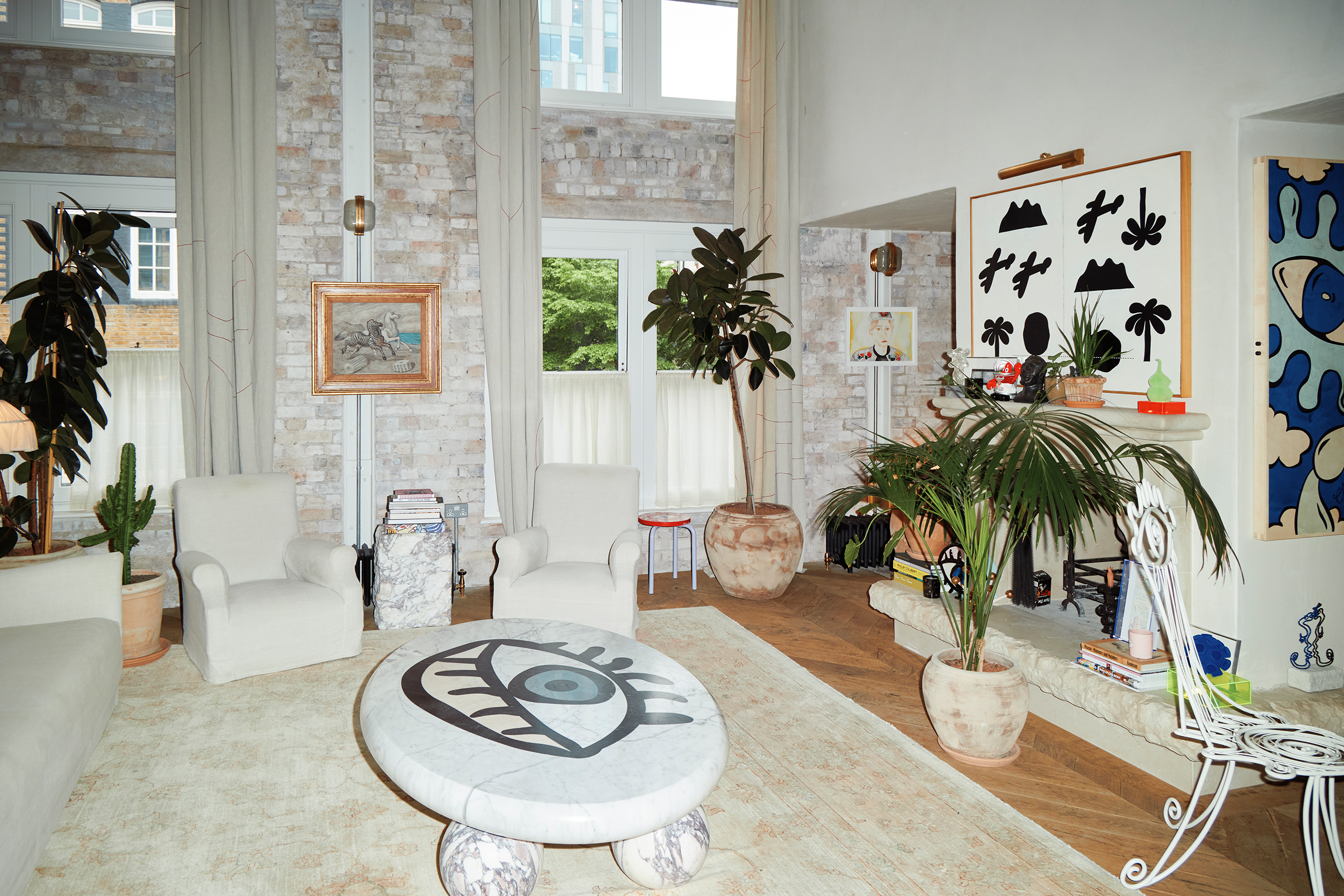



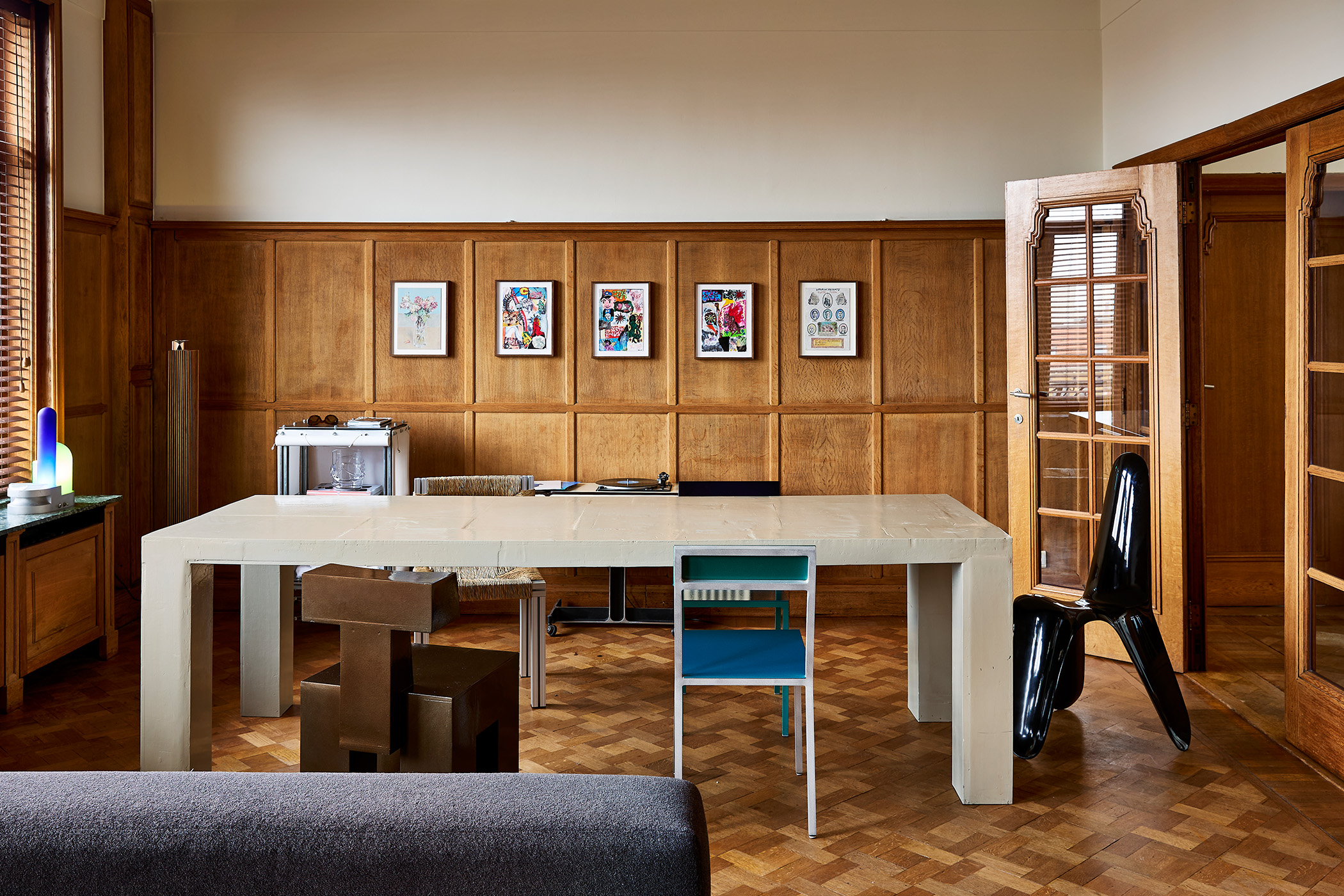
If Peggy Guggenheim, one of the 20th century’s greatest modern-art collectors, were alive today, her eye would surely have been drawn to the surrealist world of artist and filmmaker Charlotte Colbert and her fantastical, Narnia-like East End house. Shared with her husband, the artist Philip Colbert, the space is equal parts museum, work studio, emporium and home, and feels like a living exhibition of both of their work
Charlotte greets me on the cobbled street outside her front door and leads me through a whitewashed ground-floor studio, up a zig-zag of short, custom-made wrought-iron staircases and into a vast, loft-like living room. Here light streams through large square windows, creating abstract patterns on the reclaimed wood floor while green foliage hangs from a mezzanine. But more than anything, it’s the pale, rough-stone and brick walls that lend a sense of calm to the explosion of colours, textures, sculptures, paintings, books and singular artefacts that cover every surface. Rather than creating a scene of chaos, the whole blends into beautiful cohesion.
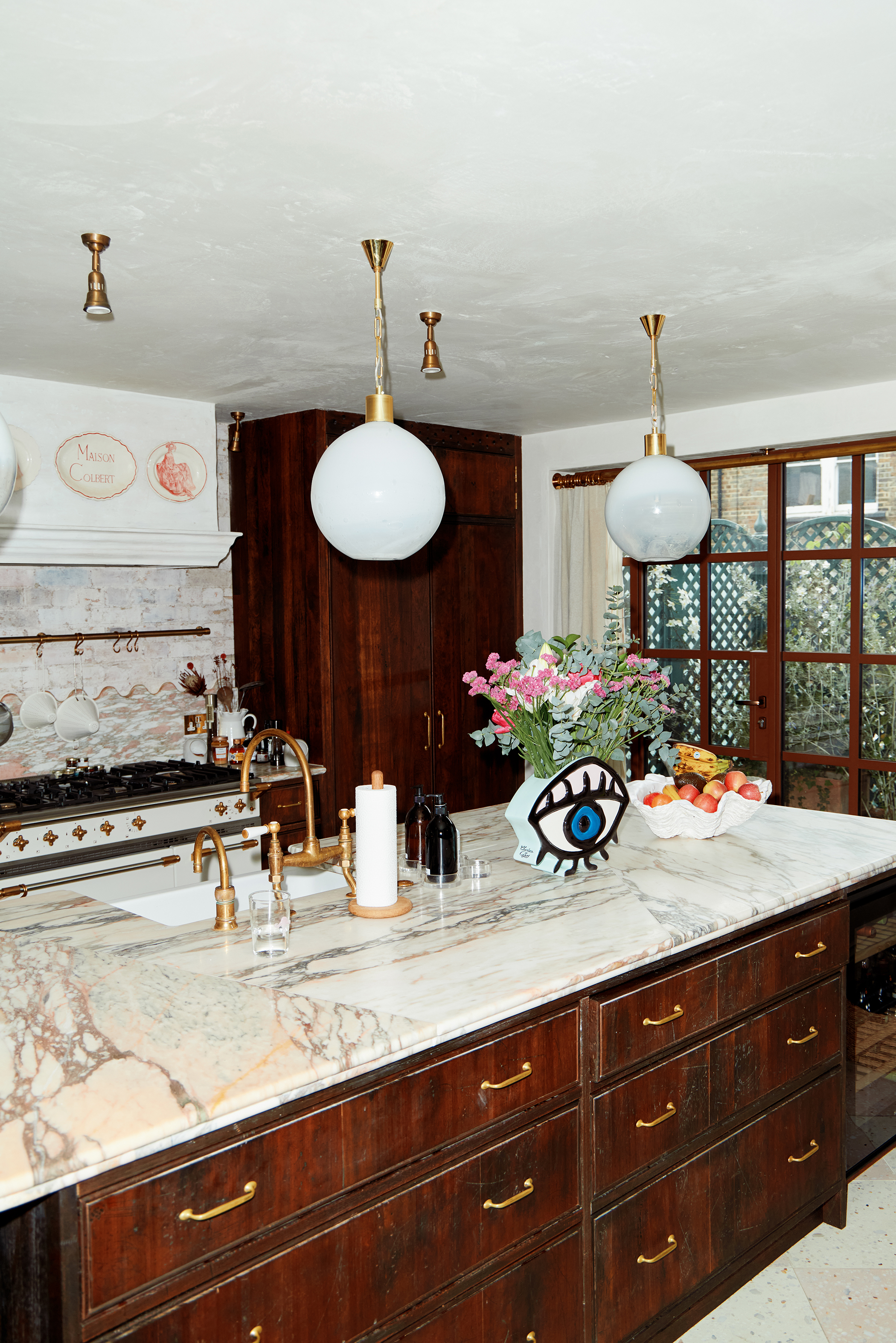
The tall, blonde 40-year-old is dressed in an oversized black mohair jumper, baggy black jeans and biker boots. “I’ve made you lunch,” she says. We perch on high stools at a marble kitchen island covered with earthenware bowls filled with lentils, quinoa, salads and dips, as well as plant pots and ceramic plates in all shapes and sizes. An ivory-coloured Aga lines the wall behind us.
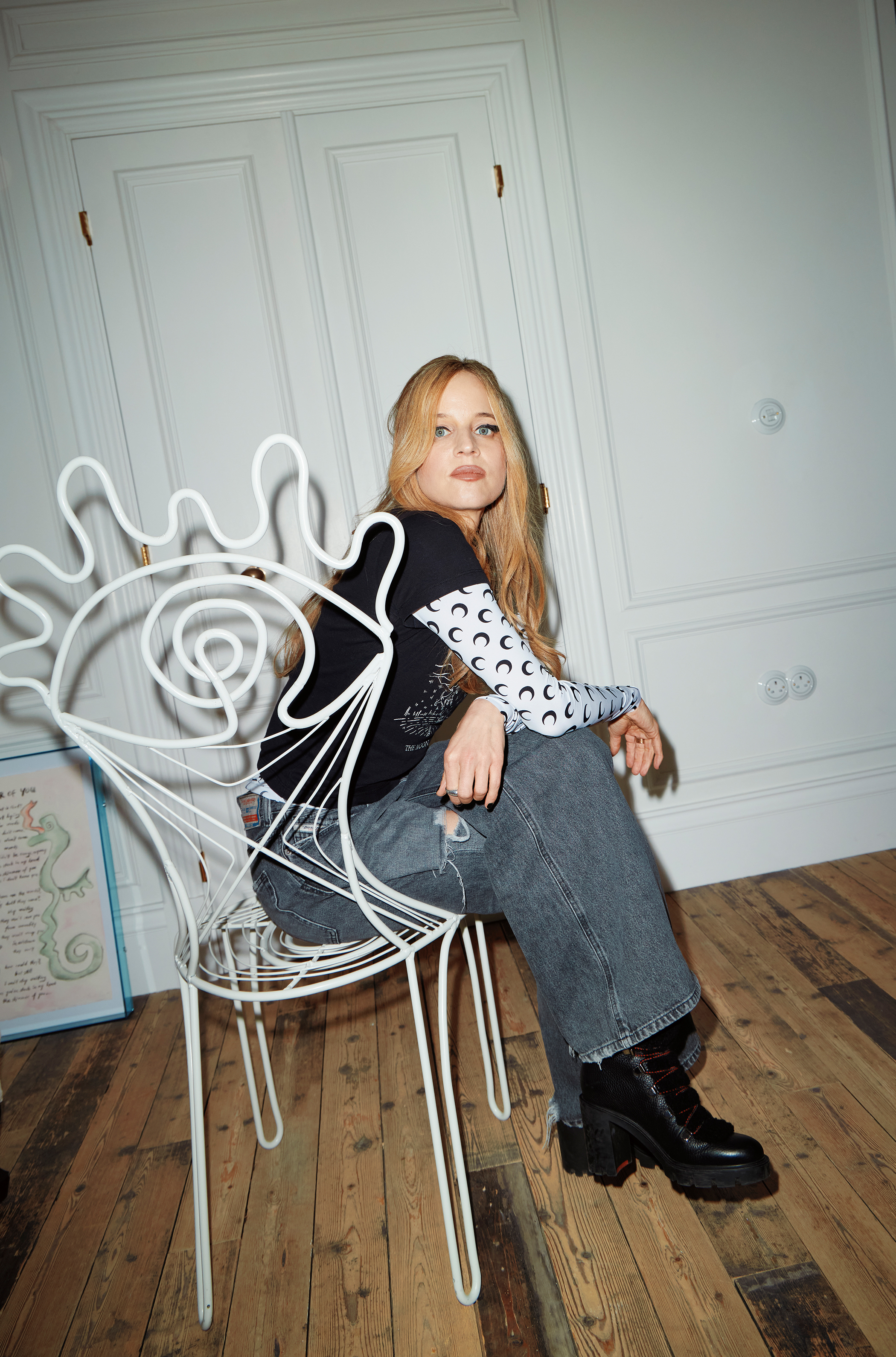
As they were for Salvador Dalí and René Magritte before her, eyes have always been an aesthetic and artistic motif for Charlotte. They appear in her own designs throughout the house: on the backs of the white sculptural wrought-iron dining room chairs at the back of the room; on a bespoke circular stained-glass window on the stairwell; on the large oval-shaped marble coffee table in the sitting-room area, where a single giant blue eye swirls on its surface. “The eyes became a symbol I kept using,” she says. “It’s nice, tapping into this idea of surrealism. It opens a crack in the matrix – it kind of reminds you that things could be otherwise.”
It’s not just eyes that proliferate in Charlotte’s designs, but facsimiles of female genitalia. In the couple’s pale pink and ivory bedroom, a giant upholstered uterus springs, octopus-like, from the headboard, while a free- standing working bath, entitled Mother’s Milk, features pink breasts jutting out along its entire surface. More breasts are found throughout the house, in varying colours, while in the ground floor “garden living space” is Motherhood, a sculpture of white-flecked marble bosoms.
Other curiosities include a custom-made bar in pink and red stripes in one corner, resembling the sort of Parisian boudoir you might find in a Montmartre turn-of-the-century club (complete with a concierge’s booth, hung with room keys), and a lift, the door of which is embossed with a lobster (Philip’s own signature motif). Down a set of stairs is a greenhouse-style salon, walls painted with bucolic scenes reminiscent of Marie-Antoinette’s Petit Trianon.
But the space was not always like this. The couple originally lived nearby and used just the ground-floor space as their studio. Eventually, sensing its possibilities, they acquired five adjacent dilapidated terrace houses, and converted them. For this they worked with designer Angus Buchanan of London’s Buchanan Studio, and Chris Dyson Architects to transform it into what it now feels like, with its vastness and airiness, a 19th-century greenhouse idiosyncratically juxtaposed with the couple’s singular artistic styles. Colbert herself has had a life of juxtaposition. Born in New York, she grew up in the countryside outside Paris. “I was very feral and quite shy as a kid,” she says. “I lived in my own universe and world. I wrote all these stories. I observed these weird bugs.” She was educated at a local French school before going to McGill University in Montreal. While there, she met the Blood Sisters, whom she describes as “an interesting group of communist lesbians who told me about the moon cup” – referring to the reusable, bell-shaped menstrual cup, for which she became a European distributor, and which influenced her later work. As Colbert says: “We all come from a uterus. Actually, that feels like science fiction. It’s so surreal.”
After graduation she moved to London to attend a screenplay-writing course at the London Film School. While studying she was hired by the actor and documentary maker Toby Jones to co-write his film Leave to Remain, about young asylum seekers in the UK. She went on to work on various film projects, and also took up photography. “I wanted to reflect the kind of madness and surrealism,” she says, “of the scapes that open up where your body is trapped but your mind can expand into any sort of universe and imagination.” In 2013 the Gazelli Art House gallery on Dover Street put on a show of her images, entitled A Day at Home.
From then on, her work expanded into sculpture, ceramics, homeware, installations and other media. “The filmmaking is the most wonderful thing, because it’s so complete, and as an art form it works within so many things that you know,” she says. “Tarkovsky [the Russian filmmaker] called it sculpting in time.” She directed and co-wrote her first feature – She Will, starring Alice Krige, Malcolm McDowell and Rupert Everett – in 2021, garnering rave reviews, and has written and directed her second, Becoming Capa, currently in post-production. I wonder whether her filmmaking is an evolution of her art, or the other way around. “I’m a confused person trying to understand that, and I guess my work happens through different mediums,” she says. “I’ve always swung between moving images and sculpture – they evolve in parallel. You’re told to do things one after the other, but my brain struggles with that. It’s easier for me to do everything at the same time.”
To that end, she has just returned from overseeing the first public installations of her work in America and Italy. The first, in New York, is Chasing Rainbows – two 30ft silver sculptures, each of a singular gigantic eye (one stands in front of the Flatiron building in Midtown; the other is downtown, in the meat-packing district). The second installation is part of this year’s Venice Biennale, where one of her works towers on the edge of the Grand Canal – fittingly, opposite the Peggy Guggenheim collection.
Newsletters
Choose the newsletters you want to receive
View more
For information about how The Observer protects your data, read our Privacy Policy
As I look around the house one last time, I notice a black-and-white portrait of Colbert, taken by David Bailey, resting against a bookcase. It is simply shot, without artifice, and yet her gaze manages to convey that ever-watchful eye, critically observing the space around her and where she might take it next.