
Mowing the communal gardens of Hoathly Hill in rural West Sussex taught the teenage Andre Templeton Ford lessons that would shape his life. This 30-home community, founded in 1972, was based on the philosophical and spiritual teachings of the early 20th-century thinker Rudolf Steiner. Growing up here in the 1980s, sharing grounds, allotments, a pottery studio and a communal barn, young Andre learned that spaces, resources and ambitions can flourish when shared and built together.
Decades later, I’m standing with him in the entrance hall of his own self-built house, which sits on the plot right next to his childhood home. Clay Rise was designed by Andre himself, now an architect, and was recently shortlisted for the Manser Medal, the UK award for the best newly completed house. Curvaceous lines of lime-plastered walls sweep upwards into a smooth, rounded ceiling, oak handrails coil around balustrades. “These organic forms have been around me for a long time,” says Andre, referring to the undulating ceramic sculptures created in Hoathly Hill’s Sculpture Studios, which are dotted around the grounds outside.
The house is the fruition of a seed first planted four decades ago. When his parents, Mike and Helena Ford, bought their house in 1986, they thought they might use the property’s generous garden as a plot on which to build an additional home they could share, rent out or grow into. The idea lay dormant for years, surfacing occasionally in sketches and conversations, until finally Andre stepped in. “Eventually we realised what my parents really wanted was a home that could expand or contract,” he says. “Either a six-bed family house or two entirely separate units.”
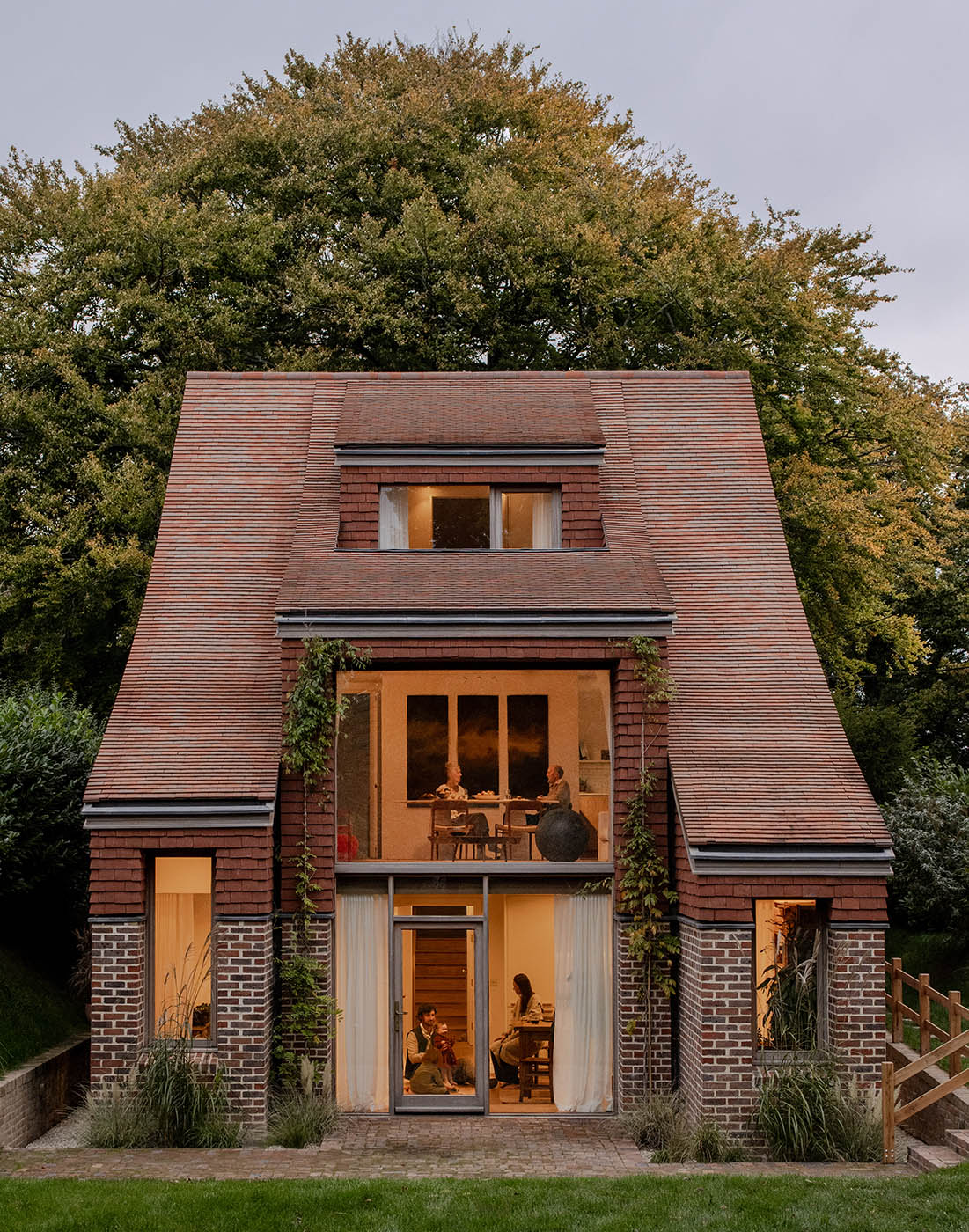
Learning curve: architect Andre Templeton Ford designed Clay Rise to suit both his parents (top floors) and his own young family (ground floor)
Two years into the build, Andre and his wife, the interior designer Jessica Templeton Ford, decided to put their flat in Walthamstow, east London, up for sale and move permanently to Hoathly Hill – despite the fact that Jessica, a stylist and photographer, was at the time heavily pregnant with their second child. “It slowly became obvious: the childcare was already here, our lives were already here,” he explains. “It wasn’t the plan at the start, but the project drew all of us in, financially, emotionally, physically.”
The young family settled into a ground-floor dwelling, with access to the garden, while Mike and Helena occupied the middle and top floors, which offer generous views across the South Downs. “I am a great believer in the tribal belonging of an extended family,” Mike says. Helena agrees: “Being part of a multi-generational household has enriched my life on so many levels.”
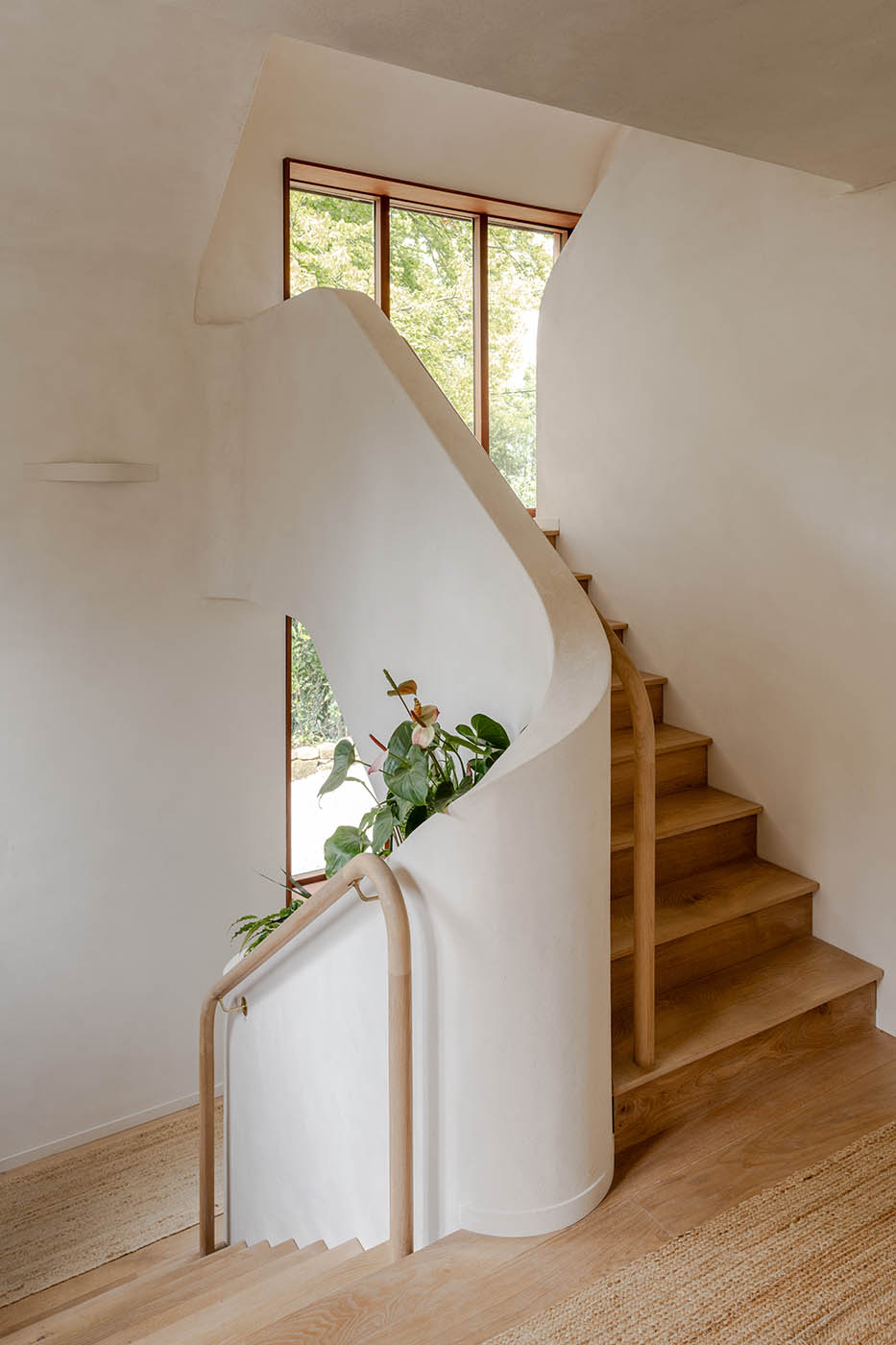
The curving staircase that joins the two homes
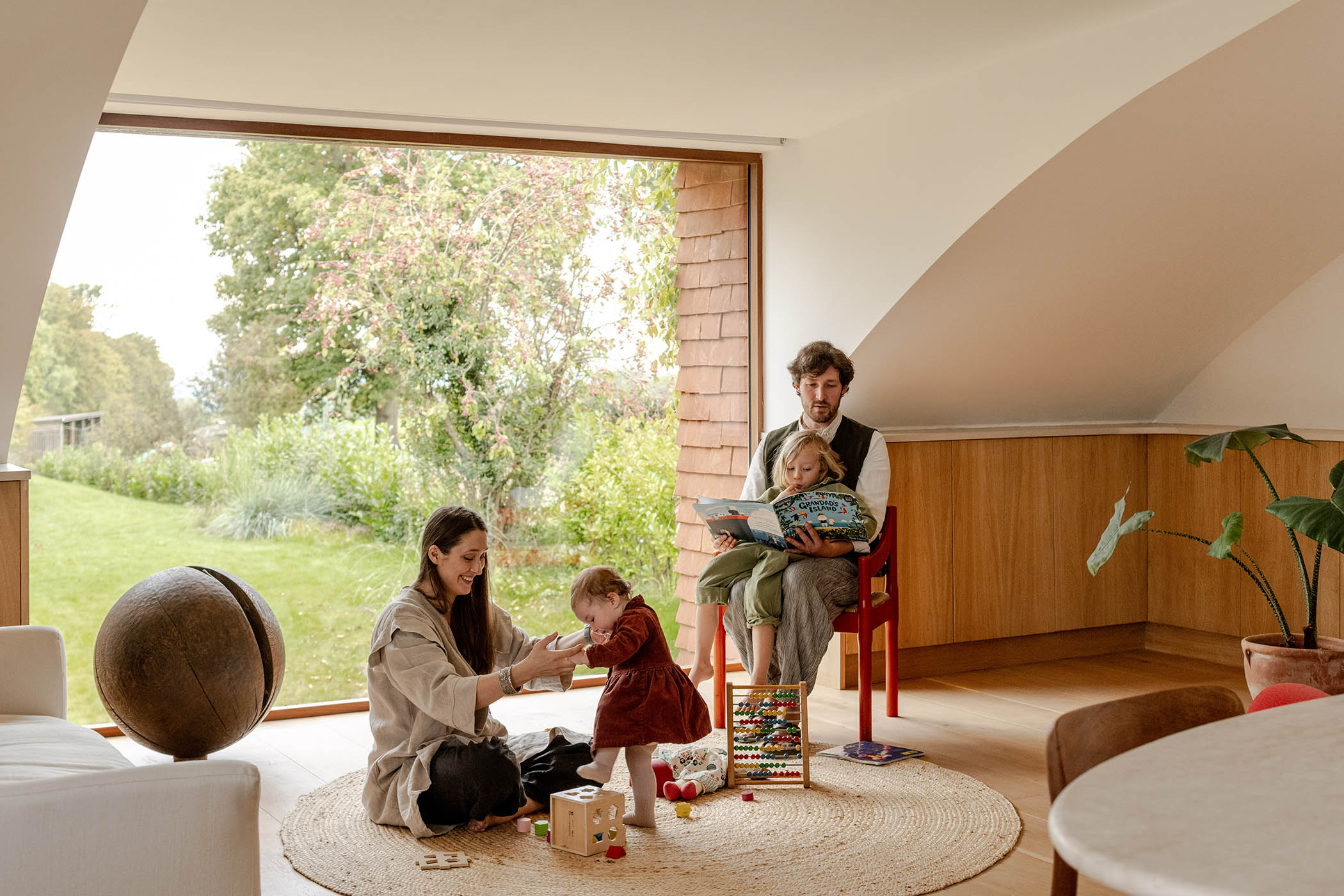
Andre and Jessica’s children – Felix, four, and Juniper, 16 months – roam freely throughout the house, bouncing about between the floors. But the adults still maintain boundaries. “It’s important to respect each other’s space,” Mike says. “I tend to knock before entering their home. It just works better that way.”
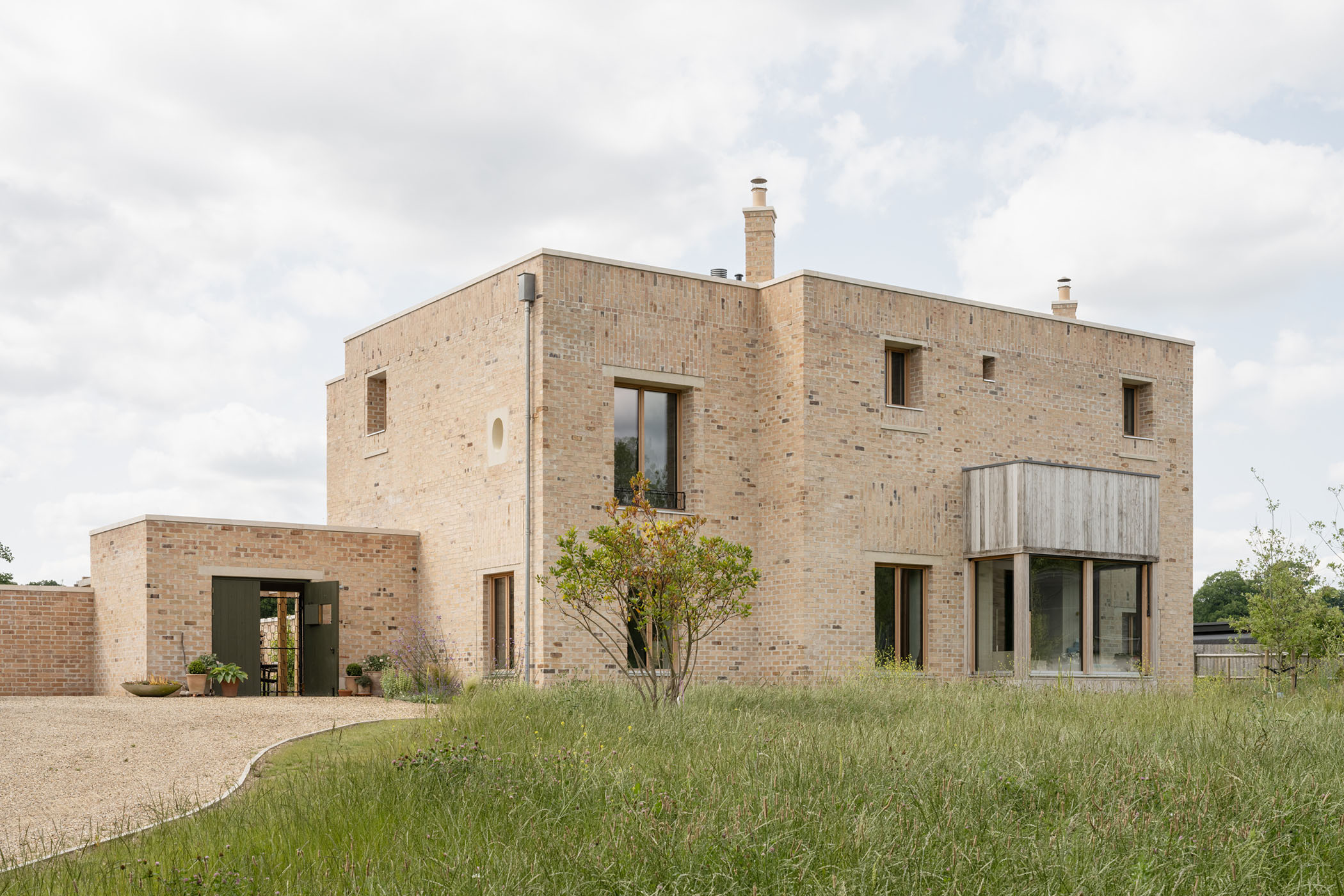
Building on the Hoathly Hill community site meant securing not just planning approval but the blessing of the community itself. The house had to sit harmoniously alongside its 1970s Steiner-inspired neighbours, which carry a distinctive northern European chalet-bungalow vibe. Andre, happy to work within these constraints, crafted a home defined by sweeping curves: a pitched red clay-tiled roof, traditional Sussex redbrick walls and expansive oak-framed picture windows. He also dug 1.5m into the hillside to create the lower floor, keeping the house’s height in line with its neighbours.
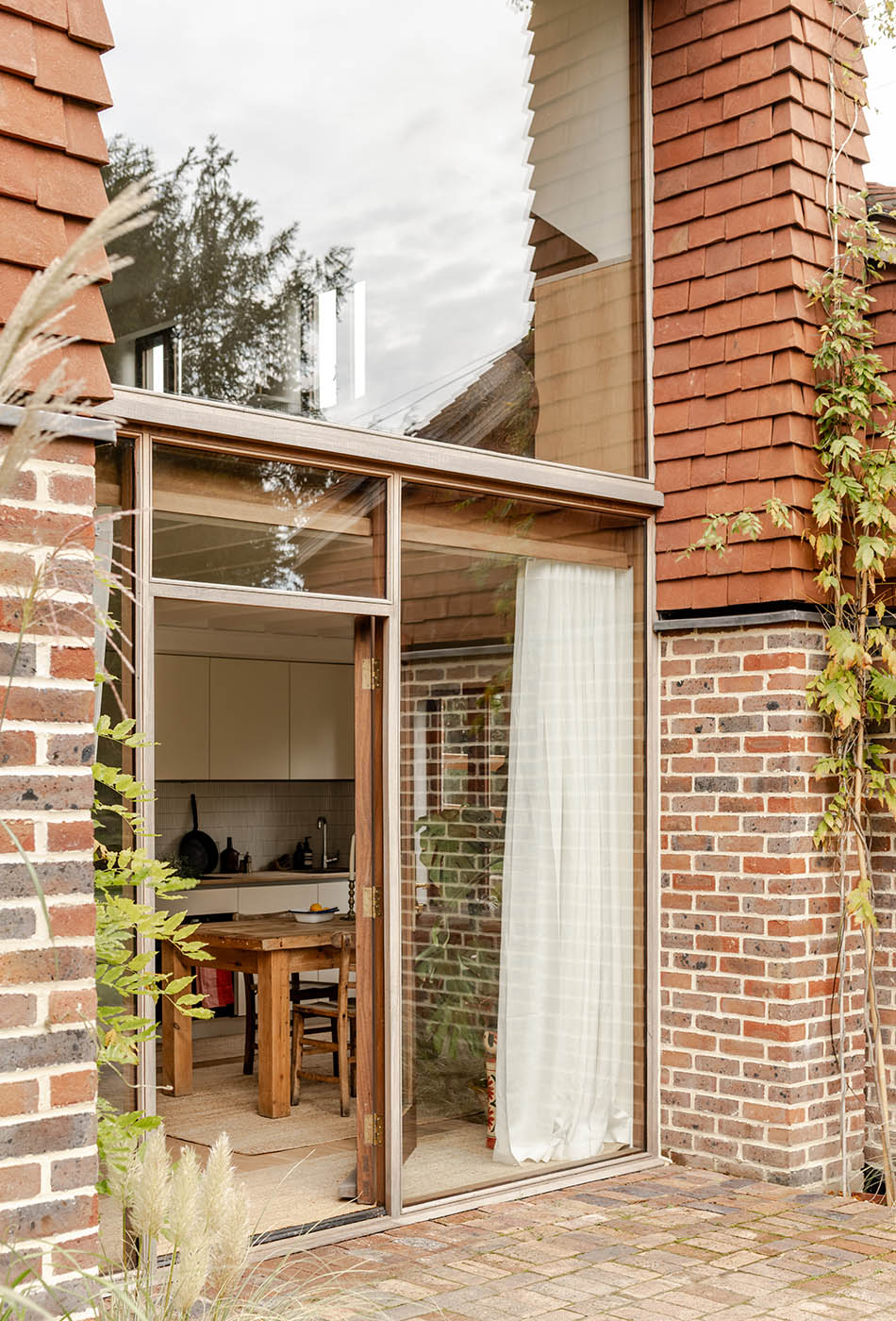
The downstairs kitchen open out to the garden
Jessica, who met Andre at a comedy club in east London, designed the interiors. “Our vision was for a restful environment,” she says. “With three generations under one roof, including two young children, it was important that the home feels peaceful.” The floors, doors and cabinetry are all made from pale oak boards. Delicate droplet-shaped lights are placed within hidden recesses in the walls, which have been painted in eco-friendly white clay paint from Earthborn. With the lighting, Andre explains, “The idea was to make it holistic, seamless, to create a sense of calm.”
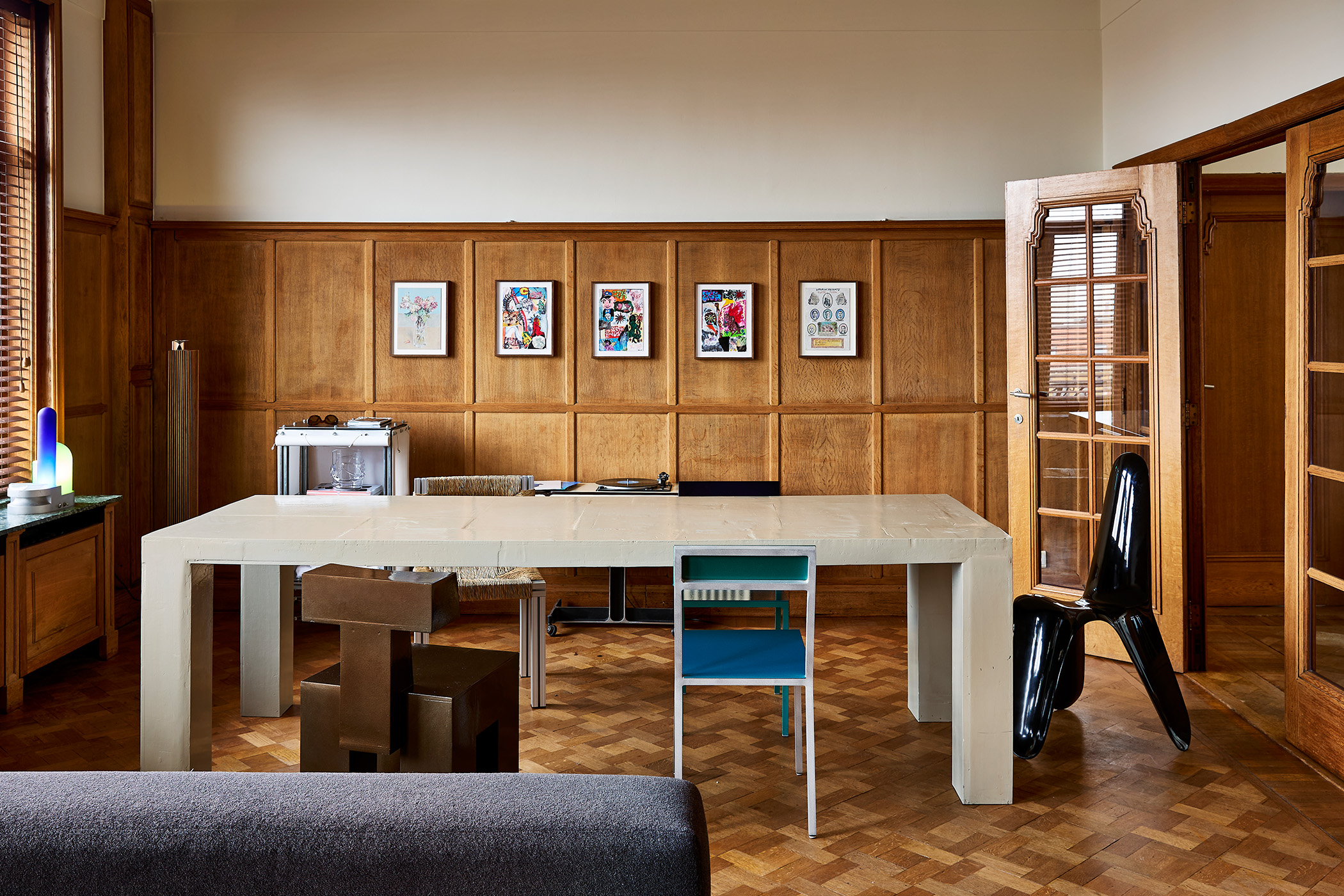
On the middle floor, in Mike and Helena’s sitting room, rounded window casings, flowing lines and a neutral backdrop enhance the peaceful atmosphere. Jessica, whose artworks also hang on the walls, introduced bolder pieces, including a cherry-red Vico Magistretti chair and a Pierre Paulin lounging tongue chair in a deep claret, both drawing in the rusty notes from the Sussex bricks and wall-hanging tiles of the exterior. She also added a stout wooden sculpture by artist David Gilbert.
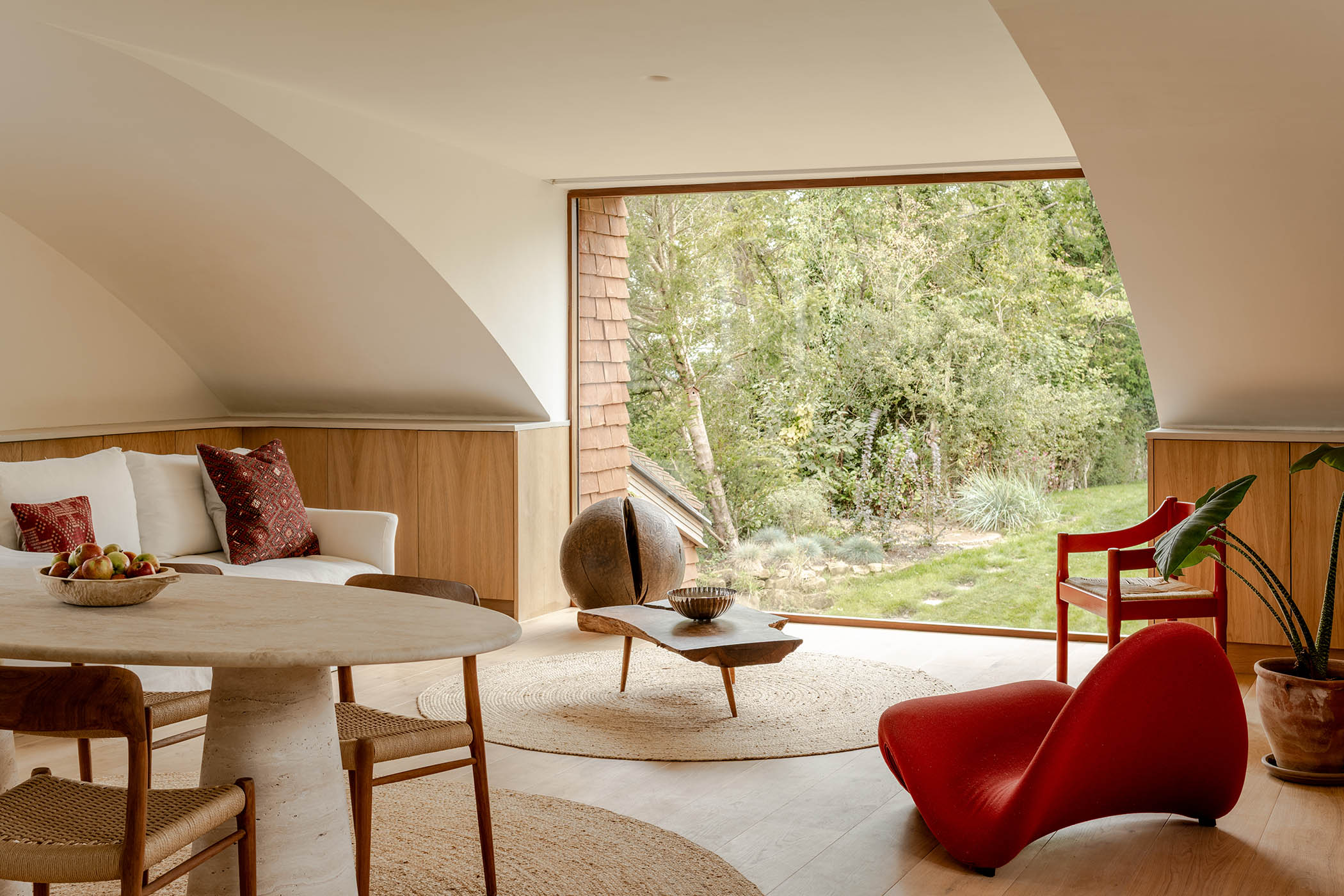
Pale oak floors and lime-plastered walls in the open-plan living-room
Downstairs, Jessica and Andre’s own living space mixes inherited and contemporary pieces: an antique sideboard and vintage leather-and-wood armchairs alongside a Choppy stool from Temper Studio and a black and white print by British artist Emily Crookshank. Both kitchens, upstairs and down, were sourced secondhand through Rehome (a platform for reselling ex-display kitchens and bathrooms) and covered with custom oak-veneer doors.
Throughout the house, each window has been designed to be as large as structurally possible, flooding all three floors with light and capturing long views of the Downs. Micro-cement, a smooth, thin coating, sweeps across counters to form the bathrooms, continuing the organic language of Andre’s architecture.
The idea of multi-generational living, pioneered in the past, alongside experimental communities and the alternative lifestyles of the 1960s and 70s, waned with the rise of the modern nuclear family. But today that tide might be turning. Families drawn to flexibility, shared resources and deeper connections are rediscovering its benefits. In Hoathly Hill, the Templeton Ford family has reimagined the model for the 21st century: a sculptural home that grows from the land and the shared lives within it.
Newsletters
Choose the newsletters you want to receive
View more
For information about how The Observer protects your data, read our Privacy Policy