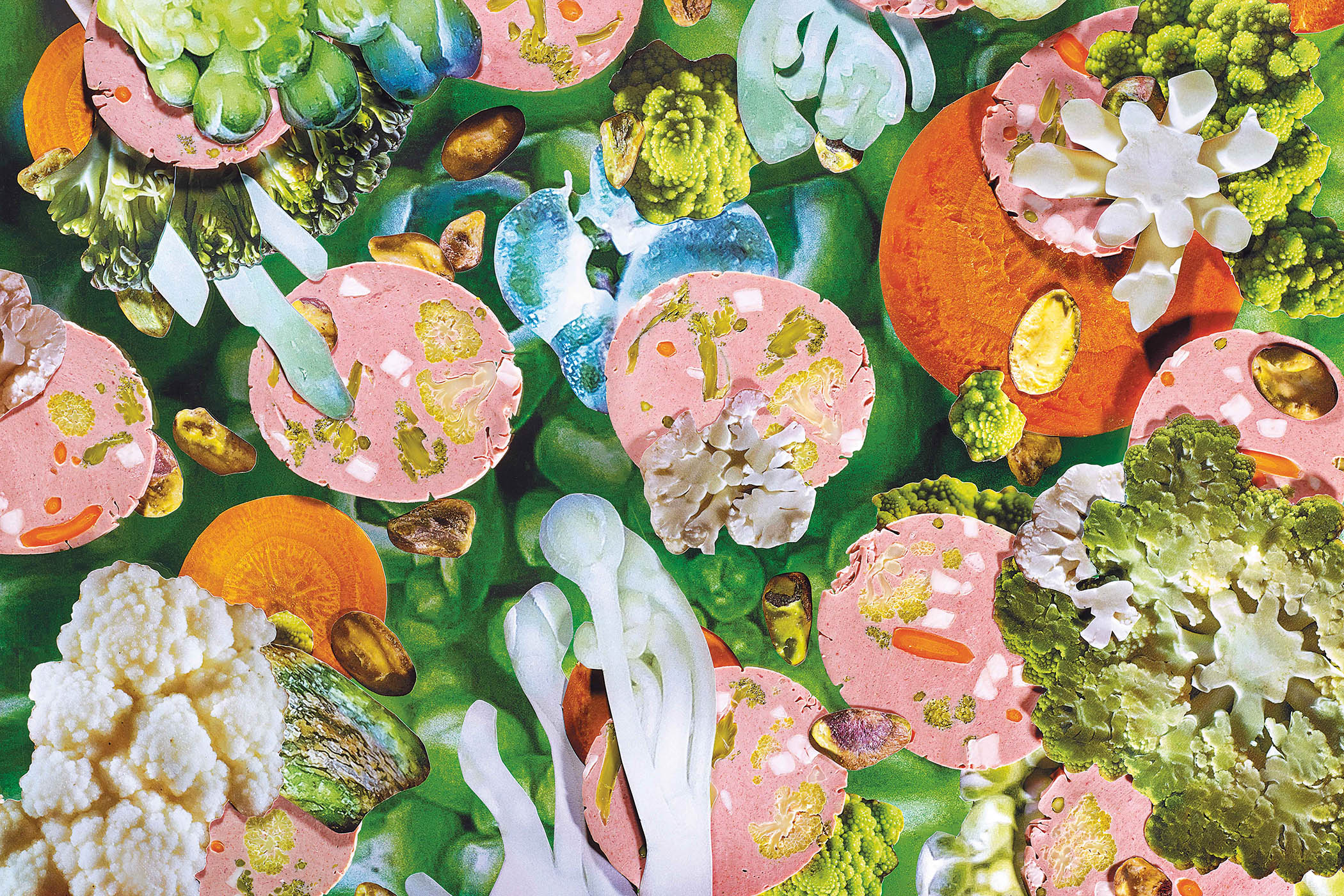

Mortadella has brought its reputation back from the brink – not bad for a vibrantly pink emulsified sausage tarred with the brush of being an ultra-processed food. In the UK, its rehabilitation has been spearheaded by chefs determined to spotlight the best of the Bolognian export in classic and contemporary forms. At Ombra in east London, Mitshel Ibrahim drapes thin slices of the sausage over airy, puffed-up parcels of fried dough called gnocco fritto. Meanwhile, at Paris Rosina’s supperclubs – the maximalist-nostalgia menus of the moment – the host skewers thick-cut pistachio-studded cubes with bravas-style potatoes and kalamata olives for an off-beat gilda. Further afield, it’s been nudged along by the cultural afterlife of Anthony Bourdain, whose favourite sandwich – wafer thin slices, fried until crisp and topped with melted provolone – can be found at Bar do Mané in São Paulo.
Made of minced pork shoulder and diced back fat, lightly seasoned with salt, white pepper and sometimes spices, such as coriander or nutmeg, mortadella’s history stretches back more than two millennia. According to food historian Luca Marchiori, its origins are commonly traced to ancient Rome. “Many say that the name mortadella comes from the Latin mortarium, which were used for grinding meat in order to turn it into sausage,” says Marchiori. “Though, there’s another theory that the name actually comes from ‘myrtatum’ in Latin, which means ‘with myrtle’, the spice said to be used in ancient Roman mortadella.”
By the middle ages, the sausage was a symbol of regional pride for Bolognians. While versions were made in the Lazio region (where some still claim it as their own), its link to the city was formalised in 1998, when mortadella di Bologna was granted Protected Geographical Indication status, which set strict standards around its ingredients, proportions of fat, seasoning and production methods. “There isn’t much variation when it’s made properly,” says Marchiori. “Mortadella comes ‘con o senza’, which means with or without, and by that we refer to the addition of pistachios.” Traditionally associated with Lazio, the nut is now permitted under PGI rules, though loyalties remain divided.
For Nick Bramham at Quality Wines in Farringdon, London, mortadella is a saving grace during winter months, when there are few other ingredients available. “Most mortadella is industrially produced and low quality,” he says. “But the stuff we use is something else.” Sourced from the Zivieri family, who make theirs from rare breed Mora Romagnola pigs, Bramham stacks thin slices into a toasted milk roll with slabs of butter. He serves that with a glass of sparkling red Missori lambrusco for £15. “It speaks to the quality of the mortadella that it doesn’t really need any embellishments,” he says. “The sandwich is really just a way to celebrate that.”
Photograph by Emile Barret from The Sausage of the Future by Carolien Niebling
Newsletters
Choose the newsletters you want to receive
View more
For information about how The Observer protects your data, read our Privacy Policy