

“POV: you’re playing Five Nights at Epstein’s at school,” begins a TikTok video made by a 13-year-old middle school student from Oklahoma. In the video, he is sitting in his school’s sports auditorium and you can hear the sounds of other students talking over the footage of his screen.
The game is a popular spin-off of the horror video game, Five Nights at Freddy’s. It involves trying to ‘survive’ five nights without being sexually abused by Epstein on his island. “It’s a pretty fun game,” the 13-year-old told me. A few of his friends have been playing it too.
They’re not alone, at least 20,000 people have already downloaded the game, and social media is filled with videos of kids across the US playing it at school, often using misspelled versions of the game’s name to subvert content restrictions.
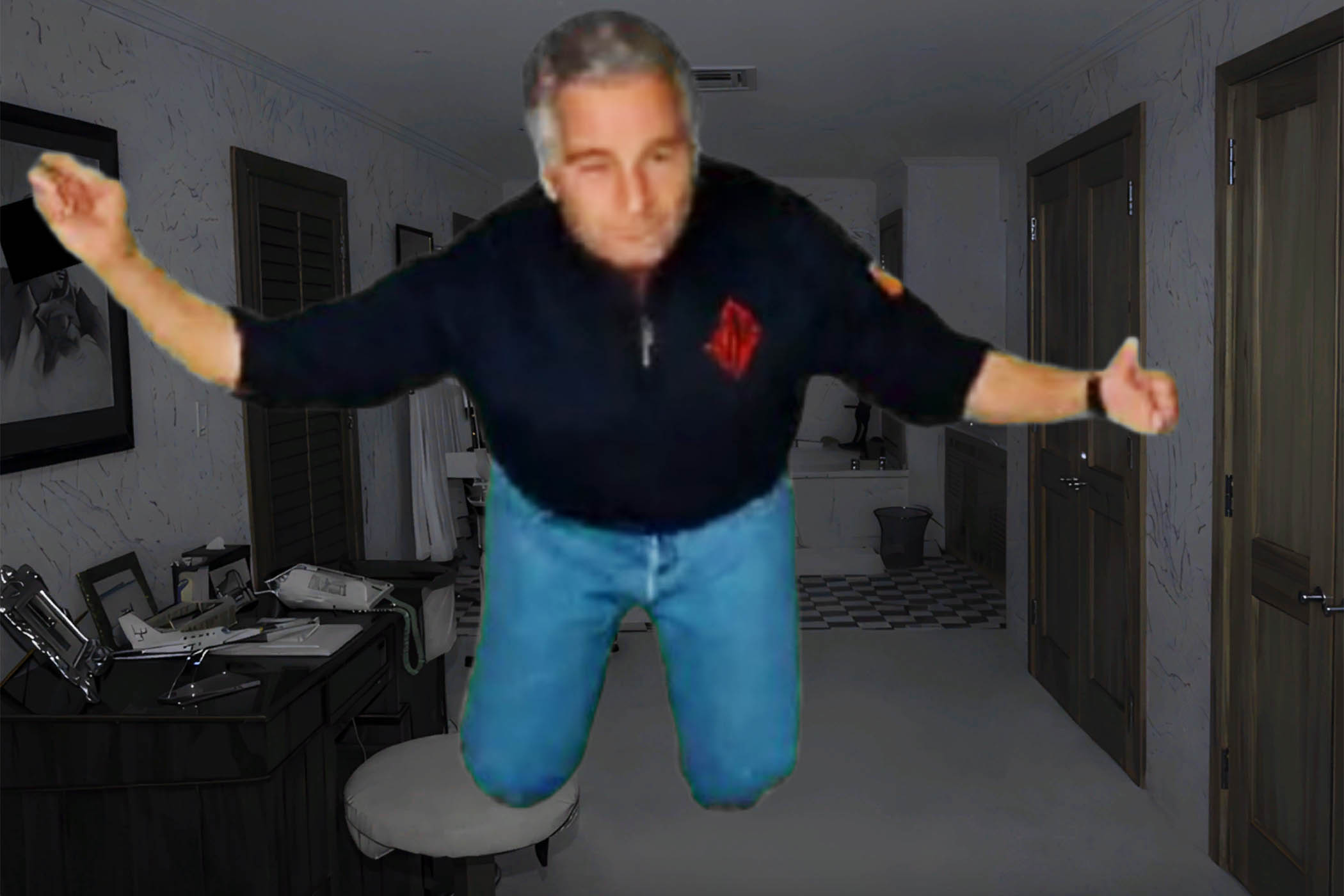
The program uses real photos released by the Department of Justice of the island where Epstein and his friends abused vulnerable young girls and women. It begins in Epstein’s bathroom which, for some horrifying reason, had a dentist setup in it. You can see a model of his plane, the ‘Lolita Express’ on his desk and a blacked-out portrait hanging on the wall.
The light is dark but weirdly clinical. Through CCTV cameras you can move between his bedrooms, his ‘sex dungeon’, his kitchen, his study and every low-lit, disturbing corner of his lair.
You look for Epstein. When you spot him, you press ‘PLAY SOUND’ to lure him away from you. The sound is the voice of a young child laughing or saying “hi”. ‘DEFEND YOURSELF AGAINST EPSTEIN’ says the instruction panel.
When you ‘fail’, Epstein jumps out to attack you and screams.
On Night Two, the game adds new enemies: you have to defend yourself against Trump as well as Epstein.
On Night Three, Stephen Hawking shows up.
Zabrey, a 19-year-old Canadian student who studies computer science, stumbled upon the game on TikTok. “I thought it was funny, but I didn’t know it was a big thing… I played the game and said, ‘oh shit it’s Epstein’.” He decided to film himself playing it and share the video online. It became the most successful video on his account to date – with 15,000 views and counting.
Over the phone, he acknowledged that Epstein was a “very bad guy” and that he felt sorry for his victims but he added: “It’s not about them, it's to make funny content. I think we should not take it too seriously. A game is a game, and real life is real life.”
Since the Epstein Files began to be released in December 2025, shock and horror have reverberated around the world but so have countless memes, lewd jokes, AI recreations of Epstein and Epstein ‘influencers’ who spend their time posting videos of him dancing. Still, no perpetrators of abuse have been prosecuted other than Ghislaine Maxwell. Some internet reviewers have pushed for Ghislaine to be added to the game. “Good but where's Ghislaine??!” read one comment on a players’ YouTube video.
It’s impossible to know who made the game, but someone who uses the pseudonym @killlala1213 has been maintaining a playable web version of it, and decided not to verify users’ ages. In a blog post they said it's up to “players and their families” to decide what’s appropriate.
In the wake of the revelations of Epstein’s wide network of abuse, charities and schools have held seminars and sent emails instructing parents how to talk to their children about Jeffrey Epstein. But many children have already encountered Epstein and his harms online, often through jokes or more disturbing graphic material. Nineteen-year-old Zabrey said: “Everyone finds it funny.”
‘Redshell Reacts,’ a video game influencer, received over 350,000 views when he streamed himself playing the game. “How bad can it possibly be?” he said, when he pressed play, then squealed and laughed at the game’s twists and turns. His followers set their sights on Epstein, who was a gamer himself. One commenter said, “big stein would have loved this since,” and suggested the sex offender was a Five Nights at Freddy’s fan, who watched the franchise’s porn (he did, in fact, send this to his girlfriend in the files.) “Maybe we judged him too harshly,” said another.
Epstein’s Xbox Live gaming is discussed throughout the Epstein files and, though he was banned from the platform after his conviction, references to his victims playing it, or him buying Xbox presents for children, continue until the month before his arrest.
Dr Charlotte Markey, a feminist psychologist who has researched violent video games, told me that certain personality traits make gamers more susceptible to turning online violence into real world aggression. But she said that in Epstein’s case this study didn’t necessarily apply: this game was already built “around a real story, which feels ethically troubling even apart from the research.” She said the game was “irresponsible… it could sensationalise violence, trivialise trauma, and add very little of value beyond shock.”
French theorist Jean Baudrillard might have recognised something familiar in this phenomenon. He argued that, in a media-saturated culture, representations can become more powerful than reality itself – they can become part of hyperreality. He predicted this kind of internet transformation, where Epstein is no longer encountered primarily as a perpetrator of abuse, or even a real person, but as an endlessly reproducible image: a meme, a character, a game mechanic. The horror, stripped of its context and consequences, becomes playable.
Still, the distance between play and reality collapses when those who lived through Epstein’s abuse speak. Last week, a group of Epstein’s victims went on Newsnight. Jena-Lisa Jones and Wendy Pesante had both met Epstein when they were 14 years old – around the same age as some of the boys playing Five Nights at Epstein’s. Lisa Phillips, a fashion model who was groomed and abused by Epstein on Little St James, was shown a photo of herself smiling on a boat in a bright pink shirt. Then, she realised Epstein’s island was in the background. "I was enjoying my life, and I had no idea what was about to happen to me," she said. "This is not what I looked like when I left the island." Who knows what the players of this game will be like when they “leave the island”? Most likely changed – and not for the better.
Photograph by Evan Productions
Newsletters
Choose the newsletters you want to receive
View more
For information about how The Observer protects your data, read our Privacy Policy