
Glamour may not be the word that springs to mind when you imagine a chess competition. But it’s fitting for the Freestyle Chess Grand Slam Tour, a series of tournaments that took place for the first time in 2025. Eschewing the stuffy halls and men-in-suits image of the classical chess circuit, games on the tour have been held in a lavish Las Vegas ballroom, on a 130ft yacht in Singapore and at a five-star hotel overlooking Cape Town’s Table Mountain.
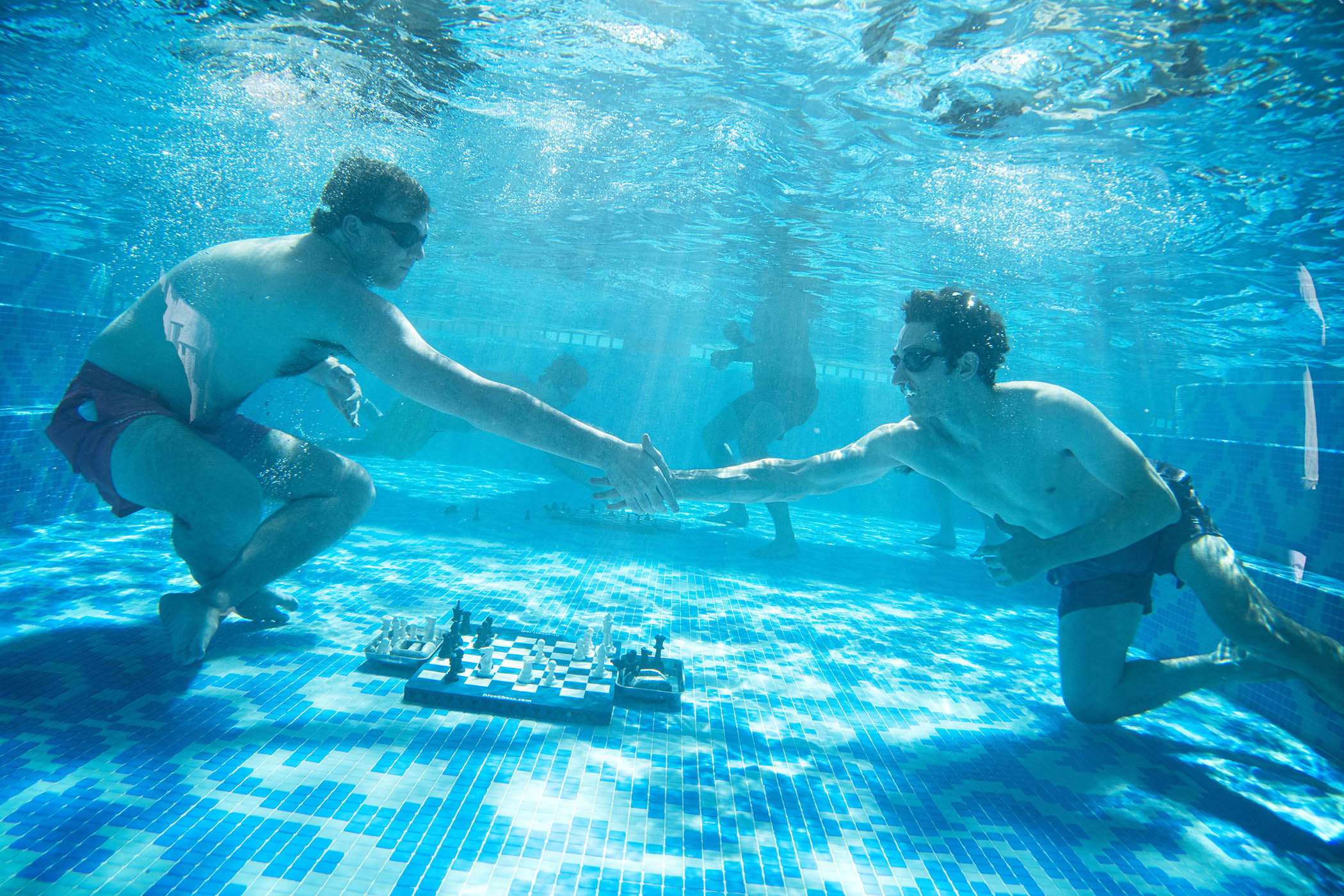
Among the events on offer in South Africa was diving chess, played at the bottom of the hotel pool – magnets kept the pieces and board in place. The world’s top chess players made their moves while holding their breath, before swimming back to the surface to gasp for air. Fabiano Caruana, the third highest-rated grandmaster in history, says half an hour played beneath the surface is more exhausting than seven on a normal board. He didn’t ultimately win the diving chess title; that went to fellow American Hans Niemann.
The underwater games were not the only spectacle. Elsewhere, players reflected on their performances in a confession booth, and heart rate monitors showed their cardiac activity as they competed.
Beyond these gimmicks, the existence of the Freestyle Chess Grand Slam points to a bigger battle for the soul of the game. Fide, the official governing body of chess, even threatened legal action against Freestyle Chess, the upstart organisation behind the tour, forcing it to drop the label “World Championship” from its events.
The struggle between traditionalism and innovation has been precipitated by drastic technological changes. Chess today is surging in popularity, thanks to the Netflix series The Queen’s Gambit, media personalities and access to 24/7 online play. The online site chess.com has more than 230 million members, while YouTube videos featuring Magnus Carlsen, the highest-rated player of all time, regularly attract millions of views.
Carlsen, with his tousled hair and easy charm, is an iconoclastic superstar. He was a grandmaster at 13; world champion at 22. But the 35-year-old Norwegian is also a modern-day disruptor.
‘In freestyle, you’re given this freedom and this canvas that is empty. Then you have to come back to the traditional format and paint a horse’
‘In freestyle, you’re given this freedom and this canvas that is empty. Then you have to come back to the traditional format and paint a horse’
Levon Aronian, Armenian grandmaster
Powerful computer programs, known as chess engines, make it easier than ever to cheat. They have also made top-level matches more staid. It is against this backdrop that Carlsen is seeking to restore the unpredictability and mystique of an ancient game. If he succeeds, chess will change for ever.
Early iterations of chess from India had elephants and chariots. The Persians preferred a farzin, orcounsellor, to a queen. But for more than a thousand years, across cultures, the starting positions in chess have remained the same. For players, the game’s beauty lies in the innumerable variations that spin out from this fixed point. But because chess engines can make hundreds of thousands of calculations to choose the best option, the enigmatic – and human – search for the perfect move is fading. “There isn’t much of an element of seeking the truth any more in classical chess,” says Carlsen, “because it has been found first by regular chess engines, and then by AI.”
This makes cheating easy, particularly online, where a player could have an engine running in one window and a game in another. It also means that elite players spend untold hours analysing their rivals’ openings and developing their own.
“It’s just a question of how much you can memorise,” says Gregory Kaidanov of the US Chess School.
Newsletters
Choose the newsletters you want to receive
View more
For information about how The Observer protects your data, read our Privacy Policy
The Norwegian champion Jonathan Tisdall says professional players are “involved in a constant information war, and the deeper they go, the more openings become worked out”. This is a problem for spectators. Traditional games can last as long as seven hours and often result in draws. It can also be a slog for grandmasters.
“You do become a little bit jaded. I don’t mind the preparation part, as long as you’re looking for something,” says Carlsen, speaking of anything that could give him an edge. But, he adds: “Nowadays there’s nothing much to be found at all. So you’re essentially banging your head against the wall.”
Freestyle chess provides an antidote to this, randomising the starting positions on the back row into one of 960 combinations, while ensuring castling remains possible on both sides (king between rooks), and that bishops are on opposite colours for each player. Players do not know what the board will look like, so they can’t analyse rival’s openings and prepare responses. It is, says Carlsen, “an attempt to reset the counter”.
This variation of chess was invented by the late grandmaster Bobby Fischer about 30 years ago and is traditionally known as Fischer Random. It hurtled into the mainstream in 2024, with a collaboration between Carlsen and Jan Henric Buettner, an eccentric German billionaire. Like thousands of others around the world, Buettner got interested in the game during the pandemic.
“I was learning about chess tournaments but I found it incredibly boring to watch two people play,” says Buettner. “It reminded me of the days before F1, when car racing was more for the enthusiast [than]the masses.”
He spotted a way to change that – and a commercial opportunity. Carlsen, for his part, was finding the traditional game of chess “stressful and boring” and thought he might be able to bring back some magic from the analogue era. “ I’d toyed with this idea for a couple of years,” he says. “Then I met Buettner in 2023.”
Carlsen said he was keen to play the Fischer Random variant against other elite players. Buettner recalls thinking: “What is he talking about? That sounds like a medicine you get in the pharmacy.”
The billionaire came up with a new name: freestyle chess. With funding from venture firm Left Lane Capital, Buettner and Carlsen persuaded 25 other grandmasters to get involved in a new tour based around Fischer Random. The total prize pool runs into millions of dollars, but it is about prestige too. You need a chess rating of at least 2725 to get an invitation. Only the very best are eligible.
As the glitzy world series got under way, a schism emerged between chess players. Grandmasters who were taking part in freestyle chess were enthusiastic about the format. “It takes chess and gives it a fresh breath,” said the Armenian grandmaster Levon Aronian, shortly after beating Carlsen in the Cape Town leg of the tour. “In freestyle, you’re given this freedom and this canvas that is empty. Then you have to come back to the traditional format and paint a horse.”
But purists worry about the future of the original game. Kaidanov believes Fischer Random will eventually “take over”. Carlsen, who won the overall freestyle tour title, is more sanguine. “I don’t think classical chess is going to go away any time soon,” he says. “But I genuinely believe there are better ways of determining who the best players are.”
Freestyle chess is inextricably tied to Carlsen and was arguably seeded by a fateful moment in 2022, the year before he met Buettner. The Norwegian was a five-times world champion and had been world No 1 for a decade. So when he sat down in St Louis, Missouri, to play Niemann, it was a surprise to everyone that he lost to the brash rising star.
Carlsen is an obsessive; his biographer, Aage Sivertsen, says there is “always a game running in his head”. Being beaten by an underdog was more than he could stand. Carlsen withdrew from the tournament and accused his opponent of cheating.
Niemann – an itinerant player who was living out of a suitcase – admitted to having cheated online in his youth, but said he had never done so during in-person games. He accused Carlsen of trying to ruin his fledgling career. The scandal played out in front of a rapt audience. In a surreal turn of events, Elon Musk amplified the baseless claims that Niemann might have used remote-controlled vibrating anal beads to communicate moves from a chess engine. Niemann ultimately filed a $100m defamation suit against Carlsen and others, which was settled between the parties in 2023.
This dramatic scandal reflects a real and growing concern about chess engines, which goes beyond them making games less interesting. Engines can beat any human, and if their suggested moves can be discreetly communicated to a player, there is no hope for the opponent.
Evidence suggests Niemann did not cheat against Carlsen. When Professor Kenneth Regan, an anti-cheating expert, was asked by Fide to investigate, he discovered nothing untoward. In fact, he says that cheating in chess in person is still “hard enough” that he is not overly taxed by it. But the damage was done by what Carlsen thought was happening.
“If you believe your opponent is cheating, you can’t play,” says Tisdall. “Once that’s in your head, it becomes impossible to react normally.”
Being accused can also be devastating for players. In October, the American grandmaster Daniel Naroditsky was found dead, aged 29. No official cause has been released but it is being investigated as a possible suicide. He spent his final months defending himself against unproven allegations of cheating.
Before the St Louis drama, Carlsen already had a fraying relationship with Fide. He had announced earlier in 2022 that he would not defend his world championship title because he had “nothing to gain”. His fifth title had been won in gruelling fashion, in a match lasting almost eight hours. Then Fide rebuked Carlsen for his behaviour towards Niemann. The relationship has never healed. In 2024, Carlsen quit a Fide championship after being told he could not play in jeans. “They can enforce their rules,” he told media outlets at the time. “That’s fine by me. My response is: ‘Fine, then I’m out. Fuck you.’”
In January 2025, Carlsen said his relationship with Fide was “pretty destroyed”, the last straw being its threat of legal action against Freestyle Chess. He hasn’t played a world championship match in the classical format since 2021, and says it is “highly, highly unlikely” he will do so again. In an ironic twist, Niemann now plays freestyle chess, having accepted a tour invitation from Carlsen.
Carlsen is widely accepted to be a genius. Tisdall says: “He is able to play games where you wonder what’s going on. He seems to have absorbed knowledge about what the engines know that we don’t.”
But this goes beyond one person and his grievances. At its core, the divisions in chess come down not to man versus man but man versus computer. Fears over cheating and frustration with the classical format both result from the same issue. Technology has changed the way that people play the game and, perhaps more fundamentally, the level of trust people have in each other.
Many will see freestyle chess as a vanity project. But there is something profound about the mission of its grandmasters: to flee the machine in search of new truths. That may be all of our futures.