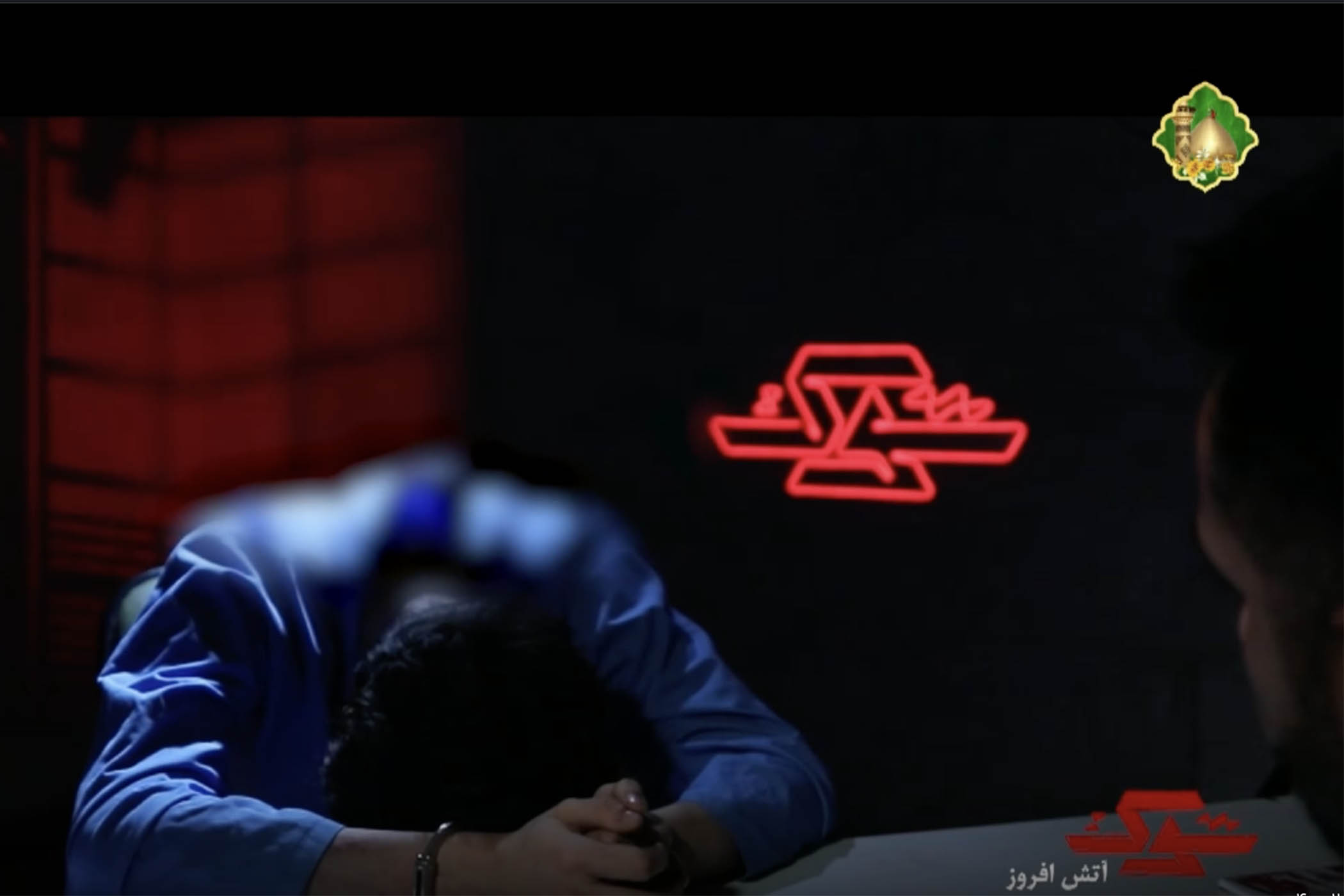
The forced confession that aired on Iranian state television is lit with a crimson backdrop silhouetting the blurred face of 18-year-old Shervin Bagherian in his bright blue prison uniform, the handcuffs on his wrists glinting on the table in front of him. An interrogator accuses the teenager of provoking crowds of demonstrators against paramilitaries and of kicking the bodies of slain security forces. When he demands if Bagherian knows “how many families you have ruined, how many children you have orphaned”, the young man slumps forward, his head of black curls between his bound arms.
Then the official tells Bagherian his crime: moharebeh – waging war against God. Sniffling as his voice quakes, the teenager politely asks what that means. The interrogator answers with one word: “Execution.”
Bagherian begs for his life: “For God’s sake, not execution! Sir, I made a mistake, I was wrong, please, for God’s sake, I wasn’t doing anything.” The interrogator is indifferent.
Bagherian’s “confession” is among hundreds to have aired on Iranian state television channels in recent weeks, the detainees dragged from prisons to sit in front of studio lights.
‘For God’s sake, not execution! Sir, I made a mistake, please, for God’s sake, I wasn’t doing anything’
‘For God’s sake, not execution! Sir, I made a mistake, please, for God’s sake, I wasn’t doing anything’
Shervin Bagherian
The US-based Human Rights Activists in Iran says more than 50,900 people have been detained since the uprising that swept the country, as the Iranian regime enacted the most brutal crackdown since the 1979 revolution that brought it to power. A former UN prosecutor told The Observer 33,000 is a conservative estimate of the death toll, as evidence trickles out amid a three-week internet blackout.
The threat of charges that carry the death penalty hangs over tens of thousands of detainees – and televised interrogations such as Bagherian’s have stoked fears that hundreds if not thousands more could be hanged. By late December, as protests slowly began to take hold across Iran, the regime had already executed at least 2,000 people in 2025, according to Abdorrahman Boroumand Center for Human Rights in Iran – the highest figure in decades. Groups tracking abuses in Iran say the looming threat of executions this time is different: unlike in the past, they are struggling to gauge just how many thousands risk being put to death for protesting. Their fears are compounded by threats of “swift action” and harsh punishments from Iran’s chief justice, Gholam-Hossein Mohseni-Eje’i.
Arina Moradi, from the rights group Hengaw, said her organisation has seen a grim pattern: the authorities tell the families of detainees their loved one is due to hang, but the accused has no access to an independent lawyer to see the charges against them. Families and rights groups then have no way to know if the death sentence is real.
Moradi views the threat of hanging as a form of abuse directed not only at detainees – many are already tortured using mock executions in jail – but at their relatives too. As officials threaten families to prevent them speaking out, and with no access to the internet, she fears huge numbers are at risk.
“When they say ‘the authorities verbally told us your child will be executed’, we believe them, but we know it’s possible the authorities might want to torture the families at the same time,” she said. “We don’t know how real these claims are without formal charges and access to a case file.”
Donald Trump has boasted that his intervention stopped more than 800 hangings in recent weeks – a claim swiftly refuted by the Iranian judiciary. As Trump’s Middle East envoy Steve Witkoff and son-in-law Jared Kushner met with Iranian foreign minister Abbas Aragchi in Oman to negotiate over the future of Iran’s nuclear programme, there was little mention of the protestors Trump previously claimed to champion.
Newsletters
Choose the newsletters you want to receive
View more
For information about how The Observer protects your data, read our Privacy Policy
Aragchi hailed the talks, due to continue this week, as “a good start,” with few clues about results. Trump maintained his threats, backed by a what he has described as “an armada,” of American warships near Iran ready to aid a potential strike. “Iran looks like they want to make a deal very badly– as they should. We have plenty of time. If you remember Venezuela, we waited around for a while…we’re in no rush,” he told reporters. “If they don’t make a deal, the consequences are very steep.”
Despite his previous warnings to strike if the regime killed protestors, Trump appeared focused entirely on Iran’s nuclear programme– with some fearing this could embolden the regime to abuse or even hang protestors in secret.
Moradi pointed to cases such as that of Erfan Soltani, 26, who was detained in a raid on his home early last month and whose family were told he would be the first demonstrator to hang. Intense scrutiny of his case – including by American officials – meant the charges were walked back, and he was bailed last week after a reported payment worth about £11,000. This idea of clemency is what Iranian officials “want to show to the world”, said Moradi, even if in reality the threats remain.
“They haven’t promised anything and there is no indication they have changed their attitudes. It’s the same pattern of a harsh crackdown on protesters and detainees – they are torturing their families,” she said. “It seems like they use select cases, like Erfan Soltani, to send a message to foreign governments, especially Washington, because of the ongoing negotiations. But in real terms nothing has changed for people inside the country. They are still under the same pressure.”
That pressure has been enacted through a campaign of deadly force by security forces and mass arrests, with thousands detained in warehouses or other facilities as prisons overflow. Activists described a wave of nighttime raids: Over a dozen armed plainclothes police raided the Tehran home of Ali Cheraghi– an accused protestor–one night in late January and took him to an unknown location, with no record of him in the prison system. Many like Cheraghi are suspected to be held in detention centres run by the intelligence services. This has not spared many the torture and mock executions Moradi says are routine.
“When I’ve spoken with people who faced mock executions before, they said that every time they were sure they would be hanged,” she said. The widespread use of executions in Iran only makes the fear more real, she added. “This is a huge fear. Every time they felt it was the real thing.”
One protester nicknamed Shahab, from the city of Karaj, near Tehran, said a member of the Basij, the paramilitary force of the Islamic Revolutionary Guard Corps (IRGC), shot him with birdshot after he was cornered during a protest. He considers himself lucky not to have been hit with live ammunition. Then he was handcuffed with his thumbs bound and thrown in the boot of a car with another protester.
“The car stopped on the highway, they got out and blindfolded us with tape,” he said, speaking via a messaging application in the brief period he had internet access.
“They took us into a large basement. It wasn’t clear where we were – maybe it was a wrestling club or some kind of sports hall.” He couldn’t tell how many people were held there, but from the noise around him he sensed a large crowd. “They didn’t let us talk, but they beat us constantly, threatening rape and killing. I heard one officer tell a guy, ‘You thought we keep garbage like you’, while laughing.”
Shahab was spared interrogation, but he heard a higher-ranking officer get angry at the forces who detained him for also sparing his life. “He said something about how this was a headache – that he told them not to leave any wounded, or arrest them: ‘Now we can’t finish him off here.’ I don’t know what happened to other detainees. I heard them talk about interrogations, but at least I didn’t hear them being shot to death like happened elsewhere.”
He was released after the low-ranking Basij members who detained him took his bank card and drained one of his accounts. “But I’m not really free,” he added. “I still need to go to the IRGC security office in Karaj once a month to sign something. I got fired from my job after my boss said my name is on a list of those banned from being hired. I don’t even know what that means – I have no paper with a verdict on.”