
Last month the City of London’s planners sent out a seasonal video to its friends and contacts. Twelve schemes for Christmas, it carolled, before unrolling clips – with snow falling and bells chiming – of proposed office towers that make older landmarks like the Gherkin look petite. These were projects to which they gave permission in 2025, a record-breaking year for consents. They included the Shard-high One Undershaft, set to be the tallest building in the City, and the second tallest, 99 Bishopsgate, which will be three times the floor area of a 1970s tower it is replacing.
According to Tom Sleigh, the chairman of the City of London Corporation’s Planning and Transportation Committee, these buildings are “part of a pattern of proactive planning decisions that are helping to shape a future-ready Square Mile, greener, denser, more dynamic, and firmly aligned with the UK growth mission”. They contribute to the 1.2m sq metres (12.9m sq ft) of new office space which, according to Corporation of London’s City Plan 2040, is the minimum needed in the Square Mile in the next 15 years.
They are also said to be part of the City’s response to the lure of working from home. They are to provide what Sleigh’s predecessor, Shravan Joshi, has called “bespoke ‘experiential’ offices which, post-pandemic, employees actually enjoy coming to work in”. To this end, the plans include trees and shrubs perched high off the ground, publicly accessible viewing platforms, unearthed fragments of Roman buildings, and “cultural offerings”. A 176m tower (577 ft) called 63 St Mary Axe comes with the promise of 78 new trees and a new “public park”, albeit one only 12m (39 ft) wide.
Cities grow, the City more than most, and the planners argue that there is demand for new offices, especially of the best quality. But there has to be a point where the dense fabric of the Square Mile can’t take any more, and it would be better to put the offices elsewhere. The blocks are already so close-packed in some areas that they are approaching a single vast mass of construction, with windows offering little more than views of windows on the other side of glass chasms. External walls are becoming formalities, polite pauses before expanses of office space resume a short distance away.
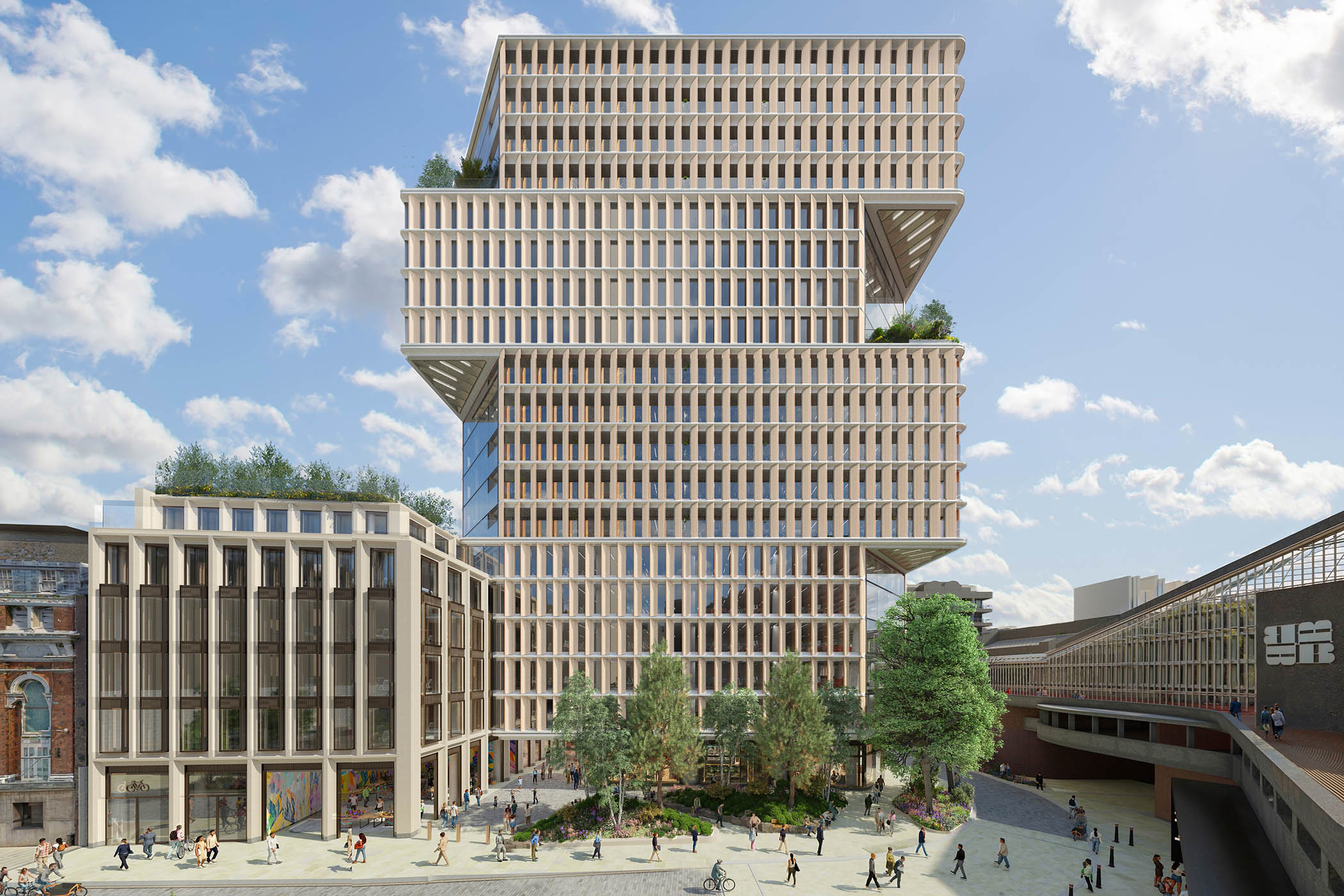
‘An ill-conceived homage’: A street-view CGI shows the entrance to the building opposite the brutalist Barbican centre (right)
At the very least, it takes skill to cram in all this extra accommodation, which means that good design – which the City’s planners profess to care about – is essential. And it means that all the greenery and public goodies have to be as promised. Here some scepticism is in order. An expansive public rooftop terrace on a building north of St Paul’s Cathedral was dropped after planning permission was granted, because its future tenants HSBC didn’t want it.
One project not included in last year’s parade, because it hasn’t been approved yet, is One Silk Street, an office block of nearly one million square feet (92,000 sq metres) designed by the architects SOM for the developers Lipton Rogers. Its site is not in the cluster towards the eastern end of the City where most tall buildings are gathered, but next to the Barbican, the residential and arts complex notable for its balanced composition around a central lake. Stan Allen, formerly dean at Princeton’s architecture school, calls it “a work of architecture that resonates across time and has an international reach”.
The proposal has provoked fury from residents and leading figures in the visual arts, and from some who are both. The Stirling prize-winning architect Amanda Levete calls it “completely inappropriate in scale and height”. “The Barbican was conceived as a model for good living at the very heart of our city,” says the artist Sir Antony Gormley, and must be protected from “raucous development”. “This mediocre, avaricious and inappropriate building,” says the broadcaster Robert Elms, who lives in the Barbican, “steals the light and privacy of its residential neighbours.”
Looking at the designs, you can see what they mean. The project swells in almost every direction: where the building it would replace is a collection of blocks of seven, 13 and 17 storeys, the proposal is a wall rising to 21 storeys. It projects over the pavement. It blocks views of the sky and will deprive neighbouring buildings of sunlight.
It is lumpen. It looms. The design, say the architects, is “rooted in the principles of formal clarity, structural honesty and contextual response”, a claim that doesn’t bear close scrutiny. Its repetitive grids are interrupted by shaved-off corners that allegedly “respond to daylight and views of neighbouring buildings”. It attempts an ill-conceived homage to the Barbican’s brutalist architecture, with emphatic horizontals and pronounced overhangs, decisions that only exaggerate its bulk.
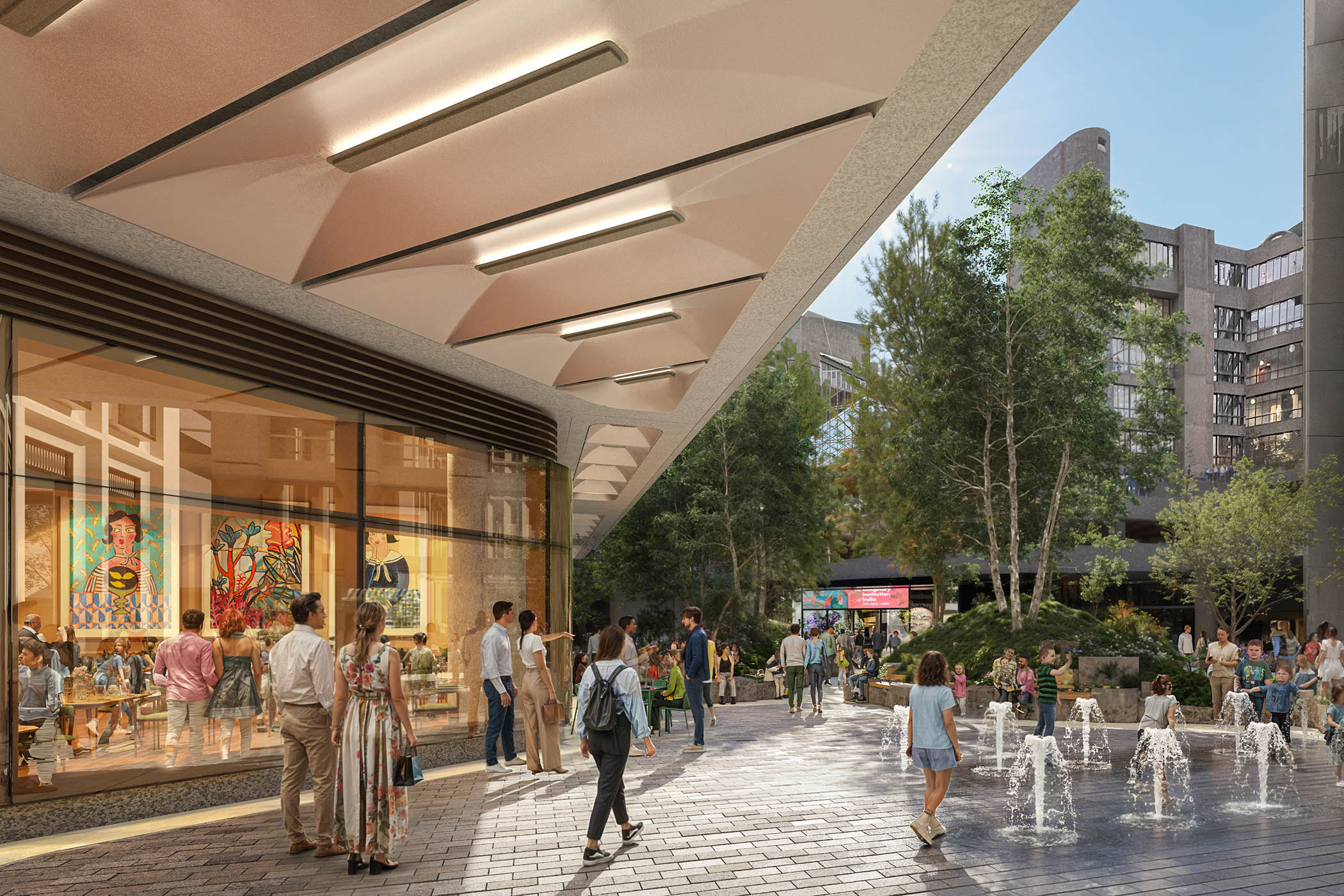
The proposal comes with gestures towards the public good and the wellbeing of its users, some of them genuinely valuable, others more tokenistic. There would be new facilities for the Guildhall School of Music and Drama and a “vibrant ground level” that includes retail outlets and a new narrow route across the site. There is to be a “new civic plaza” opposite the entrance to the Barbican arts centre, a grand term for widening the street with a scrap of land left over by the imposition of the rectangular new block on a slightly irregular plot.
Newsletters
Choose the newsletters you want to receive
View more
For information about how The Observer protects your data, read our Privacy Policy
The makers of One Silk Street can do better. Sir Stuart Lipton, founding partner and chairman of Lipton Rogers, made his name in the 1980s with the Broadgate complex next to Liverpool Street station (itself now engulfed by redevelopment), which was exemplary for its provision of open space and included an ice rink in winter. He used to like saying that “good architecture is good business”. SOM, a giant practice that started in Chicago in 1936, has produced some of the classier commercial buildings of the last 90 years, including in Britain.
There is now talk of a revised application, in which case the current plans may be no more than a bargaining position – a widening of planning’s Overton window such that something not quite as excessive can pass through. But only a radically different scheme, less aggressive and more generous, without the brutalist styling, would be worthy of the location. If One Silk Street is the harbinger of the bigger, better future promised by the City’s planners, it needs to be a genuinely outstanding work of architecture.
Photographs by Skidmore, Owings & Merrill (SOM)
• This article was amended on 15 January. An earlier version incorrectly said that the One Silk Street development had been designed for the use of the law firm Linklaters.