
With a floor area of 85sq metres (915sq ft) and a cost of £167,000, Caochan na Creige is the smallest and cheapest of the six contenders for this year’s Riba House of the Year award. It’s remote and seemingly simple – a stone chip of brutalism standing on a rocky rise next to an inlet on the Hebridean island of Harris. It’s also, for good reasons, the winner.
It’s a hands-on project, about as direct as building can be in a time of regulations and planning processes, designed by the architect Eilidh Izat and her husband Jack Arundell for their own use, and built by him, her brother Alasdair, and a stonemason friend Dan Macaulay. Izat says that Arundell, who trained as a civil engineer and has worked as a chef, likes “to do things with his hands that have an immediate impact; he likes to build, cook, fish, anything outdoors.” This is architecture in the moment.
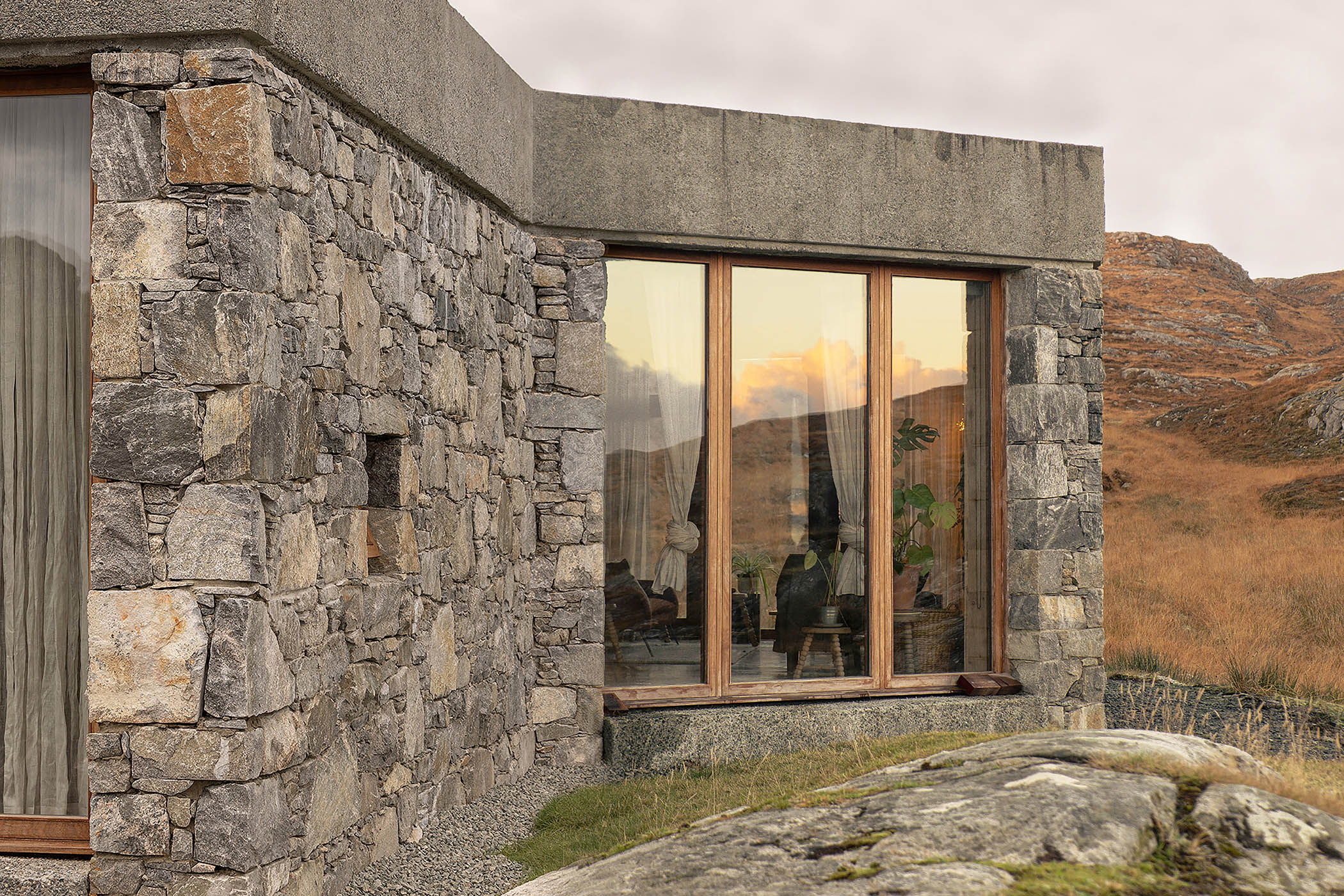
The design starts with the land and the weather. “Everything here shakes in the wind,” says Izat, speaking as Storm Bram is coming on. The Outer Hebrides, she says, are more exposed to driving rain than anywhere else in Europe. “We were conscious of coming into a landscape, not from here; building a new house is a strong statement to make.” So it is built with thick sheltering walls in Lewisian gneiss, a hard, dense, three-billion-year-old stone from quarries a few miles distant. The house’s angular plan is cranked around a rock on the site that they didn’t want to blast away.
The stone does its job of holding off the elements. Within it is a timber structure that makes as much as it can of the space. The arrangement is centrifugal but interconnected. The main rooms – bedroom, living room, kitchen – look outward in all directions to the landscape, with oblique lines of sight from one into another and on towards the horizon. A small knot of services such as a shower room, utility room and cloakroom stand roughly in the centre. A deep porch makes a sheltered way of being outside, and is a good place to keep firewood and gas cylinders.
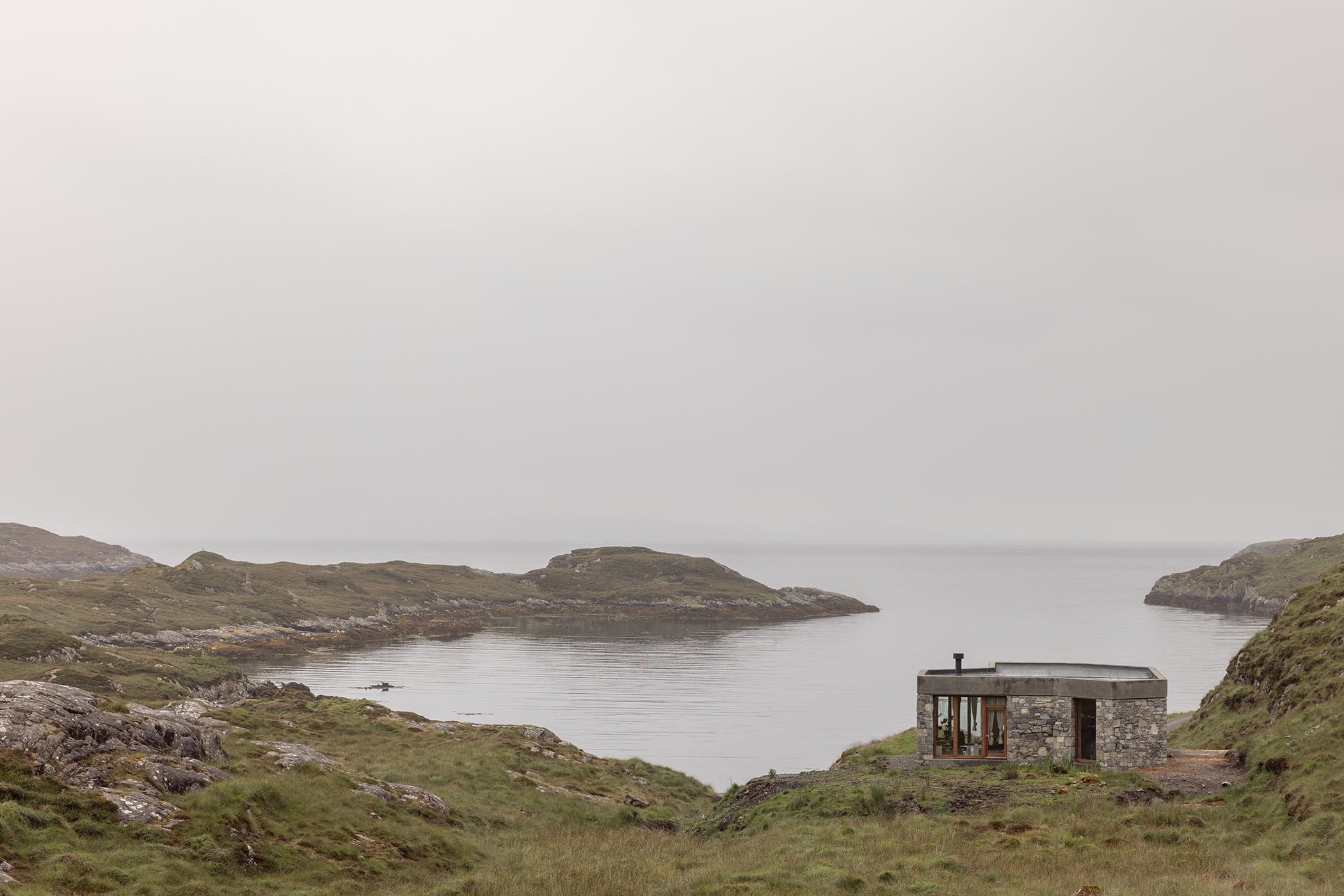
‘It creates inhabitation on some kind of edge’: the house sits on an inlet of the remote island of Harris
Ceilings and some walls are lined with Scottish cedar (“the smell is fantastic”) and the floors are in a polished concrete that uses local stone in the mix. There are also areas of unpainted clay plaster on the walls, and a rectangle of terracotta tiles. These materials have subtle pinkish tones that echo hues in the quartz within the gneiss. Furniture includes Arundell’s wooden stools, with bobbin-shaped legs inspired by traditional Highlands furniture.
It’s a cabin wrapped in a bunker: a place of peace and warmth, quiet despite the wind. The surprisingly complex interior unfolds its views by degrees rather than offering them all at once. Light comes from all sides, through large and small windows: the changing atmospheres of the day are felt inside. Reflections in the floors fold one space into another. The outdoors becomes an extension of the indoors, the bare external slopes becoming backdrops to the interior, even as the boundary between inside and out is clearly defined.
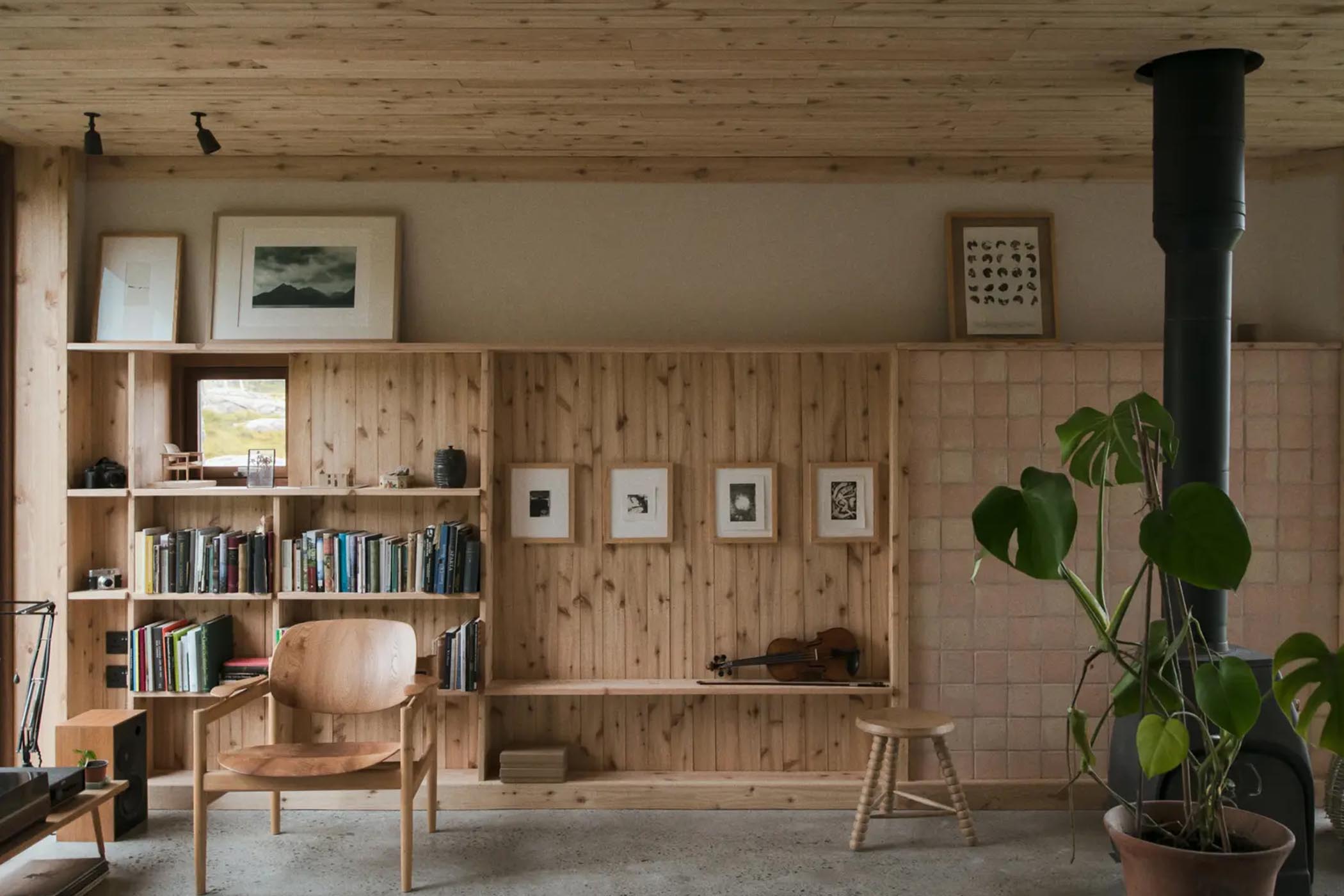
Ceilings and some walls are lined with Scottish cedar (“the smell is fantastic”) and the floors are in a polished concrete that uses local stone in the mix
Its repose has not been achieved without some struggle and risk. Hazards during construction included clouds of midges, an unseasonal storm in July, and the delivery of truckloads of stone that mostly couldn’t be used. Izat and Arundell pushed themselves to the financial limit to build to the quality they wanted. The result is a manifesto for their practice as well as their home. “It had to really show what we are about,” Izat says. “We were maxing out every card we could lay our hands on.” They opened a pop-up restaurant, called Blasta Pasta, to help raise funds.
There will also have been emotional hazards to negotiate in this small group of people working intensely together on a secluded spot. It helped that Izat and Arundell had experience of converting a garage in Edinburgh (“the cheapest property in the whole city”) into a home. This used a similar build-it-yourself approach and was “a proper taster of working together”. And, says Izat, “in our family we can put our emotions on the table and no one’s going to mind”.
So, one way and another, they did it. Caochan na Creige is a house where everything is to the point, there being no room for waste. It has, at the same time, a remarkable richness of thought per square foot. It creates inhabitation on some kind of edge, a sense of enclosure and shelter that is the more valuable for being so exposed. “The islands,” says Izat, “hold up a mirror to who you are as a person. You have to think more carefully. They strip you down to who you are.” You could say the same about their house.
Photographs by Richard Gaston/Elliot Sheppard
Newsletters
Choose the newsletters you want to receive
View more
For information about how The Observer protects your data, read our Privacy Policy