
“The building they loved has come back to them,” says Claire Pritchard, the infectiously enthusiastic director of the Greenwich Co-operative Development Agency (GCDA), “and they’re relieved that the ceilings are no longer about to fall down.” She’s talking about the local reaction to the Catford House, a new community centre formed within a south-east London palimpsest: once a farmhouse standing alone with views of fields, later a popular pub circled by the backs of houses. Now it has been rescued from dereliction with a design that draws on the richness of its setting to make a place that couldn’t be anywhere else. It is a work of creative archaeology which, by revealing and celebrating its layers of time, makes the building, while something that has never quite existed before, also look more ancient than its almost 300 years.
The project stands in the corner of a site where multistorey residential towers are on the way, in turn part of a comprehensive redevelopment of the town centre of Catford, which is promising to deliver 2,700 homes. If it’s customary for major developments to leave the occasional chocolate on the pillow in the form of community benefits, this looks like an exceptionally well-grounded, not-tokenistic example of the genre.
It’s a project supported by the London Borough of Lewisham and the Greater London Authority that provides space for GCDA, which for 43 years has been helping social enterprises and businesses to start and grow in ways that help locals to find rewarding work, become healthier and happier, and (should they wish) form better connections with fellow residents.
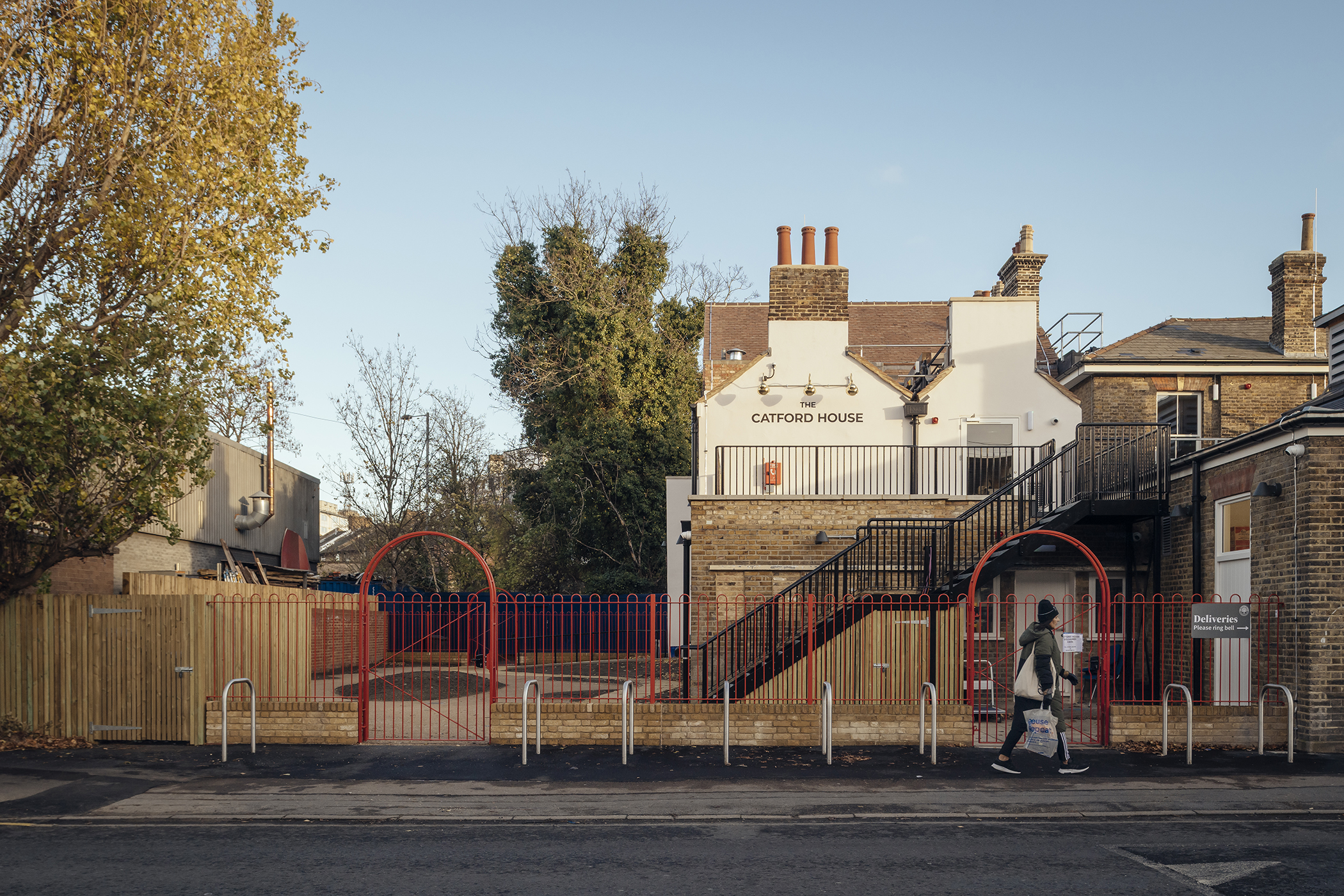
‘Architecture from the process of repair’: the Catford House
This partly centres on the growing and preparation of food, for example by backing community gardens, offering training courses in such things as pickling and preserving and cooking with toddlers, and helping food-based businesses to establish themselves. The organisation also likes to take whatever opportunities present themselves to fulfil its aims: they have helped an amateur boxing club, the teaching of crafts, the making of new materials out of old scraps. GCDA have long worked in multiple locations and continue to do so, but the Catford House gives them space, security and identity.
The new premises provide specific facilities, notably food-related initiatives, but also offer spaces where almost anything can happen. It is a reopened version of the old pub, this time serving as much as possible from local suppliers of beer, rum, coffee, pickles and other produce, and employing local people, while also earning revenue for the organisation. It welcomes those for whom a boozer is not, for personal or cultural reasons, a natural home, with plenty of alcohol-free space and times of day. It is an unofficial village hall for a suburb formed around railway lines that might house birthday parties and weddings, meetings, film screenings, music, crochet groups, yoga, wine-tasting and just sitting about and chatting.
The project is designed by Hayatsu Architects, whose founder and director Takeshi Hayatsu likes to stay close to the making of buildings and is creatively fascinated with the stories they tell and the inner lives of timber. With his former employer 6a Architects he experimented with deliberately charred wood. His clock tower for the Blue Market, up the tracks from Catford in the district of Bermondsey, is an oak-framed structure clad in silvery scales that manages to be exotic and everyday at once.
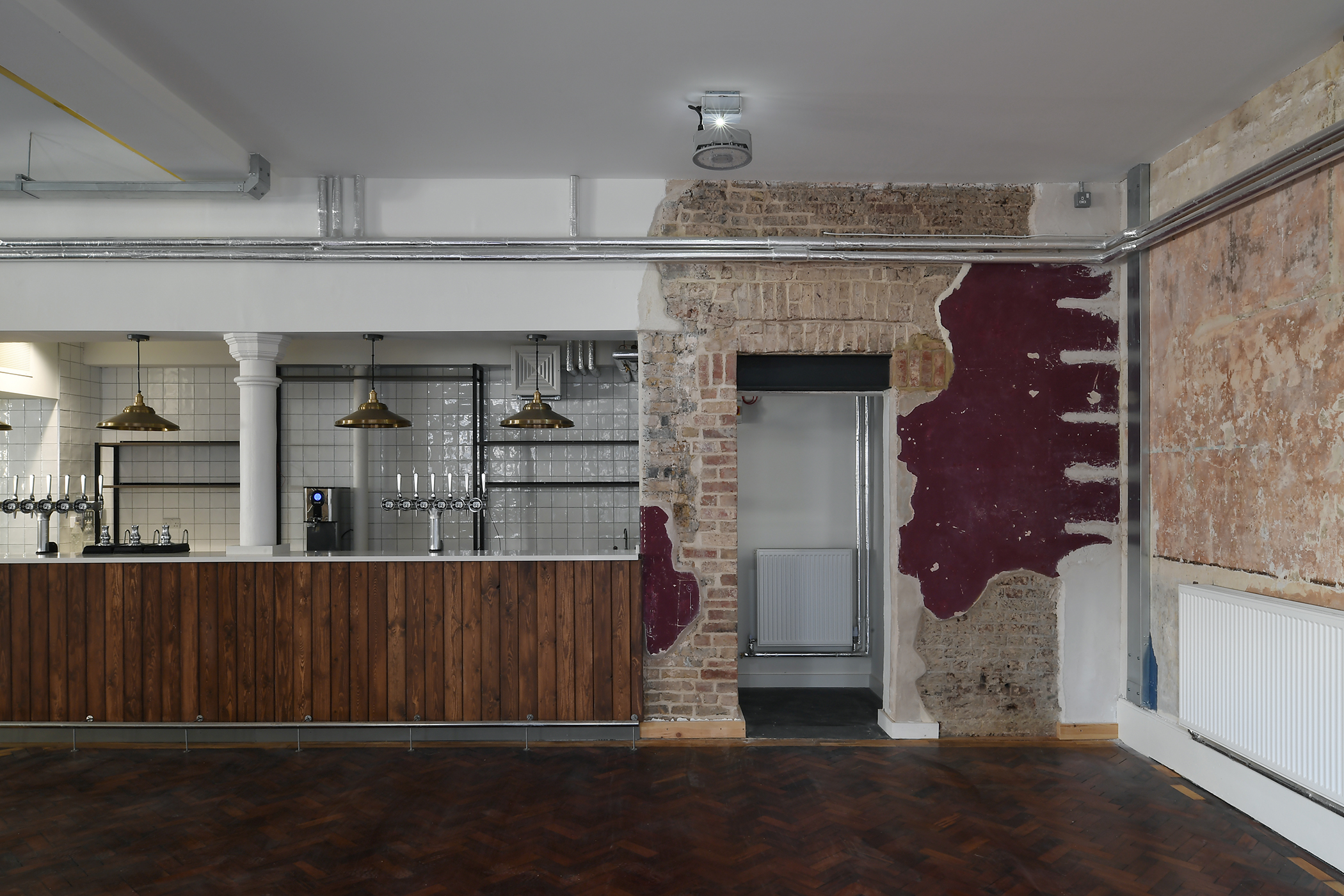
At the Catford House the expansive bar area has been reroofed and remade, and as much of the building as possible has been opened up, including those slightly mysterious rooms above and behind a pub that the public don’t usually see. For reasons of both cost and preference, the building’s history of damage and repairs and alterations is left exposed: you see the ropey brickwork of former centuries (which belies the myth that everything in the past was always exquisitely crafted) and the stitching that holds it together; you see the patches of plaster that, through constructional survival of the fittest, never fell off. This suture-ism of joints and fixes, says Hayatsu, “makes architecture from the process of repair”. By showing the building’s workings, it tells the stories of the people who built and used it.
You see the ropey brickwork of former centuries – which belies the myth that everything in the past was always exquisitely crafted – and the stitching that holds it together
You see the ropey brickwork of former centuries – which belies the myth that everything in the past was always exquisitely crafted – and the stitching that holds it together
Fragments of cornice, once cheap gob-ons (to use an old term for applique decorations), now look as august as Roman ruins. On top of this Rorschach wallscape of amoebic shapes and crusty surfaces are laid the silvery tubes of modern plumbing, electrics and ventilation. Then, in what is the design’s biggest move, a double-height hall is created by a new frame in chunky spruce, held together with steel plates. Boxy air-handling ducts, of about the same proportions as the beams, are on show, as are the gridded opaque glass blocks that enclose a toilet block. Knots and splits in the timber join the party, as do the various window sizes of the building’s domestic past. It’s a rich 3D collage of old and new, intent and chance – not fully harmonised – whose elements find their likenesses and differences with each other.
“The timber frame supports the life of the building,” says Hayatsu, which it does both literally and metaphorically. It stops the wall of the old farmhouse, which had been perilously bowing outwards, from collapsing. It also makes a space that, in keeping with GCDA’s spirit of improvisation, can be used in multiple and unforeseen ways. There’s a kind of minstrels’ gallery that allows performers to look down on audiences, or vice versa. A barbershop quartet has sung there and poetry readings have been proposed. It is also a place where children can roam, says Pritchard. “People just stand on the gallery because they can.”
Another client might have baulked at the hall’s mild profligacy – if you filled its void you could squeeze in a few more valuable square feet of space for offices or meetings – but that wouldn’t be GCDA’s way. This is not a place where everything is curated, prescribed or monetised. The architecture does its bit, offering a characterful but incomplete canvas to be filled by activity. The design “isn’t anything imposed on people”, as Pritchard puts it.
Newsletters
Choose the newsletters you want to receive
View more
For information about how The Observer protects your data, read our Privacy Policy
The early signs are that the endeavour is working. Although the Catford House is placed inconspicuously beyond an archway, and has so far been lightly marketed, its soft opening attracted 300 people, with queues out the door. “It’s glorious,” says Pritchard. “You won’t have to leave Catford,” she adds, “everything you’ll want is here.”
Photographs by David Grandorge/Jim Stephenson