

It should be easy to agree what makes a good new neighbourhood. Its ingredients include good provision for multiple forms of transport, places for children to play, contact with nature, trees, sustainability, layouts that foster interactions with neighbours, a whole greater than the sum of its parts. Along with homes, there should be schools, shops, places of work and sports and leisure facilities. The homes should be of different sizes and tenures, allowing people of all ages and backgrounds to live together. Thoughtful design of houses and streets helps, as does a sense of distinctiveness – that a given place is not the same as thousands of others. Yet most new housing developments are nothing like this.
An exception might now be on the way in Essex, where plans for Tendring Colchester Borders Garden Community, to use its unwieldy working title, have recently been submitted for planning permission. This a project on the edge of Colchester for 7,750 homes – which is big, about the size of the existing Essex town of Harwich. It will be built by Clarion, the largest housing association in the country, which has both the financial clout and the long-term view needed to achieve a successful development. In particular, it can invest in essential infrastructure before any houses are built, and continue to care for the place when it is completed.
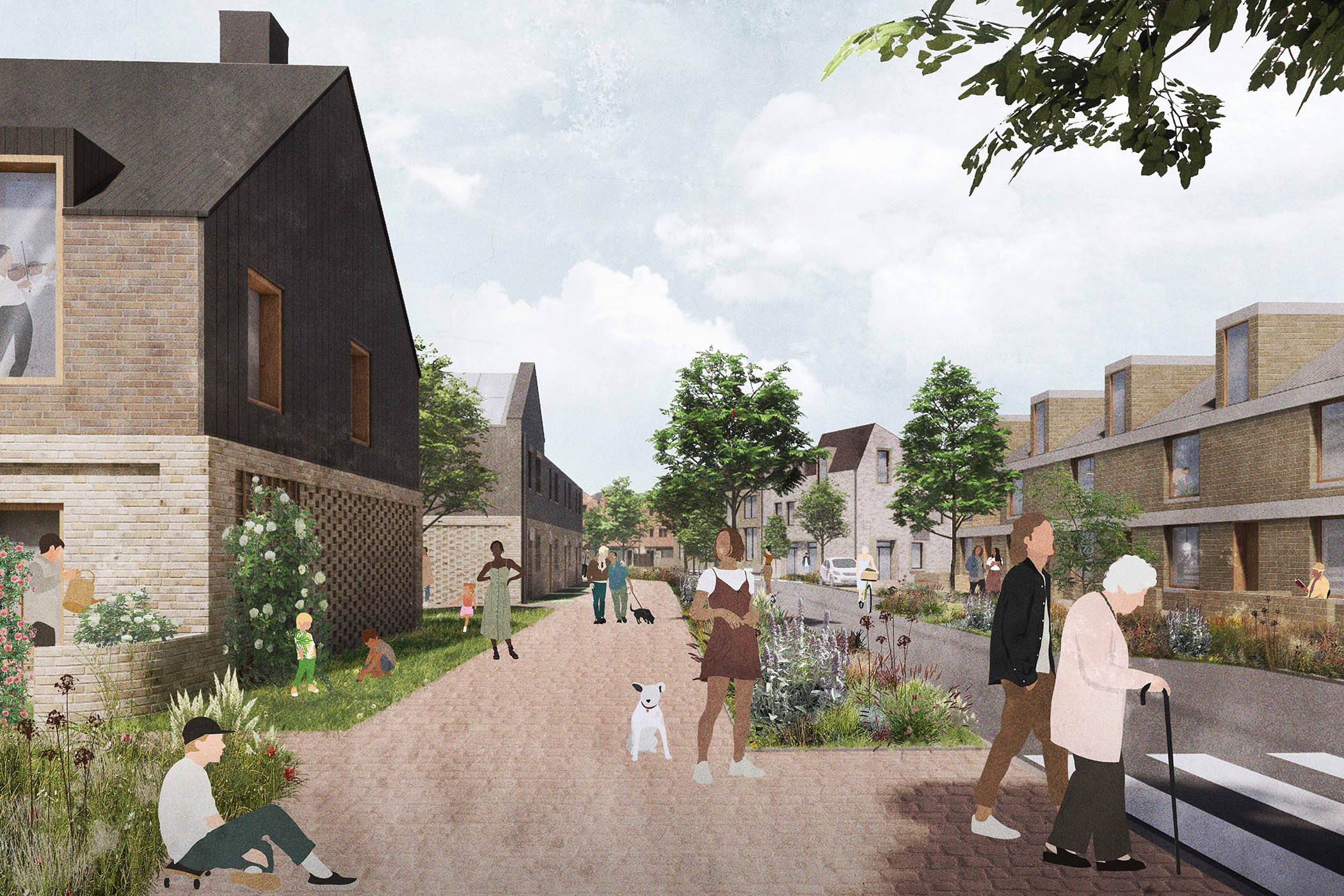
The development’s masterplan is by the architects Haworth Tompkins (who, as well as their expertise in theatres, have a line in housing), working with the landscape architects Periscope and a group of other practices. It promises all the good things, and does so by addressing the greatest obstacle to achieving well-made communities: the need to make room for cars and refuse vehicles, which usually smothers the shared spaces of residential estates with expanses of inhospitable tarmac.
People will still need and want cars in this future town, and they will want their rubbish collected. But the approach here is to make alternative transport easier and faster, and to integrate parking places and garages carefully. The plan is to make three neighbourhoods structured around a network of vehicle-free streets and shared gardens – places where you really might want to linger and chat to neighbours – and routes dedicated to pedestrians and cyclists. A rapid bus service will run through the middle, connecting the new districts to Colchester city centre.
There will be schools, offices and workshops for local businesses, and cultural, sporting and community buildings formed around informal public squares. There will be a mixture of homes for sale at market prices, available through shared ownership, and for social rent. There will be a sustainable drainage system that, rather than rushing rainwater off hard pavements into buried pipes, diverts it through open basins and channels where flora and fauna can flourish.
So far, so sensible (if hard to achieve), but the moves that could make this new place special come from its relationship to the landscape. The site is currently agricultural, with intensively farmed fields set between hedgerows. The hedgerows will be kept and enhanced, along with mature trees, framing the new walking and cycling routes. There is ancient woodland there as well, which will be made into a country park – an asset not only to the new homes, but also the adjacent suburb of Greenstead, whose high levels of deprivation recently prompted an investigation by Amol Rajan on Radio 4’s Today programme.
This framework of old greenery brings a sense of history and depth to the proposals. It combines with the wet landscape and planting in the streets and squares to make a continuous natural tissue, running from the threshold of a house to the woods. The houses themselves are neat, plain, with pitched roofs, in varied materials and colours. Pergolas, over which it is hoped plants will grow, join them together and form shelters and screens for cars.
The public buildings and workplaces will be in a similar idiom, an abstracted version of the simple traditional buildings, often clad in coloured boarding or render, that you get in Essex. At the main entrance to the neighbourhood, off a major road, you will be greeted by a red gabled structure containing places of employment. It is designed by the local practice HAT, also authors of Sunspot in Jaywick Sands, 15 miles away on the coast, a big, bold shed of a business centre which, despite its low budget, is also a civic landmark.
The project as a whole could, as Sunspot does, show a tad more fun and invention than is currently visible in the renderings. Much will rely on the upkeep of the shared spaces, to make sure that the planting is really as enticing as depicted. But this garden community offers a convincing and worked-out vision of a good life for its future thousands of residents.
As the government pushes for large numbers of homes and for a new generation of new towns, they would do well to look to Essex for inspiration.
Newsletters
Choose the newsletters you want to receive
View more
For information about how The Observer protects your data, read our Privacy Policy
Photograph © Haworth Tompkins