‘I am a staunch believer in the power of architecture,” says Edi Rama, who, since Viktor Orbán’s defeat in Hungary, is now the longest-serving prime minister in Europe, “to energise a place, to give to a place and to its people a sense of belonging and of the future, and to influence – big time – the way people think about themselves.” Most European countries, Rama believes, have forgotten how to do this. “The last great European leader that thought about architecture as an instrument of transformation and of identification was [François] Mitterrand.” The late French president commissioned a series of grands projets – the Louvre pyramid, the Grande Arche at La Défense, the Bastille opera house – that redefined the image of Paris in the 1980s and 1990s. Rama is trying something similar with his country, Albania, and its capital, Tirana.
Not everyone is enchanted. Several international reports have highlighted close links between organised crime in Albania and construction. Rama’s critics ask how Albania, which is small and not rich, can pay for such lavish and extensive buildings if not through money laundering. And how many Albanians can afford to buy an apartment in the new developments, where a one-bedroom flat may cost €500,000 (£435,000)?
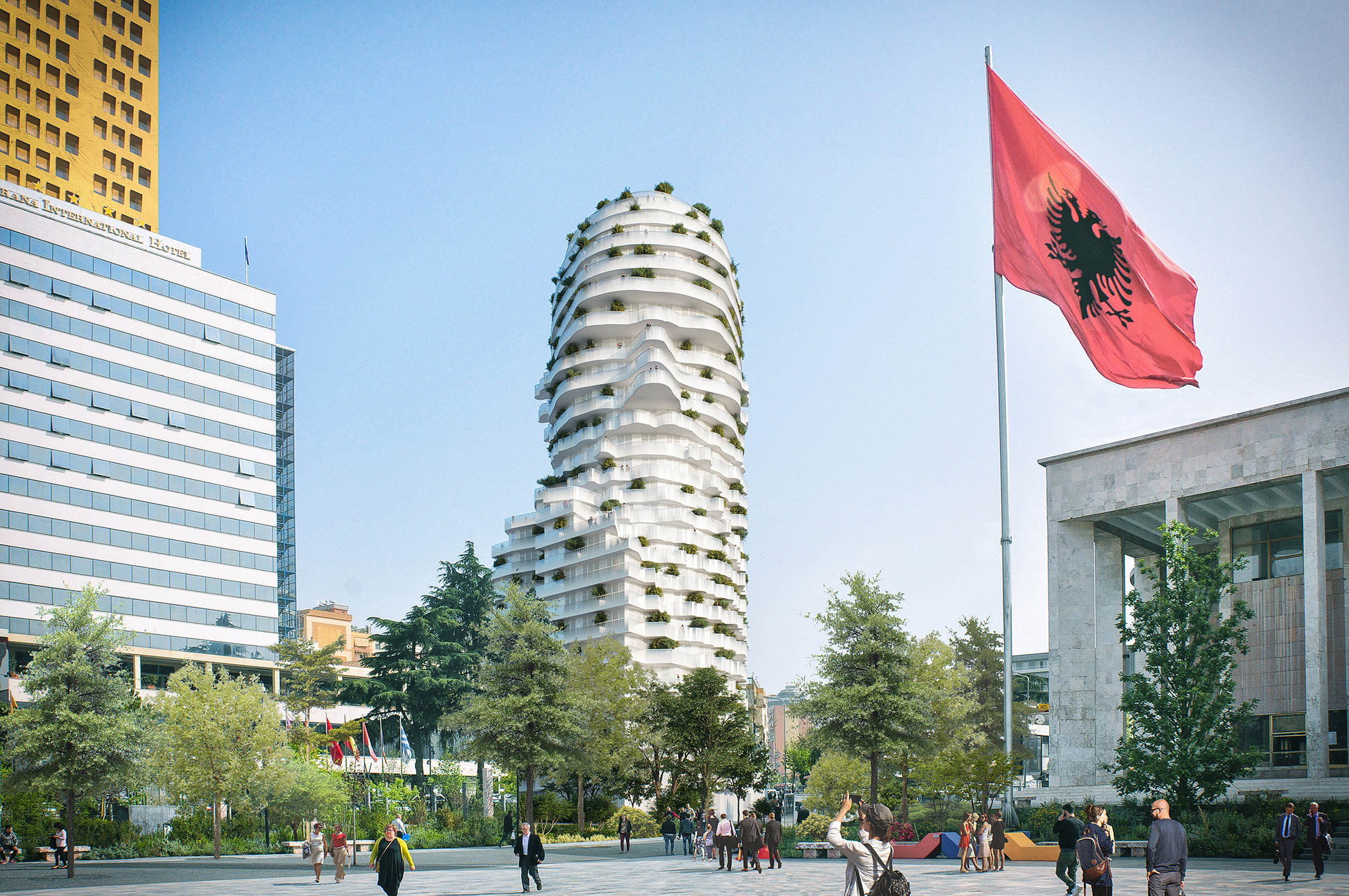
Tirana’s Rock, a residential with a head the shape of an Albanian hero
There is also opposition to a government deal with Donald Trump’s son-in-law, Jared Kushner, to develop a luxury resort on Sazan Island, a former submarine base that has been called “the last bastion of wilderness in the Mediterranean”. Forty-one environmental organisations from 28 countries have urged a halt to the project.
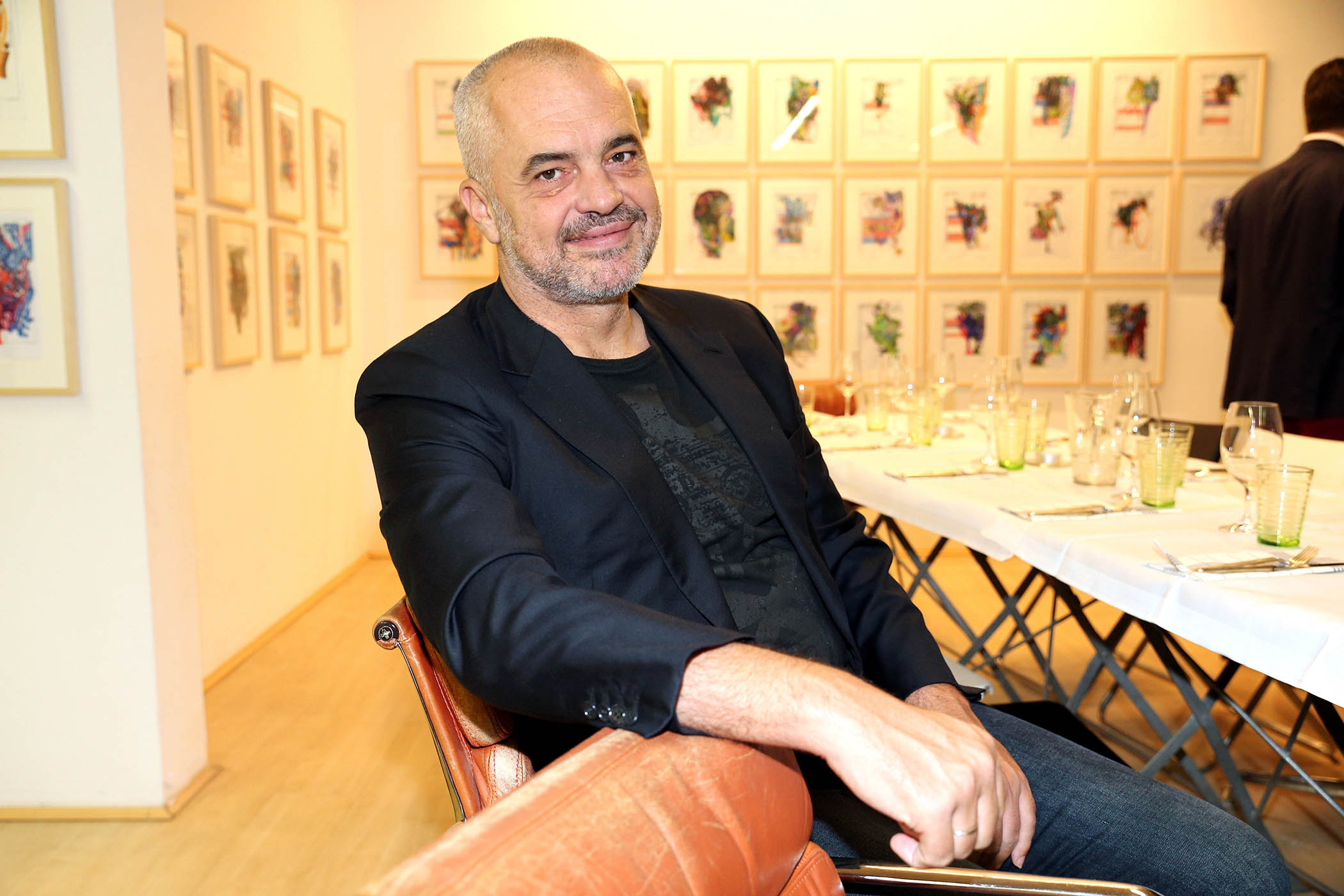
The prime minister’s office building provides evidence of his fascination with architecture. There’s a courtyard filled with timber-framed hanging gardens by the fortysomething Austrian Chris Precht, a self-described “architect by day, dreamer by night”, who seeks to address global challenges such as “biodiversity loss and a lack of empathy” with “a shift in perspective and a change in consciousness”. Rama’s droll sense of theatre is also apparent. There are halls lined with oversized heads from communist-era statues. The squawks of a caged parrot fill the corridors. Rama is an artist as well as a politician, and his personal office is papered with his drawings. He stands 6ft 7in in his socks (which, as he’s left his shoes off when I interview him, is how I find him). His height makes for striking juxtapositions with smaller leaders such as Giorgia Meloni and Volodymyr Zelensky. He is, I am told by people who know, “an extremely shrewd politician”, with “so much charisma he’s almost imploding”.
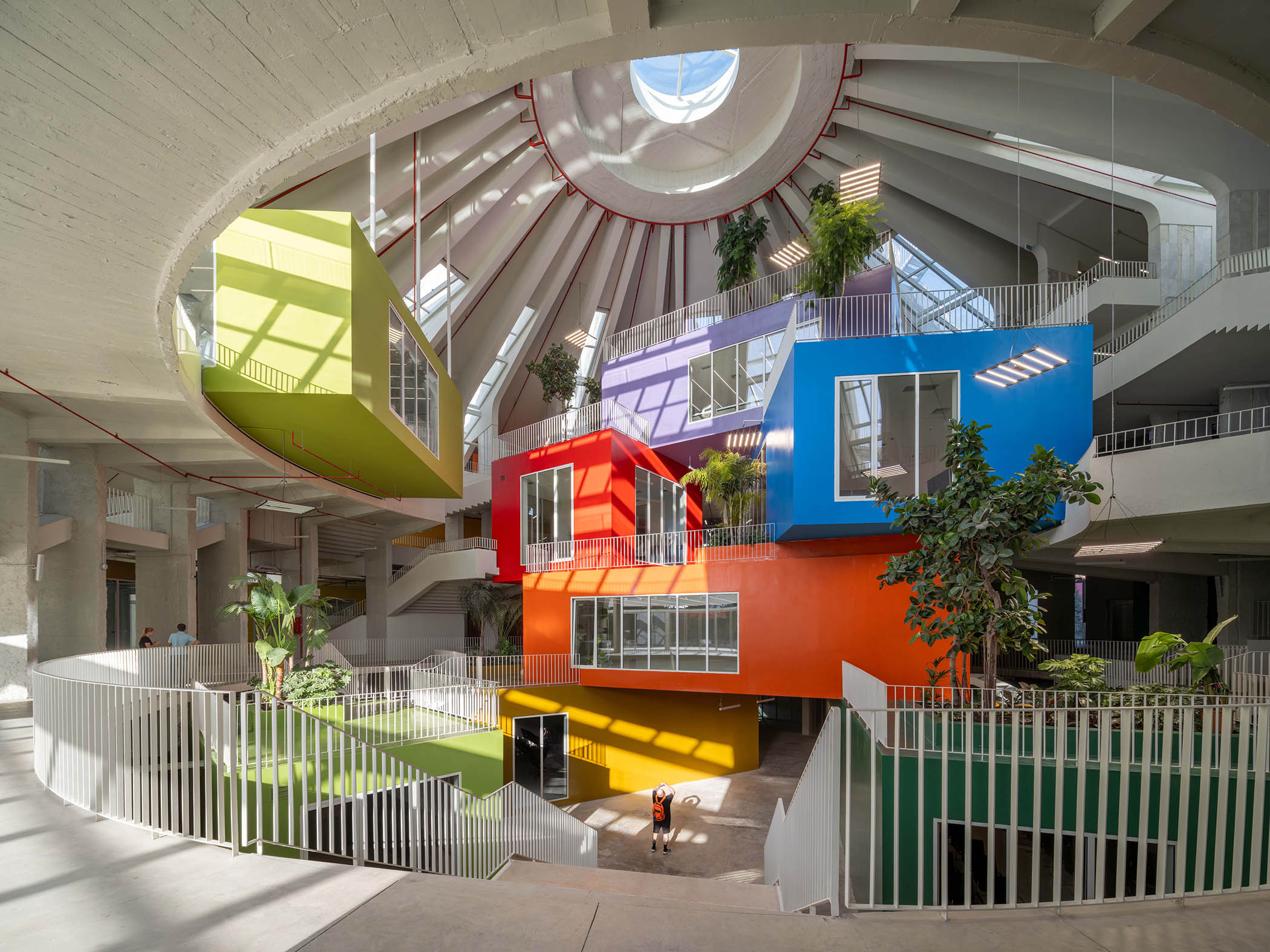
Inside the Pyramid of Tirana
His job involves political balancing acts. Admission to the European Union is the primary goal of his administration, but he has criticised the EU for refusing to talk directly to Vladimir Putin. He has also made Albania a member of Trump’s “board of peace”, praising the American president for his “strong commitment and visionary leadership”. This fulsomeness is contradicted by a bust of Abraham Lincoln, placed on the marble floor of Rama’s personal office, gazing quizzically down on a compilation of Trump’s tweets.
From a rooftop terrace, you can see how the skyline is taking shape under Rama’s influence. The towers, in what was formerly a low-rise city, are strikingly varied. Tirana’s Rock, a 26-storey, predominantly residential block in the shape of a giant head, supposedly that of the medieval national hero Skanderbeg but thought to resemble Rama, is nearing completion. It’s a parodic monument – ironic megalomania, a selfie backdrop for tourists – whose complex shape is held up by the copious spaghetti of steel reinforcement.
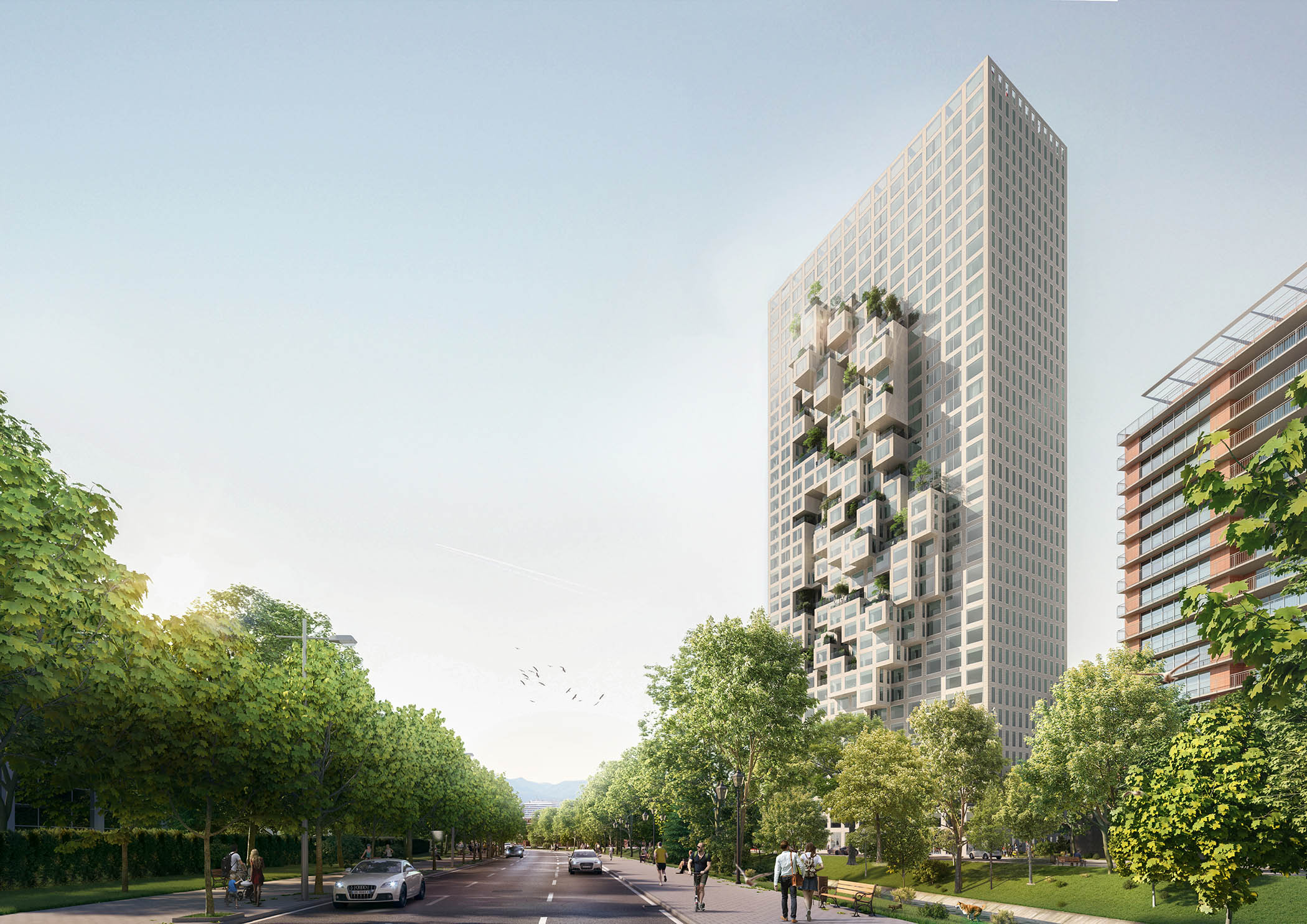
Downtown One Tirana by architecture studio MVRDV
Albania, says the prime minister, “has become a place where there is the highest concentration of renowned architects” in the world. He calls them his “Arch Army”, adding: “We have a chat group, and it’s very funny, because every time there is a prize in the world, it is won by part of this Albanian Arch Army.” He reels off names from Spain, Italy, Japan, Mexico, South America, the US.
The architects, for their part, seem delighted by the opportunities Rama gives them to express themselves, without the distraction of what one of them calls “unnecessary procedures and protocols”. Another says: “You get to do architecture with speed and freedom you don’t get in the Netherlands or Germany.” Messages in the Arch Army WhatsApp group, which I’ve seen, are full of praise: “thank you to be brave”, says one in response to Rama’s speech to the board of peace. “Bravo very beautiful,” says another of Chrysalizing, an exhibition of Rama’s sculptures at a gallery in Berlin. Someone posts a photo of a young Rama, looking handsome; heart emojis appear below it.
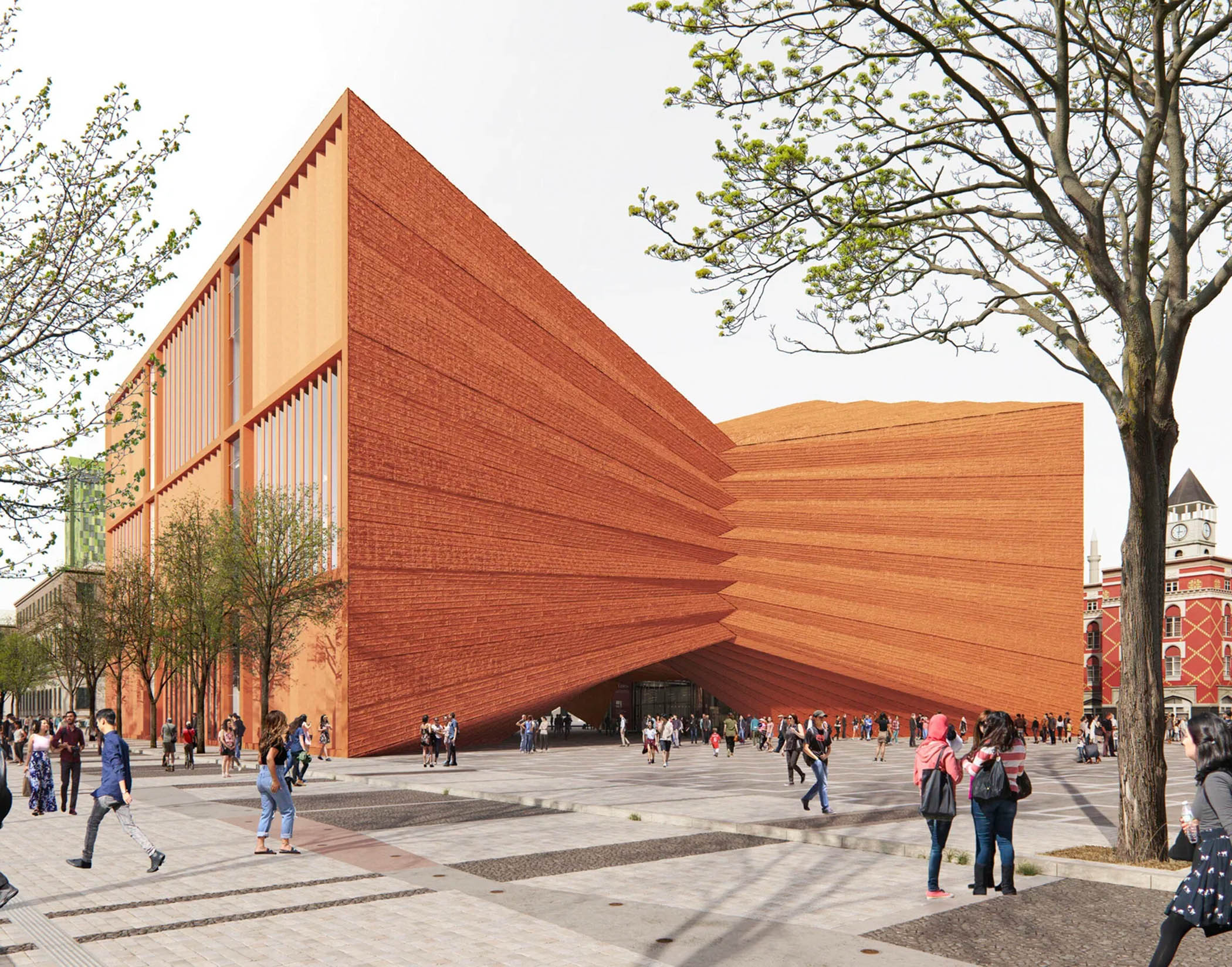
The National Theatre of Albania
He has just been made an honorary fellow of the Royal Institute for British Architects; the citation, by the London-based architect Amanda Levete, praises his “poetic vision for his country” and calls it “a clarion call and a masterclass in hope”. One architect in the group wrote: “It must be one of the most meaningful awards ever given in the field of architecture.” Another wrote: “You’re an angel for the cause of architecture.” Rama himself wrote: “I was shy to share it, because it’s a trophy from the blood of the Arch Army.”
Albania is a country of about 2.75 million people, caught between greater powers in all directions. Since independence in 1912 its rulers have included the authoritarian King Zog and the communist dictator Enver Hoxha, with a period of wartime occupation in between. The end of communism in the early 1990s was followed by chaos and internal violence. It has become more stable and prosperous in this century, but it remains one of the poorer countries in Europe. Depopulation, caused by emigration and falling birth rates, is a serious concern.
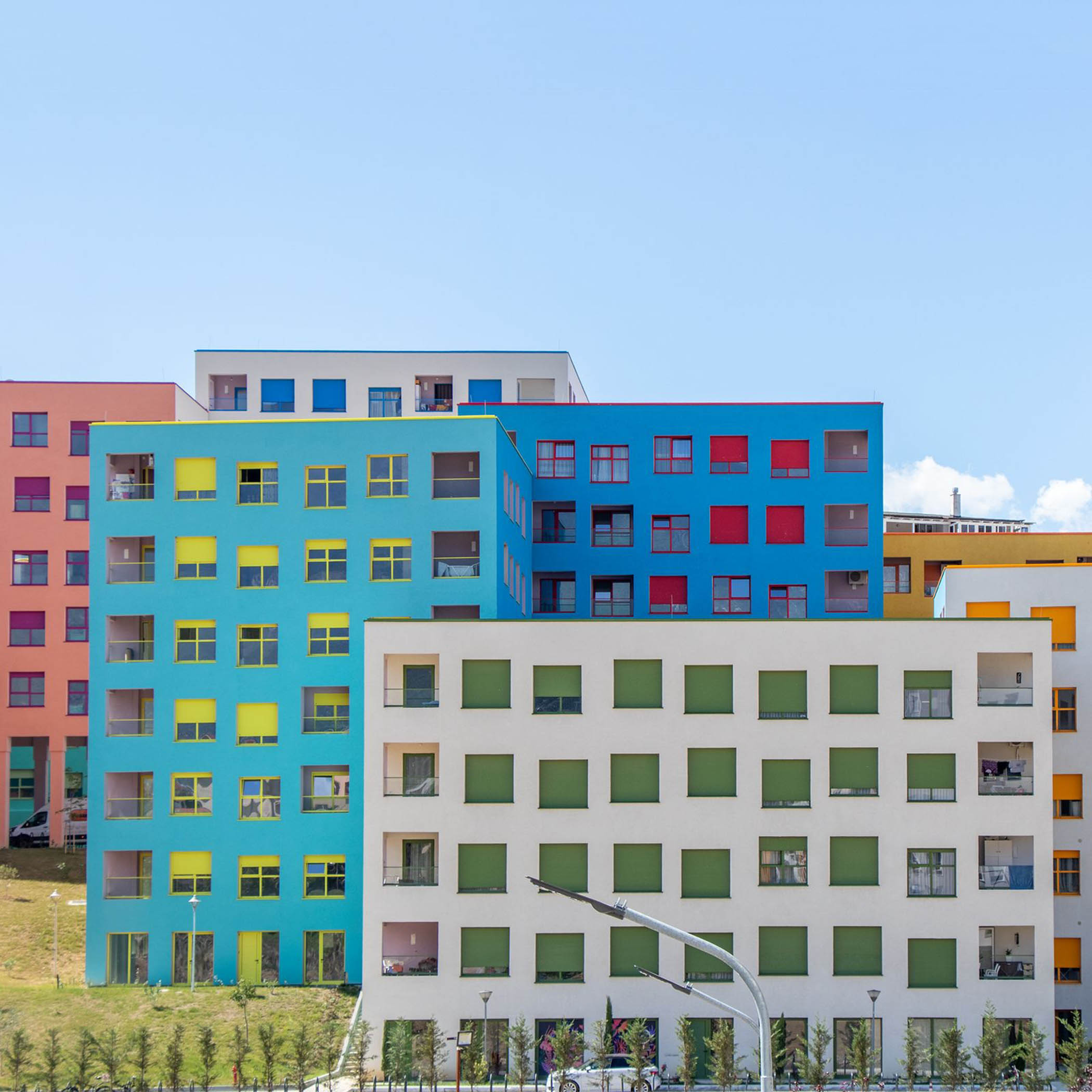
The Mangalem 21 housing estate by Dutch practice OMA
At 61, Rama has lived much of this history. He is the son of an artist, Kristaq, who was close to Hoxha’s repressive government, for which he made monumental sculptures, including the 12-metre (39ft) statue Mother Albania. The younger Rama was mayor of Tirana from 2000 to 2011 and has been prime minister since 2013. In the former job, he first became internationally famous for getting fellow artists to paint grey buildings in bright colours – a cheap way of cheering the city up.
He also set about clearing away tens of thousands of illegal buildings put up in Tirana’s open spaces during the anarchic 1990s. He started initiatives to make the city more green and walkable that continued under his ally Erion Veliaj, its mayor since 2015. One outcome was the transformation of Skanderbeg Square, Tirana’s most significant public space, from a ragged roundabout into a pedestrianised expanse paved with 30 different types of Albanian stone. Concealed water jets bring out the multiple natural colours of its subtly cambered surface, and lush planting creates areas of shade. Designed by the Belgian architects 51N4E and completed in 2017, it won international awards.
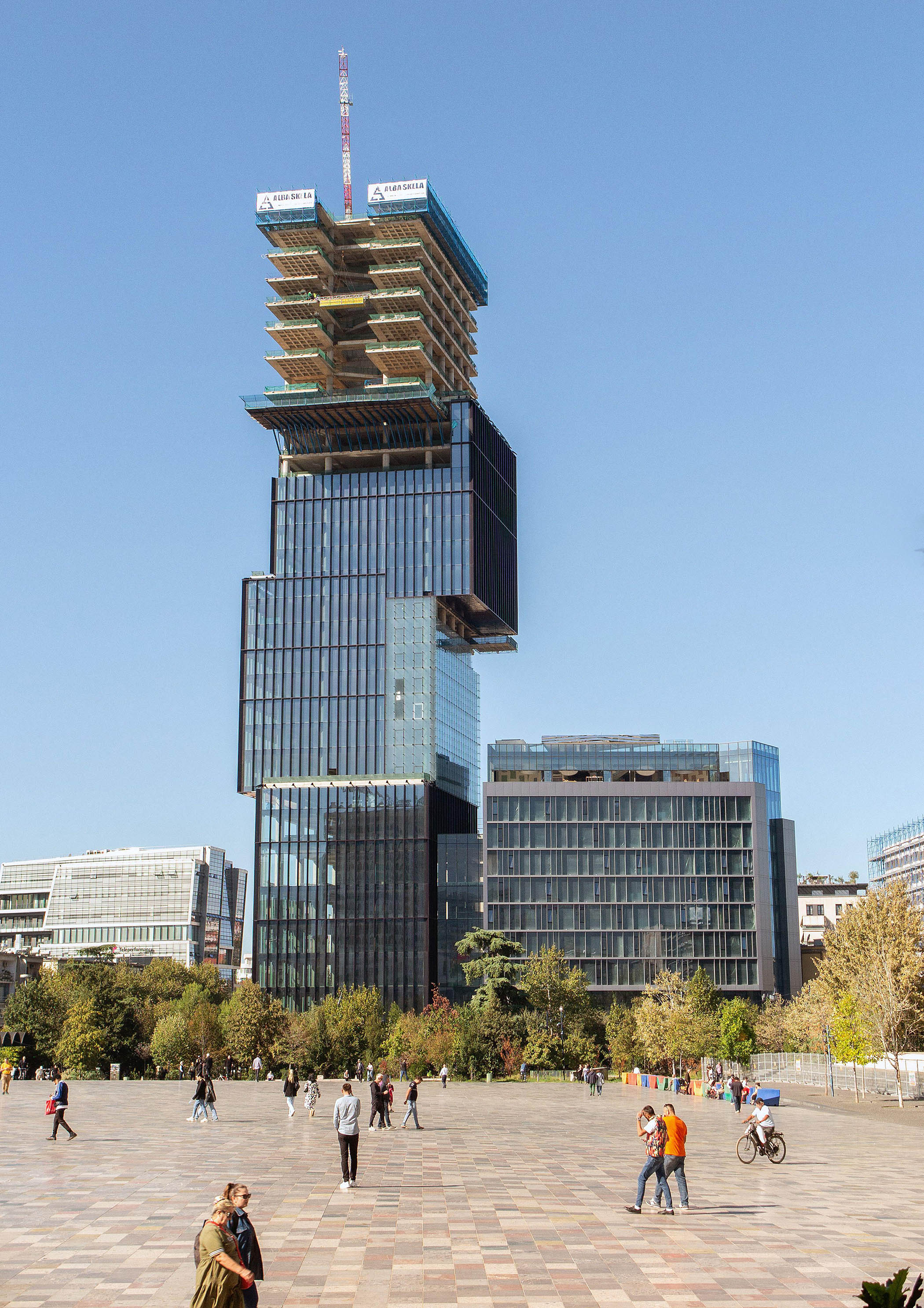
A skyscraper under construction on Tirana’s Skanderbeg Square
Now the Arch Army is marching on. Proposals include a twisting red skyscraper by Bofill Taller de Arquitectura of Barcelona. A 50-storey tower is under construction, composed of two parts that lean against each other; inspired, say its Portuguese architects OODA, by Gustav Klimt’s painting The Kiss. The Dutch architects of Tirana’s Rock, MVRDV, have also designed the Grand Ballroom, a planned 6,000-seat sports arena with associated hotel and retail space shaped like a giant ball. “I really like it that they don’t have a concept of normal in Albania,” one of Rama’s favoured architects has said. “One can put ideas forward that would be just laughed off the table in other places.”
The projects in question are mostly apartments and office blocks built by property developers, who are strongly nudged towards hiring leading international practices. Architects are sometimes chosen by competition. Rama is usually closely involved in these decisions. “There’s a contest in trying to impress him,” says one of the architects. “He definitely has his favourites.”
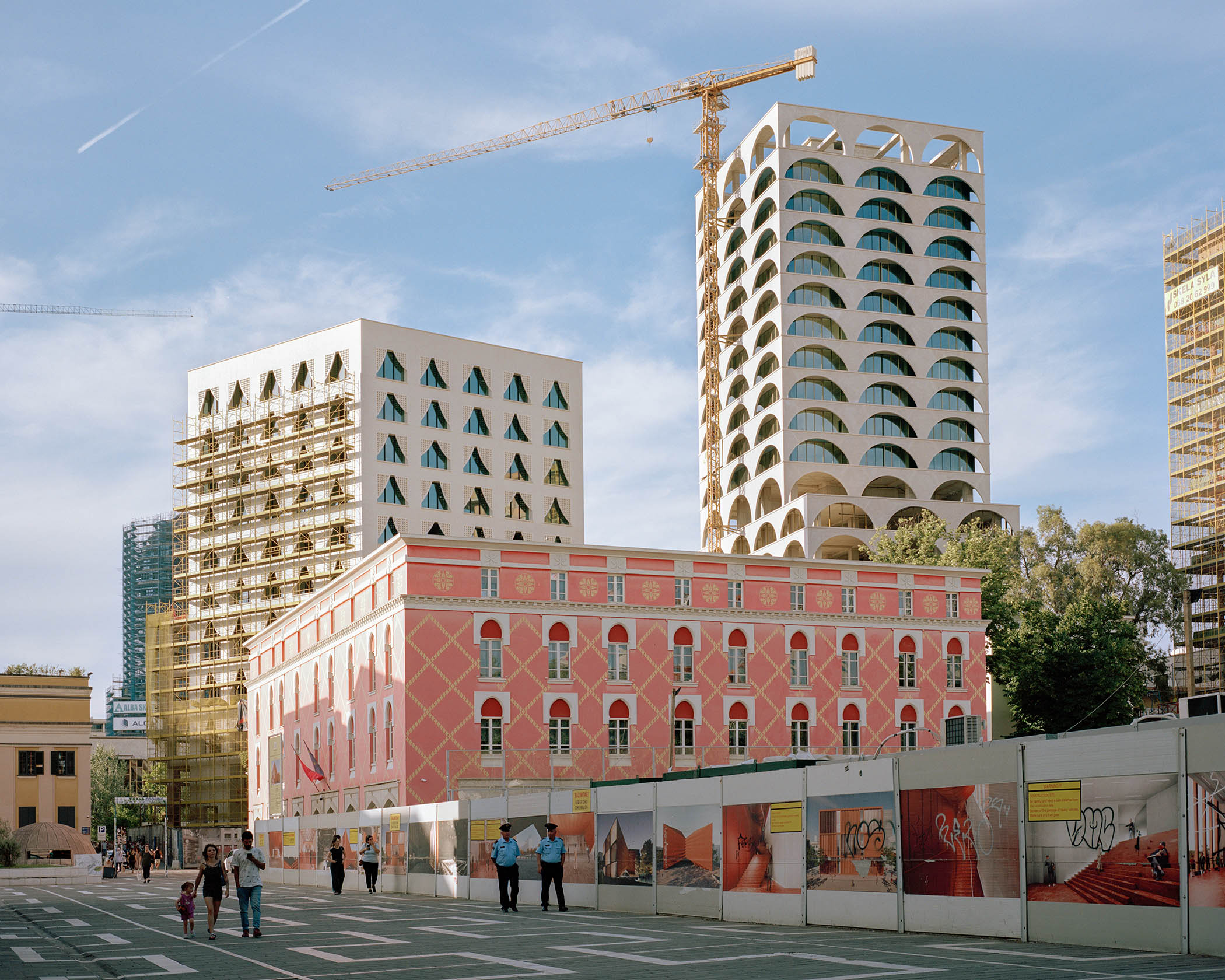
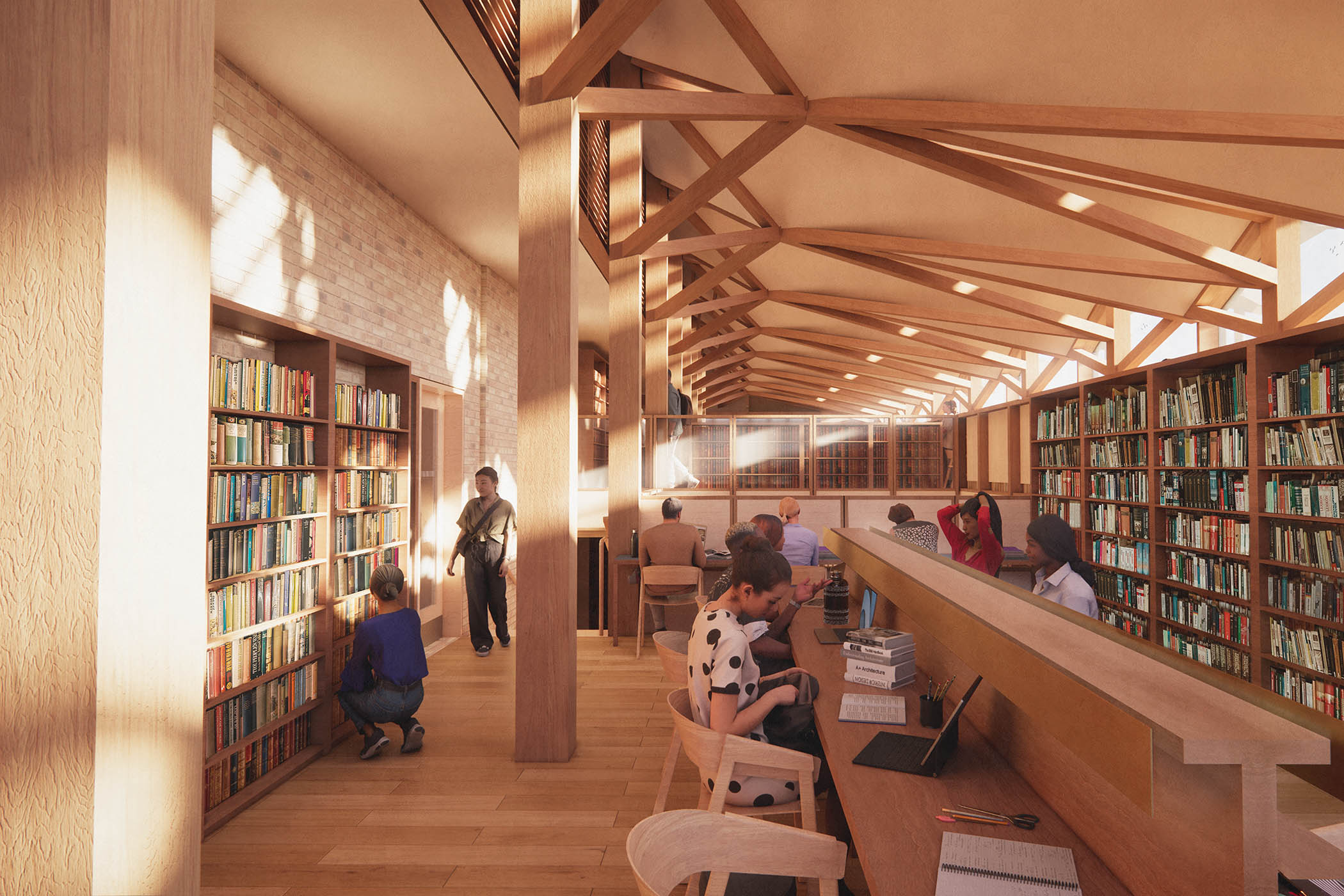
The Book Building, designed by 51N4E
There are public works, such as MVRDV’s 2023 makeover of the 1980s pyramid originally built to commemorate Hoxha, and a comprehensive renovation of the National Historical Museum. And there are projects such as Mangalem 21, a multicoloured estate of just over 1,230 middle-market apartments on the periphery by the Dutch practice OMA. Its squares and arcades, scruffy at the margins, teem with life, in a way you don’t often find in new developments.
Members of the Arch Army are also working extensively outside the capital, especially on the beautiful coast, which is less developed than most of the Med. One of the theories behind using celebrated foreign architects is that they may do a better job than the developers who destroyed the littorals of Spain or Greece. “Don’t be Alicante,” is how one architect puts it.
Newsletters
Choose the newsletters you want to receive
View more
For information about how The Observer protects your data, read our Privacy Policy
I ask Rama if the individuality of the new projects is a reaction to the uniformity of communism. “Listen,” he says. “We went from one extreme to the other, in every sense. We had 5,000 cars all over the country and today we have close to a million. We had no private property at all and now we have the highest percentage of privately owned houses in Europe – 94%. Because, after communism, everyone got the house they were living in. We had an average of 2,500 tourists per year; now we have 12 million.”
Two days before my meeting with Rama, there was an opposition protest outside his office. It featured a line of cutouts of figures in orange jumpsuits, representing ministers accused of crime. In the centre was one with Rama’s face collaged on to the body of Nicolás Maduro, the former president of Venezuela, handcuffed by US authorities. The suggestion was that Rama should suffer Maduro’s fate.
The official opposition, the politically conservative Democratic Party of Albania, has not produced any direct evidence of criminal wrongdoing by Rama, and its credibility is not helped by the fact that its chair, former prime minister Sali Berisha, has himself been arrested on corruption charges (which he denies), and in 2021 was sanctioned by the US. But several international agencies have also expressed concern about the level of criminality in the country.
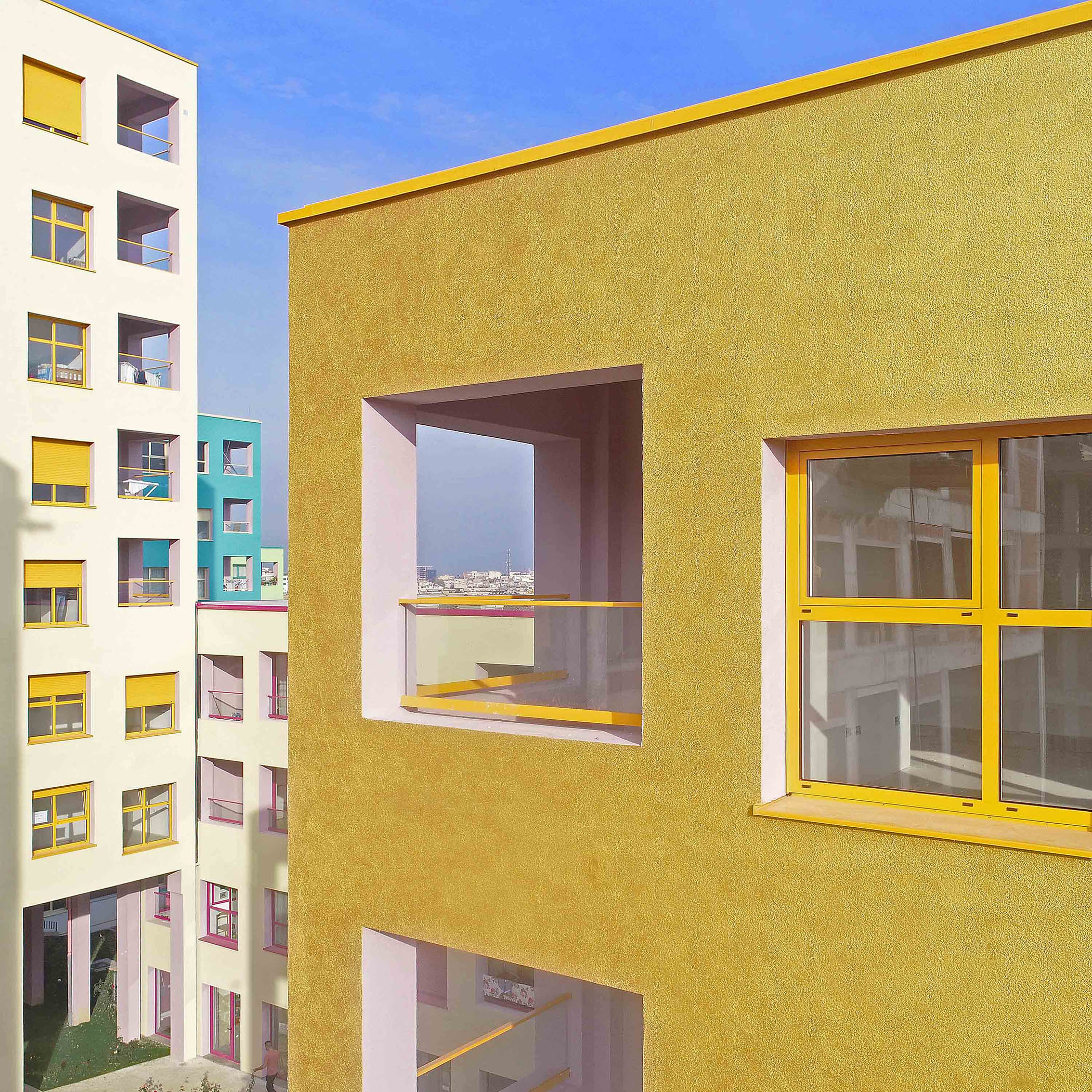
The colourful Mangalem 21 housing estate
A 2025 report by the US state department said that, while “Albania continues to make progress” in its anti-money-laundering regime, money earned from drug and human trafficking and government contract fraud is still siphoned “through real estate purchases, construction projects, virtual assets, and business development”. A draft report by the European parliament in February concluded that corruption remains “a serious challenge”.
Rama’s government is also under investigation by Spak, the judicial entity against corruption and organised crime, which was set up with the help of the US and the EU as part of Albania’s efforts to meet the standards necessary for EU admission. Spak has tried to arrest former deputy prime minister Belinda Balluku – a move Rama’s Socialist party has blocked in parliament.
In February last year, Spak ordered the arrest of Veliaj, Tirana’s mayor, reportedly along with the owners of six big construction companies, some of whom have allegedly worked closely with Rama. Veliaj has been in prison in the port city of Durrës ever since, awaiting trial, because Spak fears he could tamper with evidence and intimidate witnesses. A spokesperson from the London-based law firm Mishcon de Reya, which represents the mayor, tells me his treatment is “politically motivated”. Rama says: “This is very painful to me. I don’t think that you’ll find anywhere in the democratic world that the elected mayor can be in detention for a year and half without trial.”
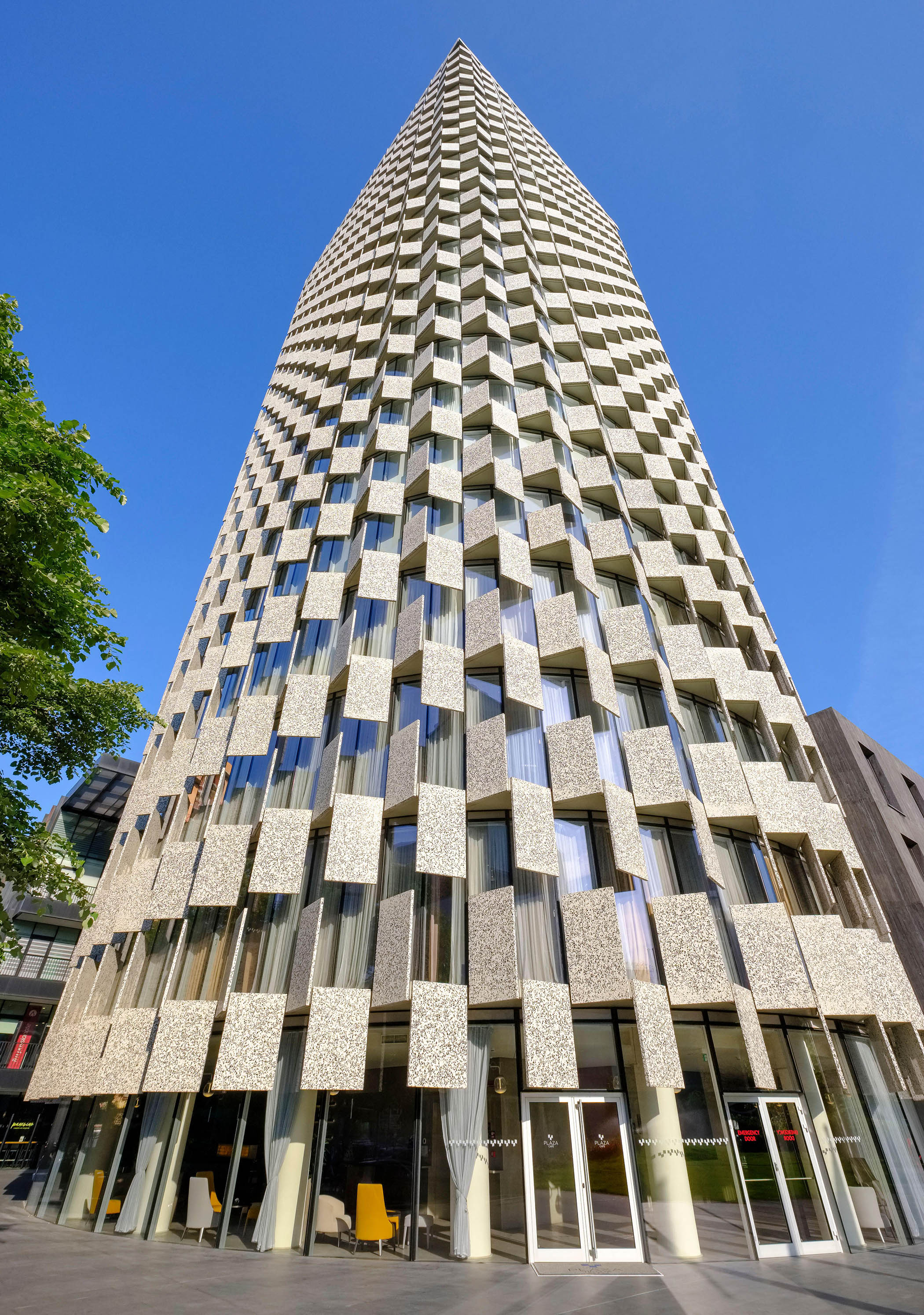
Another 51N4E project, TID Tower
Rama calls wider accusations about dirty money “weird”. “Are you confident that there is no money laundering in London?” he asks. “You will say Albania has a problem with drugs, but where is Spain? Where is the Netherlands? Where is Belgium? I don’t dispute at all the facts; I simply reject the disproportion … to stigmatise Albania – it’s absolutely nonsensical.”
His country, he continues, has created procedures to control money laundering, ensuring that large transactions are made through the international banking system. “I’m sensitive,” he says. “I feel offended that this endeavour is tarnished by this bullshit, because the towers are under particular scrutiny. There is no apartment, no space in the towers, that is sold outside the banking system.”
So where does the money come from? Rama suggests that much of it comes from the extensive Albanian diaspora repatriating their hard-earned incomes. He speaks of young men “who had to suffer a lot”, sleeping six to a room, “eating the most basic things”, to send their money home. “Leaving aside the tiny, noisy minority involved in illegal activities, the others did many works. And, of course, a lot got paid in cash, not by the mafia, but by the Brits, the Greeks, the Italians.” Every London homeowner who has paid an Albanian builder in cash has, in other words, potentially contributed to this reservoir of wealth.
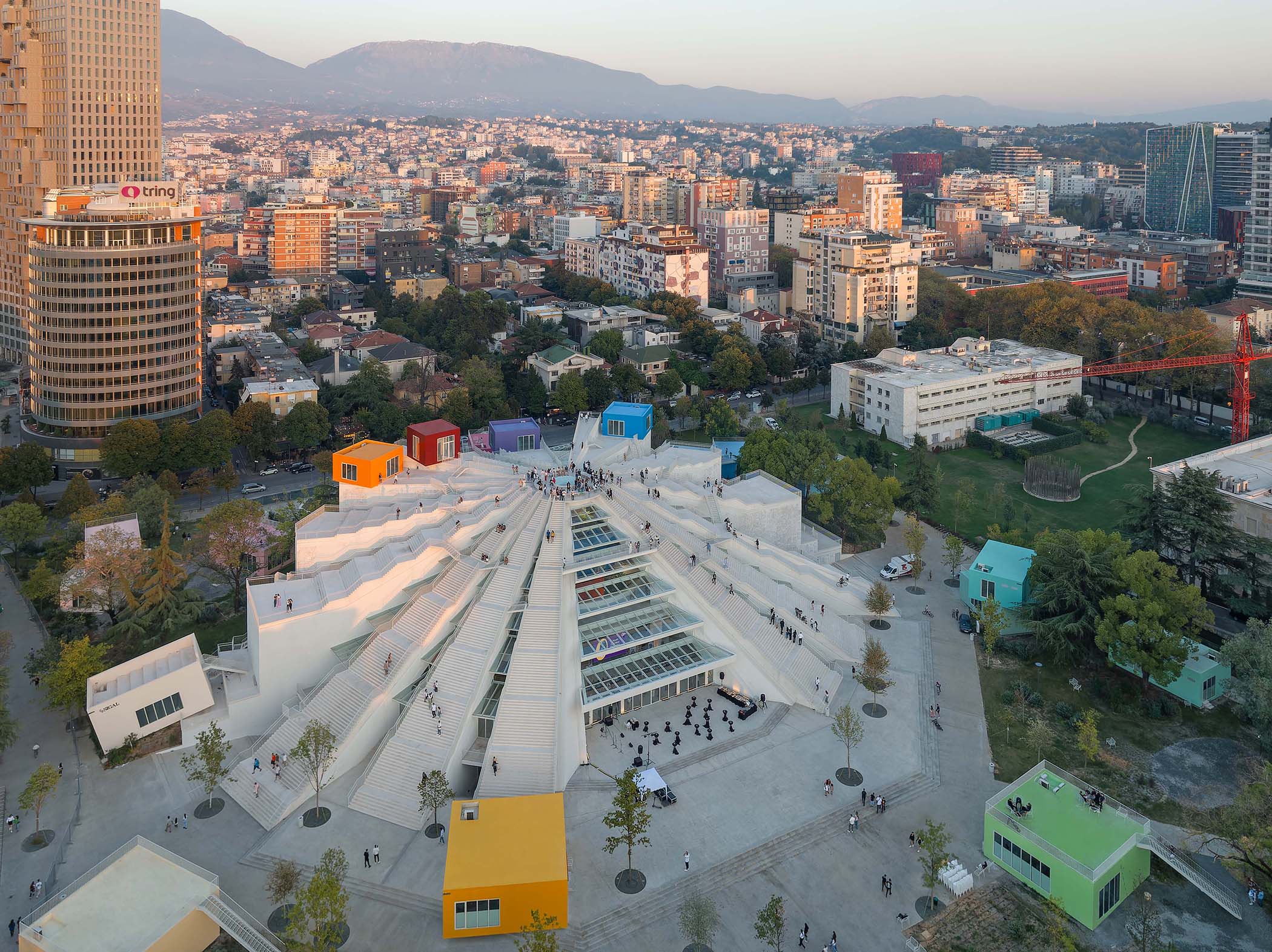
The Pyramid of Tirana from the air
Another criticism of Rama’s projects sees them as gimmicky, with foreign architects jetting in, doing eye-catching doodles and collecting their fees, without caring too much about the quality of their execution. “These practices came in with carte blanche from the prime minister,” I hear from Vincent WJ van Gerven Oei, a Tirana-based political analyst, whose Substack postings regularly criticise Rama’s projects. “They could do whatever the fuck they wanted; they held zero consultations with anyone and they just dumped in whatever they thought was their brilliant contribution to Albanian public space.” The foreign architects “exoticise” Tirana, he claims. “You know: ‘Oh my God, this wild architectural space; there’s no regulation, I can intervene here and create true value for all these poor eastern European, post-communist subjects.’”
Developments are also accused of being disorderly and unplanned. In 2015 the Italian architect Stefano Boeri was commissioned to draw up a plan that “in 2030 will turn Tirana into a European model for non-anthropocentric cohabitation between people, animals, and nature”. In practice, towers seem to pop up randomly.
For Rama, plans such as Boeri’s “are more like guidelines”. “Even for a more rigid and disciplined country [than Albania], master plans in the old way do not work any more.” While possibly sensitive that projects such as Tirana’s Rock may be seen as excessive, he’s also keen to mention more subtle, “minimalistic” architects, such as the venerated Portuguese Eduardo Souto de Moura. “Tirana’s Rock is an interesting beast,” Rama says, “but if everything would be like it, then we will have a big problem.”
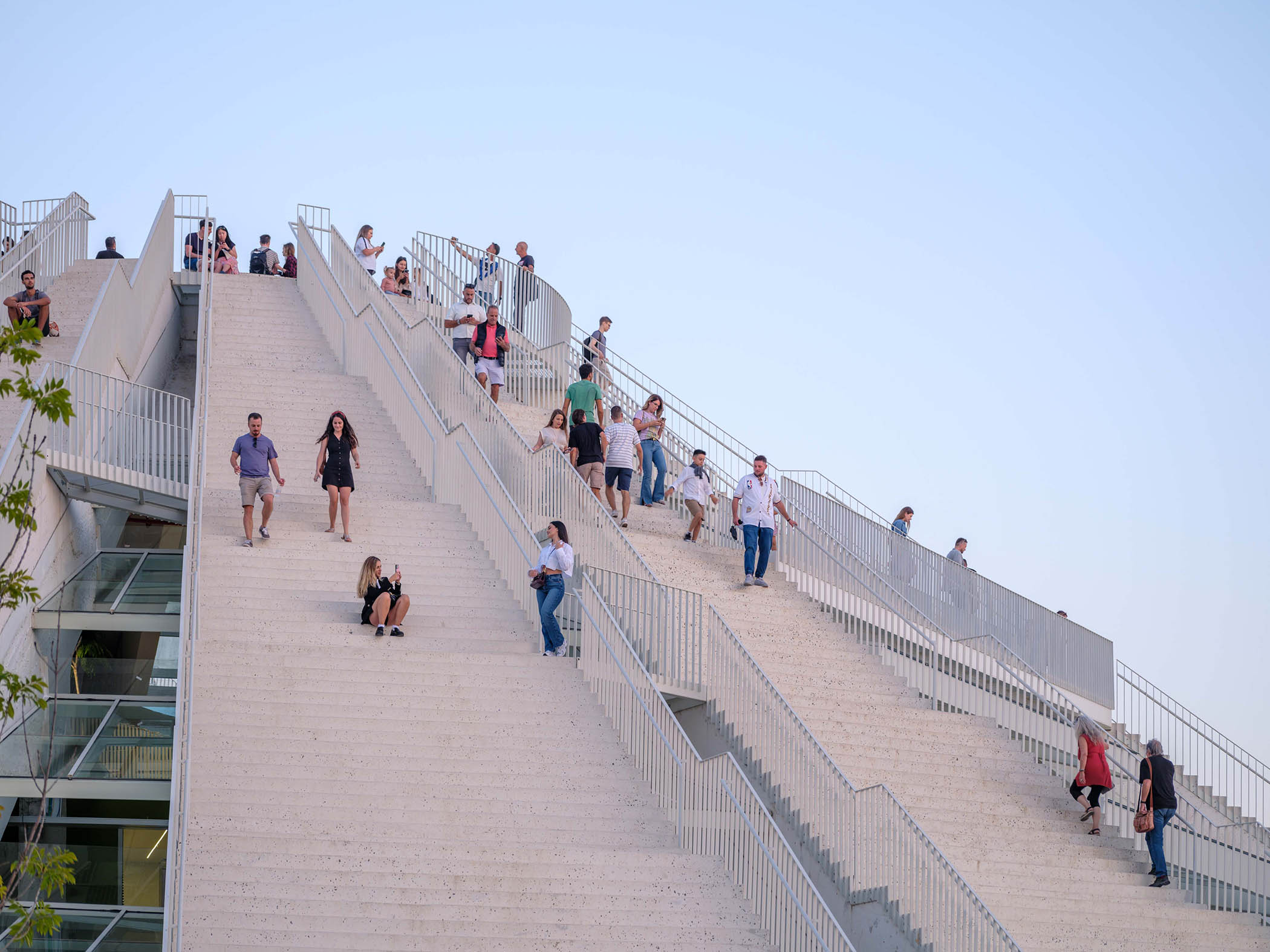
One of the Pyramid’s external staircases
Some of the Arch Army’s works are indeed superficial; others engage more intelligently with such questions as the creation of public space and the interaction of buildings and nature. They flirt with the absurd, and some embrace it completely. Collectively, they communicate a carnivalesque energy that, as intended, presents Albania in a new light. That new image comes, for now at least, with a smell of dirty money – and it’s not discriminatory against the country to point that out.
Rama claims that all the new development brings huge benefits to his nation, from the taxes raised on all this development to increasing property values and the economic effects of tourism. “I’m kind of stupefied,” he says, “by the basic and superficial discussion about the Jared Kushner investment in the south.” The prospect of the project is, Rama insists, already creating a boom in the nearby city of Vlorë, while the Albanian treasury will benefit from its stake in the joint venture.
He promises that Sazan Island will be publicly accessible and the environment will be protected: “It will,” he says, “be a gift from Albania to Europe.”
Photographs by Gisela Schober/Getty Images, Robert Wyatt/Alamy, 51N4E Platform, Ossip van Duivenbode/MVRDV, Bo Arrhed / Alamy, OMA/Reinier de Graaf/Kontakt Design Department