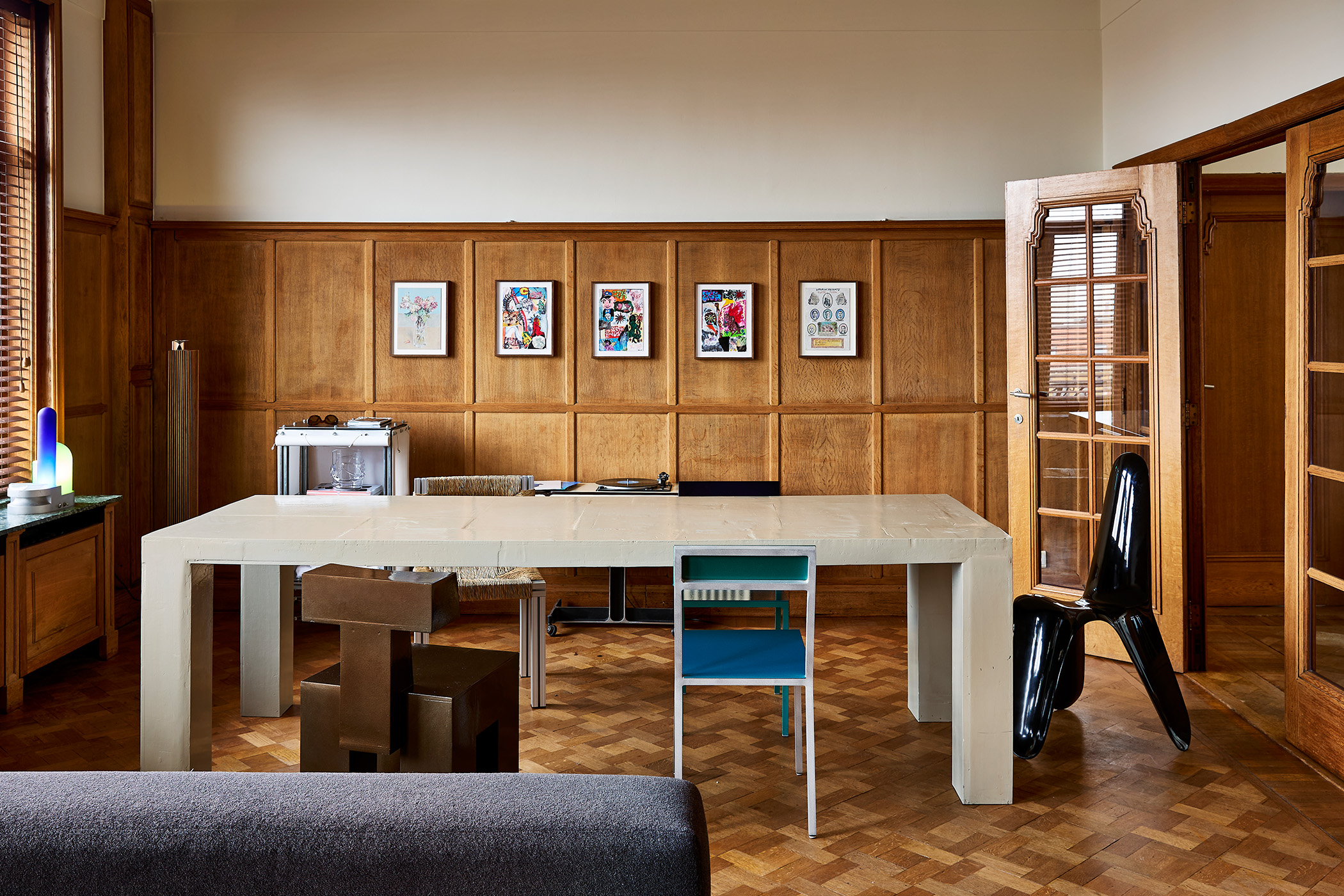
There’s a curving seat in red oak in the new V&A East Museum, where the whole London Olympic endeavour comes to rest. It has an inner and outer portion, separated by an also-curving wall of glass, such that you can be both close to your preferred companion, and find a more distant connection with whoever may be on the other side.
In one direction it looks across the museum’s bright entrance foyer towards the former Olympic stadium, now emblazoned with the claret-and-blue logos of West Ham United football club. In the other it looks towards a dazzling dress made out of 61 metres (200ft) of bunched and layered fuchsia nylon tulle, of a design worn by Jodie Comer’s doll-eyed killer Villanelle in the BBC series Killing Eve.
The dress is by Molly Goddard, the seat – which is made of red oak and inlaid with motifs derived from natural and human objects found in nearby neighbourhoods – by Andu Masebo. Both are contemporary London designers. Together, they introduce a gallery of exotic and everyday objects under the heading of Why We Make. This permanent gallery continues on the next floor up; above that, a temporary gallery hosting an opening show on British black music, with an events space on top with two terraces from which to survey the legacy of London 2012: the park and the repurposed sports venues, the housing blocks both affordable and unaffordable, and its other artistic and educational buildings.
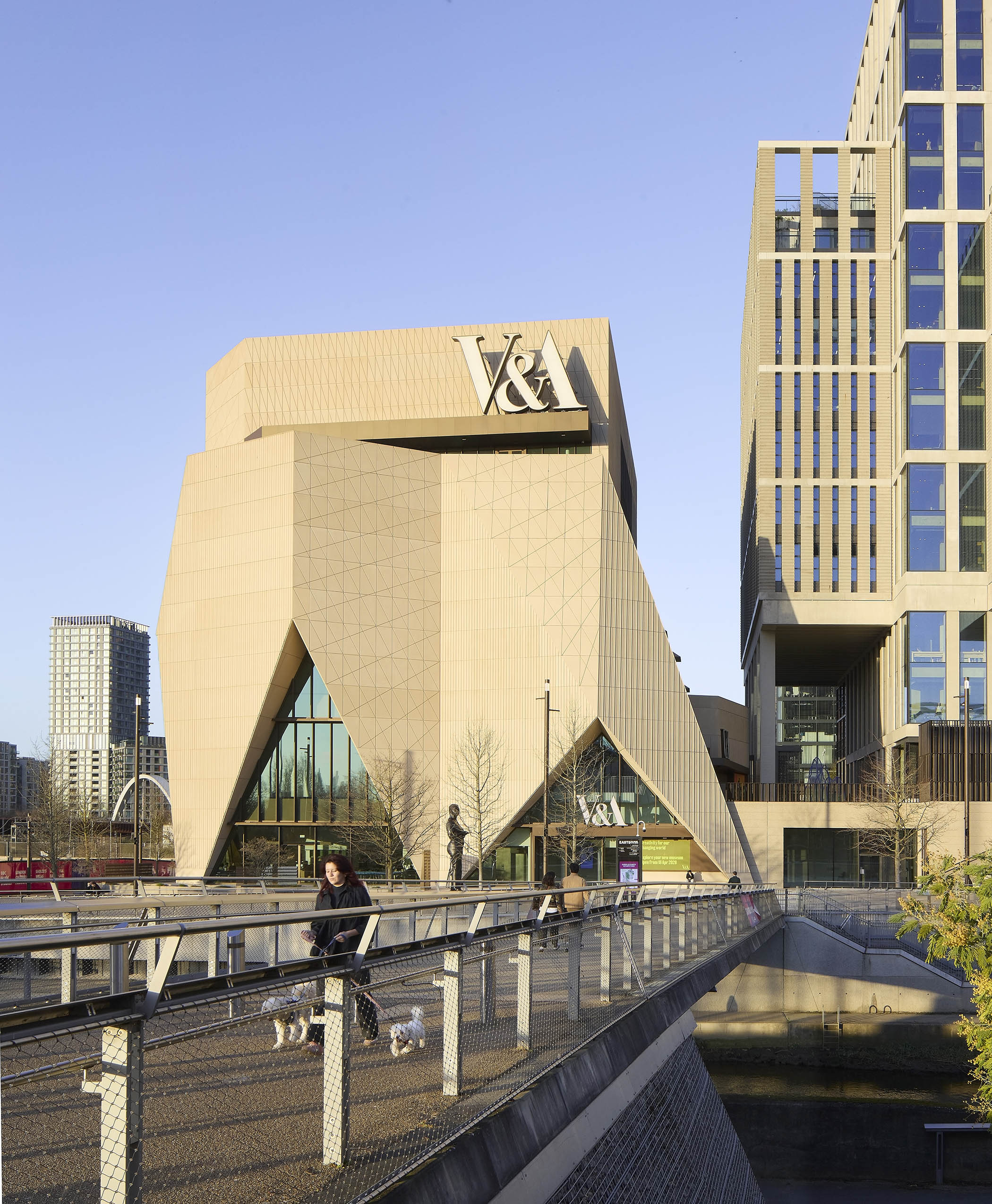
‘It has a restless, animated quality, like a creature from a vintage video game’: the newly opened V&A East Museum
The £135m museum stands at the end of a parade of palaces of culture – there are also outposts of Sadler’s Wells, the BBC and the London College of Fashion, with one of University College London a little farther away – that add up to the mayor of London’s £1.1bn endeavour to create a “cultural quarter” that would last long after the flags and fireworks of the Olympics were gone. Also in the neighbourhood is the V&A Storehouse, which opened last year, where the museum both keeps and displays the vast quantity of objects that aren’t on display in its other buildings.
The aim of V&A East Museum is to show exhibits that fall under the broad heading of design, just as the mothership in South Kensington does, but in a way that is more accessible to young adults who may be deterred by the pomp and flummery of old-fashioned museums. Its director, Gus Casely-Hayford, has promised it will be “unapologetically diverse”, a place to “tell our stories through the best things that humanity has ever created”. Its location in east London is taken as an opportunity to reach new audiences and to draw on the area’s histories of manufacturing and design, which continue up to the present.
Taken as a whole, V&A East Museum is rich, intriguing, sometimes delightful and not quite settled-in
Taken as a whole, V&A East Museum is rich, intriguing, sometimes delightful and not quite settled-in
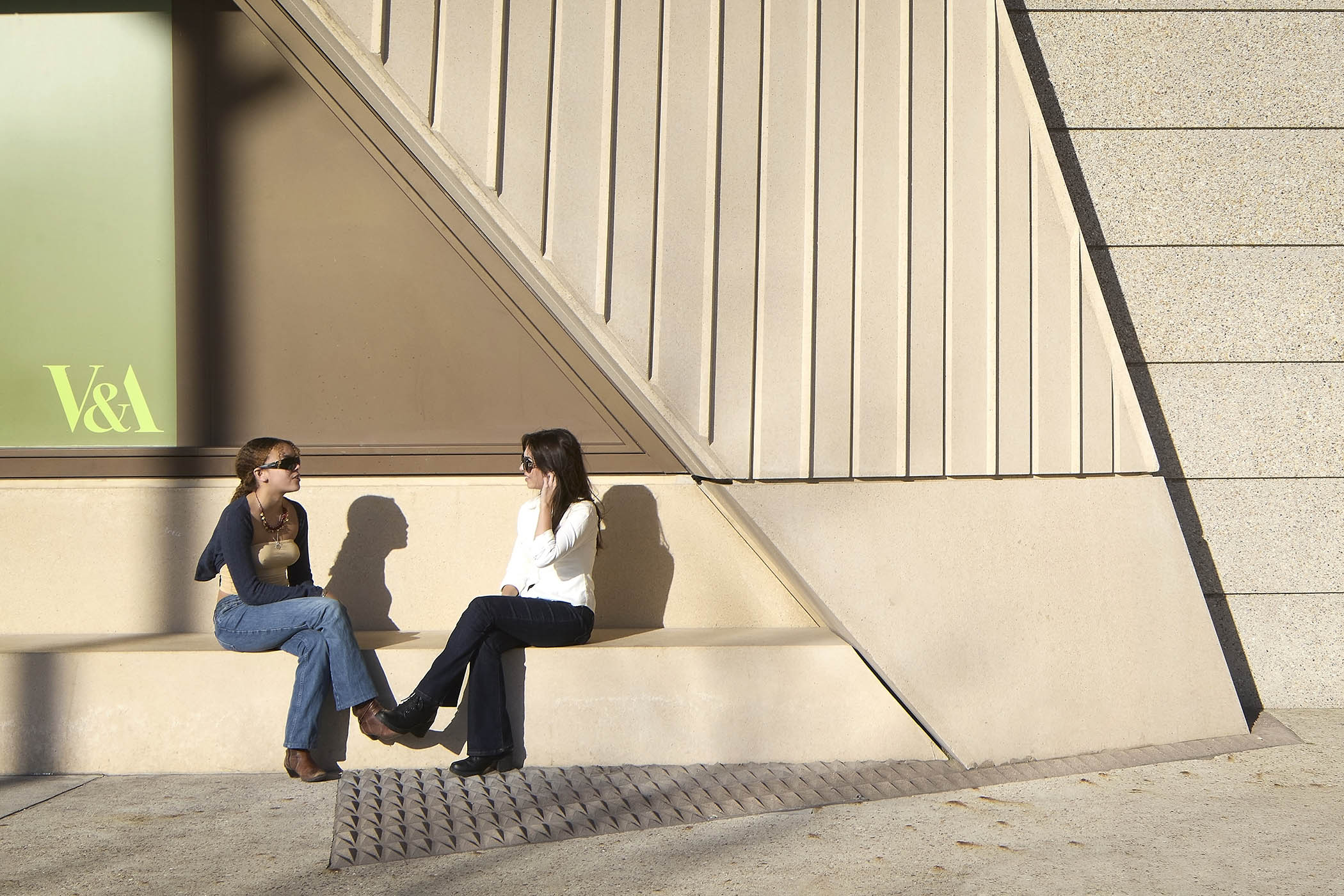
V&A East Museum is the most wrought and distinctive of the new buildings – an angular, folded work of concrete origami whose mass comes down to earth on tiptoe. Its architects, O’Donnell + Tuomey, say it’s inspired by the way a Balenciaga dress might hang from the shoulders. It has a restless, animated quality, like a creature from a vintage video game. It is, they also say, both “bold and distinctive” – a statement that here is something different and of public and cultural significance – and “welcoming, inviting and porous”. It’s the opposite of the Storehouse design, which was a conversion of part of the former Olympic media centre that is almost mute on the outside. It’s as if all the external architectural expression that didn’t go into one has been invested in other.
Sheila O’Donnell and John Tuomey, who have offices in Dublin, Cork and London, like to shape and mould spaces in close detail, and to choreograph building materials and human activity into mutually enlivening relationships. They like to get imaginatively involved with the ways buildings are built. Their other projects include the Lyric Theatre in Belfast, the Saw Swee Hock student centre at the London School of Economics, and Sadler’s Wells East, a dance theatre that opened last year in the same East Bank row as the new museum. All combine what might be called a sober palette – brick, timber, concrete – with some licence and adventure in the shapes. They are personalities.
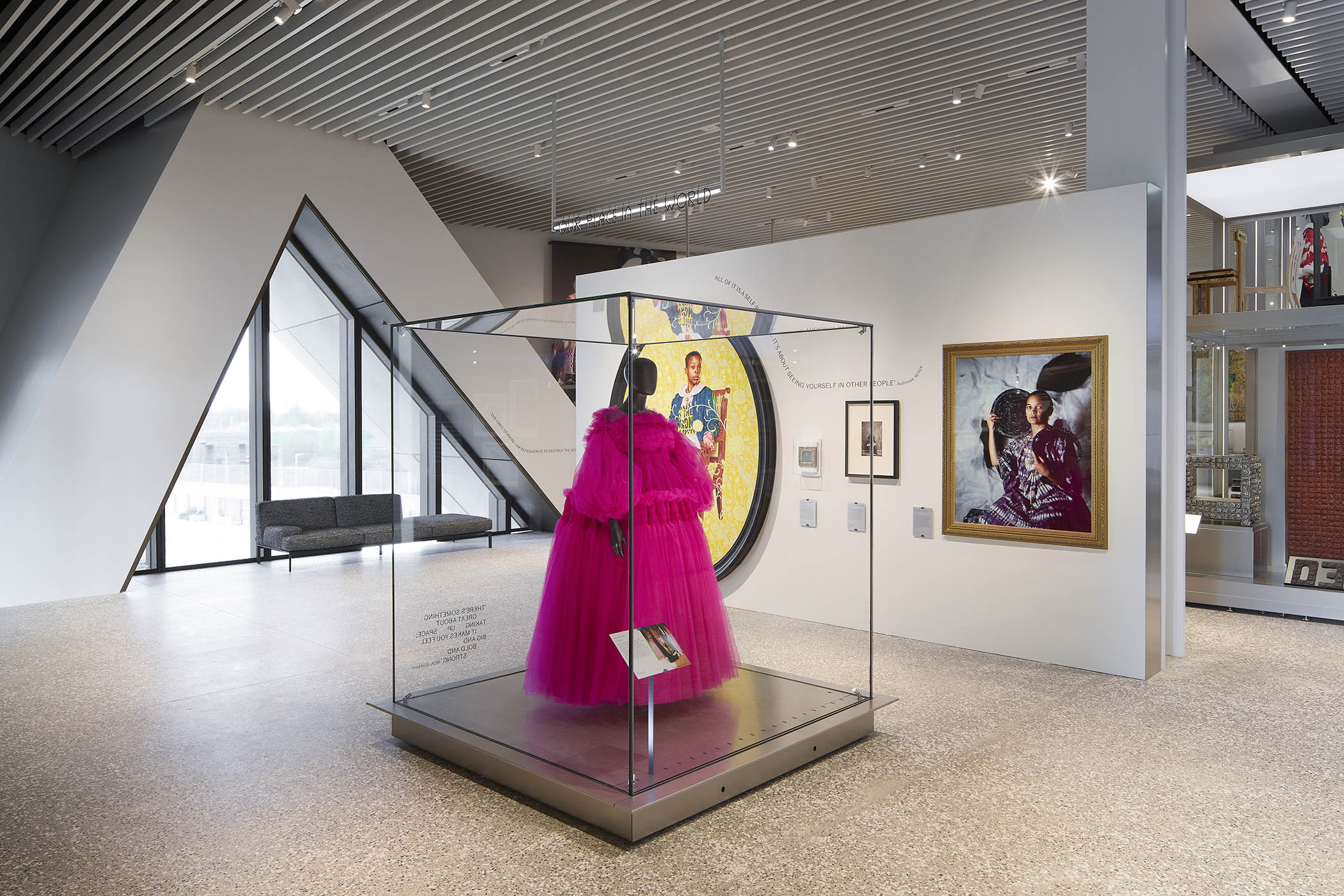
V&A East Museum’s permanent collection includes the Daria dress (2019) designed by Molly Goddard and worn by Jodie Comer in Killing Eve
The architects like a metaphor or two. Tuomey speaks of V&A East Museum as “leaning away from its neighbour to get a bit of sky around itself”. It is, as well, he suggests, like a detail in Vermeer’s Woman Writing a Letter, with her Maid, in the National Gallery of Ireland, in which there’s a space of contrast between “form and figure” – that is to say, between a thick, rolled-up sleeve and the woman’s writing forearm. By this, Tuomey means that the new museum’s external walls (the sleeve) are loosely wrapped around a vertical stack of exhibition galleries (the arm). Generous stairs and foyers inhabit the capacious volume between the two.
The “sleeve” is a work of craft and difficulty. It is made of sand-coloured precast concrete panels, fabricated by Techrete of County Dublin, that bend around the building’s complex shape. Their surface is marked with a network of fine lines and with thin ridges and furrows, creating a three-dimensional puzzle in which everything had to align precisely when the heavy panels were lifted into place. There are many Vs and As in the design, their angles echoing those of the letters of the museum’s logo, from big triangular openings to the lines on the panels to the profiles of the ridges and panels. The exterior gets more solid as it rises, contrary to gravity, but in line with the fact that it needs to be more open at its entry levels and more opaque around its galleries.
The building stands on a plaza next to one of the waterways that flow through the park, a plain space where public events are intended, overlooked by a 5.5 metre-high bronze of a young black woman in loose-fitting leisurewear holding a phone, both monumental and informal, by the sculptor Thomas J Price. From here you can enter through the wide bottom of one of the triangles, a cafe to your left, and start your journey up the building by lift or stair. You can also enter at first-floor level, from a broad elevated terrace that runs across East Bank. Either way, you find yourself on an upward cascade of white-walled circulation spaces, with flights and landings succeeding each other with a series of irregular angles.
Newsletters
Choose the newsletters you want to receive
View more
For information about how The Observer protects your data, read our Privacy Policy
In the permanent exhibition galleries, created by a partnership of the architects JA Projects, the artist Larry Achiampong and the graphic designers A Practice for Everyday Life, the mood shifts. These are more shadowy spaces, densely populated with a multiplicity of things from many different places: photography, agitprop, ceramics, a Japanese screen, another by the Bloomsbury group’s Omega Workshops, fashion, furniture, film and digitalia.
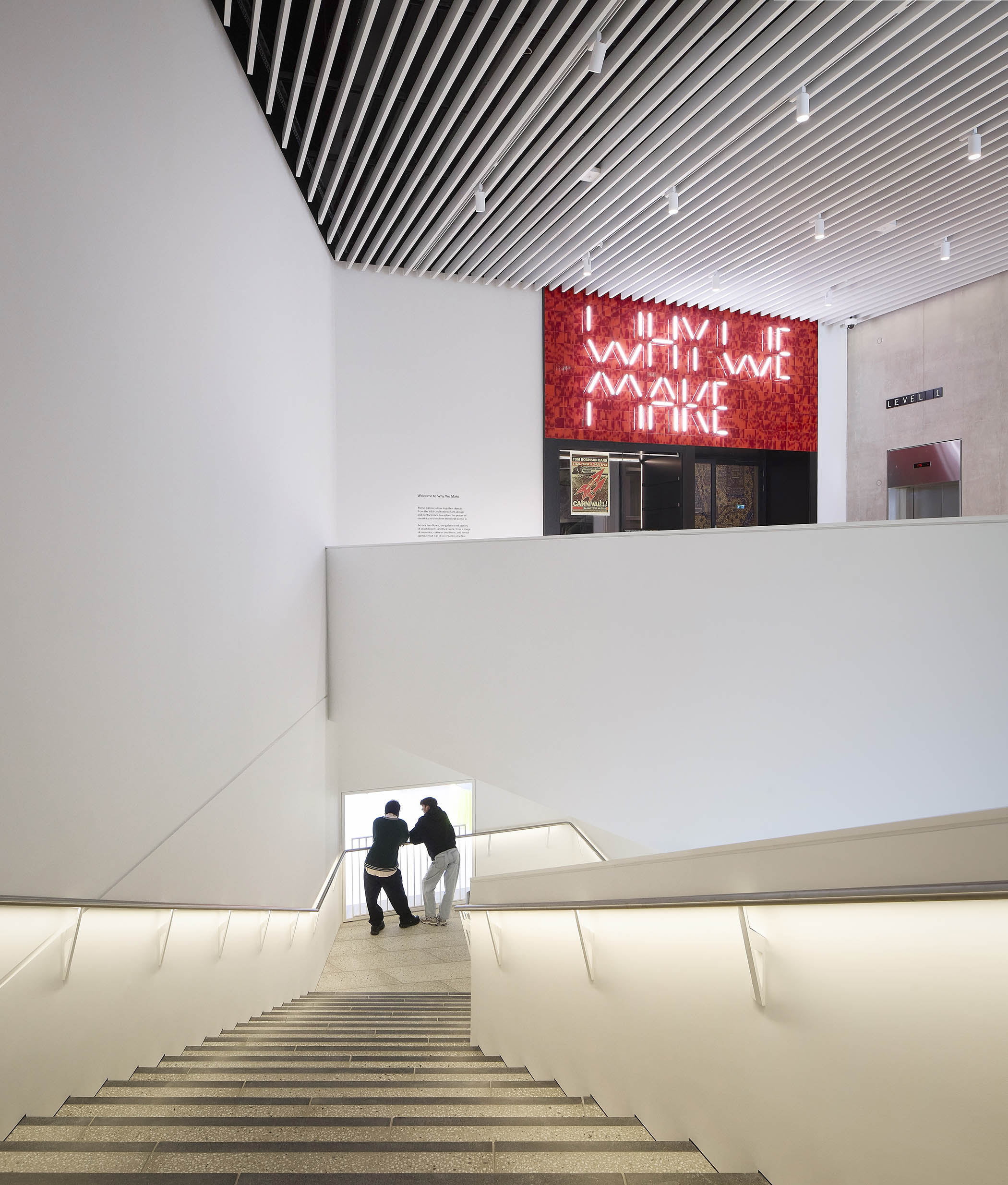
V&A East’s ‘long and wandering’ staircase
The idea here, developed in collaborations with a “youth collective” recruited from the surrounding boroughs, is to bring the spirit of east London high streets and markets into the museum. “The ambition,” says Jayden Ali of JA Projects, “is to honour the life and histories of east London – how people already make space and make stories.”
So objects are presented on tables, as they might be on a market stall, with cases sitting on top rather than built-in, and inspiration taken from the way phones are shown in shop windows, such that you can both look at and see past them. Long overhead rectangles of coloured light – abstracted versions of shop signs – help you find your way around.
These galleries are necessarily higher spec and less crowded than markets and high streets. The display cases, as conservation standards require, are sophisticated and expensive devices for controlling their internal environments. “It’s about an essence,” says Ali. “We’re not trying to make a pastiche.” The piled-up plastic crates that might prop up a table in a stall are represented by rectangular balks of fallen timber from London plane trees – chosen for the city histories they have witnessed, and still a touch rougher than normal in a national museum.
Taken as a whole, V&A East Museum is rich, intriguing, sometimes delightful and not quite settled-in. The hard edges and angles of the architecture need something else to make a place to dwell. For all the comparisons with fabrics, it doesn’t feel like something you’d want close to your body, and the contrast with the more ethereal and subtle exhibition galleries is abrupt. The journey from the precast concrete to the fuchsia tulle would benefit from some intermediate stages, which is why the curving seat – architecture you can sit on – is welcome. Fortunately, such a rapprochement is possible, and would be welcomed by the architects, by populating the stairs more richly with art and installation, as has begun to happen.
It also feels like an institution that doesn’t quite know what it is: something created to meet an opportunity rather than an organic need. In comparison with the Storehouse, whose purpose is clear, the new V&A East Museum doesn’t have an elevator pitch: it would need more a long and wandering stair, of the kind that it in fact has, in order to say what it’s about. The architecture, as can happen when a narrative is uncertain, tends to take over the story. Not that this is a problem – what, after all, would be the elevator pitch for the original Victoria and Albert Museum? – but it will need continuing creativity to make it a compelling place.
V&A East Museum is open daily, 10am-6pm, except Thursdays and Saturday, 10am-10pm
Photographs by © Hufton+Crow/V&A