Ai Weiwei does not need to look back at notes or find old news reports. Each corner and crack of the Chinese prison cell he was held in for 81 days in 2011 has stayed with him, fuelling his art and disrupting in his sleep.
“I remember every detail,” he said this weekend. “The floor and walls, the details of the sanitary system, and also those who guarded me as armed police, as well as the interrogator… For a long time afterwards, it returned to me in different forms in my nightmares.”
Now the Chinese dissident is to make those disturbing memories real again for the first time. This summer, the 68-year-old artist will spend 24 hours inside a faithful recreation of his cell, going through his private daily prison routine in front of gallery visitors in Manchester.
The unique human installation, titled Sewing a Button, will be staged at the Aviva Studios arts centre. It will mark the 15th anniversary of his secret detention by China’s security services and will be Ai’s first full-scale re-enactment of his incarceration.
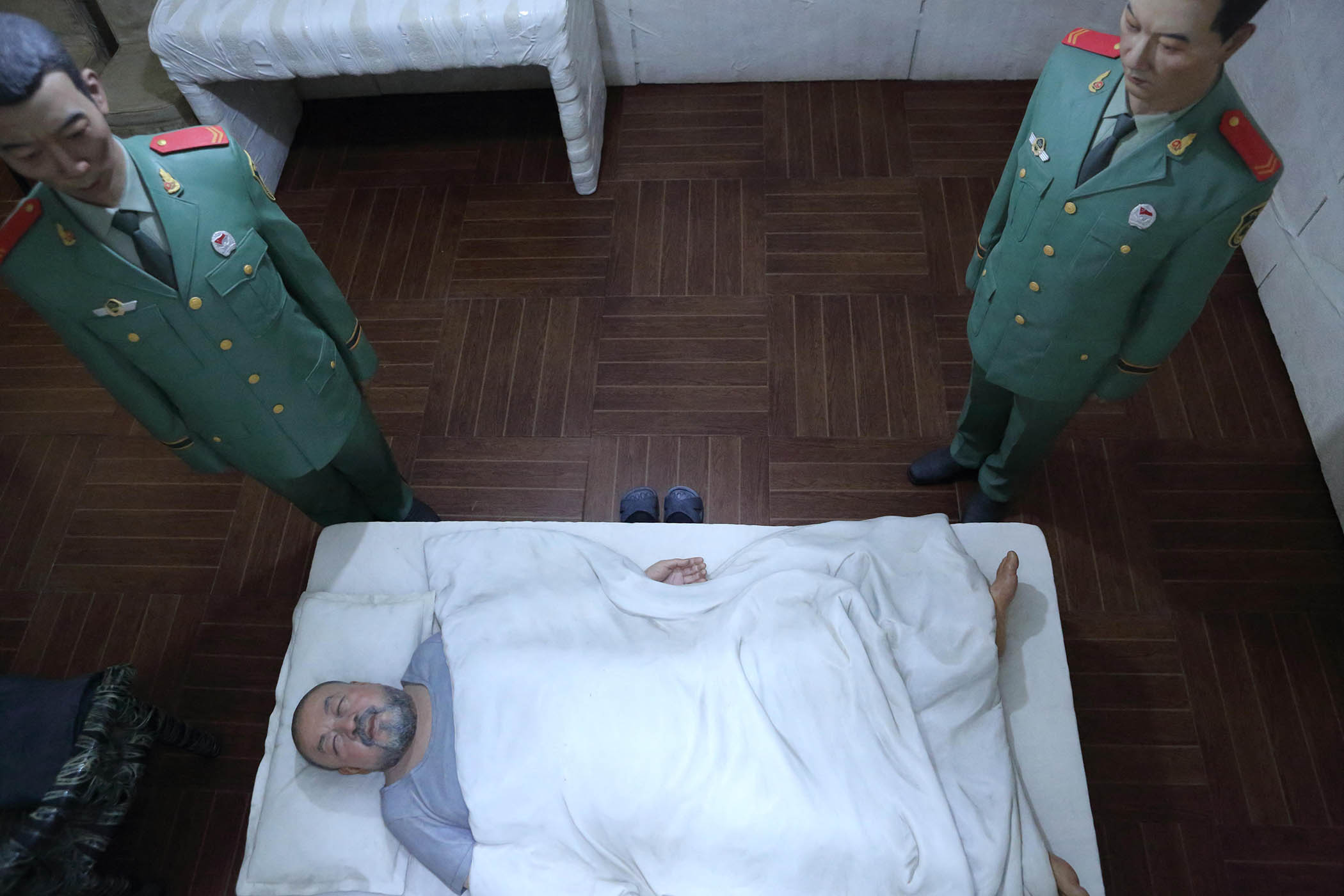
The aim is to give audiences an unfiltered insight into the oppression meted out by the Chinese state and to offer a full picture of Ai’s experience. The 7.2 metre by 3.6 metre (about 24ft by 12ft) cell will be set up in the hall of the studios, the home of the arts organisation Factory International, from 5pm on 3 July, when audiences can witness the artist’s solitary existence across a single night and day, booking two-hour slots.
‘I remember every detail. For a long time it returned to me in different forms in my nightmares’
‘I remember every detail. For a long time it returned to me in different forms in my nightmares’
Ai will sleep, eat, exercise, write, wash and be interrogated (by actors) in the cell. Gallerygoers will also be able to watch him, as his guards did, via CCTV camera. Sequences of these recordings will be shown in screens around the venue and online.
Ai, who now lives in Portugal, has combined campaigning activism with art since his student days, helping to mount a Shanghai exhibition in 2000 called Fuck Off. (The Chinese subtitle was Ways to Not Cooperate.) Over the following decade, his criticism of the state intensified via blogpostings. In response, his internet access was interrupted, his email and bank accounts hacked and his studio complex destroyed. Before his detention, an incident of police violence also led to internal bleeding and emergency brain surgery.
The look of Ai’s cell, previously recreated in a series of six smaller-scale dioramas at the 2013 Venice Biennale, has now been accurately reproduced to scale for the Manchester exhibition. But the horror of his real prison life was its sinister uncertainty.
“It was difficult to know how many different cells there were, because I was kept in a separate room throughout the detention,” he said. “I did not know whether there were other people inside the building. Only when I spoke in secret with members of the armed police, military officers and guards did I come to know that the place where I was detained had held several important prisoners, who were formally placed under criminal detention and eventually sentenced, for both financial crimes and political crimes.”
The physical privations were tough and his movements rigidly regimented. “My life in detention was extremely harsh,” Ai said. “When you are under high-pressure military control and deprived of all autonomy, every action – standing up, sitting down, going to the toilet, or sleeping – is strictly regulated in a military manner and tightly controlled according to fixed times of the day.”
Newsletters
Choose the newsletters you want to receive
View more
For information about how The Observer protects your data, read our Privacy Policy
It was this imposed regime that was most damaging. “The complete mechanisation of a human being is profoundly unnatural – an anti-natural measure that inevitably leaves a deep psychological and mental impact.” The Chinese authorities later described his detention as “residential surveillance”. But this was untrue, because Ai had no contact with the outside world.
He is perhaps best known for filling Tate Modern’s Turbine Hall with porcelain sunflower seeds, but he has created a string of works criticising the Chinese state, including his large 2020 screen display in Piccadilly Circus on the high death toll of the Sichuan earthquake. His investigation revealed that many students died because of poor school construction. In the same year, he spoke out about the denial of human rights to the Uyghur people in the Xinjiang region.
Asked if he will find reliving his captivity in the Manchester exhibit challenging, Ai said: “I do not think so. If this kind of secret detention were to occur again, I believe I am now very familiar with the kind of psychological pressure my jailers wished to impose on me. That sense of oppression comes from the uncertainty of what lies ahead – you do not know when you will be attacked, nor how intense that attack will be.
“Today, however, I am familiar with this whole language and system. I also know that, in truth, my life and my thinking are impeccable, and therefore I will not feel uneasy.”
But he is unsure how visitors will be affected. “As an artist, placing my behaviour on display before an audience carries a very different meaning. It is a re-enactment, which is not completely identical to reality. What the audience sees is not something I, as a performer, can predict,” he said.
During his original imprisonment, the artist was unaware of calls for his release across the world. “The harshest part of detention is the feeling you have fallen into a black hole in which humanity, humankind’s value system and public life disappear completely. At such a time, doubt arises.”
Astonishingly, he now believes his ordeal and his efforts to oppose Chinese repression have helped him both as a person and an artist: “Being subjected to a forced or aggressive power is, in fact, one of the clearest ways to rediscover oneself. Such authoritarian power seeks, in its own way, to diminish or erase an individual’s autonomy and self-awareness. If self-awareness can continue to exist, then autocracy, regardless of what kind of power it employs, cannot destroy a person’s will, which can be remarkably strong.”
His live appearance will mark the opening of a large exhibition, Ai Weiwei: Button Up!, at the Aviva Studios from 2 July to 6 September.