If you thought merchandise inspired by Frida Kahlo had reached its peak in 2018 with a controversial “Frida” Barbie doll, complete with floral headpiece and braided hair, think again.
When a major Tate Modern exhibition devoted to the Mexican artist and her circle opens its doors next month, visitors to the London gallery will be able to order food inspired by Kahlo’s life and buy dinner plates bearing her imagery.
It is all part of a Kahlo carnival of culture and commerce pitching its tents on both sides of the Atlantic this summer, bringing with it a Netflix documentary, a range of clothing and an opera that premieres this month in New York.
Over the last two decades, Kahlo, who died in 1954 at the age of 47, has become a mainstream brand, despite the challenging and sometimes gory nature of her work. Tate’s website warns: “This exhibition contains images of dead bodies, and references to sexual violence and miscarriage.” In Houston, Texas, where a version of the same exhibition is running at the Museum of Fine Art, printed signs impose a parental guidance rating and alert gallery-goers to “nudity, violence, smoking, and sensuality”.
This weekend an opera based on the artist’s married life is in rehearsal at New York’s Metropolitan Opera, while a lavish film version of the Tate show is primed and ready for cinematic release in Britain. The bookshelves of Tate Modern’s shop will also display copies of a new whodunnit, written by Mexican-born author Oscar de Muriel and published on the first day of the exhibition.
The successful crime writer has taken the true story behind one of the artist’s most famous works, The Suicide of Dorothy Hale, and re-imagined Kahlo as the sleuth who sets out to uncover a hidden crime. “It was both a challenge and a privilege to find a little nugget of her life that fed a world-encompassing mystery plot," de Muriel told The Observer.
“Frida Kahlo is a self-built icon, not just from her striking, unmistakable looks. She reconstructed herself from ashes and created a universal beacon of strength, honesty and survival.”
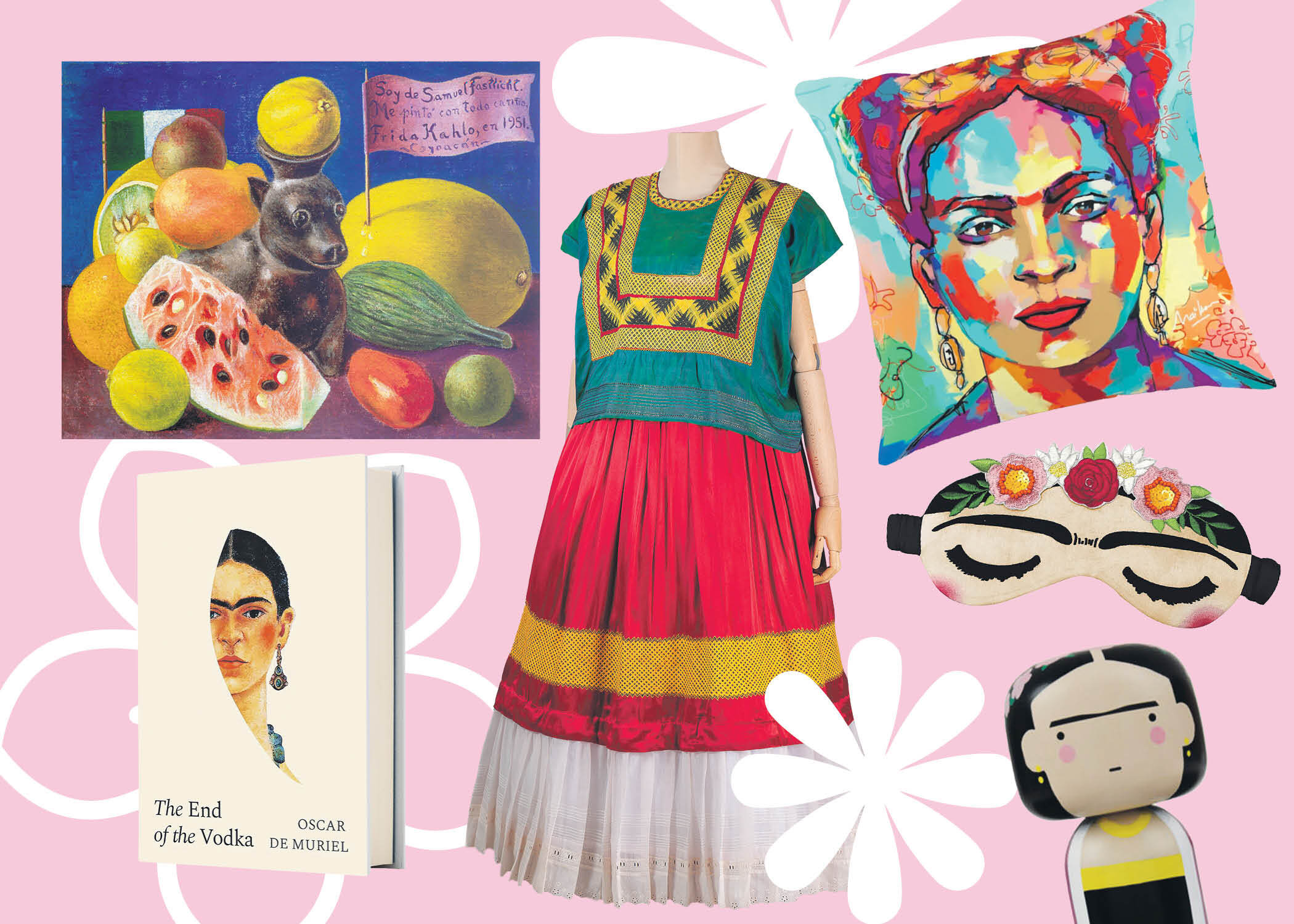
De Muriel's book will join the array of Kahlo-related merchandise already widely available on the internet – including cushions, socks, bags, dolls and an eye mask featuring her famous mono-brow. Tate’s shop buyers are hoping to compete with specially-commissioned jewellery, a new homeware range and handmade decorations imported from Mexico. When the gallery staged its last Kahlo retrospective in 2005, it made £737,000 in the gift shop.
‘Tate’s official position is that embracing a degree of spin-off fun is fine’
‘Tate’s official position is that embracing a degree of spin-off fun is fine’
Earlier this year a few of Kahlo’s relatives complained that her creative heritage risks tipping into bland commercial exploitation. Those who really want to praise Kahlo, not to bury her in tat, they argued, must tread carefully.
Tate’s official position is that embracing a degree of spin-off fun is fine because the artist herself was fascinated by these kinds of “kitsch ephemera”. The key thing, a gallery spokesperson emphasised, is to be “respectful of Frida Kahlo’s incredible artwork and legacy”.
Newsletters
Choose the newsletters you want to receive
View more
For information about how The Observer protects your data, read our Privacy Policy
After all, the Tate exhibition itself, Frida: The Making of an Icon, explicitly plans to look at “Fridamania” and her “transformation into a global brand”. More than 200 souvenir objects and knick-knacks will be on display inside the galleries, as well as in the shop. In the Tate Modern restaurant, a culinary collaboration between the gallery and the acclaimed Mexican chef Santiago Lastra will draw “on the bold flavours and cultural heritage of Mexico, reimagined through British seasonal produce, the menu reflects themes central to Frida Kahlo’s life and work” will be served from 25 June to 31 August.
The high-street trade in Kahlo design motifs has grown alongside a leap in the financial value of her work. Last November her painting El sueño (La cama) - The Dream (The Bed) - became the most expensive work by a woman ever sold at auction when it went for $54.7m (£41.8m) at Sotheby’s in New York. Crucial to the boost to her reputation were Hayden Herrera’s 1983 book, Frida: A Biography of Frida Kahlo, and the interest of Madonna, who began to collect her work in the 1990s.
The upcoming Netflix documentary series, described as the chronicle of “a bomb wrapped in silk”, will focus on “the passionate and turbulent lives” of Kahlo and her painter husband, Diego Rivera, “revealing how their relationship became an engine, a battlefield and a public spectacle”.
At the Met Opera in Manhattan, the curtain goes up on a production of El Último Sueño de Frida y Diego (Frida and Diego: The Last Dream), composed by Gabriela Lena Frank with a libretto by Nilo Cruz, on May 14.
Unusually, just a few blocks downtown, The Museum of Modern Art, will present a complimentary show, featuring artworks by both Kahlo and Rivera in a setting created by the opera and set’s designer, Jon Bausor.
Copyright for Kahlo’s artwork lapsed in the UK in 1975, 20 years after her death - when she was alive, that was the length of copyright in Mexico. Since 2004 the Frida Kahlo Corporation has held registered trademarks in the UK and many in the US. The corporation was set up by some of the artist’s relatives in association with a Venezuelan businessman Carlos Dorado. But it took a step too far in 2018, and not just for other members of the Kahlo family, with the production of the Frida Kahlo Barbie, in an infamous collaboration with Mattel.
However, Kahlo’s biographer Herrera suspects the late artist would not mind all the associated products now being sold, and might even have been amused. “A lot of her life was about getting attention,” she has said. “She would have probably used the word “cursi”, which is a Spanish word for corny.”
Illustration by Observer Design / The Tate Museum