

There is very little 5G in Hampstead and limited phone signal, so rarefied and ye olde is it here, which means that as I weave my way through its sometimes-cobbled streets I don’t call Nicole Farhi to remind her I’m coming, and when I arrive (crossing a vast chequerboard-tiled foyer that smelled of lilies) she has completely forgotten our appointment. Still, she welcomes me to join her and a neighbour by the art deco bar, where she presses coffee from a silver machine and lays out plates of biscuits and – at breakfast time – a box of truffles. The bar was driven here by its original owner, when a coffee shop Farhi used to frequent in France shut down. The room has the feeling of an artist’s salon. It is where Farhi, wearing a moth-holed sweatshirt and a pair of maroon socks as wrist-warmers, is talking about love.
The first time Farhi met her husband, the playwright David Hare, she had recently ended a long-term relationship with her business partner (and the father of her daughter), and was designing costumes for Hare’s new play. When they saw each other at the opening dinner it was love, she said – she felt it immediately. (Her invitation to that dinner is framed in the downstairs loo.) Hare soon moved into this Hampstead home, where Farhi was mid-pivot from a successful fashion designer to sculptor, under the mentorship of the Scottish artist Sir Eduardo Paolozzi. At their wedding, in 1992, Paolozzi gave her away.
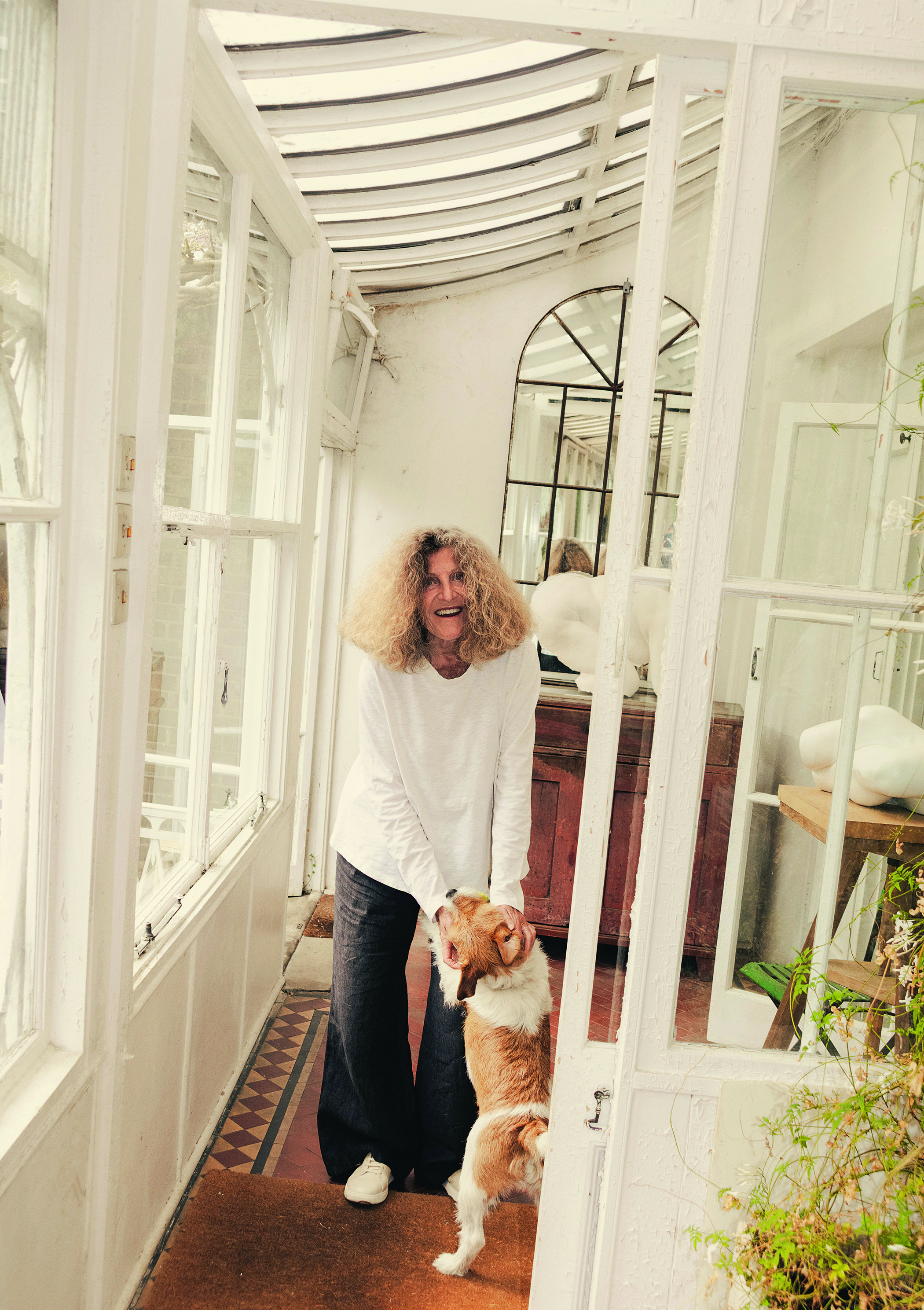
‘Everywhere I look I see the memory of the moment I met somebody’: Nicole Farhi with her dog
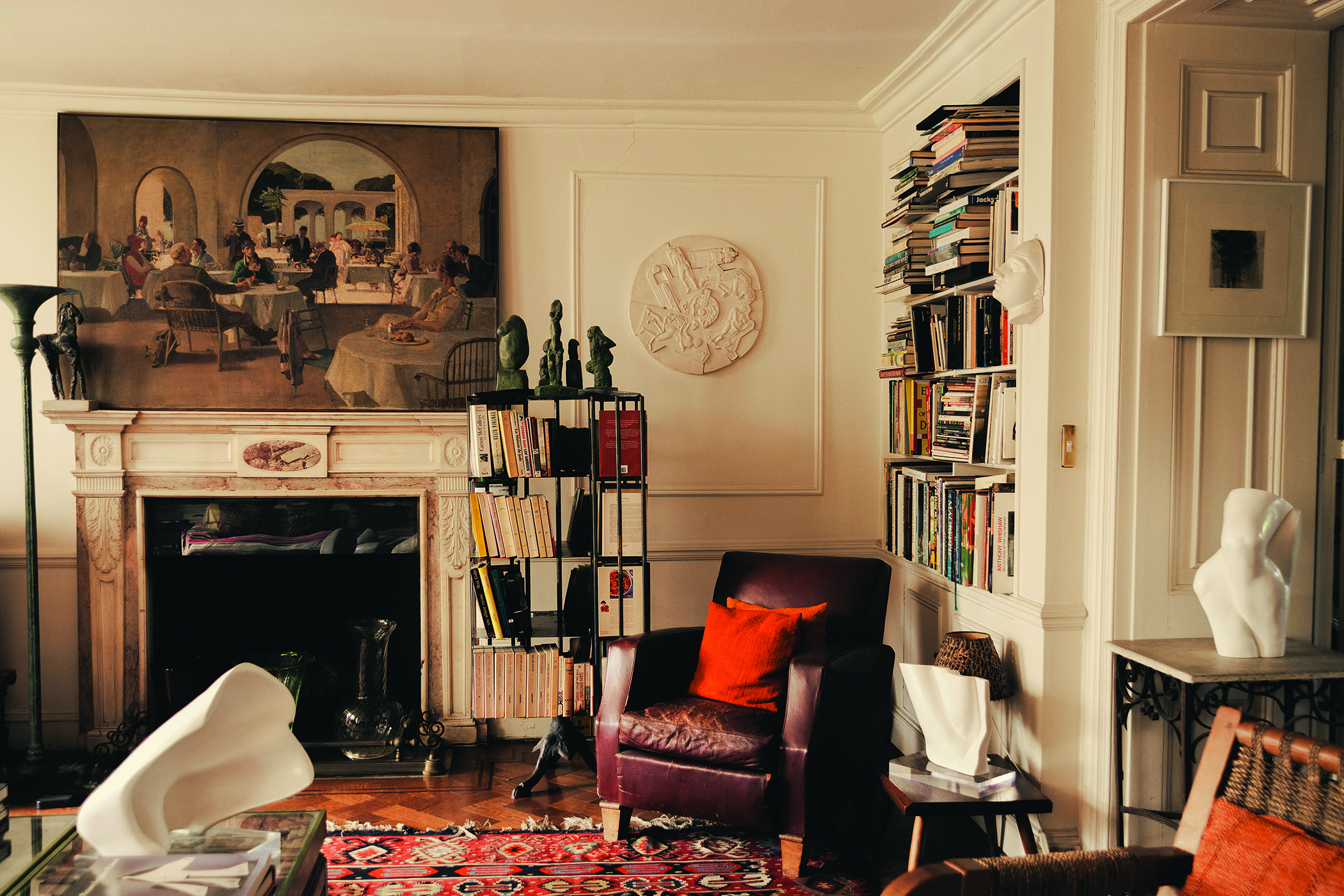
The light sweeps milkily through the house, falling on walls crammed with Paolozzi’s work and shelves heaving with books. Running alongside the garden is a former orangery that is now Farhi’s studio; after her neighbour says goodbye, Farhi walks ahead of me and removes white sheets from each sculpture with minimal theatricality. “Here is the first work I was doing, which was about the beauty of the flesh,” she says, in an accent that still contains deep imprints of Nice, where she was born 79 years ago. “It was when I was coming out from fashion, where everything I was doing was about being slim and well-dressed. Well, actually, here I undress them. And I show how beautiful a big body is too.” These pieces, cast in jesmonite, are pearly white and pendulous. On a shelf, the breast of Sue Tilley (originally famous as Lucian Freud’s model) sits beside a smoothly rounded arse, and by the window, goose pimples are visible on a torso’s cast skin. While the bodies are headless, life-sized, white, on the shelves sit first a series of small busts, victims of miscarriages of justice, and then a collection of children based on images she’d seen of young people in Gaza. “I wanted to crystallise them so we never forget,” she says. “I want to stop time with those sculptures. To say: this exists. We have to look at it.”
Inside, the living room moves into the bar, which opens on to the foyer, where a grand sweeping staircase displays Hare’s photos and ephemera, along with a large model of their wedding ring – a pair of dancing hares. “Everywhere I look gives me back a memory of the moment I made the sculpture or the moment I met somebody,” she says, pointing at a Giacometti drawing, then a late friend’s painting, then a poster from one of her recent exhibitions. In Farhi’s office a vast display of tiny heads squints out to the garden across her artful clutter, and in Hare’s study one of her tiny busts of Hannah Arendt perches on a pile of books. Their bedroom is down a Paolozzi-lined hallway. “It’s a very awe-inspiring room,” Farhi says as we enter. “It’s calming.” A large, low bed sits beneath an abstract bronze bust, between wood-panelled walls that look like oxidised metal. “I had the walls stripped and discovered these colours underneath layers and layers and layers of white then pink paint. When we uncovered a little bit I said, ‘Stop! Don’t go further!’ It’s like what you get from bronzes when they stay outside for a long time.” She and Hare sleep well here, she says.
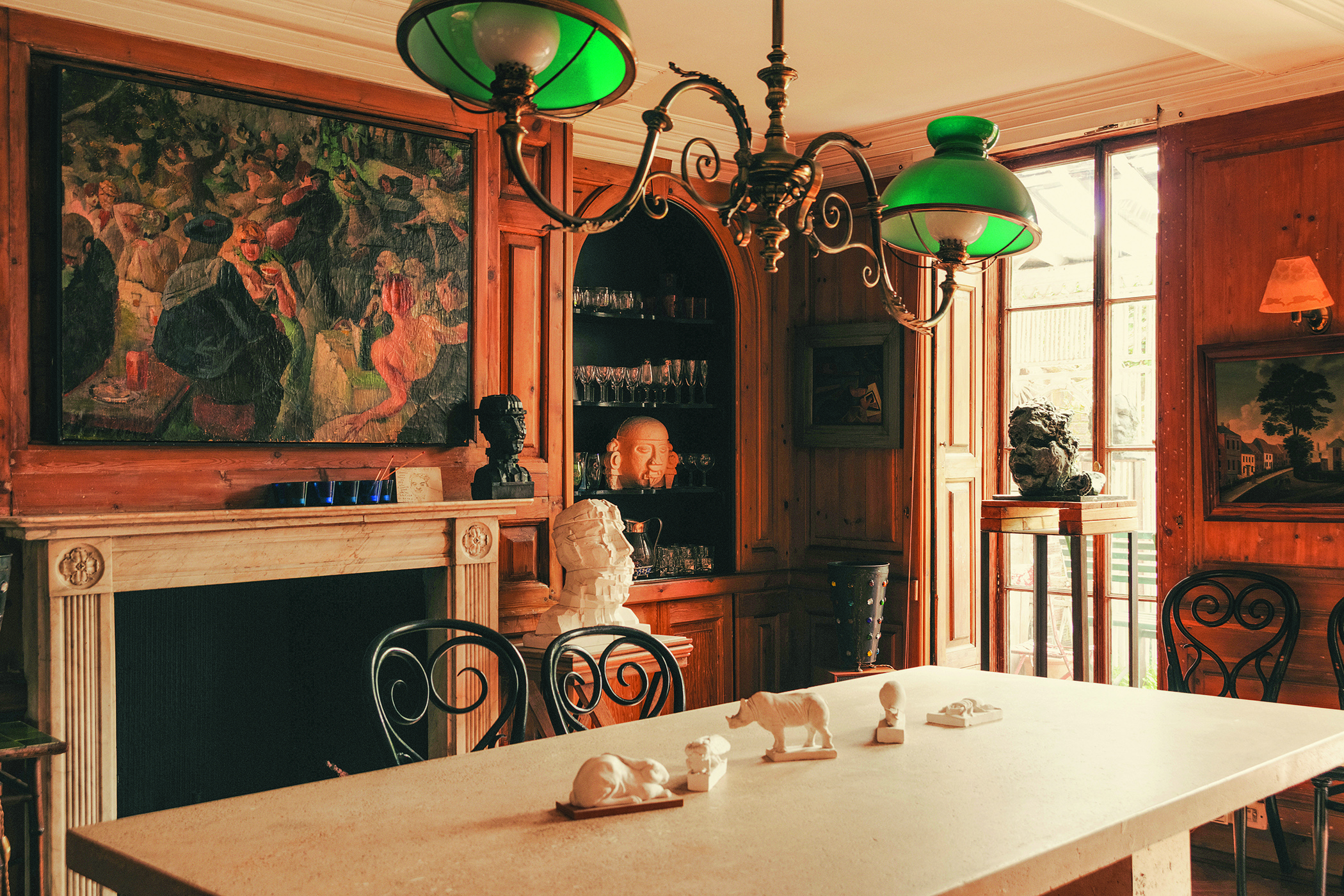
Tablew talk: in the dining room the centrepieces are sculptures by Farhi’s friend and mentor, Sir Eduardo Paolozzi
Recently, the clothes Farhi designed in the 80s and 90s have found new young fans who buy the crisp shirts and relaxed trousers on resale sites. Farhi is pleased to learn this but unsurprised. “I wasn’t trying to make costumes,” she says as we meander through the house. “I was making clothes for women and men to wear and enjoy. And they were not very complicated. They were simple because I was dressing myself and David – people like us who go to work.” Propped beside another sculpture, a large empty bowl containing the last sips of her morning Nescafé waits to be returned downstairs.
Down there, among yellow walls in a stainless steel kitchen, their two-year-old dog leaps many metres into the air with wild excitement – he is so wild that he is gently ushered into the garden to find a ball. The dining room is another shrine to Paolozzi: instead of flowers, Farhi decorates thetable with some of the sculptures he brought to dinneras a gift in lieu of wine. “He was prolific,”sheremembers. “He lived in his studio – he had his bed upstairs. And every night he would putout something to excite his mind so when hewoke up, he would look at it and it would inspirehim. Also, he never finished a piece of work in theevening – he’d want to go back to it in the morning.I don’t give advice to anybody. But if somebody asks, I say: never finish something at night.”
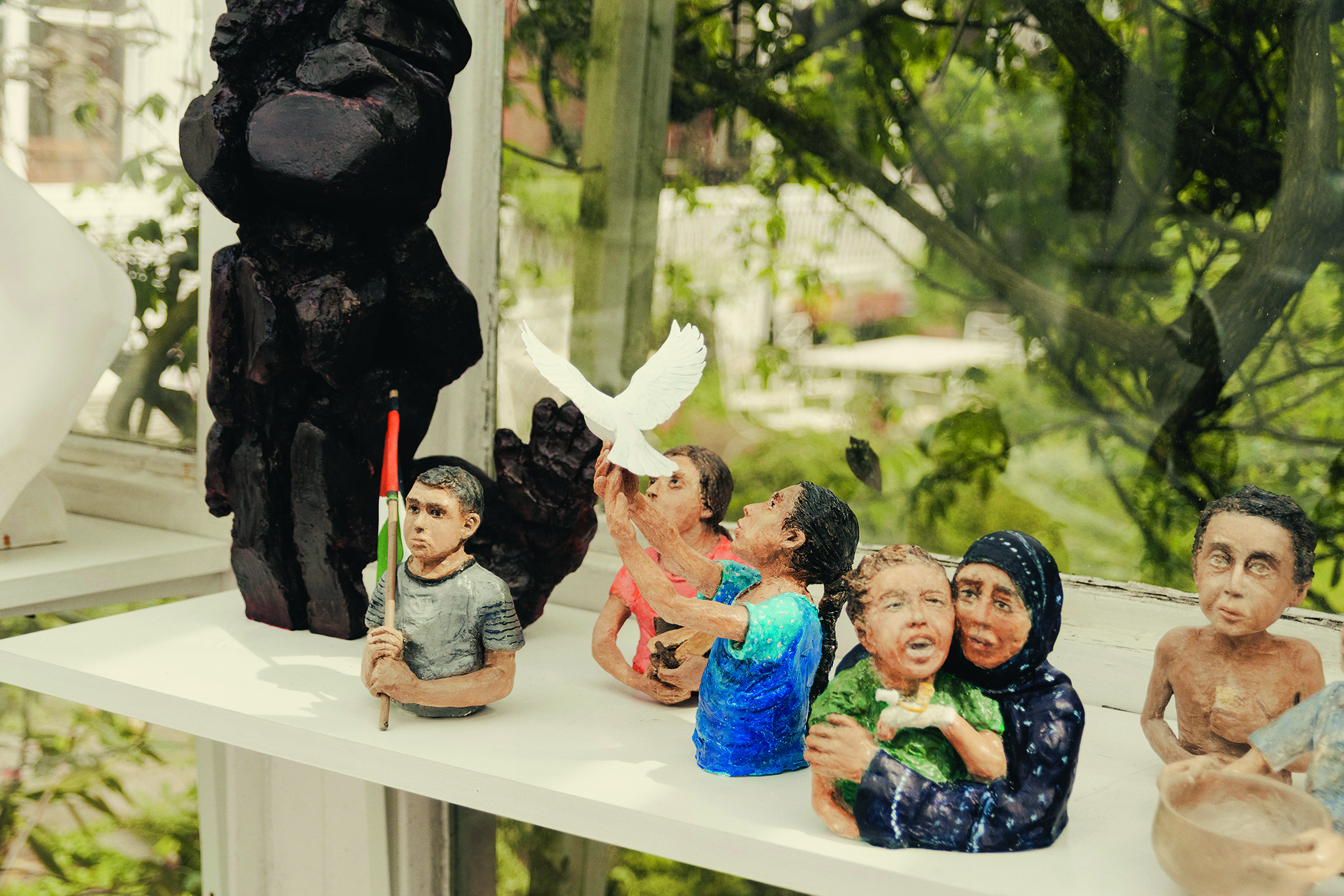
Pieces for peace: Farhi’s hand-painted busts of children in Gaza
We sit on the deep cushion-covered sofas in the living room, where Picasso books are piled on an olive green coffee table, and we quietly enjoy the comfort and the light. “This house is my dream, you know,” she admits – these days she rarely leaves, padding happily from bar to studio, occasionally adjusting the angle of a sculpture or replacing a book. “I don’t like homes that have been designed by somebody else. Because, how do they know who you are? It’s sterile! If something talks to you it doesn’t matter if people say, ‘Ugh, those chairs, they don’t go with the rug,’ right?” She doesn’t like to give advice, but what about if someone asks for Farhi’s interior design tips? “Who cares what anyone else thinks about your house?” she says. “As long as you like it.”
Newsletters
Choose the newsletters you want to receive
View more
For information about how The Observer protects your data, read our Privacy Policy