Zurbarán at the National Gallery astonishes from first to last. There has never been a show of this Spanish baroque genius in Britain before, not least because so few global museums are prepared to part for long with his electrifying saints and radiant still lifes. But in concert with the Louvre and the Art Institute of Chicago, the gallery has managed to borrow more than 40 works, from Seville to San Diego, displaying them spotlit in galleries dark as pitch, just like the very figures in the pictures themselves: a stupendous concentration of power.
Francisco de Zurbarán (1598-1664) comes between El Greco and Velázquez, who got him commissions at the royal court. He is as wild as the former, as profound as the latter, if in quite different ways. The first picture here, from 1629, imagines a saint having a vision of another saint, a double vision, in effect. Saint Peter Nolasco, a 13th-century Mercedarian, is praying obsessively to Saint Peter the Apostle, when he suddenly appears, not as some uplifting mirage but diving, head down, on his cross, teeth bared, cheeks hanging, blood rushing to his head. His eyes shine black as the nails pierced into his feet, while the Mercedarian stares, awestruck, at this plunging martyrdom. Each Peter appears in some nebulous and yet overlapping space. The time is now.
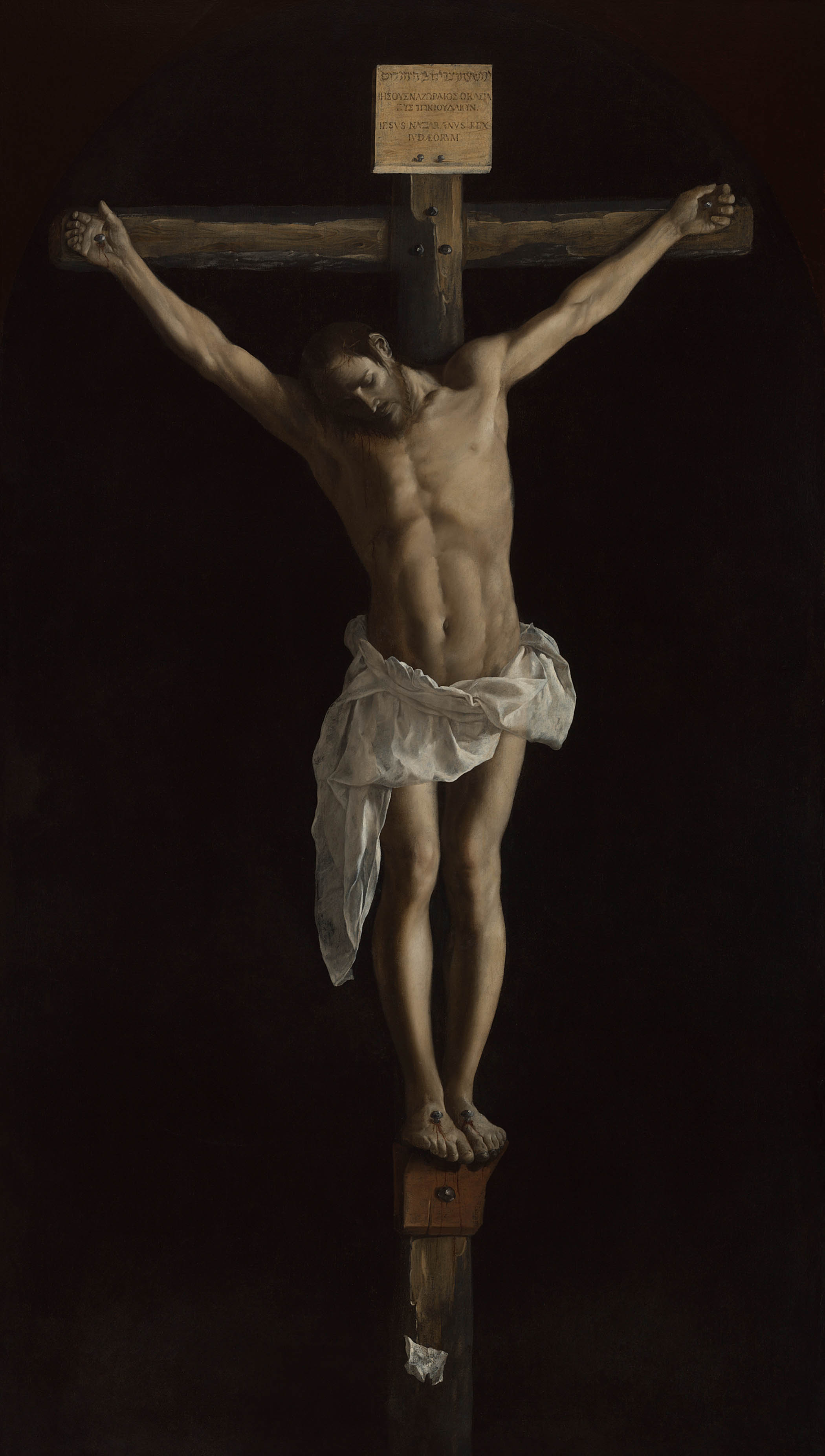
‘Hyper-real right down to the last damp tendril and pinprick of congealing blood’: left, The Crucifixion, 1627
Next to it, Zurbarán’s shattering The Crucifixion looks as though it is still hanging in the sepulchral Dominican friary for which it was made, the half-light from the actual window incorporated into the image. Christ’s crucified body emerges from the darkness, pale broken knees bent awkwardly into our space. “Everyone who sees it,” wrote one of Zurbarán’s stunned admirers, “believes it to be a sculpture.” The impulse is to reach out and touch it, even today.
Hyper-real right down to the last damp tendril and pinprick of congealing blood, its power never wavers for an instant, even up close; yet the illusion is not of life, at this early stage, so much as sculpture. Zurbarán started out as a painter of polychrome sculptures, and this sense of form and volume mobilises his art. Weeping, pointing, imploring, eyes widening, hands gesticulating, his figures inspire the same emotions – and even the same gestures – in the viewer. More than one visitor held up their hands in amazement the day I was there.
Zurbarán puts visibility before us: the look of the world, the spectacle of life. The mortals in his paintings are always depicted in the moment of seeing, beholding, witnessing, taking it all in. They look at one another as if with new eyes, every time, or they look in our direction. There is very often an eye-catcher in the foreground, holding a salver or a psalter, turning to hook us all in.
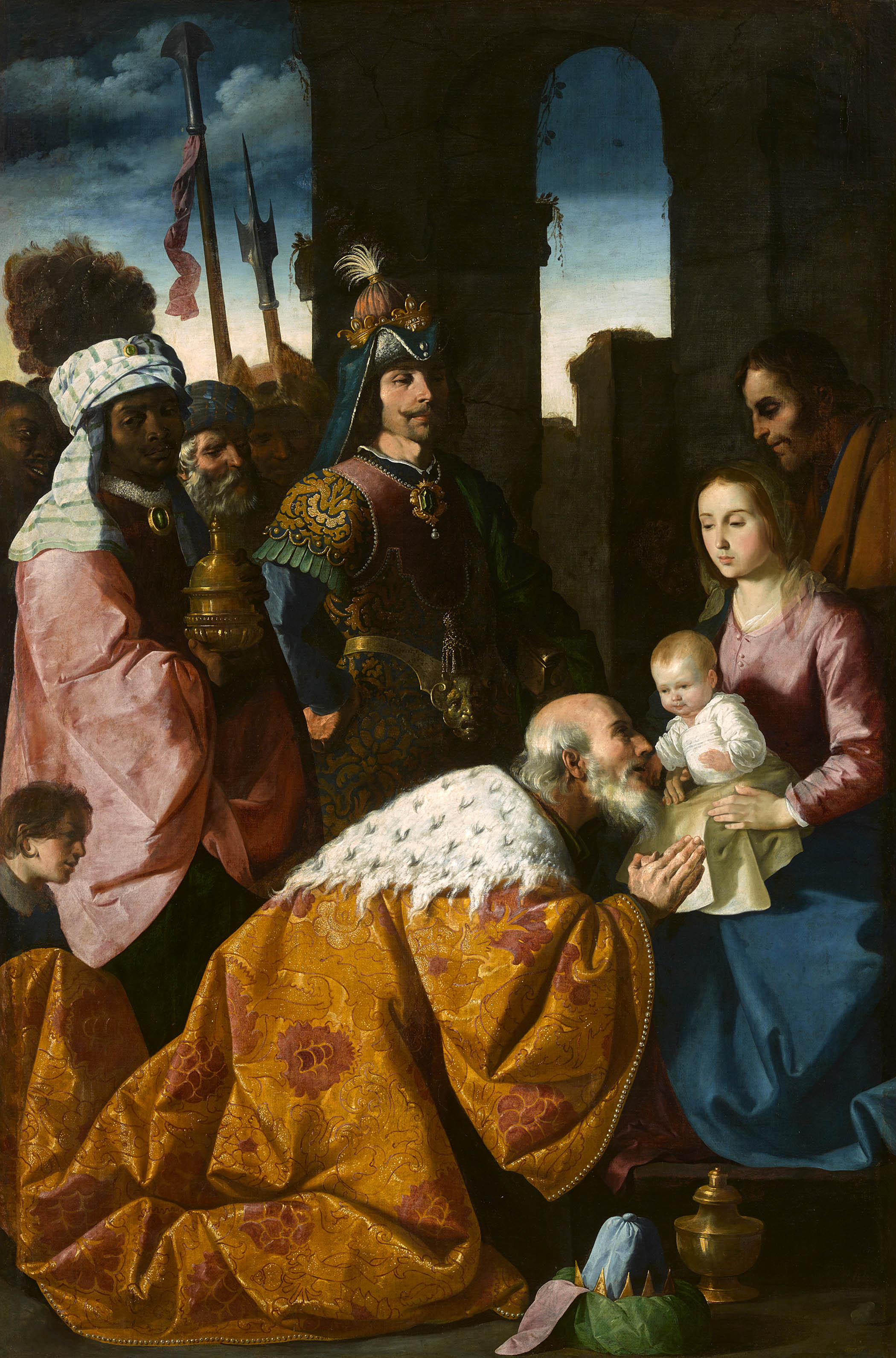
‘He paints women and children with surpassing insight’: left, Adoration of the Magi, 1638–39
His portraits of saints are like characters from a novel given their own short story, or soliloquies on a darkened stage. Each holds up an attribute – arrow, keys, wheel – along with armfuls of sumptuous period clothing, fixing you with an expression so complex it holds you on the spot. Saints were living people to Zurbarán, some of them alive in his own century. Together, they amount to an ensemble cast, making the sacred real.
Zurbarán’s Saint Francis is a lone hooded figure on his knees in utter darkness. A vision of pictorial austerity, with its paradoxical black light, the painting draws you close to the face, only to discover that the uplifted eyes are barely visible under the cowl. Francis is forcefully present, the very size of life, but his mind is elsewhere.
The same is curiously true of the baby Jesus in his Adoration of the Magi, where a dear old sage gazes tenderly up at the infant, who hasn’t yet got enough focus to return his look. Zurbarán gets the wandering and wondering eyes of a newborn so perfectly that it is no surprise to learn that he had several children of his own; he paints women and children with surpassing insight. His Virgin is a child herself, at first, her bewildered parents somehow aware that their offspring is special and clearly hearing voices. In a separate painting, many little babies’ heads gather like bubbles around the robes of the grownup Mary, reminding us that we were not only children ourselves, once, but that she is the mother of us all.
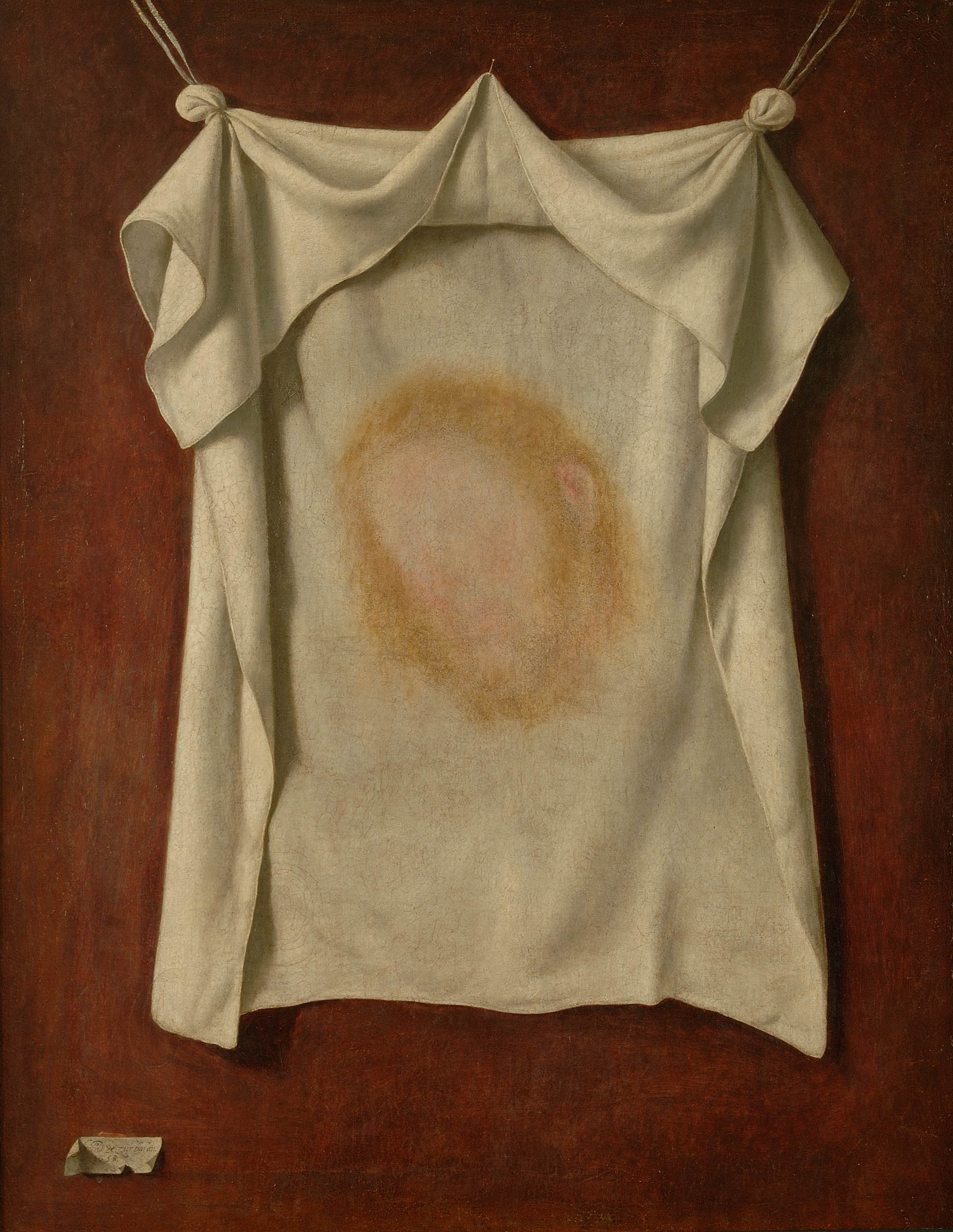
‘Zurbarán depicts a mystery so ambiguous as to be otherwise unimaginable’: Veil of Veronica, 1658, the cloth that took Christ’s miraculous imprint
Even this is not quite as wild as the lightning strike of an enormous head staring back at you down a long corridor. It beggars belief that the gigantism of modern art, from Warhol to Chuck Close to Jenny Saville, was prefigured by Zurbarán almost five centuries ago. Dark-eyed and bearded, he glowers from his two-and-a-half-metre-high canvas, equally powerful up close. This is a new attribution, but it fits: Zurbarán painting a vast picture for the grand staircase of the Buen Retiro palace in Madrid, to go with the actors and dwarves by Velázquez.
It is true that the court does not bring out the best in Zurbarán. If all we knew of him were the paintings of Hercules with a big stick, produced for Philip IV, we might not have looked at the artist again. But he slips away, back to the church that was his lifelong patron, while the court and country went slowly to the dogs.
Newsletters
Choose the newsletters you want to receive
View more
For information about how The Observer protects your data, read our Privacy Policy
Some of the great still lifes were painted for clerics, as well as rich collectors. Baskets of blazing lemons, pale china vessels – fluted, classical, long-stemmed – or pomegranates bisected to reveal their parchment-stiff divisions, all these objects are lined up along stone shelves in encroaching darkness. Anyone who loves the National Gallery’s own Zurbarán treasure – the white ceramic cup on its silver dish, garnished with a pink rose in full bloom – knows the play of water, condensation and reflecting light that makes the painting so cool and serene.
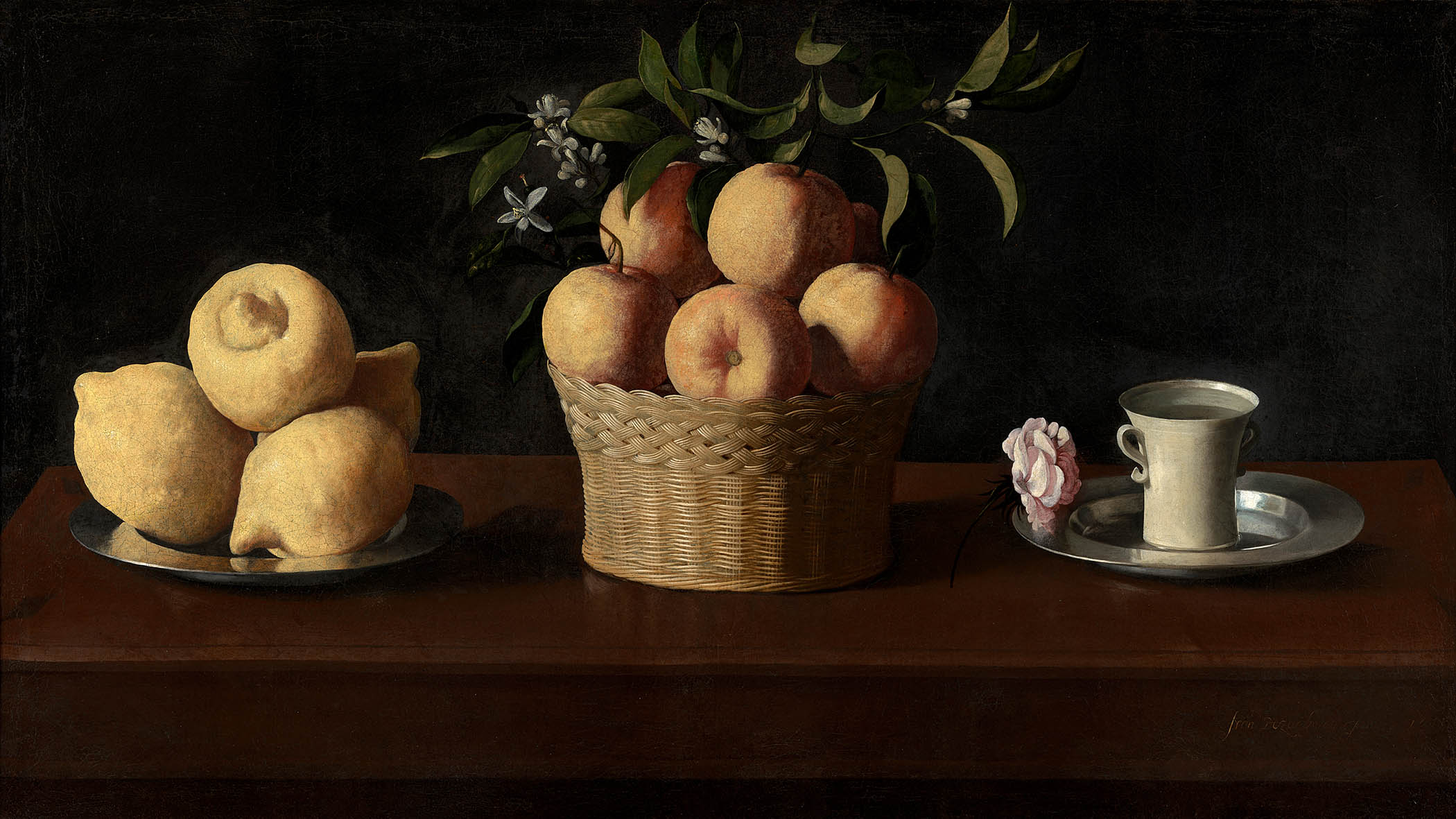
Still Life with Lemons, Oranges and a Rose, 1633
But its religious significance for the church – the thornless rose emblematic of the Virgin – is almost as surprising as the sight of this immaculate still life reappearing in a larger version, along with oranges and lemons, from the Norton Simon Museum’s collection in Pasadena. My sense is that the solo still lifes are equivalent to the solo saints: psalms condensed into sonnets.
This show is magnificently choreographed, moving from colossal altarpiece to diminutive still life, from crowded scene to loner. The lighting is subtle and concealed. There is a vision here of darkness falling upon the cross that feels so real it is as if the gallery spotlights have blown, and another of Mary watching her son prick his finger on a thorn, where the tears appear to stand wet upon her cheek.
Zurbarán’s sense of faith seems to stand outside Spanish art of this era. It goes further and deeper into what it was like, what it looked like, what it felt like, than almost any other contemporary, and always with a singular simplicity. One of the strangest paintings here, and one of the most unfamiliar – on loan from Valladolid – is Veil of Veronica. Supposedly used to wipe Christ’s face on the way to Calvary, this cloth took his miraculous imprint. But Zurbarán paints only a hazy emanation of ochre and pale pink, almost there, yet impossible to read. Which is surely as it should be: is the emanation on the cloth, within the cloth, or materialising just before it? Zurbarán depicts a mystery so ambiguous as to be otherwise unimaginable.
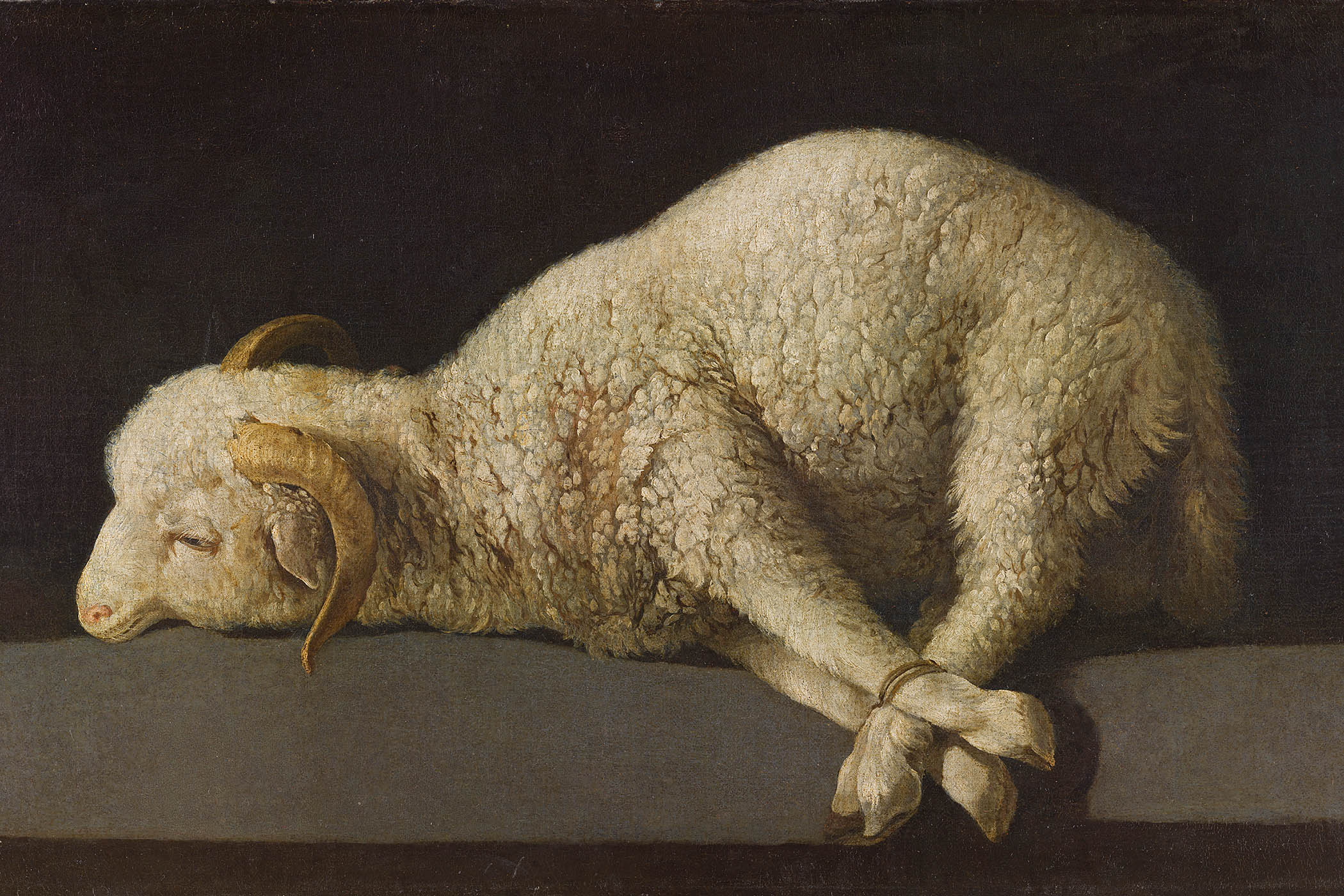
The most familiar painting, by contrast, becomes entirely new through the revelation of this show. Positioned at its climax, Zurbarán’s lamb calls upon every human heart. The soft white creature lies trussed, its hooves roped together, on a stone cold shelf in obliterating darkness. Not yet dead, it waits without any understanding of what is to come or why, fearful and innocent.
Light is God, darkness is everything else. More, even, than the great crucifixions in this show, Zurbarán makes Christ’s suffering irreducibly real in this painting: Agnus Dei, the Lamb of God.
Zurbarán is at the National Gallery, London until 23 August.
Subscribe to the Observer and join our Culture Club to enjoy 2 for 1 tickets to Zurbarán at the National Gallery. Unlock this offer and many more at observer.co.uk/culture-club
Photographs Ville de Grenoble / Musée de Grenoble – J.L. Lacroix/Museo Nacional de Escultura, Valladolid, Spain/Photographic Archive Museo Nacional del Prado/The Norton Simon Foundation/The Art Institute of Chicago