Photographs by Colin Dutton for The Observer
Midway (more or less) upon the journey of life, I find myself on a boat to San Giorgio Maggiore church. It’s Tuesday. Venice is grey and wet. Across the water, tourists disembark at San Marco and, in the widening space between us, a solitary dolphin breaches the waterline. We’re floating towards the German-Austrian painter Georg Baselitz and his show at the Fondazione Giorgio Cini. Or we were supposed to be, but Baselitz died late last month. So now we’re floating towards a prerecorded video message Baselitz made for the press preview.
The courtyard outside San Giorgio Maggiore has been filled with trees that apparently were not there yesterday. Baselitz’s paintings are large and bold and figurative. From beyond the grave, Baselitz tells us he uses gold to create space. To “show the nowhere”. His death flies low over proceedings.
In the gardens of the basilica, a small group of PRs and critics pick at plates of mortadella and anchovies. “Has anyone here pulled yet?” one of them asks. “No one’s pulled me, that’s for sure.”
It is explained that straight women find it hard to pull here because “all the men are gay”.
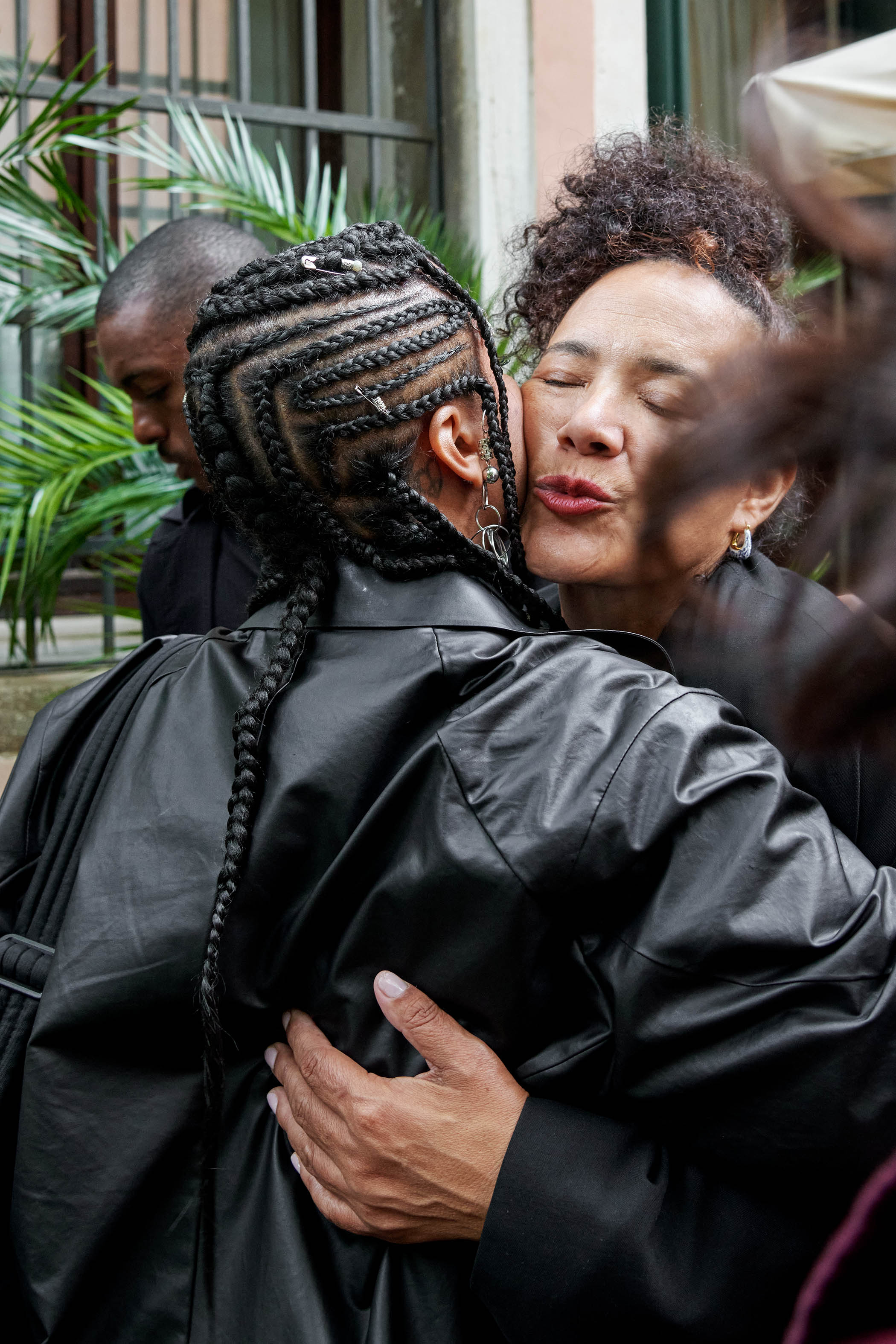
A private party at the Metropole Hotel, Venice Biennale
The theme of sex is hard to avoid at the biennale. The artist at the Danish pavilion has constructed a dystopian sperm bank; the Greeks are showing an S&M-style leather club that blares Frankie Goes to Hollywood. Performance artist Marina Abramović is doing her thing at the Gallerie dell’Accademia di Venezia.
______________________________
Death(s) in Venice.
•
Koyo Kouoh: curator of the 2026 Venice Biennale. First African woman appointed to the role. Died last year aged 57, leaving an enormous legacy and an organisational void.
•
Georg Baselitz: German-Austrian painter mentioned above. Died in April aged 88.
•
Henrike Naumann: artist selected to represent Germany. Died in February aged 41.
______________________________
In the Giardini, the controversially included Russians are having a party. Inside their pavilion, half a dozen young men dance to techno. The music sonically annexes the Japanese pavilion, where visitors can adopt a 5.5kg (12lb) ready-made baby doll and change its nappy. The Qataris are giving out disappointingly non-alcoholic apricot juice. At Florentina Holzinger’s Austrian pavilion, a naked performer scuba-dives in a tank that viewers can top up with their piss. An invigilator has warned onlookers not to poop in the tank because it upsets the mechanism. The artist’s naked body flops and dangles from an enormous bell, and swings from side to side, tolling.
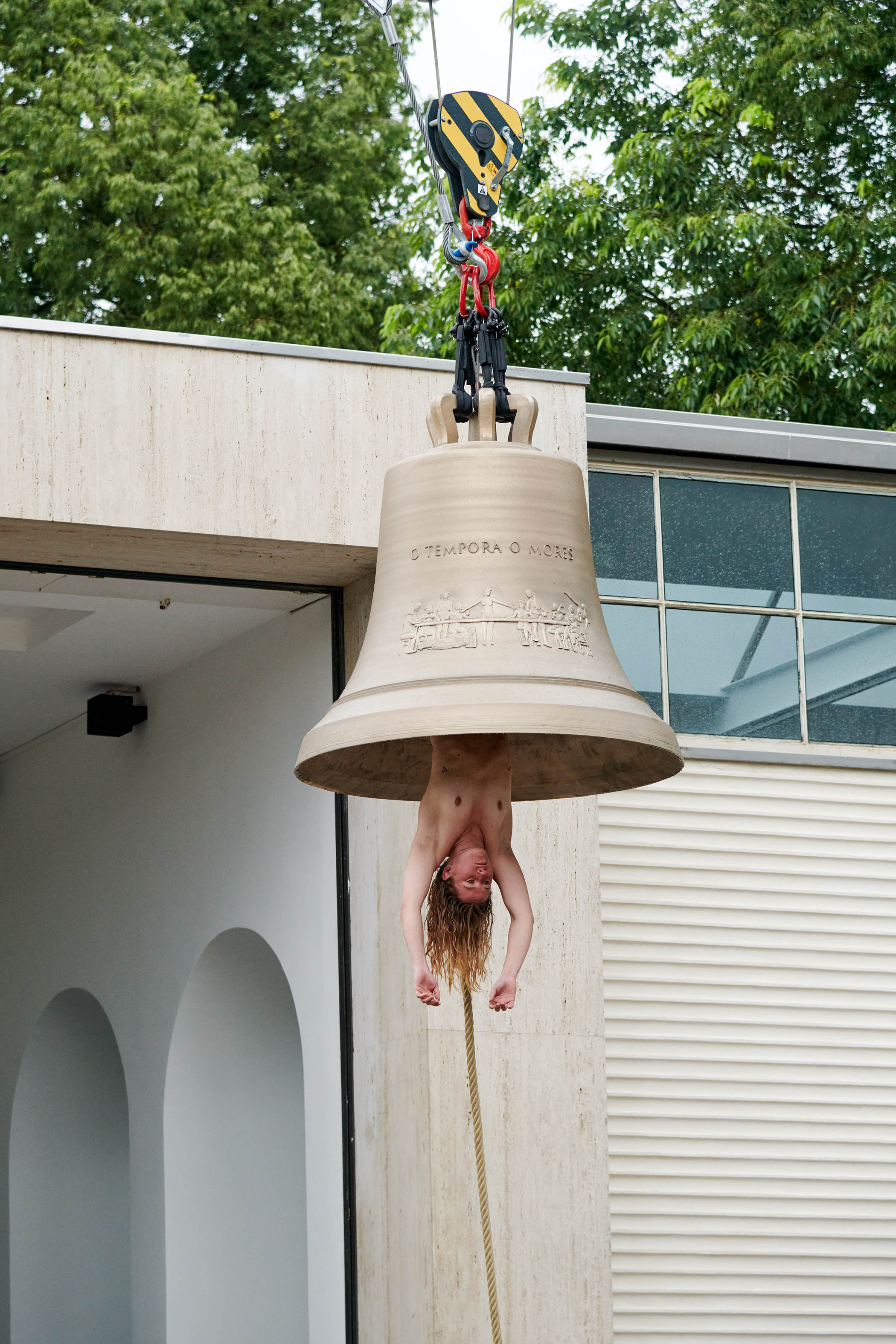
Seaworld Venice, Florentina Holzinger, Austrian pavilion
Venice is, paradoxically, very small and very tiring to navigate, as you have to walk everywhere. There is no grass. If you step in dog shit, there’s nowhere to wipe your foot clean.
The key to the biennale is to start early with the party grafting. During the VIP days before the festival opens to the public, everything runs off Fomo. Indeed, Fomo is the lifeblood of the biennale; Fomo can be tapped, piped up from the ground like oil. Palazzos have rigorous health and safety protocols so maximum capacity means maximum capacity, regardless of who you are. There’s a privileged party list going around that contains timings, locations and contacts. I got mine from the British painter Haroun Hayward, who I met at Stansted and told me I could use it provided I mention him in the piece. (Hi, Haroun!)
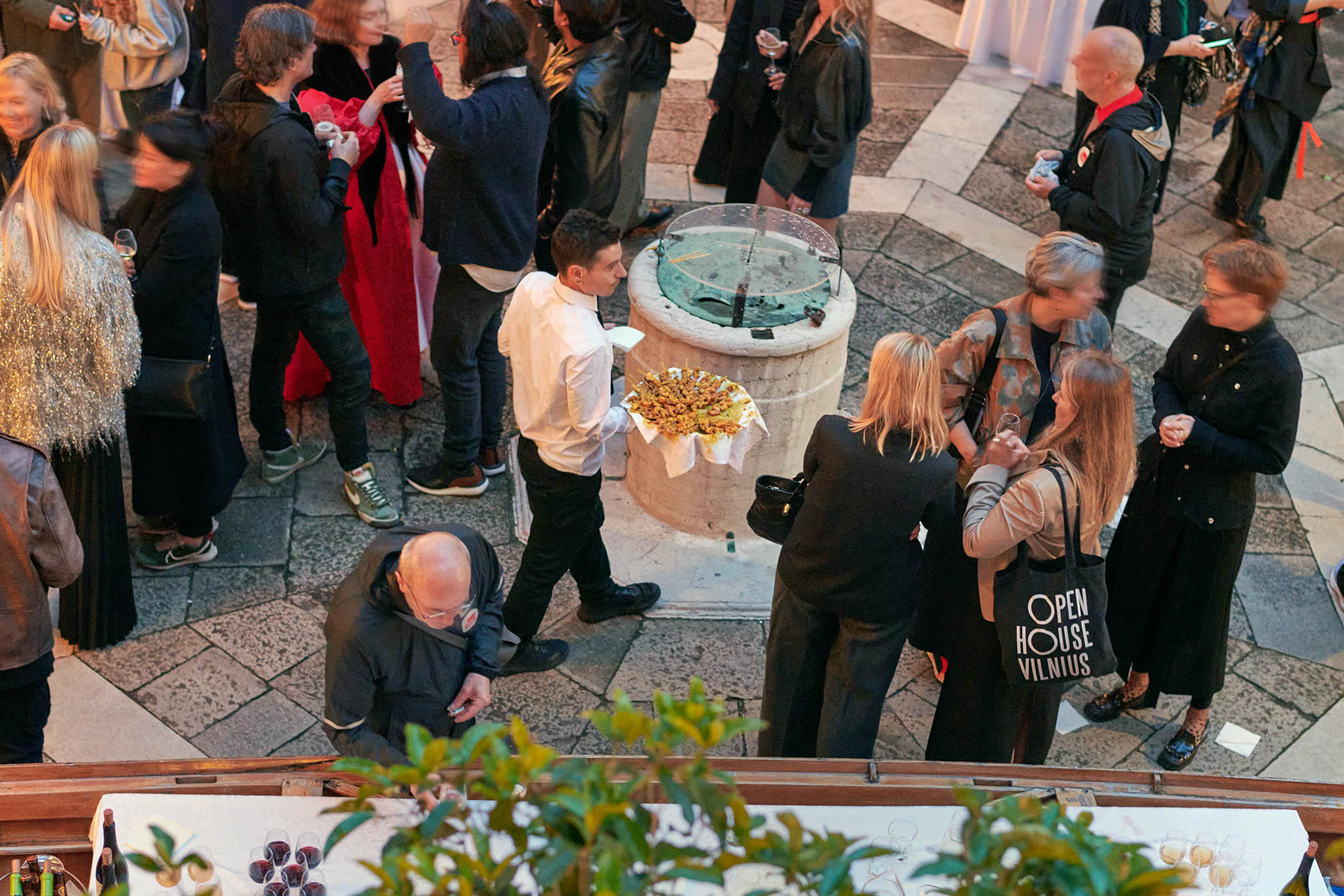
Outside the Complesso dell’Ospedaletto, several people who have never heard the word “no” before are hearing it for the first time. Inside, is an exhibition by the Fondazione in Between Art Film, featuring a large number of video works. In the courtyard, there are cigarettes and bellinis and salty canapes that make you thirsty.
I bump into the Ukrainian artist duo Yarema Malashchuk and Roman Khimei, who have a work upstairs. I’ve met Malashchuk before, in Kyiv, last September. He’s wearing a black turtleneck and is pleased to see that I’ve brought some extra-slim filter tips, which he can’t get very easily at home. During the winter, their studio roof collapsed after Russian attacks disrupted the power supply and their pipes exploded. “I was surprised at how random it is,” Malashchuk says of the nearby Russian pavilion. “I expected it to be more provocative.”
Malashchuk and Khimei’s video is a sketch in which Ukrainian thespians pretend to be Russian soldiers 50 years in the future, suffering from remorse.
As night falls, I make my way to San Lorenzo, an enormous ninth-century church where Marco Polo was buried. I’m beckoned past the queue by the PRs and into an enormous space filled with mountains of sand. Someone gives me a bespoke fan, specially scented to smell like the air before a lightning strike. The house cocktail contains saltwater. Dance music plays across the hall. I find myself in a protracted conversation about the Westminster Kennel Club dog show and don’t stay long.
Newsletters
Choose the newsletters you want to receive
View more
For information about how The Observer protects your data, read our Privacy Policy
Wednesday
The South Korean painter and sculptor Lee Ufan tells me he’s in his “shrinking phase”. The term “shrinking”, the interpreter explains, comes from a Japanese word that relates to air being released from a balloon, and doesn’t translate perfectly to English. Lee will be celebrating his 90th birthday soon and I can’t stop staring at his hands. They press together in a diamond shape, his middle finger slightly bent, perhaps double-jointed. Occasionally they open, like he’s offering something, then mesh back together. His hands are weathered and old in a manner that suggests worldliness and wisdom.
“When you get older, you start getting very anxious,” Lee explains in an anteroom of the San Marco Art Centre, where his show is located, “maybe your death is closer. You feel powerless … But when you accept that this is your shrinking phase, you can start rethinking your past in a more relaxed way, [with] a different perception of time.” Lee’s curator, Jessica Morgan, is tipped to be the next Tate director.
______________________________
A middle-aged man in a suit and tie waits at the entrance of the Giardini with a sandwich board that reads in capitals: “I’m waiting for my love.” He’s done this before at Art Basel and at Art Düsseldorf.
______________________________
Lubaina Himid is a painter and Turner prize winner. As Britain’s representative artist, she has an extremely packed schedule. We meet for a chat in the office of the pavilion where her work – large-scale paintings of black tailors, chefs and gardeners – is on display. Accompanying the paintings is a soundtrack in which the noises of a summer’s day are gradually invaded by insects. Himid’s hands move around more than Lee’s. Sometimes, they look as if they’re cupping an invisible orb. I ask what it’s like being asked to put forward some ambient notion of Britain or British national identity.
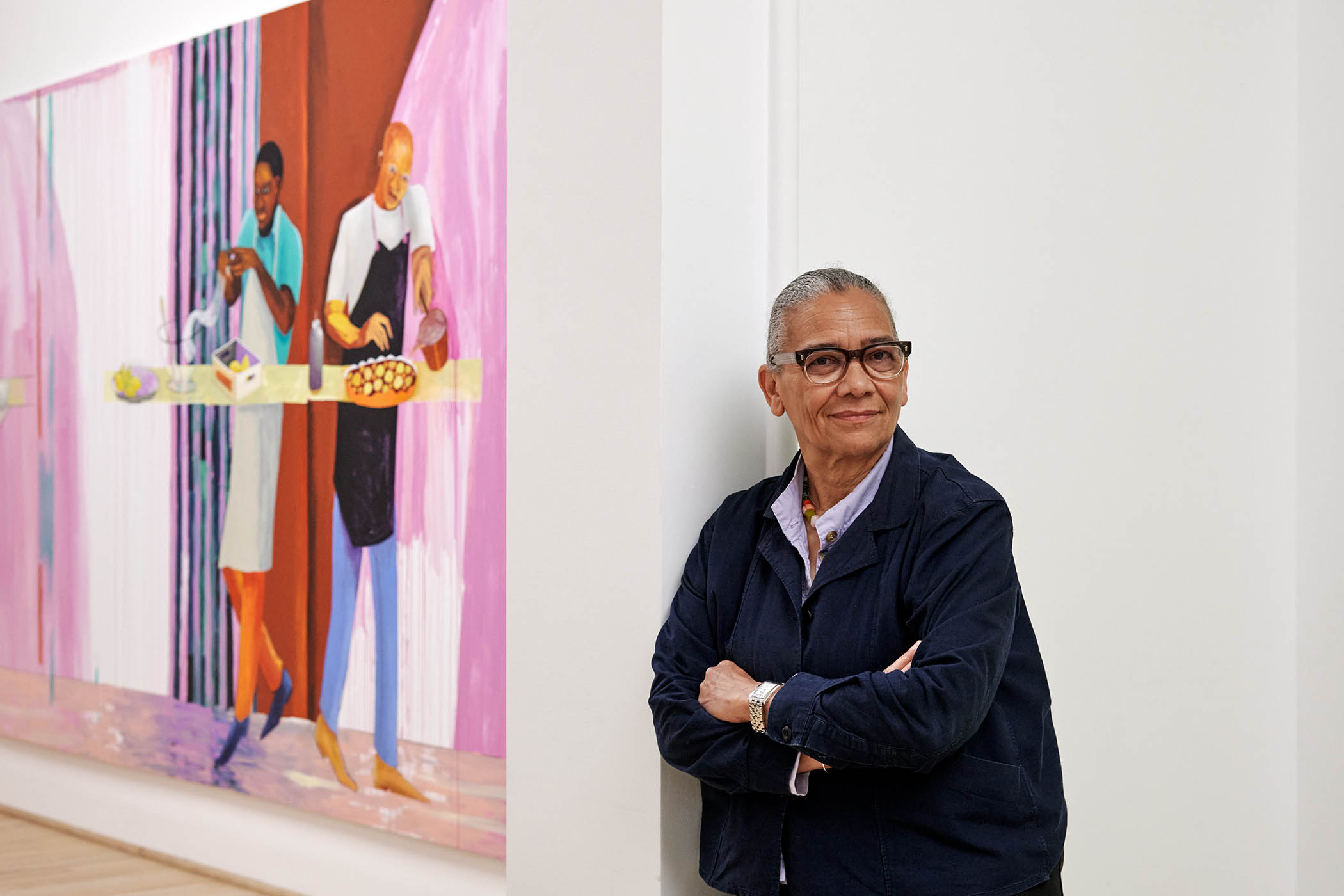
Lubaina Himid at the British pavilion
“I’m not sure … would you ask Antony Gormley the same question?”
I think I probably would.
“Would you? OK. Well, I don’t think Cathy Wilkes [the Northern Irish sculptor chosen for the pavilion in 2019] took any notice at all of the fact that it was Britain. She made a project. She put it in this space, and you can take it or leave it. I think you can take it on or you can decide not to take it on. I think it’s important for me to take it on, because those issues of ‘Why are you here?’, ‘When will you go home?’ have been with me all my life.”
Himid has lived in Britain for 70 years.
“I’m like the queen,” she says. “I’ve seen a lot of prime ministers come and go. I’ve seen policies come and go. I’ve seen football champions come and go. I understand the place.”
Recently, Himid has been grappling with the ironic absurdity of a nation that built itself on maritime colonialism being “frightened of a few boats coming with 40 people in them”.
The curator Hans Ulrich Obrist materialises around the biennale like a little childlike figure in a red coat.
When Alma Allen was chosen by the American Arts Conservancy (AAC), appointed by Donald Trump’s state department, to represent the US, his galleries dropped him and a singular question permeated the consciousness of the art world: who is Alma Allen?
Keen to find out, I collar Allen while he’s doing a press tour and ask him. He seems slightly offended. “That’s a very hard question for someone to just answer. I’m a self-taught artist. I’ve been making work for 35 years – maybe not at the centre of anyone’s art world.”
As it turns out, Allen is concerned with Hieronymus Bosch, physics, the nature of reality, mortality, the inevitability of “the portal into the unknown”, worldly chaos and sea creatures (he’s been snorkelling quite a bit recently).
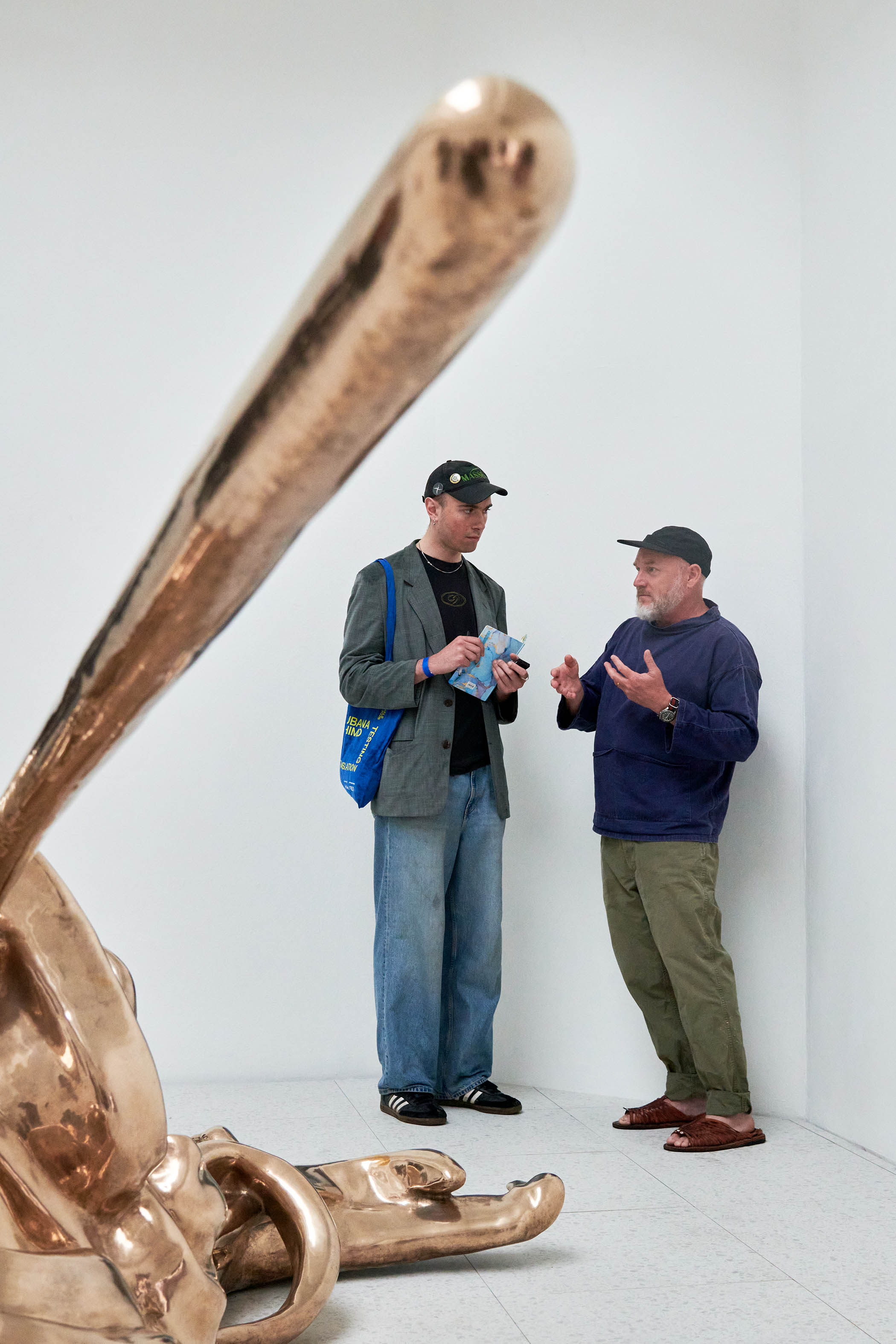
Miles Ellingham interviewing Alma Allen at the US pavilion
It’s been a stressful run-up to the biennale for him; he’s only had about a few months to prepare roughly 10 new pieces. He works mainly with sculpture. I remind him that fellow sculptor Anish Kapoor called for the US to be excluded this year. Allen feels he’s been unfairly attacked personally, which makes him sad, and his sadness is expressed to me, somewhat confusingly, in terms of sea creatures.
“The world is obviously very political, and everyone has their little corner,” he says. “Like the little sea creatures born on the same little rock, fucking with each other, angry at each other …”
So, Kapoor has made you feel like a sea creature?
“No, it’s not that [Kapoor] made me feel like a sea creature … His work is boring. His work is clinical and formal. I don’t fucking care.”
I keep trying to find out who exactly commissioned Allen at Trump’s AAC but no one seems to know. He doesn’t either.
______________________________
The South African artist Gabrielle Goliath made a work that grapples with the levelling of Gaza but it was withdrawn in January by her country’s conservative minister of sport, arts and culture, Gayton McKenzie. The work, Elegy, featuring a single, haunting note, sustained by a revolving queue of performers, has instead been installed, in protest, at the Chiesa di Sant’Antonin. Goliath felt bereft when she first heard about the cancellation, which she sees as a “gross violation of freedom of expression” and a dangerous precedent for censorship. She agrees that she does hear Elegy’s note in her dreams.
______________________________
Can mankind survive on canapes alone?
I hit my wall at the Metropole hotel during a drinks reception for London-based artist Alvaro Barrington. Exhaustion creeps in and the booze plateaus. A terrible, forlorn tiredness sweeps and doesn’t let up. I listen to people discuss where they met: São Paolo, Mexico City, New York, Berlin. A woman does her makeup, staring at her reflection in an empty frame. I push through.
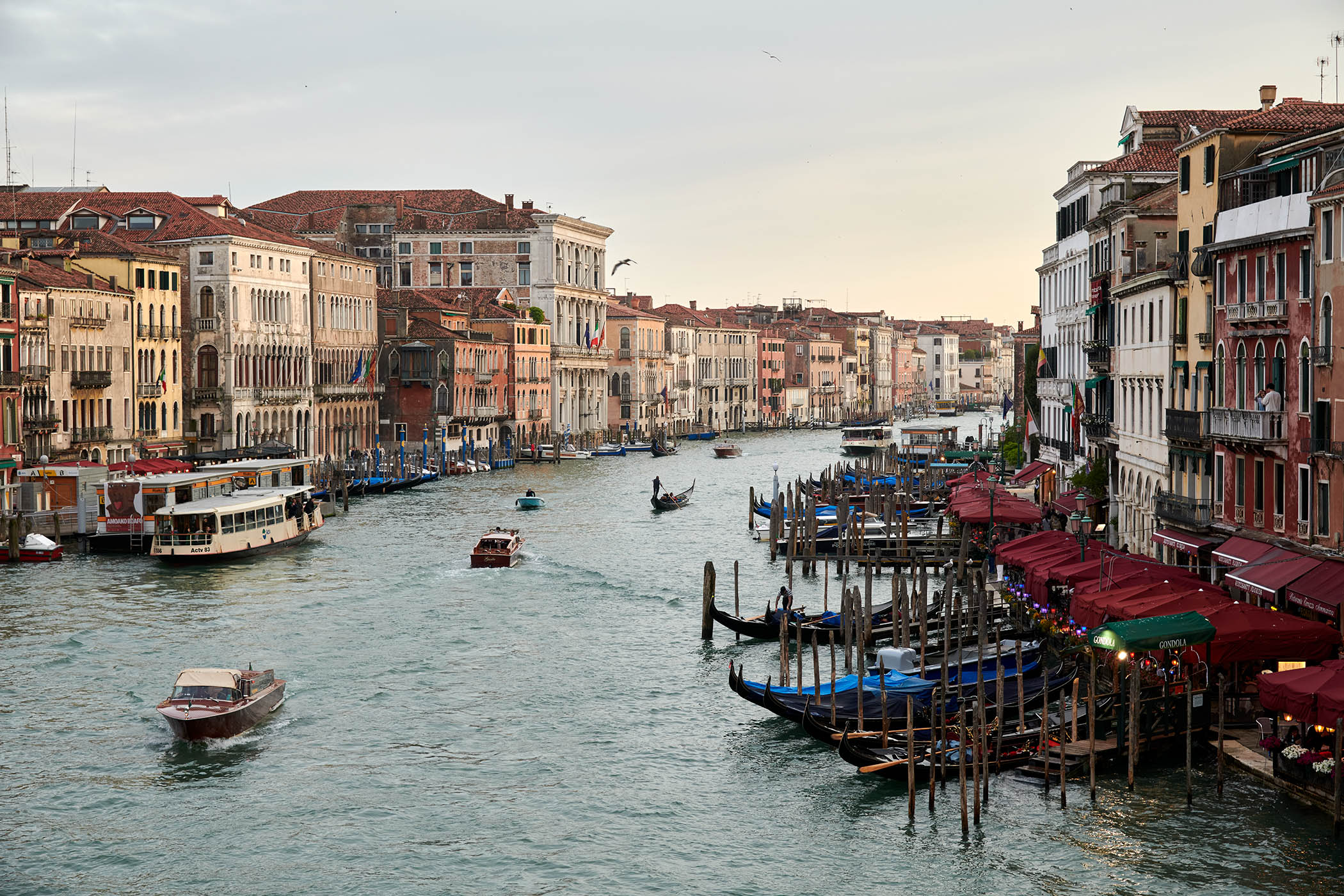
The Rialto bridge. Selfie-land. The evening sun turns Venice gold. Even with the tourist accoutrements, the cityscape is still pretty enough to make you laugh out loud. When a gondola is finished, after years of expert artisanal craftsmanship, a little party is thrown for it. There are repairs in progress at the water’s edge because, back in December, a woman hijacked a delivery boat laden with Christmas presents, but didn’t know how to drive it, and only got a few metres down the canal before crashing.
The British pavilion party is notoriously boozy. It’s held in a large courtyard next to the basilica of Santa Maria Gloriosa dei Frari. There’s no food. People approximate some uncomfortable middle ground between schmoozing and dancing.
Outside the Baltic party at the Palazzo Zeno, a large group of people are trying unsuccessfully to get in. My admittance gives me a perverse kick that I distrust. I stand a while by the door, watching people’s reactions as they’re turned away. Some loiter like pigeons by the entrance. There are canapes at the Baltic party, big plates of ham and treats that make your breath smell. I escape a drunken lecture on the psychoanalyst Melanie Klein and flee to a dysfunctional bar in San Marco. Then I faint in a sandwich shop on the way home, probably due to stress or exhaustion. Everything goes black and I come to with a bruised shoulder, staring up at a concerned student who slaps my face and calls out: “Mi scusi, signore!”
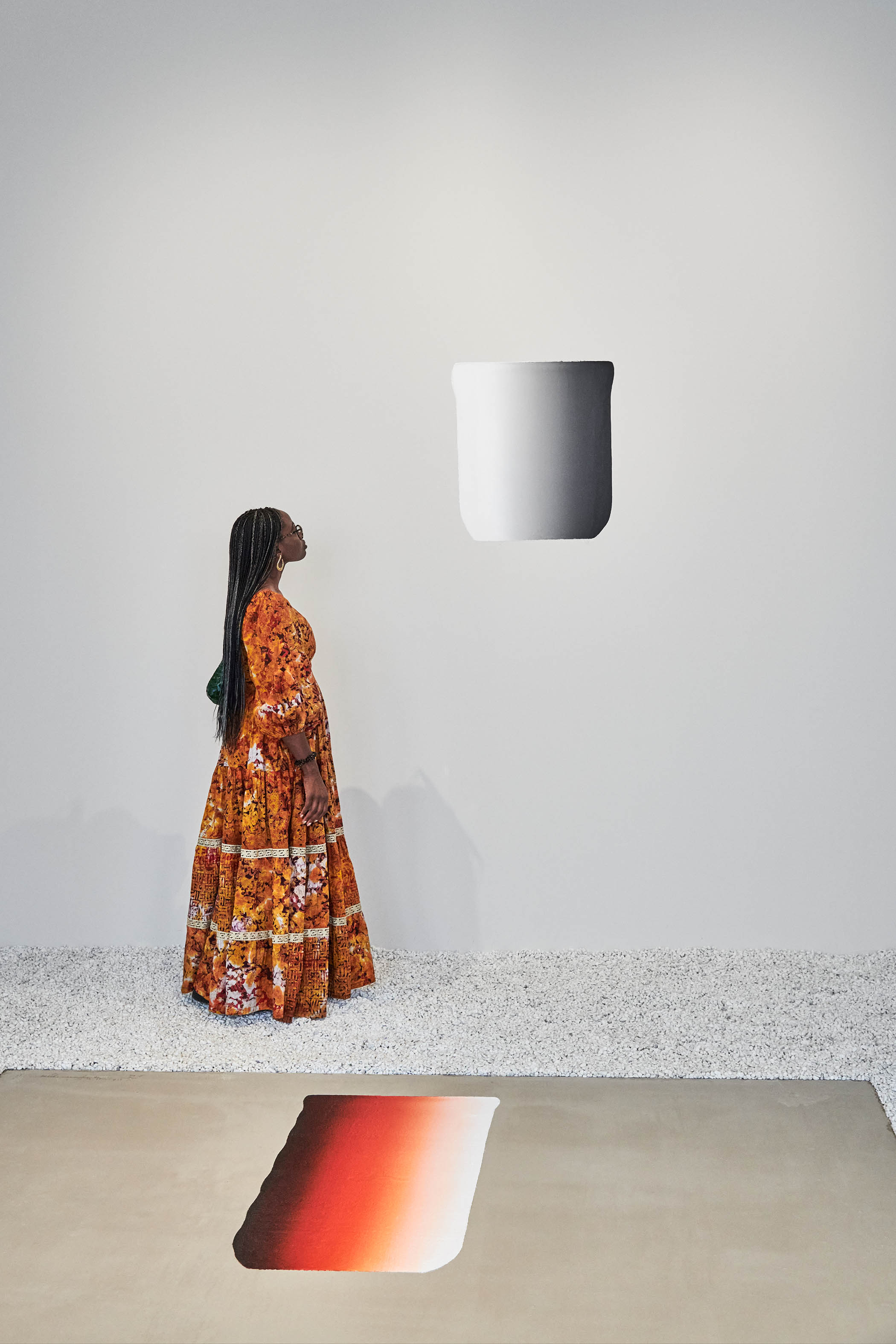
The Lee Ufan exhibition in the San Marco Art Centre
Thursday
Spirits are high at the opening of Isabel Nolan’s show, Dreamshook, at the Irish pavilion. The room is filled with chatter and Aperol spritz, and an enormous, colourful tapestry depicting the dreams of a 15th-century Venetian publisher called Aldo Manuzio. Nolan’s still breathless from the Harper’s Bazaar breakfast she attended this morning. People wander up to her and smile warmly.
On the other side of the Arsenale, Israel’s pavilion does not share the same air of jubilation. The artist Belu-Simion Fainaru sits disconsolately behind a desk. His work is a pool of water with sprinklers rigged to make little ripple shapes on the surface. He bemoans the fact that the biennale has turned into a miniature UN and finds criticism of Israel’s participation hypocritical because people aren’t saying the same of Iranian art.
Everyone is hungover. At the Palazzo Caboto, sitting on a sofa in a replica Somali living room constructed by the poet Warsan Shire in the biennale’s first Somalian pavilion, I consider my own hangover, watching the boats pass by outside the window. Today has a special, polished currency, as if Venice is trying to pretend that it is too good to be true. The world’s oldest, most meticulously constructed fairground becomes especially beautiful once you learn how to look at it. How could I have fainted like EM Forster’s Miss Honeychurch? What’s the matter with me?
The performance artist Miet Warlop and I smoke fags in a little shed behind the Belgian pavilion and ash them into an empty bottle of prosecco. I like Warlop; she has the punky, throwaway readiness of a proper European artist. Today, her performances have been called off after one of her colleagues almost blacked out. The work demands intense labour. It’s loud. People smash things. Shout. Exert themselves. I ask Warlop what the point of all this is. Why make art at all?
Warlop takes a heavy drag on her cigarette, then replies: “Because I think you can shift things…”
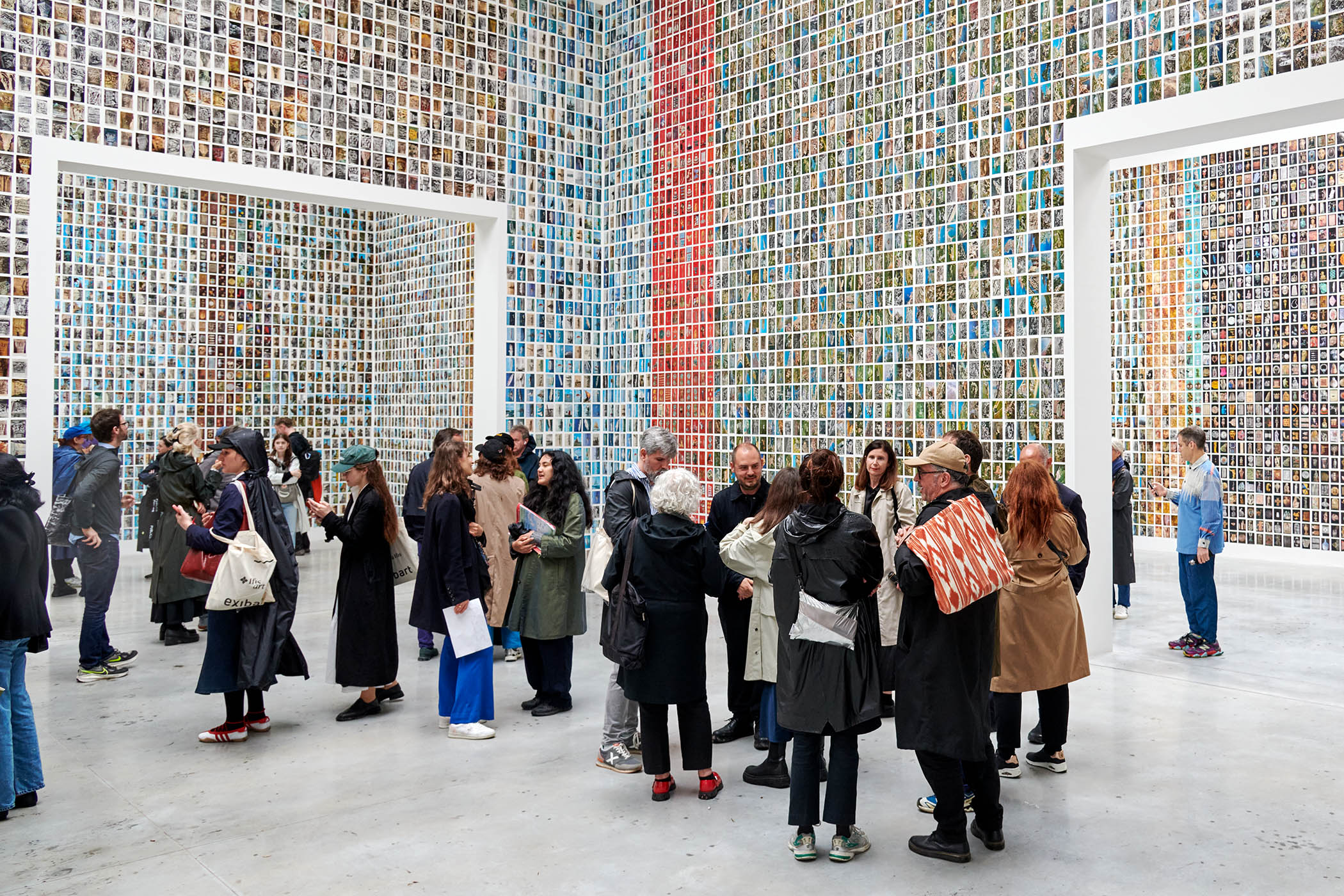
Oriol Vilanova, Los Restos, Spanish pavilion
The best work of the festival is at the pavilion of the Holy See. A soundscape has been mapped spatially on to the mystical garden of the Discalced Carmelites, part of a 17th-century friary. Each sound work is inspired by the life of Saint Hildegard of Bingen, and composers include Brian Eno, Holly Herndon, Jim Jarmusch, Patti Smith and FKA twigs. Everyone gets their own little private moment in the garden. It’s enough to make you weep.
Back to San Giorgio and a party hosted by Benedictine monks celebrating American sculptor Barry X Ball. People have heard Björk is playing later at the Icelandic party, but they always say that. Three-dimensional printed statues have been placed in the church. In one of them, an adaptation of Michelangelo’s Pietà Rondanini, Jesus’s face has been replaced. There’s only one available toilet, which feels in keeping with the asceticism of Saint Benedict. On the vaporetto to the mainland, night falls and an enormous laser beam is shot into the sky.
After about an hour, the Irish party runs out of wine, leaving only Guinness and Baileys. My stomach now contains prosecco, red wine, white wine, Aperol, Campari, Select, tequila, Guinness and Baileys. There’s no food at the Irish pavilion, just a big bowl of crisps and some white bread cut into squares. Annie Mac makes an appearance on the decks.
The Mendes Wood DM gallery boat party has become somewhat infamous; people talk about it in hushed conversations. This year marks the second time it’s been held on a pirate ship. People board at 2am, then the ship sails off into the international waters of late-night permissibility, returning briefly to unload at 3am, then 4am, then 6am. One of the founders appears in a shiny robe at the gangplank and people start forward. “Back! Get Back!” he shouts.
A seemingly random array of guests are called on board, and the door closes and the boat sails off. For some reason, I’ve been beckoned inside and the rejected crowd shrinks in the distance. Mendes Wood has found a way to max out the Fomo: something about a pirate ship pulling away, carrying your friends with it, elicits a desperation on the shore that several people aren’t used to. Not long after setting sail, I’m dosed with liquid psilocybin and gin under the half-moon.
When the boat returns at 3am, people are still waiting. More this time. Some know what went down before and how chaotic the boarding process can be, so they seize the night and try to hurl themselves through open windows. A few make it. The rest are screamed away. People argue desperately to let their friends on board but clout means nothing here. We go round again and the mushroom oil begins to peak.
At 4am, I disembark and scurry back to my hotel like a plague rat. The moon reflects in the canals on my way home and the quietness rings in my ears. I’m reminded of something someone said to me on the boat. “If you write about this,” they told me, “there has to be some part of you that sees value in it. Otherwise, there’s no point; you’re just a bully.” Groping my way up a dark stairwell towards my hotel bed, I realise that Björk’s performance has gone viral. “Son of a bitch,” I think to myself. “If only I’d been there.”