Even before a storm soaked the VIP preview of the Venice Biennale, the mood in the Giardini park was damp.
Three dozen people draped in Palestinian flags marched down a path lined with art-filled pavilions and cypress trees to protest against Israel’s presence. They passed a concrete sculpture of an origami deer suspended from a flatbed truck rescued from a Russian-occupied town in Donetsk and brought to Italy to represent Ukraine.
A few metres away, Russia was having a party. Techno music blasted from the mint green pavilion of the Russian Federation. Vodka flowed inside, while half a dozen people danced under decadent floral arrangements. A man in a bat mask flapped his arms for a videographer; his T-shirt read “La Biennale is calling” above a photo of the event’s director, Pietrangelo Buttafuoco.
Buttafuoco and the Russians have eclipsed the art at the world’s most important art festival. When he announced last year that Russia would be back for the first time since invading Ukraine, Buttafuoco split the Italian right: culture minister Alessandro Giuli called his actions “unacceptable” and declined to attend the Biennale’s public opening yesterday, while deputy prime minister Matteo Salvini – who has made no secret of his fondness for Vladimir Putin – said the director “did the right thing”.
Salvini and the Biennale director have known each other for many years. In 2011, Buttafuoco, a journalist by trade, published a book comparing the Lega leader favourably to Mussolini.
Last week, Giuli sent inspectors to the Biennale offices to review correspondence between Buttafuoco and the organisers of the Russian pavilion, including its commissioner, Anastasia Karneeva. They are reviewing whether he or his team may have helped the Russians evade sanctions.
Karneeva has spent much of her career selling art to Russian oligarchs and banks. After opening a branch of Christie’s auction house in Moscow in 2008, she built up an art collection for the financial arm of Gazprom, the Russian state energy monopoly, and co-founded an art-advisory firm with Ekaterina Vinokurova, the daughter of Russia’s foreign minister Sergei Lavrov.
Vinokurova is currently under US, UK and EU sanctions and could not travel to Venice. Neither could Karneeva’s father, Nikolai Volobuev, who is sanctioned for his former roles running the FSB, Russia’s spy agency, as well as Rostec, which manufactures the bombs being dropped on Ukraine. (Volobuev also sits on the board of Kalashnikov.)
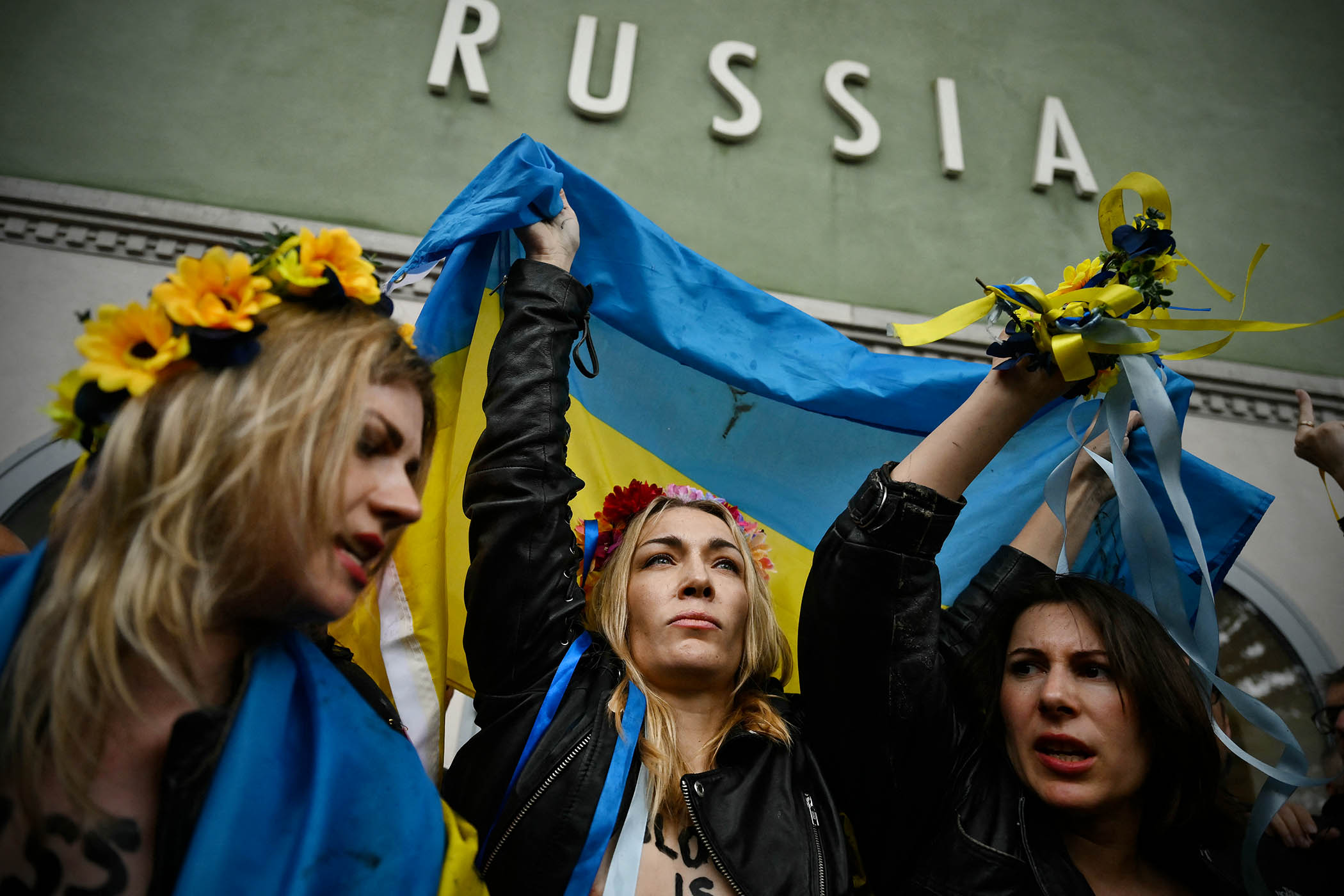
After the rain cleared on Wednesday, the Russian punk group Pussy Riot staged a protest outside the Russian pavilion in their trademark pink balaclavas. “Art for show,” they chanted. “Graves below!”
“If the Venice Biennale really cared about censorship and censored Russian artists, they would work with artists who are currently incarcerated for standing up against the regime,” said Nadya Tolokonnikova, a member of Pussy Riot who spent nearly two years in prison for a 2012 anti-Putin demonstration. “Art is never neutral.”
Newsletters
Choose the newsletters you want to receive
View more
For information about how The Observer protects your data, read our Privacy Policy
For hours, only journalists were allowed through a cordon of armed police. Inside, Karneeva could be found sheltering from the noise and crowds on the back terrace, flanked by guards as she surveyed the lagoon.
“We are not ‘back’. This is our space,” she said with irritation. “Nobody wants to talk about the art. They only care about the war.”
That war is existential for Ukrainians fighting for their lives and the survival of their culture. For years, Putin has conflated Ukrainian and Russian culture in order to advance his territorial claims.
Many fronts opened in what has become an existential crisis for the art world. As Pussy Riot’s pink smoke dissipated above the Giardini, a walkout of Italian culture workers organised by the Art Not Genocide Alliance shut nearly a third of the national pavilions.
The Russian pavilion shut for good the following day after an official visit by Salvini. Videos of the party will play from monitors in the windows of the building until the Biennale closes in November, organisers said. On Saturday, Pussy Riot posted a cease and desist letter to Karneeva and Buttafuoco for footage of their protest which had been edited into the videos, and which they said could make them criminally liable under Russian law.
As unrest brewed, the absence of much political art on display contributed to a sense of cognitive dissonance. Many pavilions vie for shock value instead. Denmark’s presents a pornographic film shot in a sperm bank. Austria’s features a performer who drinks visitors’ urine through a scuba diving tube. In an all-too-literal gesture of Freudian regression, a video in the Luxembourg pavilion stars a piece of talking human excrement.
None of these works will win the Golden Lion, art’s highest honour. The jury tried to exclude artists from countries whose leaders are facing war crimes charges at the international criminal court, after which its members were forced to resign and the prize was scrapped for the year.
Instead, a “Visitors' Lion” will be determined by an online public vote. “It’s like replacing the Academy [which awards the Oscars] with [the film-rating website] Rotten Tomatoes,” said the director of a national pavilion who declined to be named.
“La Biennale seeks to be – and must remain – a place of truce in the name of art, culture, and artistic freedom,” the foundation said in a statement. Pistols at dawn, more like.
Photograph by Marco Bertorello/AFP/Gertty Images