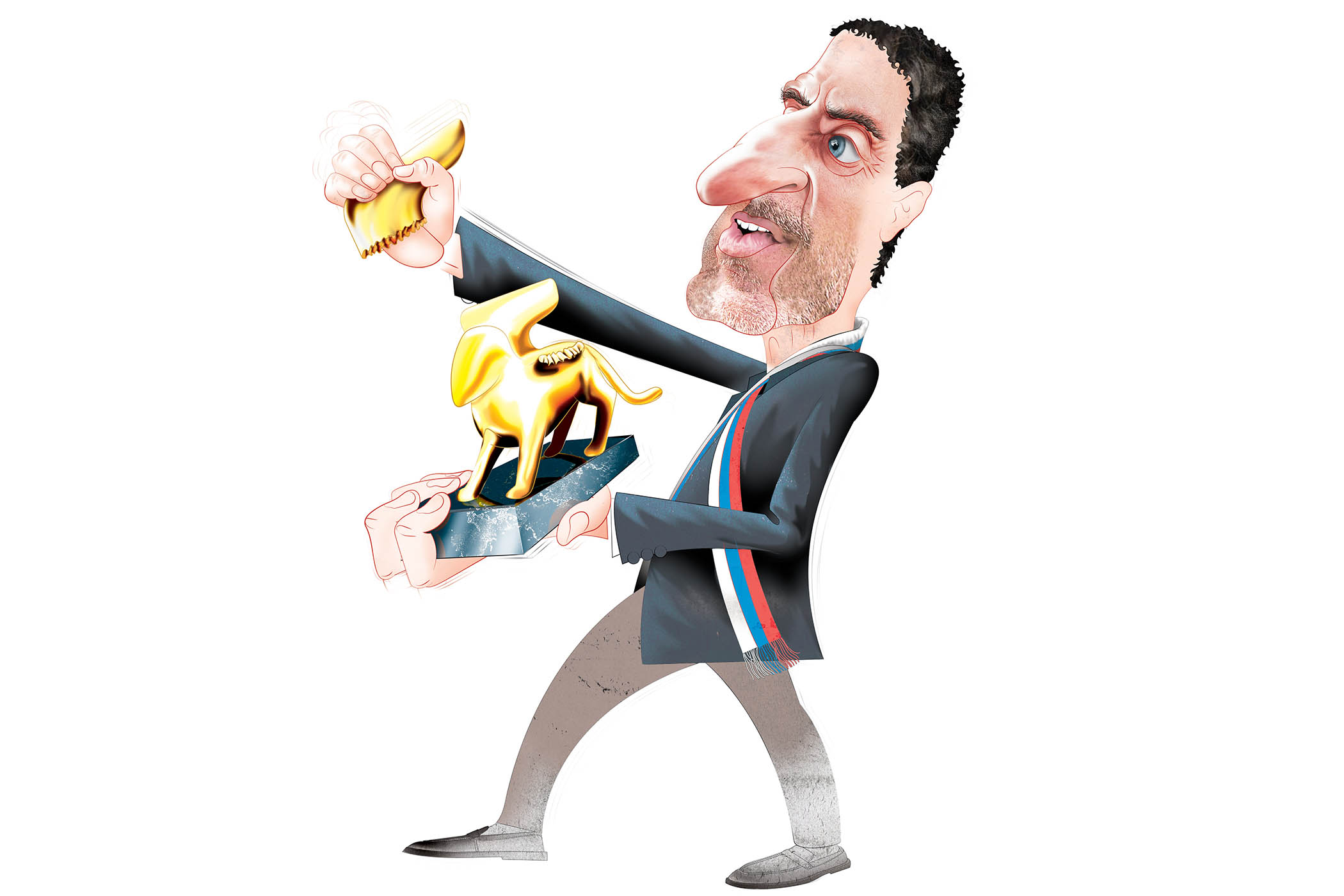
Pietrangelo Buttafuoco, clad in an unorthodox brown suit and striped tie, stood inside Venice’s Teatro Piccolo Arsenale last week to deliver a passionate monologue on artistic freedom to a crowd of journalists, politicians and cultural figures.
It was not an easy audience. The president of the Venice Biennale Foundation has come under fire for allowing Russia to participate in the festival, which began on 9 May and runs until November.
Buttafuoco, a conservative intellectual and convert to Islam, turned a press conference into a platform for his own artistic manifesto. “This is not a court of law,” he declared. “It is a garden of peace.”
The Biennale, he insisted, had always “gathered tensions, conflicts and visions”, and “we do not intend to trade, for the sake of a quiet political life, 130 years of history that have always told the world this way”.
The language was poetic, evasive and provocative, in tune with a man who is less cultural administrator, more literary dissident, and who sits uncomfortably within the Italian establishment.
The speech captured the strange position Buttafuoco now occupies in Italian public life – that of a man formed by the political right who resists subordinating art to politics, even when the pressure comes from his own side.
Also tuning in to his speech were Russian diplomats who listened approvingly to his defence of artistic freedom.
Since Russia’s invasion of Ukraine, the Biennale’s Russian pavilion has remained officially closed after the country’s artists withdrew in protest at the war. Now, Buttafuoco’s critics accuse him of facilitating Russian propaganda at a crucial period.
Last month the international jury of the festival resigned in protest over the inclusion of Russia and Israel. The European Union has withdrawn millions of funding from the Biennale and raised concerns over possible sanction violations. The buildup to the opening included protests and shadow exhibitions showcasing the work of Ukrainian artists.
Buttafuoco emerged from the same political world that brought the Italian prime minister Giorgia Meloni to power. He is regarded as one of the leading intellectuals associated with the Italian right. He was raised in Leonforte, near Enna, in inland Sicily, known for its baroque architecture, in a family with fascist loyalties. Buttafuoco was introduced to Rome’s post-fascist Italian Social Movement by his uncle Nino. Yet friends recall a young Buttafuoco being more interested in literature and mythology than politics. He opened a bookshop in his village. “But he was the only one who read the books,” joked a friend.
Newsletters
Choose the newsletters you want to receive
View more
For information about how The Observer protects your data, read our Privacy Policy
An author, journalist and television pundit, he has a reputation for being a free thinker, and friends say he immerses himself in literature.
Salvatore Merlo, a senior editor at Il Foglio, where Buttafuoco wrote a column for many years, describes him as “like a character from a novel… He is so eclectic he is extraneous to any group, even the rightwing world that he comes from.”
Today, at 61, he remains difficult to classify. His most famous novel, Le uova del drago (The Dragon’s Eggs) portrays a glamorous Nazi spy as a heroine. Federico Mollicone, a long-term friend and Brothers of Italy MP, claims that intellectually Buttafuoco is most closely aligned to his party. However, he has friends and supporters from the far left, and is a convert to Islam.
The pressure on Buttafuoco has been intense but he is not someone inclined to change position
The pressure on Buttafuoco has been intense but he is not someone inclined to change position
His appointment to run the Biennale has been seen as evidence that, after decades of complaining that Italy’s institutions were dominated by the left, the right had finally achieved cultural legitimacy. Yet the choices he has made in the role, including appointing Koyo Kouoh, the Biennale’s first female African curator, have been supported on both the left and the right. (Kouoh, from Cameroon, died of cancer before she could take up the job.)
But the same qualities that make Buttafuoco attractive to the right – irreverence, autonomy and hostility to conformity – also make him difficult to control.
“He is in conflict with that political world he belongs to because they want obedience from him. But he lives for literature not for politics. He does not respond to orders from political power,” Merlo says.
The dispute has triggered a bitter rupture with culture minister Alessandro Giuli, once one of Buttafuoco’s closest allies. The two men worked together at Il Foglio. Giuli admired Buttafuoco as a mentor, and colleagues saw them almost as father and son.
Now, after Giuli sent inspectors to Venice in search of evidence that could justify removing Buttafuoco from the Biennale presidency, the relationship has collapsed. One friend said Giuli “felt betrayed by his mentor”. Putin “has won the Biennale”, Giuli said last week.
The pressure on Buttafuoco has been intense, particularly the breakdown of personal relationships, but he is not someone inclined to change position. “He is very Sicilian, hardheaded,” says Mollicone.
Why Buttafuoco has chosen to wage this battle remains a matter of fierce debate even among people close to him. Allies refute that he is in any way an apologist for Putin.
Some dismiss the controversy as calculated provocation, to keep the Biennale at the centre of international conversation. “He should have warned the government,” said Mollicone. “He thought he could relaunch the Biennale but instead it has deeply offended the Ukrainians.”
Merlo also rejects attempts to reduce the controversy to simple ideological sympathies. “To say he is doing this because he is a Russophile is reductive,” he says, noting that Buttafuoco also defended Israel’s participation at the Biennale. “If he is working for the Russians because he defended Russia’s pavilion, then is he also working for the Israelis?”
The contradiction at Buttafuoco’s core is what makes him compelling. He belongs to the right precisely because he distrusts ideological conformity. Yet that same instinct now makes him troublesome for a governing right increasingly concerned with discipline and loyalty.
He does not treat culture as a communications strategy or ideological instrument. Admirers say he sees art as a realm of contradiction, seduction and freedom that politics cannot fully control.
That instinct has always made him eccentric within his own world. Friends describe him as solitary, spending long stretches gardening, reading and writing, becoming more withdrawn with age. His conversion to Islam is a form of “chic” rebellion against bourgeois conformity as much as a spiritual transformation, one friend said, adding that Buttafuoco often calls himself “not Muslim but Saracen”, invoking Sicily’s layered Mediterranean inheritance.
In Meloni’s Italy, where the right often speaks in the language of “God, country and family”, with God implicitly Christian, Buttafuoco’s embrace of Islam places him slightly outside the symbolic universe of his own political tribe. For supporters of the government, the irony is that Buttafuoco’s ability to openly resist pressure is proof of the freedoms he claims to defend. “In Russia,” he says, “he would have been disappeared, had an accident.”
The Italian right spent decades dreaming of cultural legitimacy. Buttafuoco was one of the figures who helped give it intellectual depth, theatricality and style. Now that legitimacy has arrived, he behaves as though culture should remain unruly, contradictory and free.
That leaves him increasingly isolated, as well as difficult to ignore.
Illustration by Andy Bunday