Frida is back, commodified into oblivion at Tate Modern. For the sake of simplicity, or sales, she no longer has the cumbersome dignity of a surname. Come and discover how Frida became an icon, for which read tequila bottles, floral headdresses, phone cases, chunky gewgaws and even the notorious Frida Barbie, her disfiguring monobrow neatly erased. In a museum first, at least for me, many of these objects are not just in the gift shop but actually on display in the exhibition itself.
Kahlo (1907-54) made a doll of herself. Or so they are claiming at Tate Modern. A stuffed ragdoll lies beside a toy horse running away with a cart. The photograph of this scenario is titled Representation of the Accident. Given that the horrifying collision in which Kahlo was impaled on a handrail, breaking – among other things – her spine, right leg and pelvis, causing lifelong pain at 18, involved a tram and a bus, this is a dubious interpretation.
But who cares when you have so many sacred relics of the martyrdom. Here is one of Kahlo’s plaster corsets, cast to her body, and decorated with a hammer and sickle to hold it together. Here are the full-skirted Tehuana dresses she wore for political reasons, but which were long enough to conceal her injuries. A sketch shows Kahlo vulnerably naked beneath her plumage, her spine the fragile Ionic column from her famous self-portrait The Broken Column, the latter, alas, not in this exhibition.
A trio of dresses make their appearance in a 1937 painting titled Memory, the Heart. Kahlo, in the middle, wears a 1930s housewife costume. She has no hands. On her right hangs a school uniform above a Mexican landscape, dear memory of youth; on her left, a Tehuana dress links arms with her. One foot is turning into a sailing ship in the blue sea on which she is trying to stand firm; the eponymous heart lies bleeding on the shore. Kahlo, in New York exile with her husband, Diego Rivera, is yearning for home.
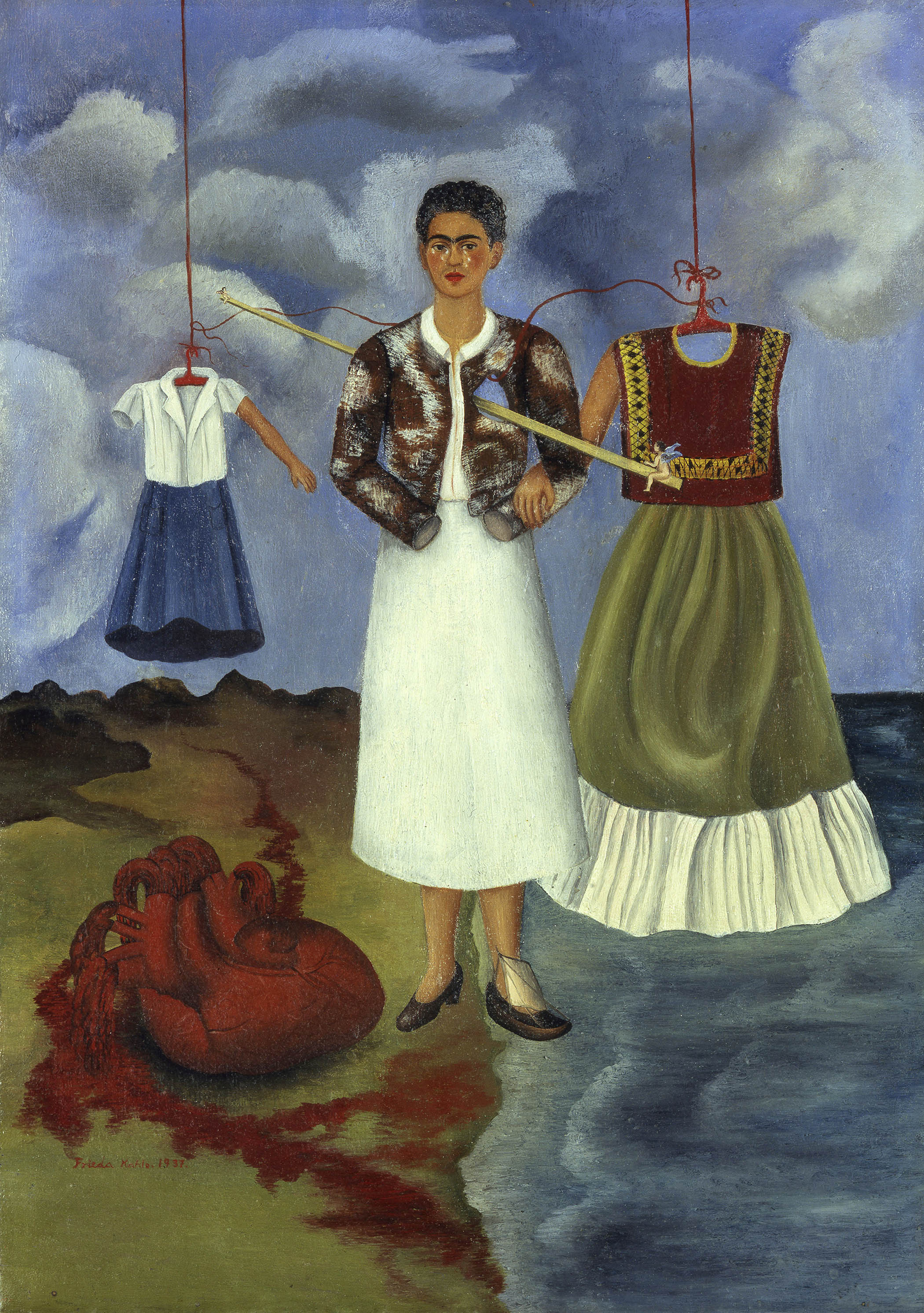
Memory, the Heart (1937)
It is a strange painting, simple yet weird, coarsely painted yet emphatically visual. You could write the sentiment down in half a phrase yet never convey the graphic impact of the image itself. Kahlo invented self-portrait motifs that have extraordinary public reach: as a deer stuck with arrows, riven in two and trussed back together, head emblazoned with a skull and crossbones, being born to her own mother, dressed in a man’s suit with her beautiful hair lopped into mutinous tresses all around her. Alas, again, not one appears in this show.
There are a precious few self-portraits: Kahlo with a monkey and cat in a Rousseau-esque jungle, her neck noosed with thorns, or swan-necked in a red velvet dress. But what is singularly missing from this show, first to last, is the artist’s own work.
Not her face, of course, which appears all the way through in photographs and films and cack-handed portraits by other people. Rivera’s early drawings of Kahlo are useless. Her marriage and divorce and remarriage to this gargantuan philanderer, who had already been married twice and later had an affair with her sister, is a tale too outrageous for this show. Instead, crowds gather before a film of the lovers projected on a wall, smartphones held high to record Instagram homages of their own.
Kahlo’s central motif was, of course, her own face, and she fixed it so clearly in her paintings she is more easily imitated than the Virgin Mary
Kahlo’s central motif was, of course, her own face, and she fixed it so clearly in her paintings she is more easily imitated than the Virgin Mary
Rivera, in Tweedledum trousers hoisted high around his girth, fiddles with the flowers in Kahlo’s hair. She kisses his hand. He pets her like a small cat. The film is nauseating to watch, and I wish I had never seen it, but Kahlo as adoring lover is all part of the tragedy narrated in photographs. Here she is bare-breasted before her sometime lover, the gallerist Julien Levy, tiny and swooning against the mountainous Rivera, profoundly alone in a beautiful photograph by Imogen Cunningham.
Kahlo joined the Communist party at 20, had an affair with Trotsky and was, briefly, accused of complicity in his murder in Mexico City in 1940. But no photographs of their relationship are included in this show. It would presumably narrow the retail opportunities to focus too much on her politics, though the hammer and sickle is painted right there in red upon the plaster corset.
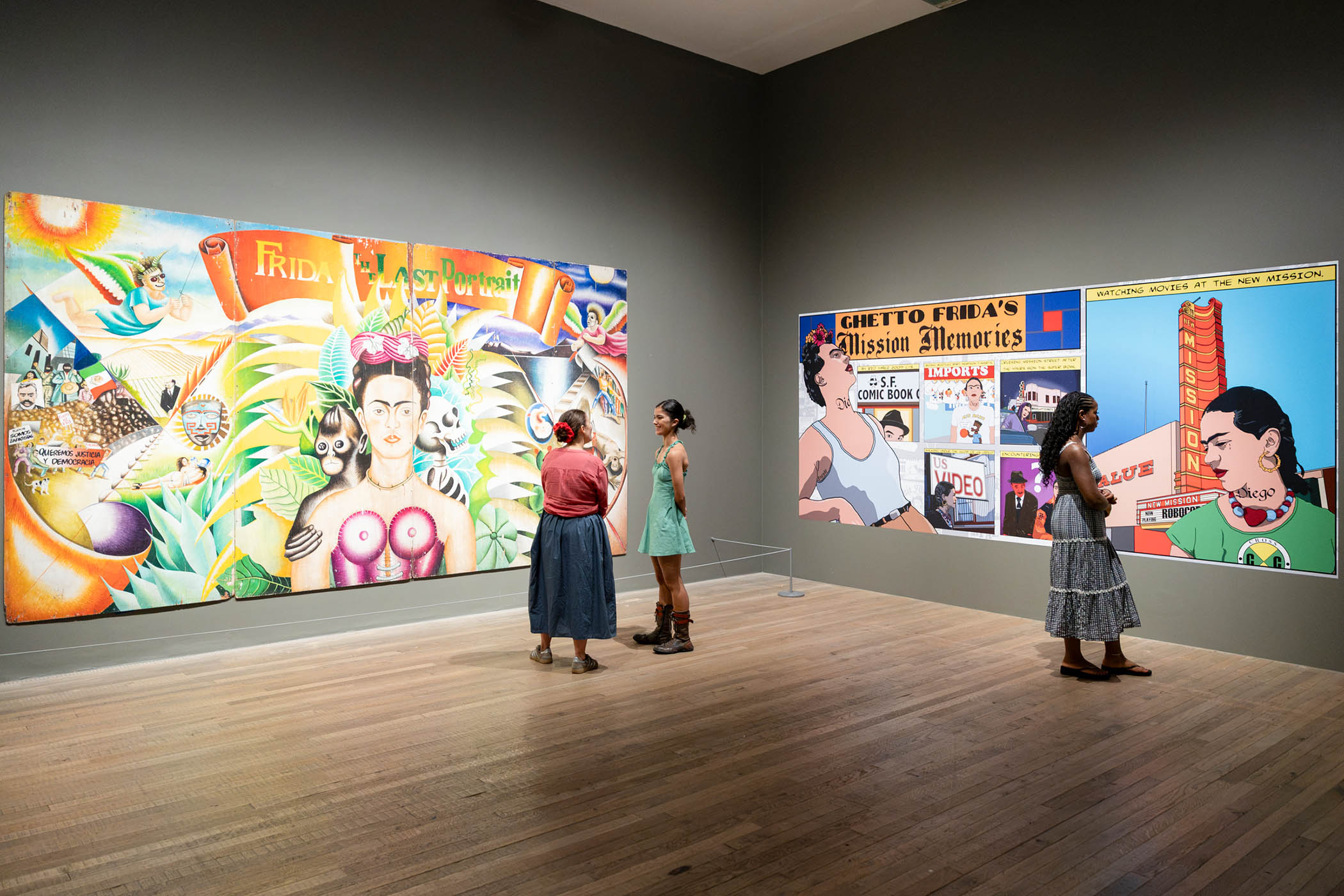
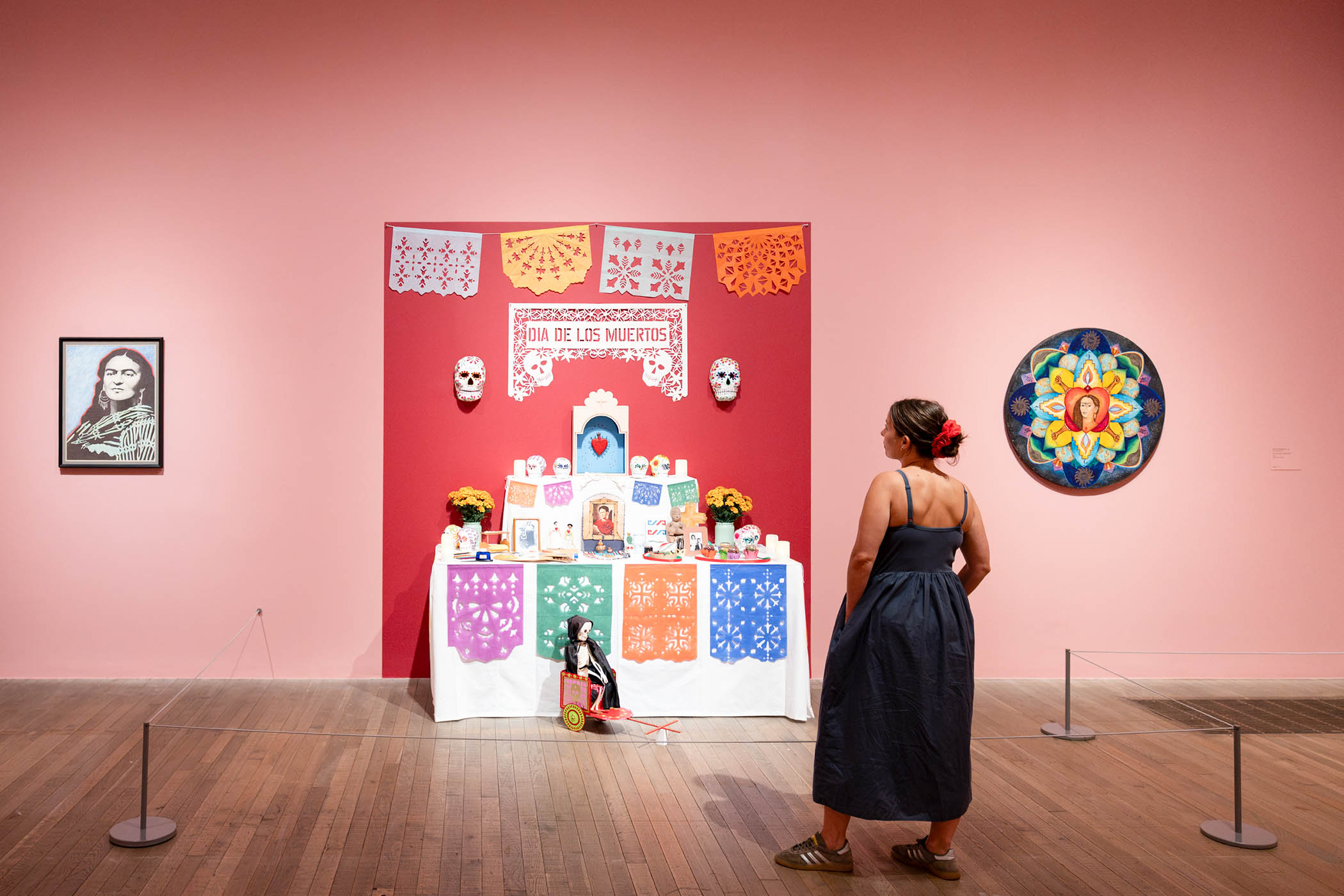
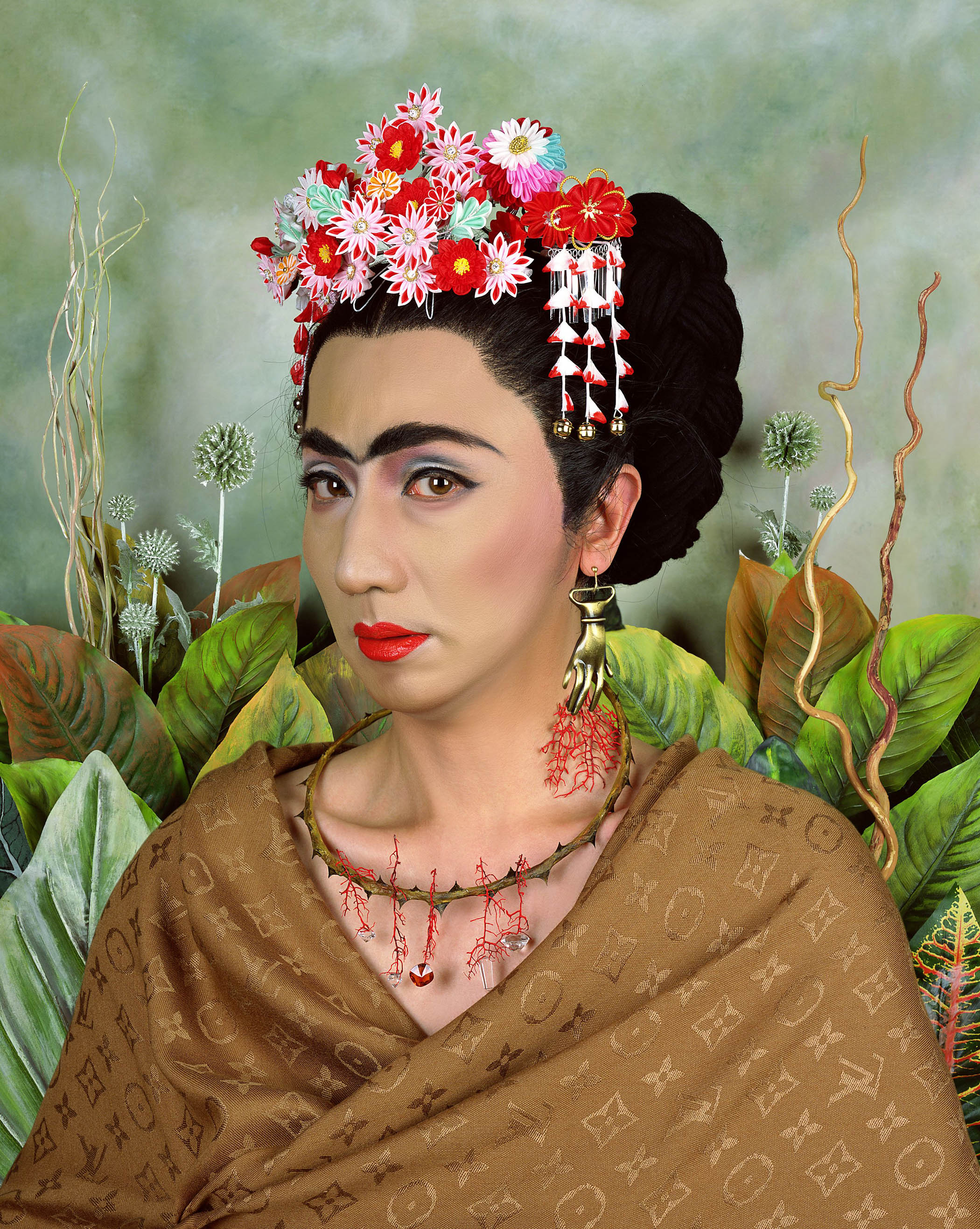
Instead, the show dilates upon Kahlo as secular saint: a Day of the Dead altar for Frida, worshipful tributes by fellow Latin American artists. There is a gallery of impersonations, from the Japanese actor-photographer Yasumasa Morimura to Tracey Emin in bed, head heaped high with crimson roses in Mary McCartney’s photograph. Kahlo’s central motif was, of course, her own face, beautiful, stern, unsmiling, dark-eyed, and she fixed it so clearly in her paintings she is more easily imitated than the Virgin Mary. But 50 depictions by other people only serve to emphasise her ringing absence.
Newsletters
Choose the newsletters you want to receive
View more
For information about how The Observer protects your data, read our Privacy Policy
Kahlo’s androgyny – “in general, I have the face of the opposite sex” – inevitably leads to a gallery devoted to gender-consciousness. Cross-dressers, trans artists, bondage lovers, and so on, all somehow feel able to inhabit her suffering, offering up accompanying interviews in the catalogue.
Another gallery of tribute acts includes some of the worst art I have ever seen in a gallery: Kahlo’s self-portraits reprised in Artex and glitter, acrylic, plaster and clumsy daub. Here the origins of this exhibition at the Museum of Fine Arts in Houston are truly exposed. “Fridamania”, as they call it, manifests in the proliferation of private Frida museums, collections and foundations in the US. It is well known that blue-chip collectors such as Madonna would not lend their Kahlos for this show. Some serious art historical principle had to be inserted, like a steel beam, into the rickety structure; its name is surrealism.
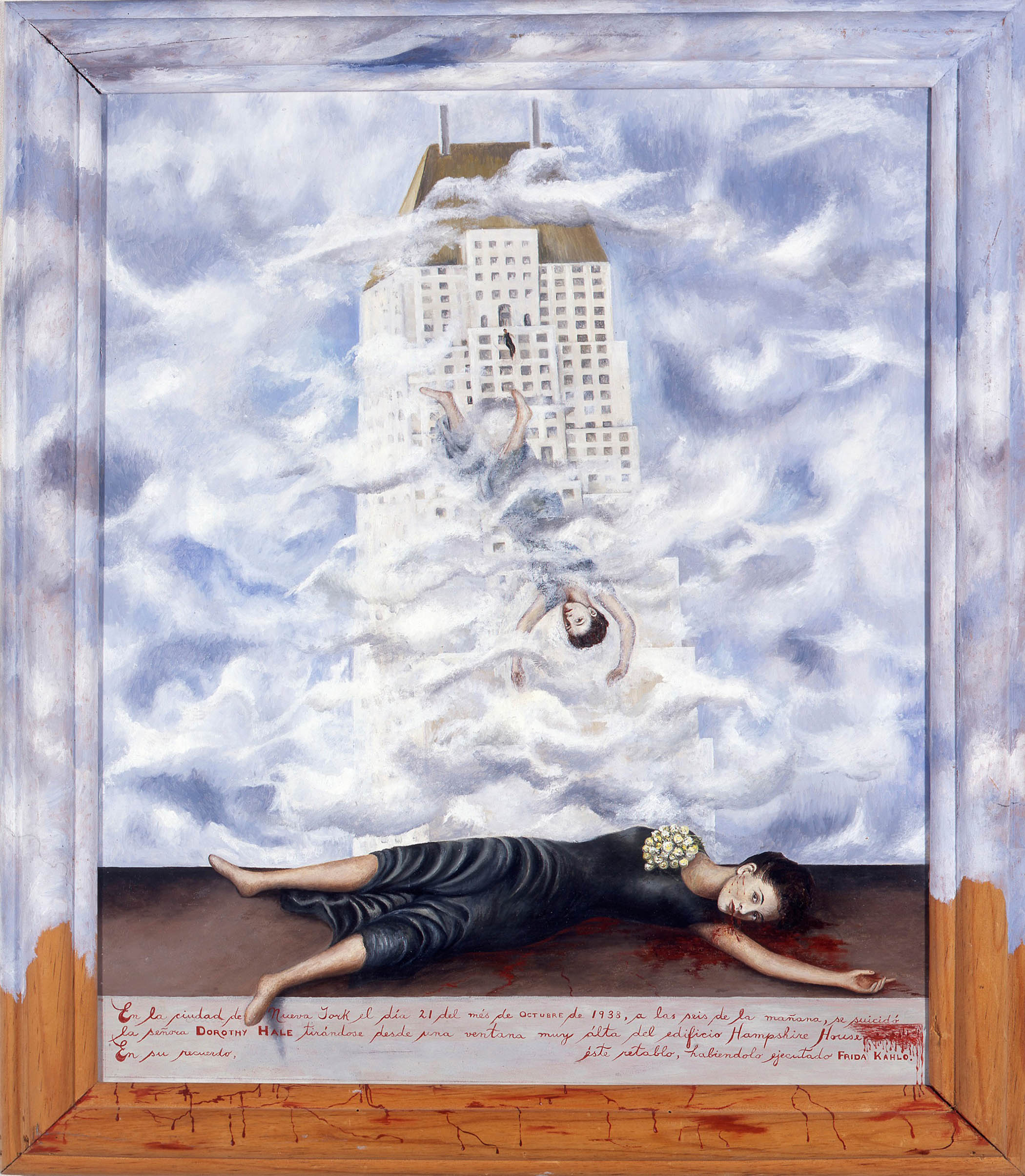
Kahlo was well versed in surrealism, and André Breton tried hard to co-opt her. There are drawings here in which she dreams of Rivera, blood, the stars, all three – and a handful of borderline outsider paintings of the sort that obsessed Breton. But by far the most powerful image in this gallery has nothing to do with surrealism at all: Kahlo’s painting of her friend Dorothy Hale’s suicide in New York. Hale is tiny at the top of a skyscraper, large in the middle and lying like a saint, eyes to the sky, in the foreground. The entire narrative appears condensed in a three-scene image, like a medieval painting.
But we are not here for Kahlo’s art, such as it is (a ratio of about one in six works, many of them drawings). You can’t make an icon out of that, now can you? It is true that photographs of Kahlo working with her legs in callipers, or lying horizontal with the canvas suspended above her after yet another botched operation to the spine, show the most heroic courage. It is also true that her charismatic face – so beautiful, so unsmiling – is at the centre of her life, as well as her art. But, to a curious degree, the whole show feels quite unnecessary. It is obvious that Kahlo made herself.
But what is the point of displaying a photograph of her painting in extremis if you do not show the painting? What is the point of all these objets, if not to stimulate material greed? This is an inescapably consumerist show, making money off Kahlo’s reputation, in the absence of her corpus, in a kitsch and glitzy way. Was ever an artist more traduced?
Frida: The Making of an Icon is at Tate Modern until 3 January 2027
Photographs courtesy Philadelphia Museum of Art, Christie’s Images / Bridgeman Images, Mary McCartney courtesy of the artist